
Bhagavad Gita — Gunatraya Vibhaga Yoga, Shloka 20
Gunatraya Vibhaga Yoga
गुणानेतानतीत्य त्रीन्देही देहसमुद्भवान् । जन्ममृत्युजरादुःखैर्विमुक्तोऽमृतमश्नुते ॥ १४.२० ॥
guṇān etān atītya trīn dehī deha-samudbhavān | janma-mṛtyu-jarā-duḥkhair vimukto ’mṛtam aśnute || 14.20 ||

Ayant transcendé ces trois guṇas nés du corps, l’être incarné, libéré des souffrances de la naissance, de la mort et de la vieillesse, goûte à l’immortalité.
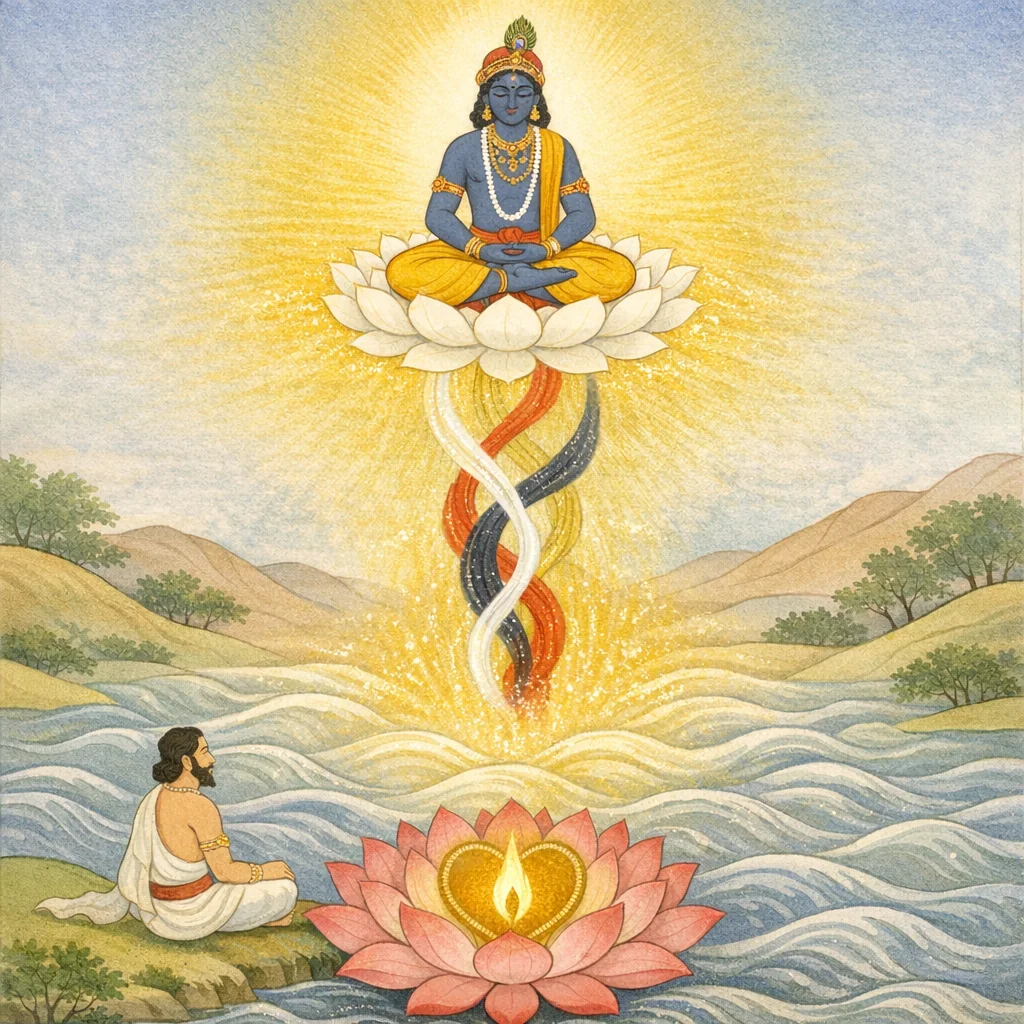
Having transcended these three guṇas, which arise from the body, the embodied one is freed from the suffering of birth, death, and old age, and attains immortality.
Transcending these three guṇas born of embodiment, the embodied self—released from the pains of birth, death, and aging—partakes of the deathless.
Traditional translations often read “immortality” as mokṣa (freedom from rebirth). Academic renderings may keep “amṛta” as “the deathless,” leaving open whether it is a state, principle, or liberation outcome; the verse strongly implies soteriological release.
FAQs
It portrays liberation as no longer being compelled by habitual patterns (guṇas). The “pains” named can also be read as existential anxieties tied to change and loss.
The verse articulates a transition from prakṛti-conditioned life to realization of the “deathless” (amṛta), a standard marker of mokṣa in Indian philosophical discourse.
It concludes the descriptive section with a soteriological outcome: knowledge and transcendence of the guṇas culminate in freedom from the cycle characterized by birth and death.
As a contemplative aim, it suggests cultivating stable awareness that is not dominated by mood, craving, or inertia—framed as a path toward deeper freedom from fear and compulsive reactivity.
Read Bhagavad Gita in the Vedapath app
Scan the QR code to open this directly in the app, with audio, word-by-word meanings, and more.