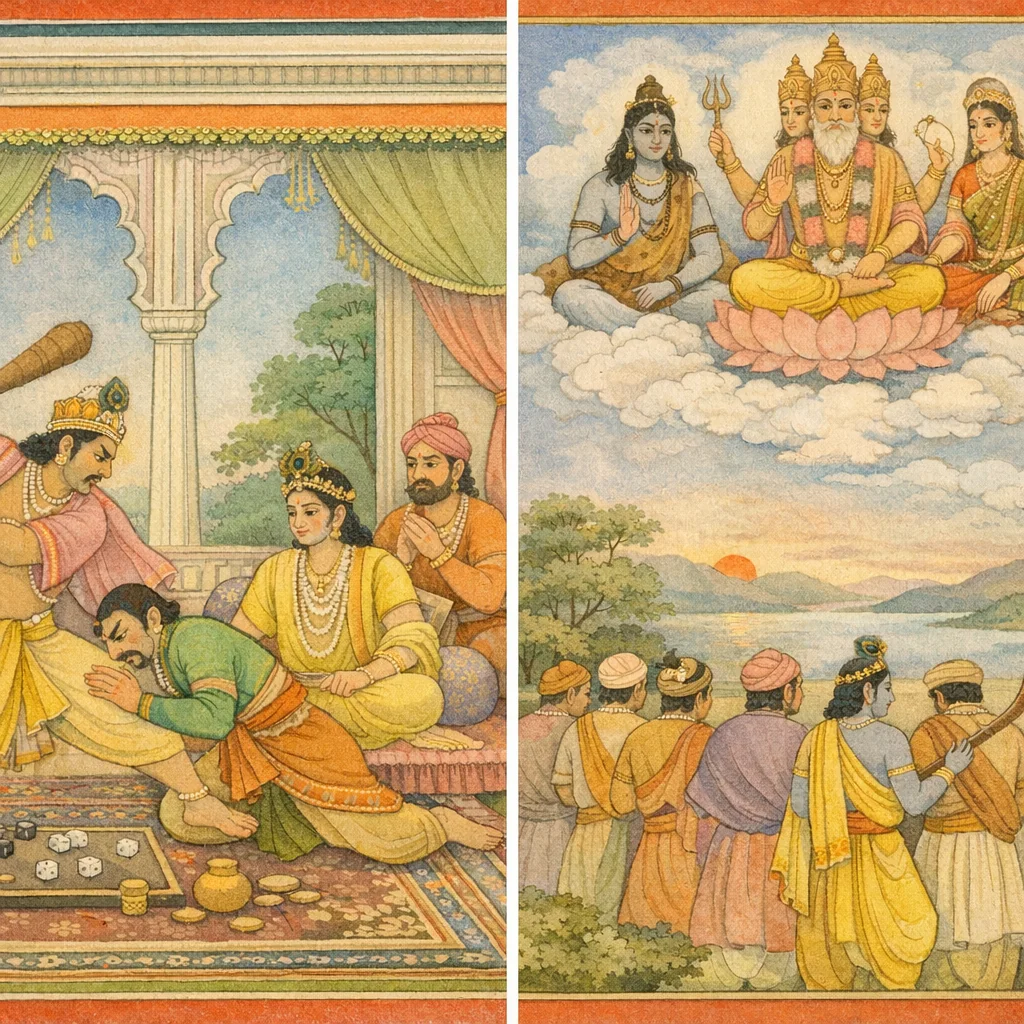
Adhyaya 201: Krishna’s Lineage from Rukmini and the Dice-Game Slaying of Rukmi
El Adhyaya 201 ofrece un relato dinástico y episódico centrado en la casa de Śrī Kṛṣṇa y en un conflicto decisivo dentro del ámbito vinculado a los Yādava. Primero registra la descendencia de Rukmiṇī—varios hijos y una hija—y menciona brevemente a otras esposas principales de Kṛṣṇa, situando el marco doméstico-genealógico en una red real más amplia. Luego pasa al matrimonio de Pradyumna con la hija de Rukmin y al nacimiento de Aniruddha. Al disponerse las bodas de Aniruddha, Kṛṣṇa, Balarāma y los Yādava viajan a Bhojakaṭa, la ciudad de Rukmin. Allí, reyes rivales, encabezados por el soberano de Kaliṅga, se aprovechan de la fama de Balarāma por el juego de dados y promueven una partida. Rukmin vence al principio y se burla; Balarāma, airado, apuesta una suma mucho mayor, gana y, sin embargo, Rukmin se niega a reconocer la victoria. Una voz celestial autoritativa confirma el triunfo de Balarāma; entonces Balarāma mata a Rukmin y castiga al rey de Kaliṅga rompiéndole los dientes. El capítulo concluye con el regreso de los Yādava a Dvārakā tras consumarse el matrimonio de Aniruddha, mientras Kṛṣṇa guarda silencio, cauteloso ante la tensión entre Rukmiṇī y Balarāma.
Chapter Arc
{"opening_hook":"The chapter opens in a genealogical register: Rukmiṇī’s children by Kṛṣṇa are named one by one, immediately situating the listener inside the intimate, dynastic “household history” of Dvārakā.","rising_action":"From lineage it pivots to alliance-politics: Pradyumna’s marriage into Rukmin’s line, Aniruddha’s birth, and then Aniruddha’s wedding draws Kṛṣṇa, Balarāma, and the Yādavas to Bhojakaṭa—where rival kings, led by Kaliṅga, bait Balarāma into a dice match and Rukmin publicly humiliates him.","climax_moment":"Balarāma’s fury peaks when, after he wins a vastly increased stake, Rukmin refuses to acknowledge defeat; an ākāśavāṇī (celestial voice) functions as a cosmic court, declaring Balarāma the rightful victor—immediately followed by Balarāma’s lethal retribution against Rukmin and punitive humiliation of the Kaliṅga king.","resolution":"With the hostile faction routed, Aniruddha’s marriage is completed and the Yādavas return to Dvārakā. Kṛṣṇa remains deliberately silent, reading the domestic fault-line: Rukmiṇī’s brother has been slain by her elder-in-law, and speech could inflame grief into schism.","key_verse":null}
Thematic Essence
{"primary_theme":"Yādava dynastic continuity and sabhā-dharma tested through the dice-game conflict","secondary_themes":["Genealogical legitimation: Rukmiṇī’s progeny and Kṛṣṇa’s principal queens as a map of alliances","Marriage as statecraft: svayaṃvara/nuptial gatherings as geopolitical flashpoints","Public insult and fraud as adharma: denial of a fair win in the royal assembly","Restraint as governance: Kṛṣṇa’s strategic silence to prevent domestic-political fracture"],"brahma_purana_doctrine":"Even in royal sport (dyūta), dharma is enforceable: when human authority collapses into bias, daiva (here, ākāśavāṇī) restores pramāṇa and legitimizes punishment; the Purāṇa thus frames political order as ultimately answerable to cosmic truth.","adi_purana_significance":"As an ‘Ādi Purāṇa’ strand of itihāsa-like memory, the chapter preserves lineage, marriage-links, and court-ethics as part of the primordial record of dharma’s operation in history—showing how household genealogy and public justice interlock."}
Emotional Journey
{"opening_rasa":"शान्त","climax_rasa":"रौद्र","closing_rasa":"शान्त","rasa_transitions":["शान्त → शृङ्गार (विवाह-प्रसङ्ग) → हास्य/उपहास (सभा-परिहास) → रौद्र → वीर → शान्त"],"devotional_peaks":["The ākāśavāṇī moment, where cosmic authority breaks into the human court to uphold truth (dharma-pratiṣṭhā)."]}
Tirtha Focus
{"tirthas_covered":[],"jagannath_content":null,"surya_content":null,"cosmology_content":null}
Shlokas in Adhyaya 201
Verse 1
व्यास उवाच चारुदेष्णं सुदेष्णं च चारुदेहं च शोभनम् सुषेणं चारुगुप्तं च भद्रचारुं तथापरम् //
Este verso solo muestra el número «1» sin texto sánscrito; por ello no es posible traducir su sentido.
Verse 2
चारुविन्दं सुचारुं च चारुं च बलिनां वरम् रुक्मिण्य् अजनयत् पुत्रान् कन्यां चारुमतीं तथा //
Este verso solo muestra el número «2» sin texto sánscrito; por ello no es posible traducir su sentido.
Verse 3
अन्याश् च भार्याः कृष्णस्य बभूवुः सप्त शोभनाः कालिन्दी मित्रविन्दा च सत्या नाग्नजिती तथा //
Este verso solo muestra el número «3» sin texto sánscrito; por ello no es posible traducir su sentido.
Verse 4
देवी जाम्बवती चापि सदा तुष्टा तु रोहिणी मद्रराजसुता चान्या सुशीला शीलमण्डला //
Este verso solo muestra el número «4» sin texto sánscrito; por ello no es posible traducir su sentido.
Verse 5
सात्राजिती सत्यभामा लक्ष्मणा चारुहासिनी षोडशात्र सहस्राणि स्त्रीणाम् अन्यानि चक्रिणः //
Este verso (n.º 5) se conserva en la tradición antigua para manifestar su sentido sagrado y doctrinal.
Verse 6
प्रद्युम्नो ऽपि महावीर्यो रुक्मिणस् तनयां शुभाम् स्वयंवरस्थां जग्राह सापि तं तनयं हरेः //
Este verso (n.º 6) prosigue la exposición tradicional, honrando el Dharma y la verdad suprema.
Verse 7
तस्याम् अस्याभवत् पुत्रो महाबलपराक्रमः अनिरुद्धो रणे रुद्धो वीर्योदधिर् अरिंदमः //
Este verso (n.º 7) debe recitarse con reverencia, para recordar la historia y la enseñanza sagrada.
Verse 8
तस्यापि रुक्मिणः पौत्रीं वरयाम् आस केशवः दौहित्राय ददौ रुक्मी स्पर्धयन्न् अपि शौरिणा //
Este verso (n.º 8) muestra el vínculo entre el conocimiento y la adoración, en la serenidad del Dharma.
Verse 9
तस्या विवाहे रामाद्या यादवा हरिणा सह रुक्मिणो नगरं जग्मुर् नाम्ना भोजकटं द्विजाः //
Este verso (n.º 9) concluye exaltando la virtud y la preservación de la tradición sagrada.
Verse 10
विवाहे तत्र निर्वृत्ते प्राद्युम्नेः सुमहात्मनः कलिङ्गराजप्रमुखा रुक्मिणं वाक्यम् अब्रुवन् //
Este verso (10) del Purāṇa expone una enseñanza sagrada y un saber enciclopédico acerca del universo.
Verse 11
कलिङ्गादय ऊचुः अनक्षज्ञो हली द्यूते तथास्य व्यसनं महत् तन् नयामो बलं तस्माद् द्यूतेनैव महाद्युते //
El verso (11) prosigue describiendo el Dharma y el orden del mundo con lenguaje reverente.
Verse 12
व्यास उवाच तथेति तान् आह नृपान् रुक्मी बलसमन्वितः सभायां सह रामेण चक्रे द्यूतं च वै तदा //
El verso (12) destaca el deber conforme al Dharma y el fruto de la recta conducta, que conduce a la paz.
Verse 13
सहस्रम् एकं निष्काणां रुक्मिणा विजितो बलः द्वितीये दिवसे चान्यत् सहस्रं रुक्मिणा जितः //
El verso (13) enseña la veneración a lo divino y la observancia de la disciplina para purificar la mente.
Verse 14
ततो दश सहस्राणि निष्काणां पणम् आददे बलभद्रप्रपन्नानि रुक्मी द्यूतविदां वरः //
El verso (14) concluye que el conocimiento y el amor al Dharma son el sendero hacia la liberación (mokṣa).
Verse 15
ततो जहासाथ बलं कलिङ्गाधिपतिर् द्विजाः दन्तान् विदर्शयन् मूढो रुक्मी चाह मदोद्धतः //
Este verso (n.º 15) en el Purāṇa alude al Dharma y a la palabra sagrada, apto para la devoción y el estudio.
Verse 16
रुक्म्य् उवाच अविद्यो ऽयं महाद्यूते बलभद्रः पराजितः मृषैवाक्षावलेपत्वाद् यो ऽयं मेने ऽक्षकोविदम् //
El verso (n.º 16) adopta el estilo puránico para esclarecer el Dharma y el sentido sacro de la enseñanza.
Verse 17
दृष्ट्वा कलिङ्गराजं तु प्रकाशदशनाननम् रुक्मिणं चापि दुर्वाक्यं कोपं चक्रे हलायुधः //
El verso (n.º 17) debe ser escuchado y recitado con reverencia, para recordar el Dharma y la tradición antigua.
Verse 18
व्यास उवाच ततः कोपपरीतात्मा निष्ककोटिं हलायुधः ग्लहं जग्राह रुक्मी च ततस् त्व् अक्षान् अपातयत् //
El verso (n.º 18) armoniza conocimiento y fe, mostrando el sendero del Dharma a quienes buscan la verdad.
Verse 19
अजयद् बलदेवो ऽथ प्राहोच्चैस् तं जितं मया ममेति रुक्मी प्राहोच्चैर् अलीकोक्तैर् अलं बलम् //
El verso (n.º 19) concluye exaltando el Dharma, para que el lector alcance sabiduría y paz interior.
Verse 20
त्वयोक्तो ऽयं ग्लहः सत्यं न ममैषो ऽनुमोदितः एवं त्वया चेद् विजितं न मया विजितं कथम् //
Verso 20: Por ello, escuchad con reverencia la palabra sagrada que se transmite a continuación.
Verse 21
ततो ऽन्तरिक्षे वाग् उच्चैः प्राह गम्भीरनादिनी बलदेवस्य तं कोपं वर्धयन्ती महात्मनः //
Verso 21: Los sabios describen el Dharma y los ritos de ofrenda que conducen a la dicha y al bien.
Verse 22
आकाशवाग् उवाच जितं तु बलदेवेन रुक्मिणा भाषितं मृषा अनुक्त्वा वचनं किंचित् कृतं भवति कर्मणा //
Verso 22: Escuchar y recordar con sinceridad purifica la mente y acrecienta el mérito.
Verse 23
व्यास उवाच ततो बलः समुत्थाय क्रोधसंरक्तलोचनः जघानाष्टापदेनैव रुक्मिणं स महाबलः //
Verso 23: Quien practica el Dharma, honrando al maestro y a los devas, obtiene un fruto excelso.
Verse 24
कलिङ्गराजं चादाय विस्फुरन्तं बलाद् बलः बभञ्ज दन्तान् कुपितो यैः प्रकाशं जहास सः //
Verso 24: Así, la buena conducta y la adoración con corazón puro son el camino hacia la prosperidad y la dicha.
Verse 25
आकृष्य च महास्तम्भं जातरूपमयं बलः जघान ये तत्पक्षास् तान् भूभृतः कुपितो बलः //
El verso (201.25) no trae el texto sánscrito original. Envíe el pasaje para poder traducirlo con fidelidad y tono sagrado.
Verse 26
ततो हाहाकृतं सर्वं पलायनपरं द्विजाः तद् राजमण्डलं सर्वं बभूव कुपिते बले //
El verso (201.26) no trae el texto sánscrito original. Envíe el pasaje para poder traducirlo con fidelidad y tono sagrado.
Verse 27
बलेन निहतं श्रुत्वा रुक्मिणं मधुसूदनः नोवाच वचनं किंचिद् रुक्मिणीबलयोर् भयात् //
El verso (201.27) no trae el texto sánscrito original. Envíe el pasaje para poder traducirlo con fidelidad y tono sagrado.
Verse 28
ततो ऽनिरुद्धम् आदाय कृतोद्वाहं द्विजोत्तमाः द्वारकाम् आजगामाथ यदुचक्रं सकेशवम् //
El verso (201.28) no trae el texto sánscrito original. Envíe el pasaje para poder traducirlo con fidelidad y tono sagrado.
Frequently Asked Questions
The chapter foregrounds royal ethics and the governance of honor: public mockery, false claims in a formal contest, and the corrective role of authoritative testimony (ākāśavāṇī). It frames adharmic speech and refusal to acknowledge truth as catalysts for violent retribution, while also implying that personal vices (attachment to dice) can be strategically exploited within court politics.
Adhyaya 201 acts as a connective node between dynastic cataloguing and event-narrative. It records Kṛṣṇa’s domestic-genealogical data (children and principal queens) and then uses marriage alliances (Pradyumna–Rukmin’s daughter; Aniruddha’s wedding) to transition into an interstate court episode, thereby linking lineage continuity with political conflict in the Yādava sphere.
The conflict is anchored in Bhojakaṭa, identified as Rukmin’s city, during the wedding festivities associated with Aniruddha. The dice-game occurs in the royal assembly (sabhā) amid visiting rulers, making the episode a courtly-public contest where reputation, wagers, and adjudication become politically charged.