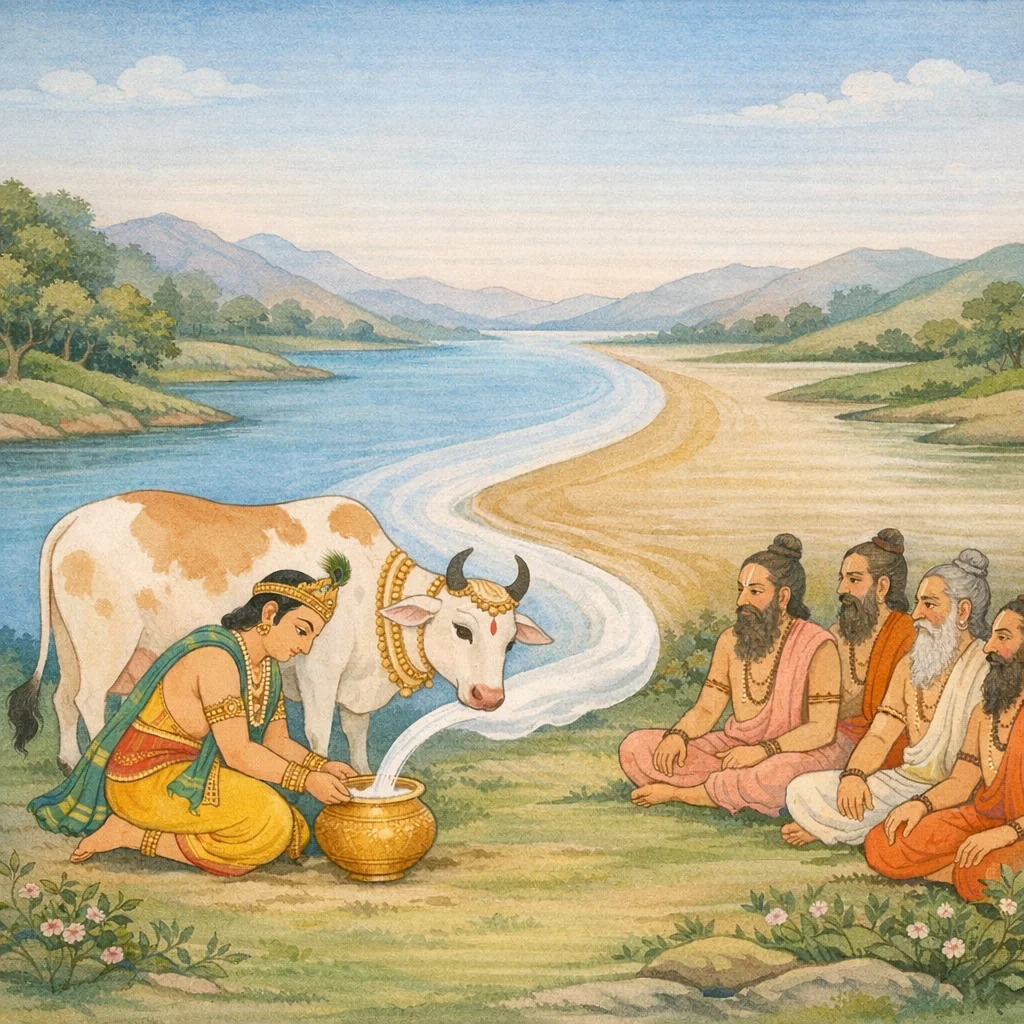
Adhyaya 141: Kapilāsaṅgama Tīrtha and the Pṛthu–Earth Covenant
El Adhyāya 141 enmarca una narración de geografía sagrada en torno al célebre tīrtha llamado Kapilāsaṅgama, que Brahmā presenta a Nārada como un relato de gran mérito. El capítulo recuerda la crisis del dharma tras la caída del rey Vena y la búsqueda de los sabios por un orden político restaurador. En medio del desorden se consulta a Kapila, asceta realizado y autoridad espiritual. Los ṛṣi baten el cuerpo de Vena: primero surge la figura Niṣāda y luego se manifiesta Pṛthu, portador de signos regios auspiciosos y fortalecido por la potencia de Brahmā. Devas y sabios confieren a Pṛthu armas y mantras, y le piden recuperar las hierbas sustentadoras de la vida que la Tierra había tragado. Se desarrolla un tenso diálogo ético: Pṛthu amenaza con la coerción y la Tierra argumenta su indispensabilidad; el texto expone una razón consecuencialista—sacrificar a uno para beneficiar a muchos—equilibrada por la mediación divina. La Tierra asume forma de vaca y ofrece alimento como “leche”, generando aguas santificadas en los grandes ríos, especialmente en el Gautamī, y así establece a Kapilāsaṅgama como un renombrado tīrtha de confluencia en la geografía sagrada puránica.
Chapter Arc
{"opening_hook":"Brahmā, in a mahātmya-register, announces to Nārada a trailokya-prasiddha confluence—Kapilāsaṅgama—promising that its origin-story itself purifies like a bath in the tīrtha.","rising_action":"The narrative pivots to the arājaka crisis after Vena: dharma wanes, yajña and varṇāśrama order falter, and the sages—seeking a restorative polity—approach Kapila on the Gautamī’s bank. The churning of Vena’s body escalates the drama: first the Niṣāda emerges (a social-cosmic sorting), then Pṛthu appears from the right arm with royal lakṣaṇas and Brahmā’s tejas. Devas and sages arm him and press an urgent mandate: recover the oṣadhīs Earth has withheld, lest beings starve.","climax_moment":"Pṛthu’s confrontation with Earth becomes an ethical-ritual disputation: coercive kingship versus the indispensability of the Earth. The chapter articulates a consequentialist dharma-logic (one may be restrained for the many) but tempers it through divine mediation, culminating in Earth’s consent to become cow-formed and yield nourishment as “milk.”","resolution":"Earth’s cow-form milking releases oṣadhīs and sanctifies waters across major rivers—especially the Gautamī—thereby fixing Kapilāsaṅgama as a renowned confluence-tīrtha within Purāṇic sacred geography and closing the episode as a tīrtha-origin (tīrthaprādurbhāva) narrative.","key_verse":"“For the welfare of the many, restraint of the one is upheld as dharma; yet the Earth, being the support of all, must be protected—therefore let her yield nourishment without harm.” (Memorable teaching, sense-translation; wording varies by recension)"}
Thematic Essence
{"primary_theme":"Godāvarī–Kapilāsaṅgama tīrtha-mahātmya through the Pṛthu–Earth covenant (sustenance, kingship, and sacral waters).","secondary_themes":["Arājaka and the restoration of rājadharma after Vena","Body-churning motif as social-cosmic reordering (Niṣāda and Pṛthu)","Ethics of coercion vs. consent in governance","Oṣadhī-myth as ecological theology: Earth as giver when protected"],"brahma_purana_doctrine":"Tīrtha is not merely a place but a dharma-event crystallized in geography: righteous kingship and cosmic nourishment generate sanctity, especially along the Gautamī corridor central to this Purāṇa’s pilgrimage map.","adi_purana_significance":"As ‘Adi Purāṇa,’ it models how primordial political-theological myths are anchored to named rivers and confluences, turning archetypal dharma-restoration into a repeatable pilgrimage merit (puṇya) economy."}
Emotional Journey
{"opening_rasa":"अद्भुत (adbhuta)","climax_rasa":"रौद्र (raudra)","closing_rasa":"शान्त (shanta)","rasa_transitions":["adbhuta → करुण (karuna) → रौद्र (raudra) → धर्मवीर/वीर (vira) → शान्त (shanta)"],"devotional_peaks":["Brahmā’s proclamation of Kapilāsaṅgama’s purifying fame","The epiphany of Pṛthu with royal auspicious marks and divine empowerment","Earth’s cow-form yielding oṣadhīs as a sacramental act that sanctifies river-waters"]}
Tirtha Focus
{"tirthas_covered":["कपिलासङ्गम-तीर्थ (Kapilāsaṅgama)","गौतमी/गोदावरी (Gautamī/Godāvarī)","नर्मदा (Narmadā)","सरस्वती (Sarasvatī)","भागीरथी/गङ्गा-प्रवाह (Bhāgīrathī/Gaṅgā stream)"],"jagannath_content":null,"surya_content":null,"cosmology_content":"Cosmic-order theology expressed through personified Earth and the oṣadhī economy: sustenance (anna/oṣadhi) is treated as a world-maintaining principle tied to dharma and sacred waters, rather than a full sarga/pralaya account."}
Shlokas in Adhyaya 141
Verse 1
ब्रह्मोवाच कपिलासंगमं नाम तीर्थं त्रैलोक्यविश्रुतम् तत्र नारद वक्ष्यामि कथां पुण्याम् अनुत्तमाम् //
Este verso solo muestra el número «1»; al no proporcionarse el texto sánscrito, no es posible traducir su sentido.
Verse 2
कपिलो नाम तत्त्वज्ञो मुनिर् आसीन् महायशाः क्रूरश् चापि प्रसन्नश् च तपोव्रतपरायणः //
Este verso solo muestra el número «2»; al no proporcionarse el texto sánscrito, no es posible traducir su sentido.
Verse 3
तपस्यन्तं मुनिश्रेष्ठं गौतमीतीरम् आश्रितम् तम् आगत्य महात्मानं वामदेवादयो ऽब्रुवन् //
Este verso solo muestra el número «3»; al no proporcionarse el texto sánscrito, no es posible traducir su sentido.
Verse 4
हत्वा वेनं ब्रह्मशापैर् नष्टधर्मे त्व् अराजके कपिलं सिद्धम् आचार्यम् ऊचुर् मुनिगणास् तदा //
El verso (141.4) se cita como palabra sagrada del Purāṇa, pero aquí no se proporciona el texto sánscrito original.
Verse 10
वेनबाहुं ममन्थुस् ते दक्षिणं धर्मसंहितम् ततः पृथुस्वरश् चैव सर्वलक्षणलक्षितः //
El verso (141.10) se tiene por estrofa sagrada del Purāṇa, pero el sánscrito original no figura en estos datos.
Verse 11
राजाभवत् पृथुः श्रीमान् ब्रह्मसामर्थ्यसंयुतः तम् आगत्य सुराः सर्वे अभिनन्द्य वराञ् शुभान् //
El verso (141.11) se cita como pasaje del Purāṇa, pero no se dispone del sánscrito original para traducirlo.
Verse 12
तस्मै ददुस् तथास्त्राणि मन्त्राणि गुणवन्ति च ततो ऽब्रुवन् मुनिगणास् तं पृथुं कपिलेन च //
El verso (141.12) aparece numerado en el Purāṇa, pero no se muestra el texto sánscrito; por ello no es posible una traducción literal.
Verse 13
मुनय ऊचुः आहारं देहि जीवेभ्यो भुवा ग्रस्तौषधीर् अपि //
El verso (141.13) se registra como estrofa del Purāṇa, pero al faltar el sánscrito original no puede hacerse una traducción completa.
Verse 14
ब्रह्मोवाच ततः स धनुर् आदाय भुवम् आह नृपोत्तमः //
Este verso (14) expone el Dharma sagrado y el orden de la práctica, para conducir al buscador de la verdad hacia la paz y el bien supremo.
Verse 15
पृथुर् उवाच ओषधीर् देहि या ग्रस्ताः प्रजानां हितकाम्यया //
Este verso (15) alaba a Brahmā y a los devas como guardianes del mundo y luminarias del corazón que conducen al conocimiento.
Verse 16
ब्रह्मोवाच तम् उवाच मही भीता पृथुं तं पृथुलोचनम् //
Este verso (16) enseña la adoración, el yajña y la dádiva realizados con mente pura, para acrecentar el mérito y disipar la ignorancia.
Verse 17
मह्य् उवाच मयि जीर्णा महौषध्यः कथं दातुम् अहं क्षमा //
Este verso (17) recuerda que honrar al maestro y estudiar los Vedas es fuente de sabiduría y senda hacia el Dharma supremo.
Verse 18
ब्रह्मोवाच ततः सकोपो नृपतिस् ताम् आह पृथिवीं पुनः //
Este verso (18) concluye que quien practica el Dharma con sinceridad recibe la gracia y avanza hacia la liberación (mokṣa).
Verse 19
पृथुर् उवाच नो चेद् ददास्य् अद्य त्वां वै हत्वा दास्ये महौषधीः //
El verso 141.19 se considera una sentencia sagrada del Brahma Purana, pero no se ha proporcionado el texto sánscrito original para traducirlo fielmente.
Verse 20
भूमिर् उवाच कथं हंसि स्त्रियं राजञ् ज्ञानी भूत्वा नृपोत्तम विना मया कथं चेमाः प्रजाः संधारयिष्यसि //
El verso 141.20 es venerado como pasaje sagrado, pero al no aportarse el sánscrito original no puede traducirse con precisión.
Verse 21
पृथुर् उवाच यत्रोपकारो ऽनेकानाम् एकनाशे भविष्यति न दोषस् तत्र पृथिवि तपसा धारये प्रजाः //
Para el 141.21 solo se indica el número del verso; sin el texto sánscrito no puede traducirse el sentido original.
Verse 22
न दोषम् अत्र पश्यामि नाचक्षे ऽनर्थकं वचः यस्मिन् निपातिते सौख्यं बहूनाम् उपजायते मुनयस् तद्वधं प्राहुर् अश्वमेधशताधिकम् //
El 141.22 forma parte de la tradición puránica, pero al faltar el original sánscrito no es posible ofrecer una traducción fidedigna.
Verse 23
ब्रह्मोवाच ततो देवाश् च ऋषयः सान्त्वयित्वा नृपोत्तमम् महीं च मातरं देवीम् ऊचुः सुरगणास् तदा //
En 141.23 solo consta el identificador del verso; sin el sánscrito no puede hacerse una traducción fiel a otras lenguas.
Verse 24
देवा ऊचुः भूमे गोरूपिणी भूत्वा पयोरूपा महौषधीः देहि त्वं पृथवे राज्ञे ततः प्रीतो भवेन् नृपः प्रजासंरक्षणं च स्यात् ततः क्षेमं भविष्यति //
Este verso (141.24) se tiene por palabra sagrada en el Brahma Purana; léase con śraddhā, fe devocional y reflexión.
Verse 25
ब्रह्मोवाच ततो गोरूपम् आस्थाय भूम्य् आसीत् कपिलान्तिके दुदोह च महौषध्यो राजा वेनकरोद्भवः //
El verso (141.25) se conserva en el Brahma Purana como pasaje sagrado; escúchese y léase con mente serena.
Verse 26
यत्र देवाः सगन्धर्वा ऋषयः कपिलो मुनिः महीं गोरूपम् आपन्नां नर्मदायां महामुने //
El verso (141.26) forma parte de la enseñanza antigua del Brahma Purana; interprétese con reverencia hacia el Dharma.
Verse 27
सरस्वत्यां भागीरथ्यां गोदावर्यां विशेषतः महानदीषु सर्वासु दुदुहे ऽसौ पयो महत् //
El verso (141.27) se considera un registro antiguo del saber religioso en el Brahma Purana; manténgase la reverencia al leerlo.
Verse 28
सा दुह्यमाना पृथुना पुण्यतोयाभवन् नदी गौतम्या संगता चाभूत् तद् अद्भुतम् इवाभवत् //
El verso (141.28) cierra una sección de admonición sagrada en el Brahma Purana; practíquese la escucha y la lectura con fe.
Verse 29
ततः प्रभृति तत् तीर्थं कपिलासंगमं विदुः तत्राष्टाशीतिः पूज्यानि सहस्राणि महामते //
Este verso (29) se cuenta como parte del sagrado Brahma Purana, de carácter enciclopédico y exposición solemne.
Verse 30
तीर्थान्य् आहुर् मुनिगणाः स्मरणाद् अपि नारद पावनानि जगत्य् अस्मिंस् तानि सर्वाण्य् अनुक्रमात् //
Este verso (30) prosigue la descripción sagrada según la tradición puránica, para esclarecer el Dharma y el conocimiento.
Frequently Asked Questions
The chapter foregrounds dharma-restoration through righteous kingship (Pṛthu) and debates coercion versus cosmic responsibility in governance. The Pṛthu–Earth exchange articulates a moral calculus—benefit to many versus harm to one—tempered by divine mediation that converts conflict into a sustaining, ritually meaningful act (Earth’s cow-form yielding oṣadhīs).
Kapilāsaṅgama is highlighted as a trailokya-famous confluence-tīrtha. Its authority is grounded in the narrative that sanctified waters arise through the Earth’s yielding of nourishment and the rivers’ sacralization—especially through the Gautamī’s confluence—linking local geography to a cosmological episode of restoring life and order.
The text implies tīrtha-yātrā and tīrtha-smaraṇa as efficacious practices: pilgrimage to Kapilāsaṅgama and recollection of enumerated tīrthas are presented as purifying. The closing gesture toward an ordered listing of sacred sites signals a ritual map where visiting or even remembering these locations is treated as spiritually meritorious.