Adhyaya 209: Balarama Slays Dvivida and Restores Cosmic Order
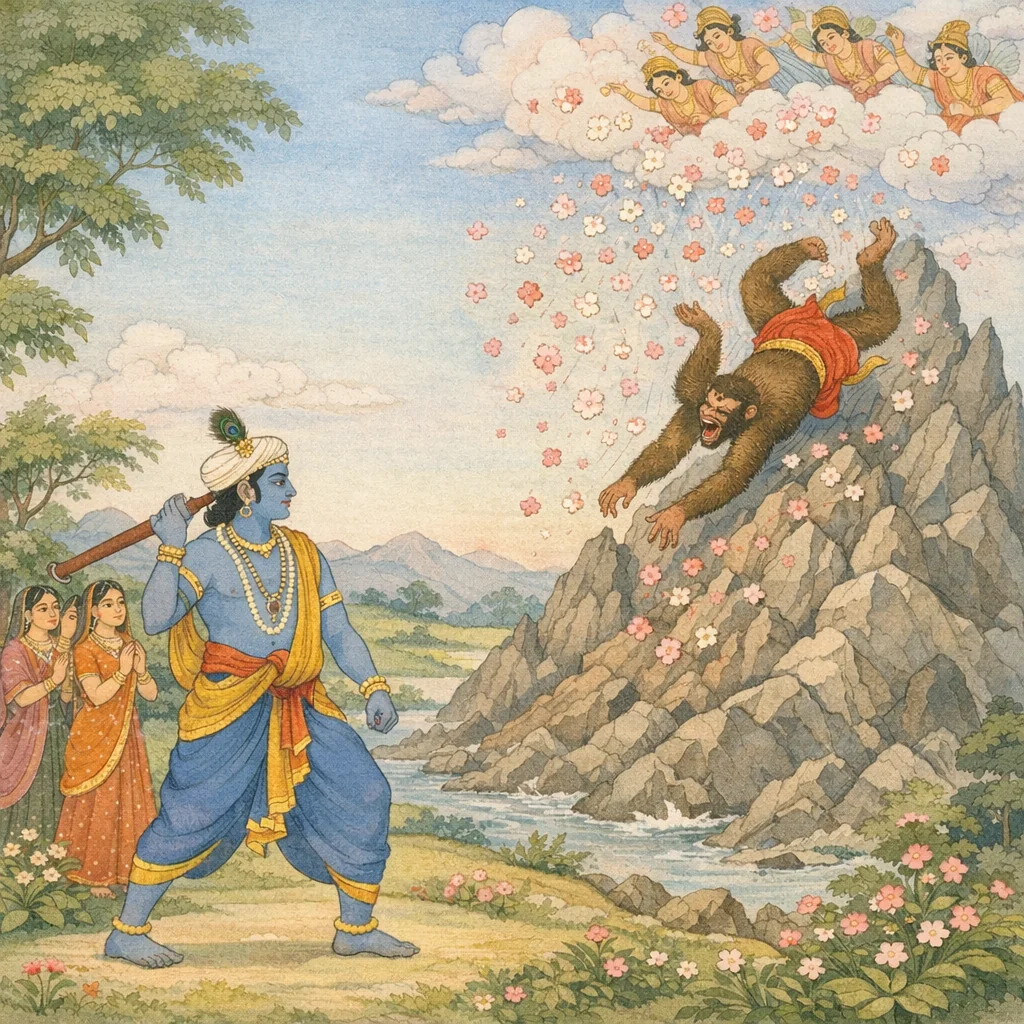
El Adhyaya 209, narrado por Vyāsa ante los sabios reunidos, relata la carrera perturbadora y la destrucción final de Dvivida, un poderoso vānarā que se alía con Naraka, rey asura enemigo de los devas. Movido por la venganza tras la muerte de Naraka a manos de Kṛṣṇa, Dvivida emprende una violencia contra el rito: obstaculiza los yajñas, quebranta los límites del dharma, arrasa poblados, arroja montañas para aplastar aldeas, arranca peñascos y los lanza a las aguas, y agita el océano hasta que rebasa sus márgenes e inunda las moradas costeras. El desorden cósmico y social culmina en el jardín de Raivata, donde Balarāma (Halāyudha), gozando con Revatī y otras mujeres, es burlado y atacado por el mono. Sigue un combate físico—piedra contra maza, saltos y golpes—que termina con el golpe decisivo de Balarāma, que mata a Dvivida, quien al caer hace añicos una cumbre montañosa. Los devas celebran con flores y alabanzas, y Vyāsa concluye situando esta hazaña entre los inconmensurables hechos de Baladeva, identificado con Śeṣa, el sustentador de la tierra.
Chapter Arc
{"opening_hook":"Vyāsa, in the purāṇic frame of instruction to the sages, introduces a single disruptive figure—Dvivida the vānarā—whose strength is turned into a vow of retaliation against the devas after Naraka’s fall at Kṛṣṇa’s hands. The hook is moral-cosmic: one being’s grudge becomes a public calamity.","rising_action":"Dvivida’s campaign escalates from anti-ritual violence (yajña-obstruction, breaking dharma-boundaries) to geo-environmental assault: he devastates settlements, hurls mountain-masses onto villages, uproots rocks and casts them into waters, and even churns the ocean so it swells beyond its limits, flooding coastal habitations. Disorder spreads from the sacrificial ground to the landscape itself, signaling a collapse of ṛta/dharma.","climax_moment":"At Raivata’s garden, the disorder becomes personal and immediate: Dvivida mocks and attacks Balarāma (Halāyudha) and harasses the women. The combat—stone and mountain fragments against the plough-bearing club—reaches its peak when Balarāma lands the decisive blow, killing Dvivida; the fall shatters a mountain peak, visually sealing the restoration of order.","resolution":"The devas shower flowers and praise, reading the victory as cosmic re-stabilization. Vyāsa closes by placing this deed among Baladeva’s immeasurable exploits and explicitly identifying him with Śeṣa, the earth-bearer—thereby interpreting the episode as the triumph of the sustaining principle over chaotic force.","key_verse":null}
Thematic Essence
{"primary_theme":"धर्म-रक्षा द्वारा लोक-व्यवस्था-स्थापनम् (Restoration of cosmic and social order through Baladeva’s slaying of Dvivida)","secondary_themes":["यज्ञ-विघ्न और वेद-मार्ग-विरोध (anti-ritual violence as adharma)","पर्यावरण/भूगोल-हिंसा: पर्वत-प्रक्षेप, शिलाक्षेप, सागर-क्षोभ (geo-cosmic destabilization)","नरक-वधोत्तर प्रतिशोध-राजनीति (asuric retaliation after Naraka’s death)","उद्यान-लीला से रण-लीला तक: रैवतोद्यान में स्त्री-अपमान का प्रतिकार (defense of dignity and protection of the vulnerable)"],"brahma_purana_doctrine":"Adharma is diagnosed not only as moral failing but as yajña-disruption and boundary-breaking that spills into nature; the Purāṇa reads Baladeva-as-Śeṣa as the dhāraṇa-śakti that re-establishes maryādā (limits) in society and in the elements.","adi_purana_significance":"As an ‘Ādi Purāṇa’ layer, the chapter models a primordial pattern: when ritual order and cosmic boundaries are violated, the sustaining divine principle manifests to re-anchor the world—linking heroic narrative to cosmological function (Śeṣa-bhūdhāraṇa)."}
Emotional Journey
{"opening_rasa":"भयानक (bhayānaka)","climax_rasa":"वीर (vīra)","closing_rasa":"शान्त (śānta)","rasa_transitions":["bhayānaka → रौद्र (raudra) → vīra → अद्भुत (adbhuta) → śānta"],"devotional_peaks":["Devas’ flower-shower and stuti after Dvivida’s death, reading the act as dharma’s victory.","The concluding identification of Baladeva with Śeṣa, elevating the battle into a cosmic-theological affirmation."]}
Tirtha Focus
{"tirthas_covered":["रैवतोद्यान (Raivata’s garden/park)"],"jagannath_content":null,"surya_content":null,"cosmology_content":"Implicit cosmology through ‘boundary’ imagery: ocean swelling beyond limits and the earth’s stability restored via Baladeva’s Śeṣa-identity (bhū-dhāraṇa)."}
Shlokas in Adhyaya 209
Verse 1
व्यास उवाच शृणुध्वं मुनयः सर्वे बलस्य बलशालिनः कृतं यद् अन्यद् एवाभूत् तद् अपि श्रूयतां द्विजाः //
Verso 209.1: Al inicio de este nuevo capítulo, el Purāṇa prosigue la exposición del dharma y de la historia de las dinastías reales.
Verse 2
नरकस्यासुरेन्द्रस्य देवपक्षविरोधिनः सखाभवन् महावीर्यो द्विविदो नाम वानरः //
Verso 2: Esta palabra sagrada se proclama en el Purāṇa para iluminar el Dharma y aclarar la doctrina.
Verse 3
वैरानुबन्धं बलवान् स चकार सुरान् प्रति //
Verso 3: Los sabios deben escucharlo con reverencia y retener su sentido profundo.
Verse 4
द्विविद उवाच नरकं हतवान् कृष्णो बलदर्पसमन्वितम् करिष्ये सर्वदेवानां तस्माद् एष प्रतिक्रियाम् //
Verso 4: Con la lectura y la escucha constantes, crece el mérito y se disipa la ignorancia.
Verse 5
व्यास उवाच यज्ञविध्वंसनं कुर्वन् मर्त्यलोकक्षयं तथा ततो विध्वंसयाम् आस यज्ञान् अज्ञानमोहितः //
Verso 5: Quien practica el Dharma conforme a esta palabra sagrada obtiene dicha y paz interior.
Verse 6
बिभेद साधुमर्यादां क्षयं चक्रे च देहिनाम् ददाह चपलो देशं पुरग्रामान्तराणि च //
Verso 6: Por ello, honra este Purāṇa y aférrate al Dharma como el sendero supremo.
Verse 7
क्वचिच् च पर्वतक्षेपाद् ग्रामादीन् समचूर्णयत् शैलान् उत्पाट्य तोयेषु मुमोचाम्बुनिधौ तथा //
No se ha proporcionado el texto sánscrito de este verso. Envíe el original para una traducción fiel y reverente.
Verse 8
पुनश् चार्णवमध्यस्थः क्षोभयाम् आस सागरम् तेनातिक्षोभितश् चाब्धिर् उद्वेलो जायते द्विजाः //
No se ha proporcionado el texto sánscrito de este verso. Envíe el original para una traducción fiel y reverente.
Verse 9
प्लावयंस् तीरजान् ग्रामान् पुरादीन् अतिवेगवान् कामरूपं महारूपं कृत्वा सस्यान्य् अनेकशः //
No se ha proporcionado el texto sánscrito de este verso. Envíe el original para una traducción fiel y reverente.
Verse 10
लुठन् भ्रमणसंमर्दैः संचूर्णयति वानरः तेन विप्रकृतं सर्वं जगद् एतद् दुरात्मना //
No se ha proporcionado el texto sánscrito de este verso. Envíe el original para una traducción fiel y reverente.
Verse 11
निःस्वाध्यायवषट्कारं द्विजाश् चासीत् सुदुःखितम् कदाचिद् रैवतोद्याने पपौ पानं हलायुधः //
No se ha proporcionado el texto sánscrito de este verso. Envíe el original para una traducción fiel y reverente.
Verse 12
रेवती च महाभागा तथैवान्या वरस्त्रियः उद्गीयमानो विलसल्ललनामौलिमध्यगः //
Este verso sagrado (12) del Purana expone el Dharma puro y el saber antiguo de la tradición.
Verse 13
रेमे यदुवरश्रेष्ठः कुबेर इव मन्दरे ततः स वानरो ऽभ्येत्य गृहीत्वा सीरिणो हलम् //
El verso (13) prosigue describiendo el orden del mundo y los principios excelsos del Dharma.
Verse 14
मुशलं च चकारास्य संमुखः स विडम्बनाम् तथैव योषितां तासां जहासाभिमुखं कपिः //
El verso (14) enseña la adoración de lo Divino y la observancia de la disciplina para alcanzar la paz.
Verse 15
पानपूर्णांश् च करकांश् चिक्षेपाहत्य वै तदा ततः कोपपरीतात्मा भर्त्सयाम् आस तं बलम् //
El verso (15) recuerda que el karma y el Dharma guían a los seres hacia las consecuencias justas.
Verse 16
तथापि तम् अवज्ञाय चक्रे किलकिलाध्वनिम् ततः समुत्थाय बलो जगृहे मुशलं रुषा //
El verso (16) alaba a los sabios que escuchan y recuerdan el Purana, acrecentando la sabiduría y la fe.
Verse 17
सो ऽपि शैलशिलां भीमां जग्राह प्लवगोत्तमः चिक्षेप च स तां क्षिप्तां मुशलेन सहस्रधा //
Este verso (n.º 17) queda señalado en la tradición, pero no se ha proporcionado el texto sánscrito para traducirlo.
Verse 18
बिभेद यादवश्रेष्ठः सा पपात महीतले अपतन् मुशलं चासौ समुल्लङ्घ्य प्लवंगमः //
Este verso (n.º 18) aparece solo con numeración; no se ha aportado el original sánscrito para una traducción fiel.
Verse 19
वेगेनायम्य रोषेण बलेनोरस्य् अताडयत् ततो बलेन कोपेन मुष्टिना मूर्ध्नि ताडितः //
El verso (n.º 19) está enumerado, pero al faltar el texto sánscrito no puede ofrecerse una traducción rigurosa.
Verse 20
पपात रुधिरोद्गारी द्विविदः क्षीणजीवितः पतता तच्छरीरेण गिरेः शृङ्गम् अशीर्यत //
El verso (n.º 20) no viene acompañado del sánscrito; por ello no es posible traducirlo con propiedad a otras lenguas.
Verse 21
मुनयः शतधा वज्रिवज्रेणेव हि ताडितम् पुष्पवृष्टिं ततो देवा रामस्योपरि चिक्षिपुः //
El verso (n.º 21) requiere el original sánscrito para una traducción acorde al tono sagrado, pero no ha sido proporcionado.
Verse 22
प्रशशंसुस् तदाभ्येत्य साध्व् एतत् ते महत् कृतम् अनेन दुष्टकपिना दैत्यपक्षोपकारिणा जगन् निराकृतं वीर दिष्ट्या स क्षयम् आगतः //
Este verso solo presenta el número «22» en la fuente; no se ha proporcionado el texto sánscrito.
Verse 23
व्यास उवाच एवंविधान्य् अनेकानि बलदेवस्य धीमतः कर्माण्य् अपरिमेयानि शेषस्य धरणीभृतः //
Este verso solo presenta el número «23» en la fuente; no se ha proporcionado el texto sánscrito.
Frequently Asked Questions
The chapter foregrounds the restoration of dharmic order against forces that sabotage yajña and social boundaries. Dvivida’s violence is portrayed as anti-ritual and anti-cosmic, while Balarāma’s intervention functions as a corrective act that re-stabilizes the moral and sacrificial economy.
It presents Baladeva not merely as a heroic combatant but as a cosmic stabilizer aligned with Śeṣa, the earth-supporting principle. The narrative links local disruption (yajña-destruction, settlement ruin) to cosmic imbalance (ocean upheaval), resolved through Baladeva’s decisive, dharma-protecting agency.
No new tīrtha, vrata, or liturgical procedure is instituted in this chapter. Ritual appears primarily through its negation—yajñas being obstructed—so the emphasis is on safeguarding sacrificial practice rather than prescribing a novel observance.