
Bhagavad Gita — Karma Yoga, Shloka 6
Karma Yoga
कर्मेन्द्रियाणि संयम्य य आस्ते मनसा स्मरन् । इन्द्रियार्थान्विमूढात्मा मिथ्याचारः स उच्यते ॥ ३.६ ॥
karmendriyāṇi saṃyamya ya āste manasā smaran | indriyārthān vimūḍhātmā mithyācāraḥ sa ucyate || 3.6 ||

Quien, refrenando los órganos de la acción, se sienta mientras en la mente recuerda los objetos de los sentidos, ese de alma extraviada es llamado hipócrita.
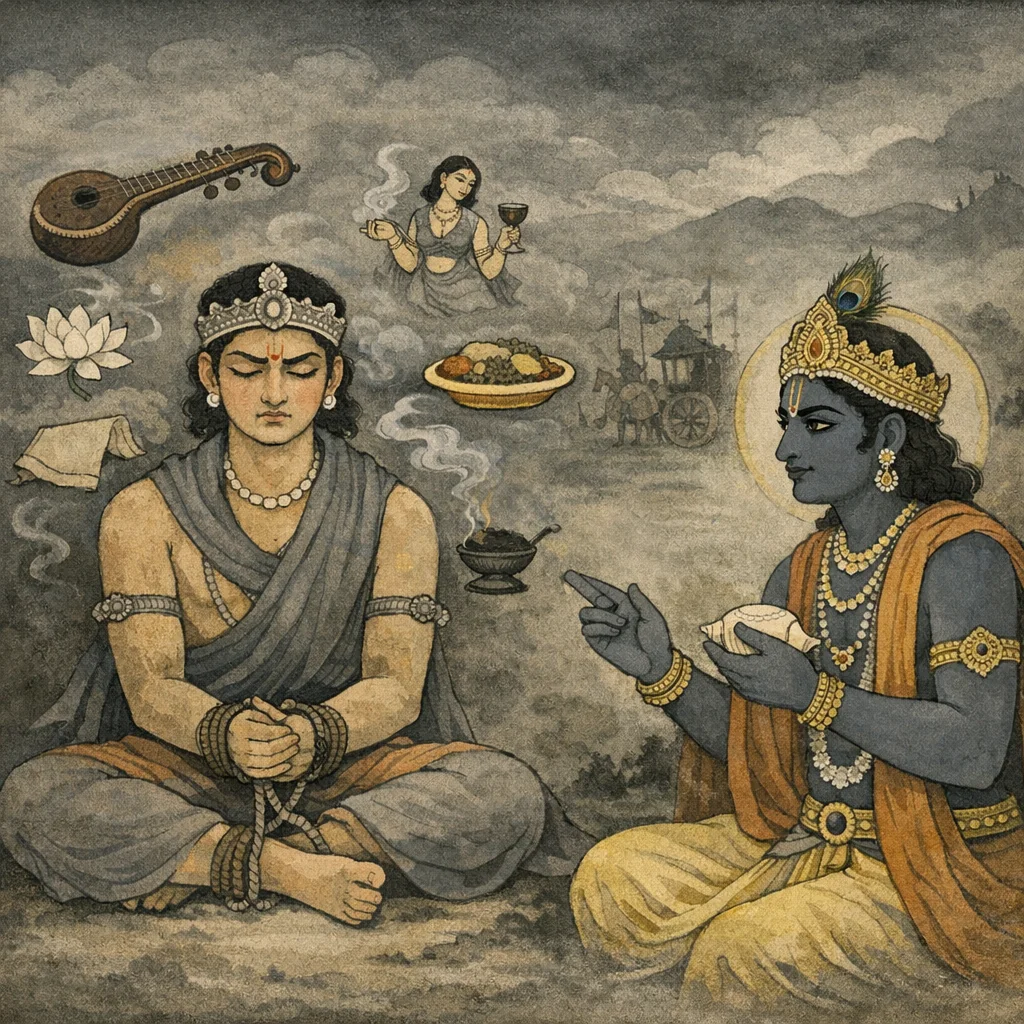
One who restrains the organs of action but sits dwelling in the mind on sense-objects—such a deluded person is called a hypocrite.
Restraining the organs of action, the one who remains (inactive) while mentally recalling sense-objects—such a person, of confused self-understanding, is said to be of false conduct.
‘Mithyācāra’ is often rendered ‘hypocrite,’ but more literally denotes ‘false/inauthentic practice.’ The emphasis is on inner consistency: external restraint without cognitive-emotional transformation is incomplete.
FAQs
The verse identifies a split between outward behavior and inward preoccupation. It suggests that sustainable self-control requires working with attention and desire, not only suppressing behavior.
It implies that bondage is maintained at the level of identification and craving; mere physical restraint does not dissolve the underlying dispositions (saṃskāras) that perpetuate cyclic patterns.
Krishna cautions Arjuna against equating renunciation with simply not acting; the quality of mind and motive is central to the Gītā’s account of discipline.
In ethics and self-improvement, performative restraint (appearing disciplined) can coexist with compulsive attention to the very things one claims to renounce. The verse recommends integrity: align habits, intentions, and attention-training.