
Bhagavad Gita — Karma Sannyasa Yoga, Shloka 25
Karma Sannyasa Yoga
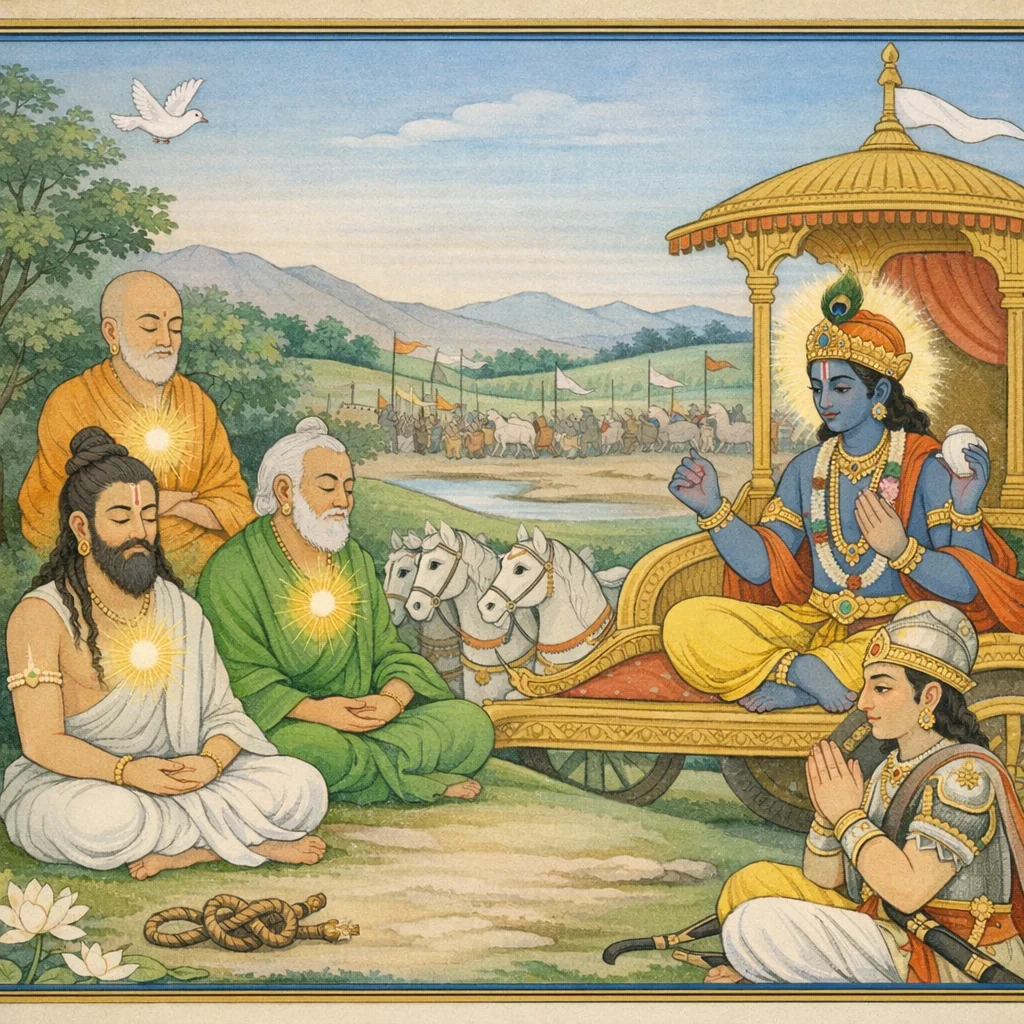
लभन्ते ब्रह्मनिर्वाणमृषयः क्षीणकल्मषाः । छिन्नद्वैधा यतात्मानः सर्वभूतहिते रताः ॥ ५.२५ ॥
labhante brahma-nirvāṇam ṛṣayaḥ kṣīṇa-kalmaṣāḥ | chinna-dvaidhā yatātmānaḥ sarva-bhūta-hite ratāḥ || 5.25 ||

Los ṛṣi, cuyas impurezas han sido consumidas, cuyas dudas han sido cortadas, que han dominado la mente y se deleitan en el bien de todos los seres, obtienen el nirvāṇa en Brahman (la paz suprema / la liberación).
जिनके पाप नष्ट हो गये हैं, जिनके संशय मिट गये हैं, जिन्होंने मन को वश में कर लिया है और जो सब प्राणियों के हित में लगे रहते हैं—वे ऋषिजन ब्रह्मनिर्वाण (परम शान्ति/मोक्ष) को प्राप्त होते हैं।
The seers—whose impurities have been exhausted, whose inner dualities are cut off, who are self-controlled, and who delight in the welfare of all beings—attain brahma-nirvāṇa (the quiescence/liberation associated with Brahman).
The verse is textually stable across common recensions; differences are mainly interpretive. “brahma-nirvāṇa” is read variously as (a) liberation into/with Brahman (non-dual or Vedāntic readings), (b) the “extinction” of egoic afflictions culminating in liberation (yogic/ascetic readings), or (c) the peace of one established in Brahman while living. “ṛṣayaḥ” may be taken narrowly as Vedic seers/ascetics or broadly as spiritually mature practitioners.
FAQs
The verse links well-being to reduced mental “impurities” (habitual reactivity and guilt), the resolution of doubt, and disciplined attention (yatātmānaḥ). It suggests that inner calm is stabilized when one is not preoccupied with self-centered aims and instead maintains a prosocial orientation (sarvabhūta-hite ratāḥ).
Metaphysically, “brahma-nirvāṇa” indicates a culminating state associated with Brahman—interpreted as liberation, profound peace, or abiding in the ultimate reality. The conditions named—purification, non-duplicity (chinna-dvaidhā), and self-control—are presented as prerequisites for realizing that state.
In Chapter 5 (Karmasaṃnyāsa-yoga), Krishna emphasizes that renunciation and disciplined action converge when guided by knowledge. This verse continues the argument that liberation is compatible with active concern for others, not merely withdrawal, and that inner renunciation involves removing doubt and ego-driven conflict.
As a practical ethic, the verse can be read as recommending (1) reflective practices that reduce harmful habits, (2) critical inquiry that resolves paralyzing indecision, (3) self-regulation, and (4) sustained engagement in activities that benefit others—framing these as mutually reinforcing supports for a stable, peaceful life.