
Bhagavad Gita — Karma Sannyasa Yoga, Shloka 14
Karma Sannyasa Yoga
नादत्ते कस्यचित्पापं न चैव सुकृतं विभुः । अज्ञानेनावृतं ज्ञानं तेन मुह्यन्ति जन्तवः ॥ ५.१५ ॥
nādattē kasyacit pāpaṃ na caiva sukṛtaṃ vibhuḥ | ajñānenāvṛtaṃ jñānaṃ tena muhyanti jantavaḥ || 5.15 ||

El Omnipresente no asume el pecado de nadie ni tampoco su mérito; el conocimiento está cubierto por la ignorancia, y por eso los seres se extravían.
विभु न किसी का पाप ग्रहण करता है और न पुण्य ही; ज्ञान अज्ञान से ढका हुआ है, इसलिए प्राणी मोहित होते हैं।
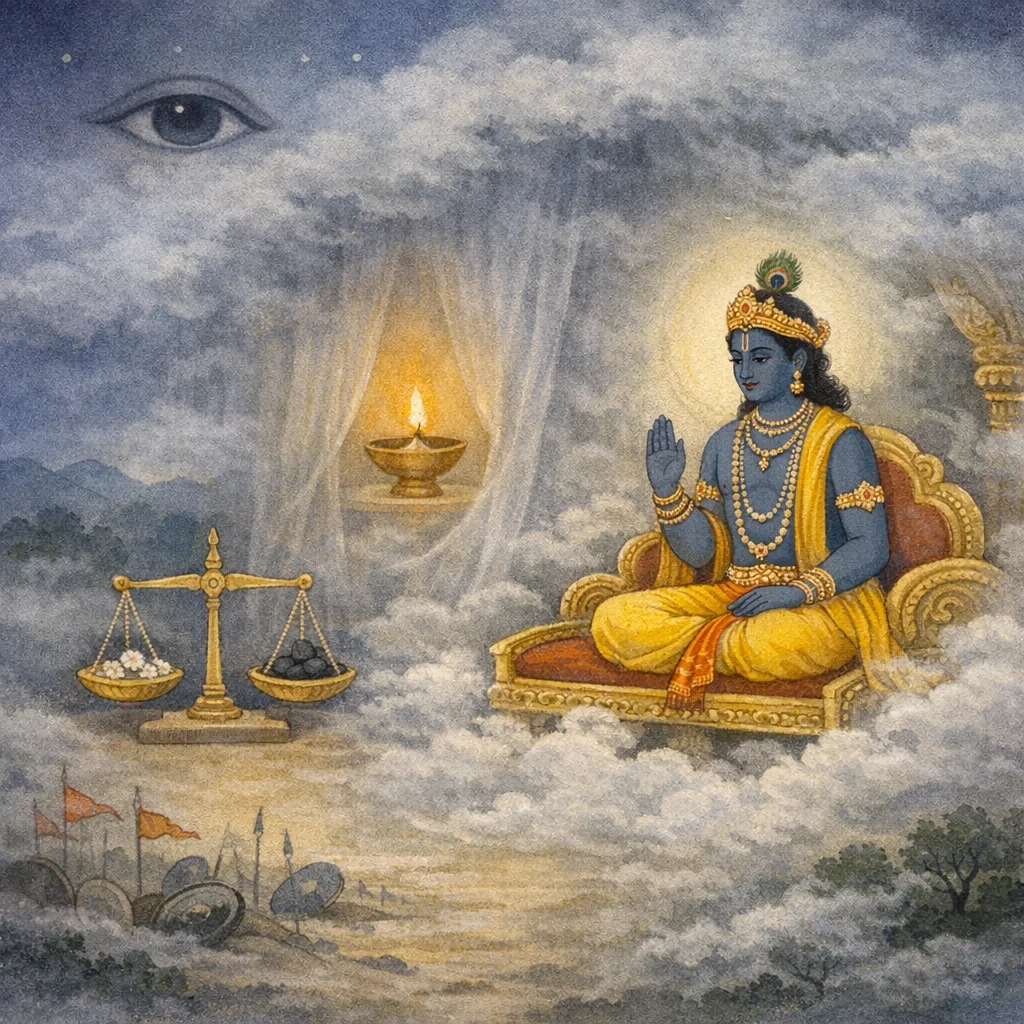
The all-pervading one takes neither anyone’s wrongdoing nor merit; knowledge is covered by ignorance—therefore beings are deluded.
The verse is frequently used to argue against divine partiality: moral qualities are not transferred to God. “Knowledge covered by ignorance” is a general anthropological claim about cognitive obscuration, interpreted variously as māyā/avidyā (Vedānta) or misidentification with prakṛti (Sāṃkhya-yoga).
FAQs
The verse explains harmful behavior and suffering primarily through distorted understanding rather than through an externally imposed fate, highlighting the role of clarity, education, and self-inquiry.
It asserts that the ultimate reality (or Lord) is not a receptacle for individual moral qualities; delusion arises because cognition is obscured by ignorance.
It supports the chapter’s emphasis on knowledge and inner renunciation: liberation is linked to removing ignorance rather than negotiating with a deity for altered outcomes.
When evaluating actions, focus on correcting misunderstandings and biases (in oneself and institutions) rather than assuming moral failure is fixed or divinely assigned.
Read Bhagavad Gita in the Vedapath app
Scan the QR code to open this directly in the app, with audio, word-by-word meanings, and more.