
Shloka 23
Akshara Brahma Yoga — Akshara Brahma Yoga
यत्र काले त्वनावृत्तिमावृत्तिं चैव योगिनः । प्रयाता यान्ति तं कालं वक्ष्यामि भरतर्षभ ॥ ८.२३ ॥
yatra kāle tv anāvṛttim āvṛttiṃ caiva yoginaḥ | prayātā yānti taṃ kālaṃ vakṣyāmi bharatarṣabha || 8.23 ||

Ahora te diré, oh el mejor de los Bhâratas, los tiempos en que los yoguis, al partir, alcanzan la no‑retornación, y también aquellos en que retornan.
Now I shall tell you, O best of the Bharatas, the times at which yogins departing attain non-return, and also return.
I will declare, O bull of the Bharatas, the time in which yogins who depart go to non-return, and also (the time leading to) return.
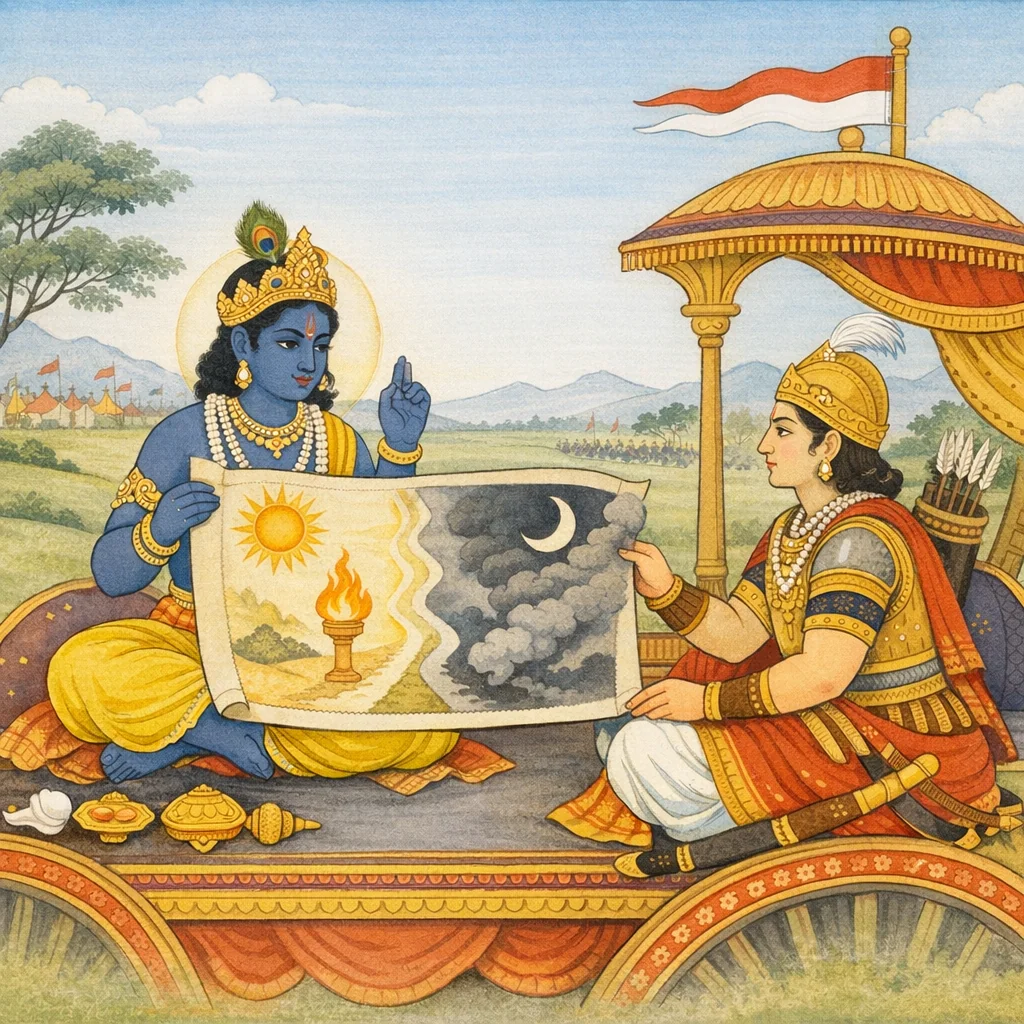
The verse introduces a doctrinal scheme of ‘times/paths’ at death. Some later traditions read these as literal cosmic routes; others interpret them symbolically as modes of realization.
FAQs
The ‘time’ language can function as a pedagogical device: it maps outcomes to conditions, encouraging disciplined preparation and clarity about what leads to lasting freedom versus cyclical repetition.
It signals a framework where post-mortem trajectory depends on realization and alignment, distinguishing liberation (non-return) from continued cyclic existence (return).
It bridges the earlier focus on the imperishable goal with a traditional cosmological teaching about two routes, elaborated in the next verses.
It can be read as emphasizing ‘right conditions’ for transition—cultivating stable practice so that life’s endings and changes are met with coherence rather than confusion.