
Shloka 2
Akshara Brahma Yoga — Akshara Brahma Yoga
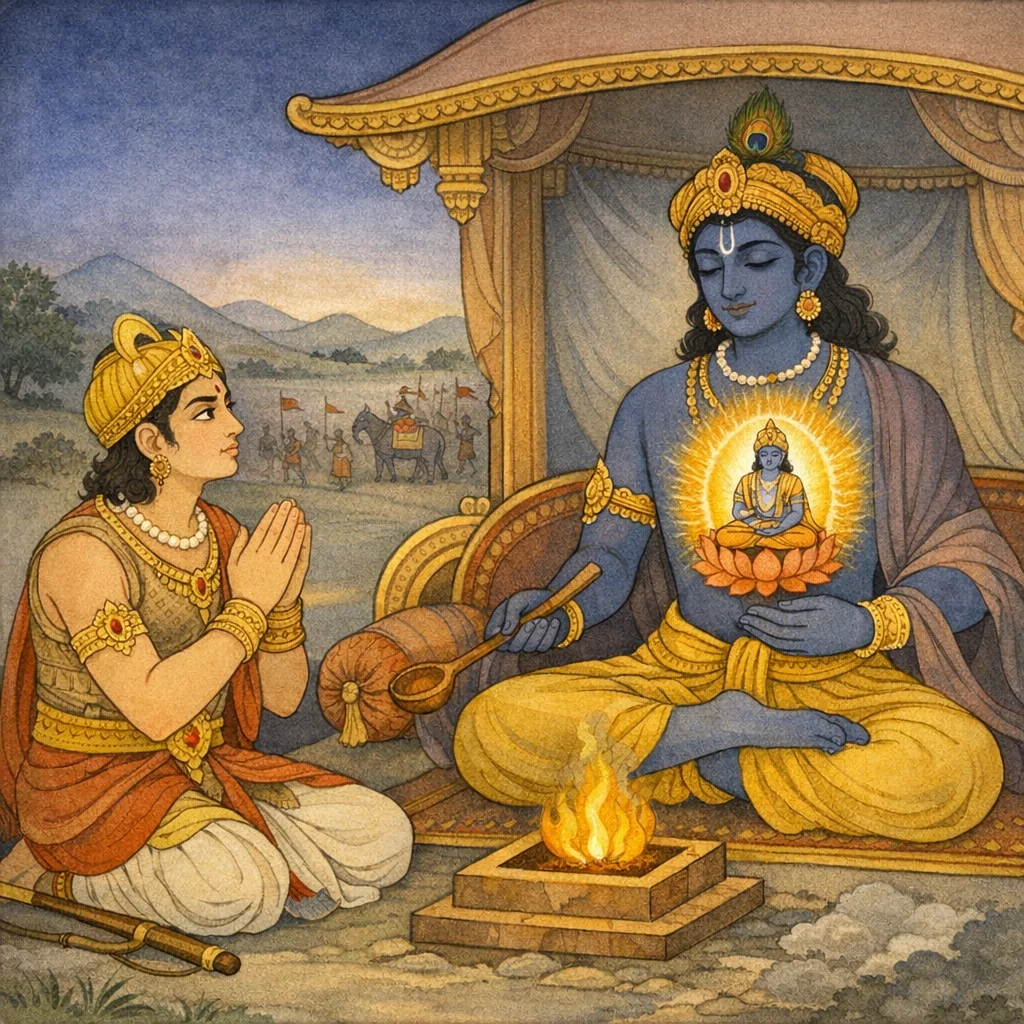
अधियज्ञः कथं कोऽत्र देहेऽस्मिन्मधुसूदन । प्रयाणकाले च कथं ज्ञेयोऽसि नियतात्मभिः ॥ ८.२ ॥
adhiyajñaḥ kathaṁ ko ’tra dehe ’smin madhusūdana | prayāṇakāle ca kathaṁ jñeyo ’si niyatātmabhiḥ || 8.2 ||

¿Quién es el adhiyajña aquí, en este cuerpo, oh destructor de Madhu? ¿Y cómo has de ser conocido en el momento de la partida por los de mente disciplinada?
And who is the adhiyajña here in this body, O destroyer of Madhu? And how are You to be known at the time of departure by the self-controlled?
Arjuna asks: what is meant by 'adhiyajña' (the principle presiding over sacrifice) as present in embodied existence, and by what disciplined means is Kṛṣṇa to be cognitively realized at the time of dying (the moment of departure).
Interpretations vary on 'in this body': some read it as the locus of ritual meaning internalized as contemplative practice; others as a theological claim that the divine is immanent within embodied life. The verse itself remains stable across editions.
FAQs
It highlights the challenge of maintaining clarity and focus under extreme transition; the 'time of departure' functions as a test case for the stability of attention and values.
The verse asks how a transcendent reality can be known as present within embodied life, and what constitutes valid 'knowing' in a liminal moment.
It bridges technical definitions (8.1) with the practical question central to Chapter 8: how disciplined remembrance relates to liberation.
It can be read as guidance for cultivating steady attention and meaning-making so that one’s core commitments remain accessible under stress or major life transitions.