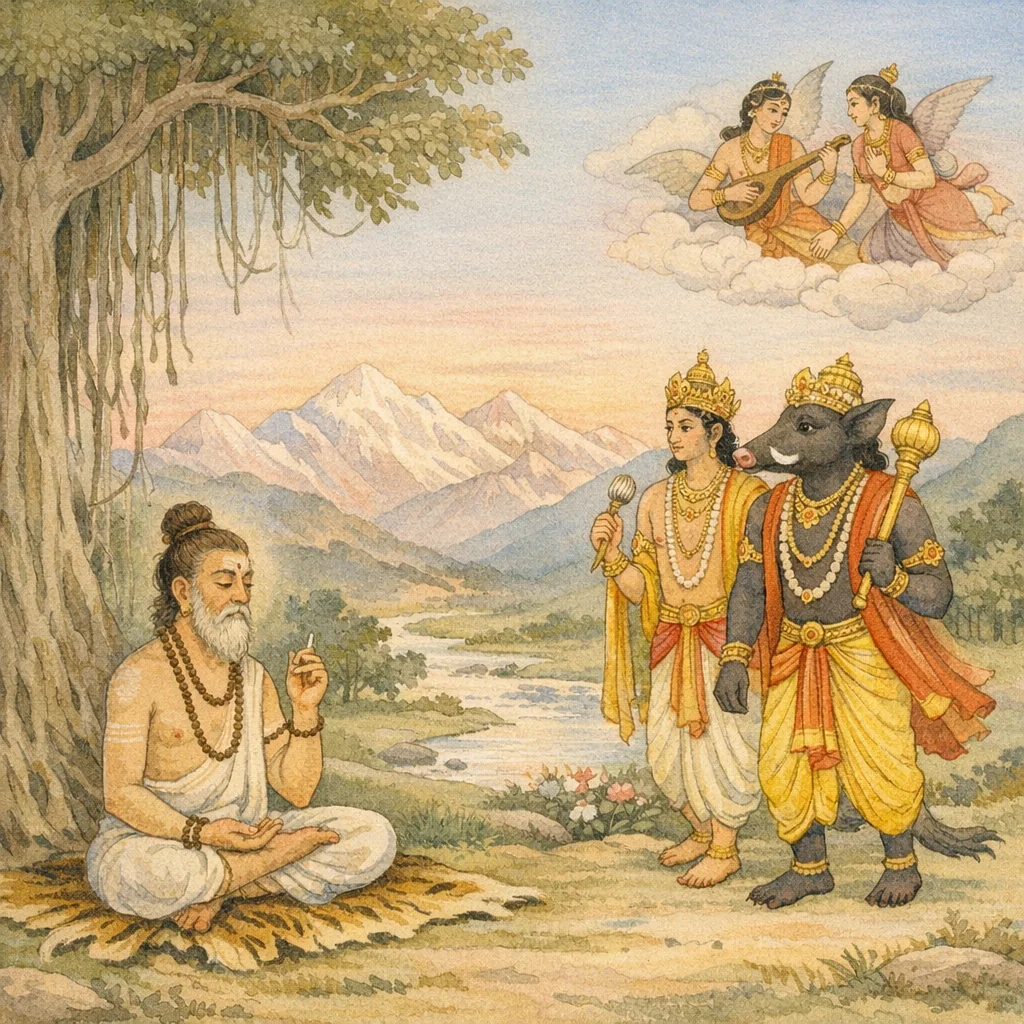
Adhyaya 98: Chapter on the Sacred Hill Episode: Satyatapā and the Marvel of Varāha
Parvādhyāyaḥ (Satyatapā–Varāha-adbhuta-prasaṅgaḥ)
Ethical-Discourse (Tapas, Dharma, and Sacred Landscape / Tīrtha-Māhātmya)
In dialogue, Pṛthivī asks Varāha to explain a marvel reported on Himavant. Varāha recounts the brāhmaṇa Satyatapā, who once fell in with bandits but reformed through the company and instruction of ṛṣis, especially in connection with Durvāsas. He undertakes tapas on Himavant’s northern flank near the Puṣyabhadrā River, at a spot marked by Citrāśilā and a great banyan, Bhadravaṭa. A wonder occurs when he accidentally cuts his finger: no blood flows; it becomes ash-like powder and then is restored whole. A kinnara couple reports this to Indra; Indra and Viṣṇu (as Varāha) approach, test the ascetic’s discernment, reveal themselves, and grant boons—sin-purification for those who honor brāhmaṇas through a prescribed monthly observance, and Satyatapā’s liberation. His teacher Āruṇi later arrives, confirms his attainment, and both merge into Nārāyaṇa, affirming disciplined dharma within sacred landscapes and tīrtha.
Primary Speakers
Key Concepts
Shlokas in Adhyaya 98
Verse 1
अथ पर्वाध्यायः ॥ धरण्युवाच ॥ योऽसौ सत्यतपा नाम लुब्धो भूत्वा द्विजो बभौ ॥ येनारुणिर्व्याघ्रभयाद्रक्षितो यः स्वशक्तितः ॥
Pṛthivī said: “That brahmin named Satyatapā—who, becoming greedy, turned into a hunter—by his own power protected Aruṇi from the fear of a tiger…”
Verse 2
दुर्वासाः संश्रुतार्थश्च हिमवन्तं नगं ययौ ॥ तस्योपरि महच्चित्रं भवतीति त्वयेरितम् ॥
“And Durvāsas, having learned the matter, went to the mountain Himavant. You have stated that upon it there is a great marvel.”
Verse 3
कीदृशं तन्ममाचक्ष्व महत्कौतूहलं विभो ॥ श्रीवराह उवाच ॥ स हि सत्यतपा पूर्वं भृगुवंशोद्भवो द्विजः ॥
“Tell me what it is like; I have great curiosity, O Lord.” Śrī Varāha said: “For that Satyatapā was formerly a brahmin born in the lineage of Bhṛgu.”
Verse 4
दस्युसंसर्गसम्भूतो दस्युवत्समजायत ॥ ततः कालेन महता ऋषिसङ्गात्पुनर्द्विजः ॥
“Arising through association with bandits, he became like a bandit; then, after a long time, through the company of sages, he again became a brahmin.”
Verse 5
बभौ दुर्वाससा सम्यग्बोधितश्च विशेषतः ॥ हिमाद्रेरुत्तरे पादे पुष्यभद्रा नदी शुभा ॥
“He became distinguished again, having been properly instructed—especially—by Durvāsas. On the northern slope of the Himālaya is the auspicious river Puṣyabhadrā.”
Verse 6
तस्यास्तीरे शिला दिव्या नाम्ना चित्रशिला धरे ॥ न्यग्रोधश्च महांस्तत्र नाम्ना भद्रो महावटः ॥
On its bank is a divine rock named Citraśilā, O Earth; and there also stands a great nyagrodha tree—an immense banyan—named Bhadra.
Verse 7
तत्र सत्यतपाः स्थित्वा तपः कुर्वन्महातपाः ॥ स कदाचित्कुठारेण चकर्त्त समिधः किल ॥
There Satyatapā stayed, practicing austerity—an ascetic of great tapas. Once, it is said, he cut firewood with an axe.
Verse 8
चिच्छेद चाङ्गुलीमेकां वामतर्जनिकां मुनिः ॥ छिन्नायामङ्गुलौ तस्य भस्मचूर्णं भवत्किल ॥
The sage cut off one finger—his left index finger. When that finger was cut, it is said that it became powdery ash.
Verse 9
न लोहितं न मांसं तु न मज्जा तत्र दृश्यते ॥ अङ्गुली सन्धिता तेन पूर्ववच्छाभवत्कृते ॥
No blood, no flesh, and no marrow were seen there. He rejoined the finger, and once it was done, it became as before.
Verse 10
प्रभाते विमले प्राप्तमिन्द्रलोकमिति स्मृतिः ॥ अथेन्द्रेण सुराः सर्वे यक्षगन्धर्वकिन्नरैः ॥
In the remembered account, at a clear dawn he attained Indra’s world. Then, together with Indra, all the gods—along with Yakṣas, Gandharvas, and Kinnaras—assembled.
Verse 11
पृष्टाः किञ्चिदिहास्चार्यमपूर्वं कथ्यतामिति ॥ तत्र रुद्रसरस्तीरे यदेतन्मिथुनं शुभम् ॥
When asked, “Let something wondrous and unprecedented here be told,” they said: “There, on the bank of Rudra-saras, there is this auspicious pair.”
Verse 12
स्थितं किन्नरयोस्तच्च वाक्यं चेदमुवाच ह ॥ दृष्टं तु महदाश्चर्यं पुष्यभद्रातटे शुभे ॥
And standing there by the two Kinnaras, he spoke these words: “Indeed, a great marvel has been seen on the auspicious bank of the Puṣyabhadrā.”
Verse 13
यदेतत्सत्यतपसः समवोचत्ततः शुभे ॥ दृष्टं किञ्चिदिहास्चर्यं दृष्टिस्तु हिमवद्गिरौ ॥
Then, O auspicious one, Satya-tapas spoke as follows: “Something wondrous has been seen here—this sight is on the Himavat mountain.”
Verse 14
पुष्यभद्रानदीतीरे महदाश्चर्यमुत्तमम् ॥ यदेतत्सत्यतपसः समवोचस्ततः शुभे ॥
On the bank of the Puṣyabhadrā river there is a great and supreme marvel—thus indeed Satya-tapas declared, O auspicious one.
Verse 15
स्रवणं भस्मनश्चैव श्रुतं सर्वं शशंस ह ॥ तच्छुत्वा सहसा शक्रो विस्मितो विष्णुमब्रवीत् ॥
And he reported everything that was heard—about the “flow” and about the ash. Hearing that, Śakra (Indra) suddenly, astonished, spoke to Viṣṇu.
Verse 16
आगच्छ विष्णो गच्छामो हिमवत्पार्श्वमुत्तमम् ॥ तत्राश्चर्यमपूर्वं मे कथितं किन्नरेण ह ॥
“Come, O Viṣṇu; let us go to the most excellent side of Himavat. There a Kinnara has told me of an unprecedented marvel.”
Verse 17
एवमुक्तस्ततो विष्णुर्वाराहं रूपमग्रहीत् ॥ मृगयुश्च तथैवेन्द्रो जग्मतुस्तमृषिं प्रति ॥
Thus addressed, Viṣṇu assumed the form of Varāha. Indra too—together with the hunter—went toward that sage.
Verse 18
विष्णुर्वाराहरूपेण ऋषिदृष्टिपथे स्थितः ॥ भूत्वा दृश्योऽप्यदृश्योऽभूत्पुनरेव च दृश्यते ॥
Viṣṇu, in the form of Varāha, stood within the range of the sage’s sight. Having become visible, he became invisible; and again he is seen.
Verse 19
भगवन्निह दृष्टस्ते वराहः पृथुलो महान् ॥ येन तं हन्मि भृत्यानां पोषणाय महामुने ॥
“Venerable sir, here you have seen a great, massive boar. Tell me by what means I might kill it, O great sage, for the sustenance of my dependents.”
Verse 20
एवमुक्तो मुनिस्तेन चिन्तयामास तत्क्षणात् ॥ यदि तं दर्शयाम्यस्मै वराहं हन्यते तदा ॥
Thus spoken to, the sage reflected at that very moment: “If I show him that boar, then it will be killed.”
Verse 21
नो चेत्कुटुम्बः क्षुधया सीदत्यस्य न संशयः ॥ जायापुत्रसमायुक्तो लुब्धकोऽयं क्षुधान्वितः ॥
If not, his household will surely languish from hunger—of this there is no doubt. This hunter, accompanied by wife and sons, is afflicted by hunger.
Verse 22
नाध्यगच्छत बुद्धिश्च क्षणात्तस्य व्यजायत ॥
His understanding did not arrive at a resolution; yet in an instant, a new insight arose for him.
Verse 23
दृष्टं चक्षुर्निहितं जङ्गमेषु जिह्वा वक्तुं मृगयौ तद्विसृष्टम् ॥ द्रष्टुं चक्षुर्नास्ति जिह्वेह वक्तुं जिह्वायाः स्यात्तत्त्वतोऽस्तीह चक्षुः ॥
Among moving creatures, sight is lodged in the eye; the tongue is fashioned for speech—thus it is assigned. The tongue cannot see, nor does the eye speak here; in principle, the tongue remains a tongue, and the eye indeed remains an eye.
Verse 24
एवं श्रुत्वा द्वावपि तस्य तुष्टौ इन्द्राविष्णू दर्शयन्तौ स्वमूर्तिम् ॥ वाक्यं चेदमूचतुर्ब्रूहि नौ ते तुष्टौ धन्यं वरमेकं वदस्व ॥ तच्छ्रुत्वाऽसौ सत्यतपा उवाच ॥
Hearing thus, both Indra and Viṣṇu were pleased with him and revealed their own forms. They spoke these words: “Speak—both of us are pleased with you, fortunate one. State a single boon.” Hearing that, Satyatapā replied.
Verse 25
न चातिरिक्तोऽस्ति वरः पृथिव्यां यद्दृष्टो मे पुरतो देवदेवाः ॥ बलं वरेणापि कृतार्थतासीत्तथापीदं ये सदा पर्वकाले ॥
There is no boon greater on earth than this: that the gods of gods have been seen by me face to face. Even by a boon, fulfillment has been achieved; yet I ask this further, concerning those who always act at the times of sacred observance.
Verse 26
सशल्यश्च वराहोऽयं ममाश्रममुपागतः ॥ एवं गते तु किं कार्यमथासौ चिन्तयन् प्रभुः ॥
“This boar has come to my hermitage, and it is wounded. Things being thus, what should be done?” Thus the venerable lord reflected.
Verse 27
विप्रा विप्राश्चार्चयन्तीह भक्त्या तेषां पापं नश्यतां मासमेकम् ॥ यत्सञ्चितं त्वेष एको वरोऽस्तु ह्यभीष्टो मे सांप्रतम् देहि मह्यम् ॥
“May the brāhmaṇas be worshipped here with devotion, and may their sin—whatever has been accumulated—be destroyed for one month. Let this be the single boon I choose; grant me now what I desire.”
Verse 28
अदर्शनं गतौ देवो सोऽपि तत्र व्यवस्थितः ॥ लब्ध्वा वरं सत्यतपा ब्रह्मभूतोऽभवद्धृदि ॥
“When the deity departed from sight, he too remained established there. Having obtained the boon, Satyatapā became brahman-like—spiritually elevated—within his heart.”
Verse 29
यावदास्ते शुभे देशे कृतकृत्यो महामुनिः ॥ तावत्तस्य गुरुस्तत्र त्वारुणिः समदृश्यत ॥
“As long as the great sage remained in that auspicious place, his tasks fulfilled, so long did his teacher, Tvāruṇi, appear there.”
Verse 30
पृथ्वीं प्रदक्षिणीकृत्य तीर्थहेतोर्विचक्षण ॥ तेन चासौ महाभक्त्या पूजितो मुनिपुङ्गवः ॥
“Having circumambulated the earth in pradakṣiṇā for the sake of the tīrthas (sacred pilgrimage-fords), the discerning one worshipped that foremost of sages with great devotion.”
Verse 31
पाद्याचमनगोदानेः कृतासनपरिग्रहः ॥ ज्ञात्वा स शिष्यं सिद्धं तु तपसा दग्धकिल्बिषम्
Having completed the offering of water for the feet, the ritual sipping (ācamana), and the gift of a cow—and having taken his seat—he recognized that the disciple had indeed attained siddhi, his faults burned away by tapas (austerity).
Verse 32
इदानीमात्मना सार्द्धं मुक्तिकालो मतोऽस्ति ते ॥ उत्तिष्ठ गम्यतां पुत्र मया सार्द्धं परं पदम्
Now, with your own self in full inner readiness, the time of liberation (mokṣa) is deemed to have come for you. Rise, my son; let us go together to the supreme state.
Verse 33
यद्गत्वा न पुनर्जन्म भवतीति न संशयः ॥ एवमुक्त्वा तु तौ सिद्धावुभौ सत्यतपारुणी
Having gone there, there is no doubt that rebirth does not occur again. Having spoken thus, the two—both accomplished (siddha)—proceeded, ardent through truth and tapas (austerity).
Verse 34
ध्यात्वा नारायणं देवं तद्देहे तौ लयं गतौ ॥ यश्चापि शृणुयात्पादं पर्वाध्यायं सविस्तरम्
Meditating on Nārāyaṇa, the Divine, the two entered dissolution into that (divine) body. And whoever also listens to this section—this chapter-unit—in full detail…
Verse 35
उवाच विनयापन्नं प्राञ्जलिं पुरतः स्थितम् ॥ अरुणिरुवाच ॥ पुत्र सिद्धोऽसि तपसा ब्रह्मभूतोऽसि सुव्रत
He addressed the humble one standing before him with hands folded. Aruṇi said: “My son, you are accomplished through tapas; you have become one with Brahman, O you of excellent vows.”
Verse 36
तस्मिन् भद्रवटे चैके मिथुनं किन्नरं स्थितम् ॥ रात्रौ सुप्तमृषेस्तस्य दृष्ट्वा तन्महदद्भुतम्
There, at Bhadravaṭa, a single pair of Kinnaras dwelt. At night, seeing that ṛṣi asleep, they beheld a great marvel connected with him.
Verse 37
तावदिन्द्रो धनुष्पाणिस्तीक्ष्णसायकधृग्वने ॥ आगत्य सत्यतपतमृषिमेनमुवाच ह
Meanwhile Indra, bow in hand and bearing keen arrows, came into the forest and addressed this sage, Satyatapā.
Verse 38
मुक्तिं चाहं व्रजामीति द्वितीयोऽस्तु वरो मम ॥ तथे त्युक्त्वा तु तौ देवौ दत्त्वा तस्य वरं शुभम्
“And I too shall go to liberation (mokṣa)”—let this be my second boon. Saying, “So be it,” those two deities granted him that auspicious boon.
Frequently Asked Questions
The narrative frames ethical reform and disciplined conduct as achievable through right association (ṛṣi-saṅga), sustained tapas, and discernment under pressure. It also presents social ethics—especially honoring brāhmaṇas with devotion—as a community-facing practice linked to the reduction of accumulated wrongdoing, while positioning liberation (mokṣa) as the ultimate outcome of realized austerity and Nārāyaṇa-centered contemplation.
The chapter specifies a monthly duration (māsam ekam) connected with the effect of brāhmaṇa-arcana/pūjā—described as a boon for the removal of sin over one month. It does not provide explicit lunar tithi names or seasonal (ṛtu) markers in the supplied verses, but it does narratively mark time as “prabhāte” (at dawn) and “rātrau” (at night) around the kinnara episode.
Through Pṛthivī’s inquiry and Varāha’s response, sacred geography is presented as an ethical landscape: the river (Puṣyabhadrā), the banyan (Bhadravaṭa), and named stones (Citrāśilā) function as ecological anchors for disciplined living. The text implies that human self-regulation (tapas, restraint, reverence) is practiced within and supported by specific terrestrial sites, aligning moral order with the stewardship and sacralization of Earth’s places.
Satyatapā is identified as a brāhmaṇa of the Bhṛgu lineage (Bhṛguvaṁśodbhava). The narrative also references Durvāsas as a key instructive sage, Āruṇi as Satyatapā’s guru, and celestial-cultural figures including Indra, yakṣas, gandharvas, and a kinnara couple who serve as witnesses and messengers within the story’s transmission chain.