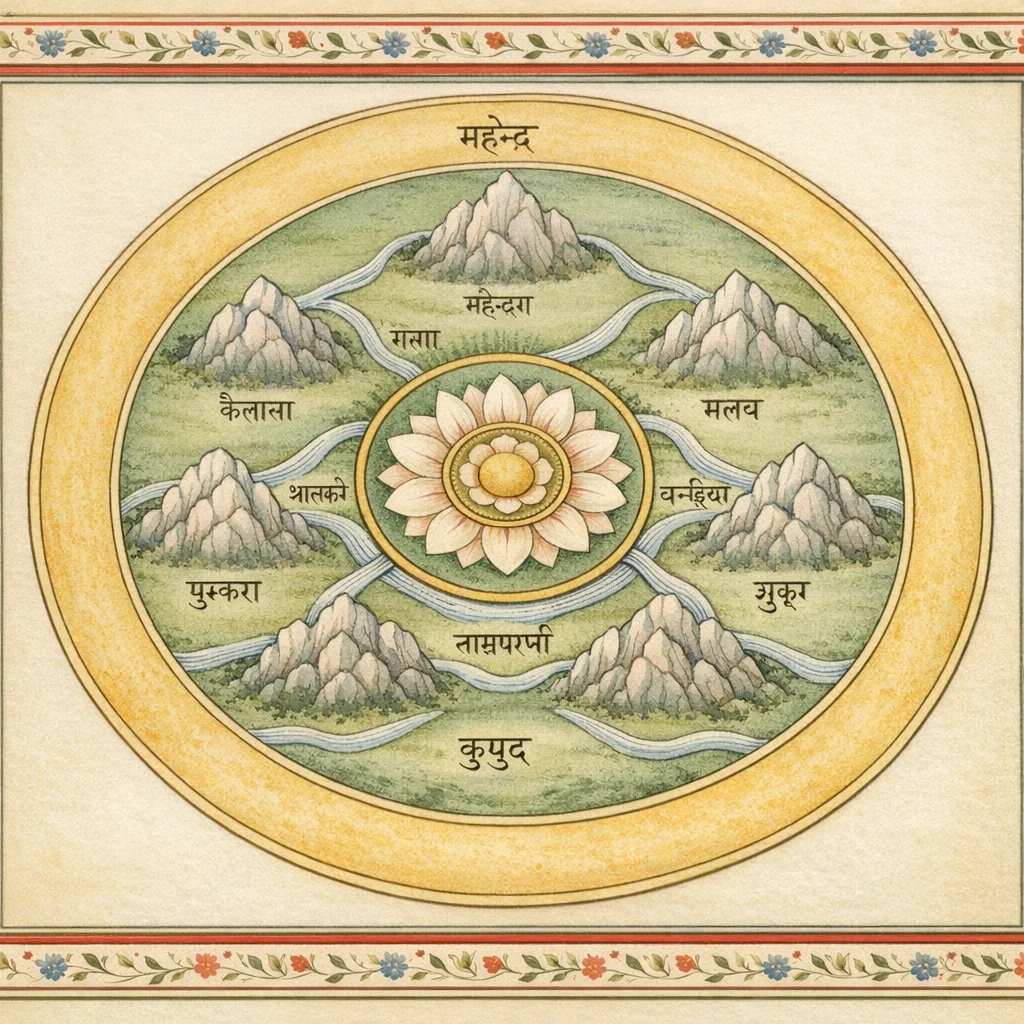
Adhyaya 87: Description of Krauñcadvīpa: its mountains, regions, rivers, and encircling ocean
Krauñcadvīpa-varṇana (Parvata–Varṣa–Nadī–Samudra-vibhāgaḥ)
Ancient-Geography (Purāṇic Cosmography) / Environmental Topography
Within the Varāha–Pṛthivī teaching frame, this chapter offers a cosmographic lesson that portrays Earth’s ordered structure as a form of balance. The speaker (marked as Rudra in the manuscript) describes Krauñcadvīpa as the fourth continent, its proportional scale in relation to Kuśadvīpa, and the ocean that encircles it. It enumerates seven principal, jewel-like mountains with their relative heights, mapping the land’s stabilizing features. The text then lists the seven varṣas (sub-regions) and seven major rivers with alternative or descriptive names, along with mention of additional minor rivers. The section concludes by identifying the surrounding ocean of ghṛta (clarified butter), affirming the Purāṇic vision of a layered, ecologically patterned world.
Primary Speakers
Key Concepts
Shlokas in Adhyaya 87
Verse 1
रुद्र उवाच । अथ क्रौञ्चं भवति चतुर्थं कुशद्वीपाद् द्विगुणमानतः समुद्रः क्रौञ्चेन द्विगुणेनावृतः । तस्मिंश्च सप्तैव प्रधानपर्वताः । प्रथमः कौञ्चो विद्युर्लतो रैवतो मानसः सैव पावकः । तथैवान्धकारः सैवाच्छोदकः । देवावृत्तो स च सुरापो भण्यते । ततो देविष्ठः स एव काञ्चनशृङ्गो भवति । देवनन्दात्परो गोविन्दः, द्विविन्द इति । ततः पुण्डरीकः सैव तोषाशयः । एते सप्त रत्नमयाः पर्वताः क्रौञ्चद्वीपे व्यवस्थिताः । सर्वे च परस्परेणोच्छ्रयाः । तत्र वर्षाणि तथा क्रौञ्चस्य कुशलो देशः सैव माधवः स्मृतः वामनस्य मनोऽनुगः सैव संवर्तकस्ततोऽष्णवान् सोमप्रकाशः । ततः पावकः सैव सुदर्शनः । तथा चान्धकारः सैव सम्मोहः । ततो मुनिदेशः स च प्रकाशः । ततो दुन्दुभिः सैवानर्थ उच्यते । तत्रापि सप्तैव नद्यः
Rudra said: “Now the dvīpa called Krauñca becomes the fourth, being double in extent compared to Kuśadvīpa; and it is enclosed by an ocean twice its measure, named Krauñca. In it are seven principal mountains: Kauñca first; then Vidyullatā, Raivata, Mānasa; likewise Pāvaka, likewise Andhakāra, and likewise Acchodaka. Devāvṛtta is also mentioned, and is called Surāpa. Then there is Devīṣṭha, which indeed becomes Kāñcanaśṛṅga. Beyond Devananda is Govinda, called Dvivinda. Then come Puṇḍarīka and likewise Toṣāśaya. These seven jewel-like mountains are established in Krauñcadvīpa, all rising in relation to one another. There the regions (varṣas) are also described: Kuśala-deśa, Mādhava, Vāmana’s Mano’nuga, Saṃvartaka, Aṣṇavān, Somaprakāśa; then Pāvaka, also called Sudarśana; and Andhakāra, also called Saṃmoha; then Munideśa and that called Prakāśa; then Dundubhi, also said to be Anartha. There too are seven rivers.”
Verse 2
गौरी कुमुद्वती चैव सन्ध्या रात्रिर्मनोजवा ख्यातिश्च पुण्डरीका च गङ्गा सप्तविधाः स्मृताः । गौरी सैव पुष्पवहा कुमुद्वती ताम्रवती रोधसन्ध्या सुखावहा च मनोजवा च क्षिप्रोदा च ख्यातिः सैव गोबहुला पुण्डरीका चित्रवेगा शेषाः क्षुद्रनद्यः ॥ क्रौञ्चद्वीपो घृतोदेनावृतः । घृतोदा शाल्मलेनेति
Gaurī, Kumudvatī, Sandhyā, Rātri, Manojavā, Khyāti, Puṇḍarīkā, and Gaṅgā are remembered as seven rivers. Gaurī is also called Puṣpavahā; Kumudvatī is also Tāmravatī; Rodhasandhyā is also Sukhāvahā; Manojavā is also Kṣiprodā; Khyāti is also Gobahulā; Puṇḍarīkā is also Citravegā; the rest are minor streams. Krauñcadvīpa is enclosed by the Ghee-ocean (Ghṛtoda); and ‘Ghṛtoda’ is associated with Śālmaladvīpa.
Frequently Asked Questions
The passage primarily teaches an ordered model of Earth (Pṛthivī) through systematic geography—continents, mountains, regions, and rivers—implying that terrestrial stability depends on structured landforms and regulated waters. The instructional logic frames environmental order as a prerequisite for sustaining life and cosmic balance rather than presenting a direct social-legal injunction.
No explicit calendrical markers (tithi, nakṣatra, māsa, or seasonal timings) appear in the cited material. The content is descriptive cosmography rather than a ritual schedule.
It models balance through enumerated structures: seven principal mountains (as stabilizing features), seven varṣas (organized land divisions), and seven rivers (hydrological circulation), all enclosed by a concentric ocean. This mapping presents Earth as a regulated system in which landforms and waterways collectively maintain coherence.
No royal genealogies or human historical lineages are referenced in the cited verses. The only explicit speaker attribution in the manuscript excerpt is Rudra, while the broader work’s pedagogical frame is typically presented as Varāha instructing Pṛthivī.