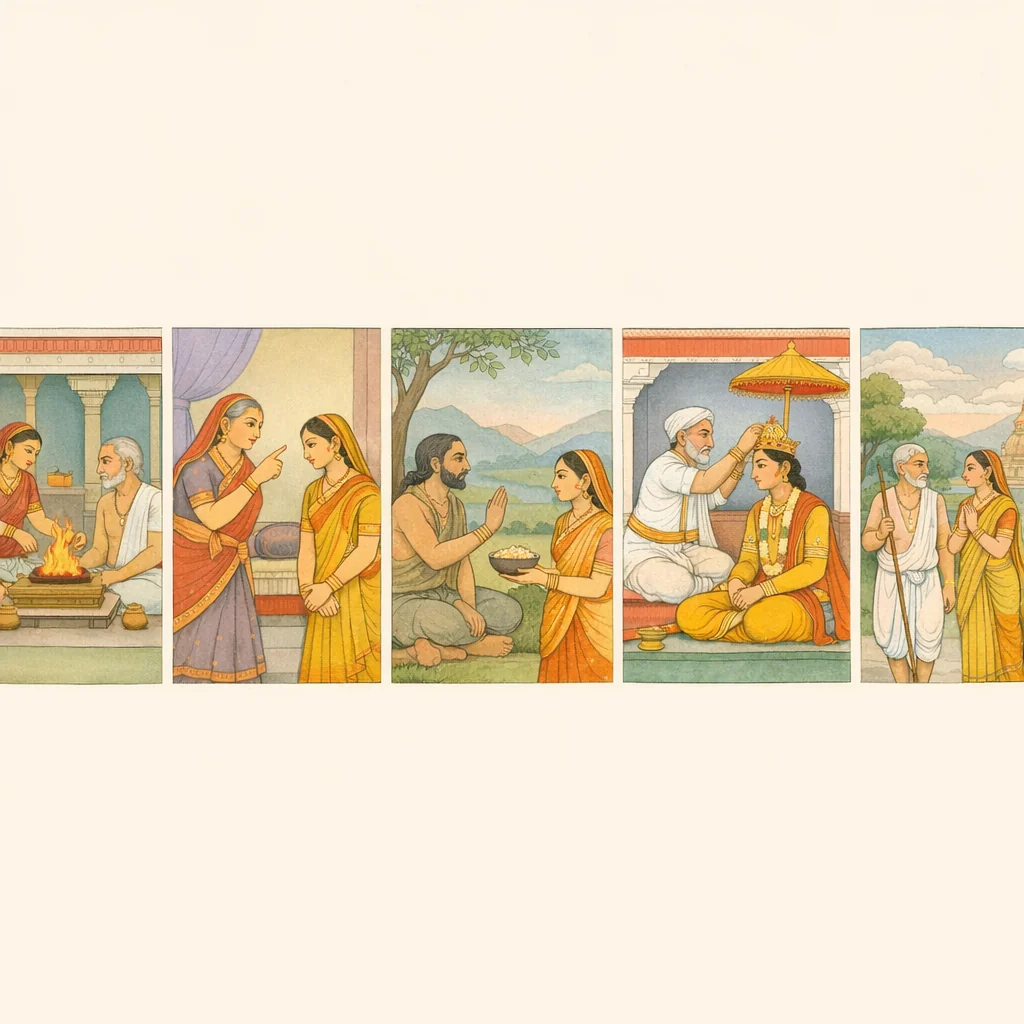
Adhyaya 8: Dialogue on the Ethical Limits of Subsistence and the Five Great Sacrifices (Dharmavyādha, Mātaṅga, and Prasanna)
Dharmavyādha–Mātaṅga–Prasanna Saṃvādaḥ
Ethical-Discourse (Dharma, Non-violence, Household Economy, Ritual Ecology)
Varāha tells Pṛthivī of a dharmavyādha who, though long living as a hunter, limits harm to the bare minimum for subsistence and upholds household dharma through truthfulness, fire-service, hospitality, and regular śrāddha at Mithilā on festival days. His daughter Arjunakī is married to Prasanna, son of Mātaṅga. When the mother-in-law harshly brands the girl as bound to violence, the dharmavyādha visits Mātaṅga’s home and refuses to eat, arguing that grain-based food can involve vast unseen killing of aquatic and tiny creatures, whereas his own livelihood takes fewer lives. He presents this as an ethical critique of consumption and a demand for proper ritual-moral boundaries, invoking the pañca-mahāyajñas. He then returns, installs his son as heir, and goes on pilgrimage to Puruṣottama, reciting a Viṣṇu-stotra on the cosmic protection of Earth.
Primary Speakers
Key Concepts
Shlokas in Adhyaya 8
Verse 1
श्रीवराह उवाच । योऽसौ वसोः शरीरे तुव्याधो भूत्वा नृपस्य ह । स स्ववृत्त्यां स्थितः कालं चतुर्वर्षसहस्रिकम् ॥ ८.१ ॥
Śrī Varāha said: He who became a hunter in the body of King Vasu remained established in his own livelihood for a period of four thousand years.
Verse 2
एकैकं स्वकुटुम्बार्थे हत्वा वनचरं मृगम् । भृत्यातिथिहुताशानां प्रीणनं कुरुते सदा ॥ ८.२ ॥
Having killed, for the sake of his own household, a single wild creature dwelling in the forest, he continually undertakes the proper satisfaction and provision of dependents, guests, and the sacrificial fire.
Verse 3
मिथिलायां वरारोहे सदा पर्वणि पर्वणि । पितॄणां कुरुते श्राद्धं स्वाचारेण विचक्षणः ॥ ८.३ ॥
O fair-hipped lady, in Mithilā the discerning person regularly performs the śrāddha for the ancestors on each and every parvan day, in accordance with proper conduct.
Verse 4
अग्निं परिचरन् नित्यं वदन् सत्यं सुभाषितम् । प्राणयात्रानुसक्तस्तु योऽसौ जीवं न पातयेत् ॥ ८.४ ॥
Constantly attending to the sacred fire, speaking truth and well-spoken words, one who is devoted to sustaining life should not strike down any living being (that is, should not kill).
Verse 5
एवं तु वसतस्तस्य धर्मबुद्धिर्महातपाः । पुत्रस्त्वर्जुनको नाम बभूव मुनिवद्वशी ॥ ८.५ ॥
Thus, while he was dwelling there, that great ascetic—whose understanding was grounded in dharma—had a son named Arjunaka, self-controlled like a sage.
Verse 6
तस्य कालेन महता चारित्रेण च धीमतः । बभूवार्ज्जुनकी नाम कन्या च वरवर्णिनी ॥ ८.६ ॥
In due course of time, through the distinguished conduct of that wise man, there came to be a maiden named Ārjjanakī, a young woman of excellent complexion.
Verse 7
तस्याः यौवनकाले तु चिन्तयामास धर्मवित् । कस्येयं दीयते कन्या को वा योग्यश्च वै पुमान् ॥ ८.७ ॥
But when she reached youth, the knower of dharma reflected: “To whom should this maiden be given? And who, indeed, is the suitable man?”
Verse 8
इति चिन्तयतस्तस्य मतङ्गस्य सुतं प्रति । धर्मव्याधस्य सुव्यक्तं प्रसन्नाख्यं प्रति ब्रुवन् ॥ ८.८ ॥
As he was reflecting thus, he spoke clearly to the son of Mataṅga—addressing the dharma-minded hunter, known by the name Prasanna.
Verse 9
एवं सञ्चिन्त्य मातङ्गः प्रसन्नं प्रति सोद्यतः । उवाच तस्य पितरं प्रसन्नायार्ज्जुनीं भवान् । गृहाण तपतां श्रेष्ठ स्वयं दत्तां महात्मने ॥ ८.९ ॥
Having thus reflected, Mātaṅga promptly approached Prasanna and addressed his father: “O best among ascetics, accept Arjunī, whom I myself bestow of my own accord, as a gift for the noble-minded one.”
Verse 10
मतङ्ग उवाच । प्रसन्नोऽयं मम सुतः सर्वशास्त्रविशारदः । गृह्णाम्यर्जुनकीं कन्यां त्वत्सुतां व्याधसत्तम ॥ ८.१० ॥
Mataṅga said: “This son of mine is gracious in disposition and well-versed in all the śāstras. Therefore, O best of hunters, I accept Arjunakī, your daughter, as (his) bride.”
Verse 11
एवमुक्ते तदा कन्यां धर्मव्याधो महातपाः । मतङ्गपुत्राय ददौ प्रसन्नाय च धीमते ॥ ८.११ ॥
When this had thus been said, then the righteous hunter—an ascetic of great austerity—gave the maiden to the son of Mataṅga, who was graciously disposed and wise.
Verse 12
धर्मव्याधस्तदा कन्यां दत्वा स्वगृहमीयिवान् । सा अपि श्वशुरयोर्भर्तुः शुश्रूषणपरा अभवत् ॥ ८.१२ ॥
Then Dharma-vyādha, having given the maiden (in marriage), went to his own home. She too became devoted to attentive service toward her parents-in-law and her husband.
Verse 13
अथ कालेन महता सा कन्या अर्जुनकी शुभा । उक्ता श्वश्रुवा सुता पुत्रि जीवहन्तुस्त्वमीदृशी । न जानासि तपश्चर्तुं भर्त्तुराराधनं तथा ॥ ८.१३ ॥
Then, after a long time, that auspicious maiden Arjunakī was addressed by her mother-in-law: “Daughter, you are of such a kind—one who harms living beings. You do not know how to practice austerity, nor likewise how to honor and attend upon your husband.”
Verse 14
सा अपि स्वल्पापराधेन भर्त्सिता तनुमध्यमा । पितुर्वेश्मगता बाला रोदमानाऽ मुहुर्मुहुः ॥ ८.१४ ॥
Even she—slender-waisted—having been rebuked for a minor offense, went to her father’s house; the young girl repeatedly wept again and again.
Verse 15
पित्रा पृष्टा किमेतत्ते पुत्रि रोदनकारणम् । एवमुक्ता तदा सा तु कथयामास भामिनी ॥ ८.१५ ॥
Questioned by her father—“Daughter, what is this? What is the cause of your weeping?”—thus addressed, that woman then began to relate the matter.
Verse 16
श्वश्र्वा अहम् उक्ता तीव्रेण कोपेन महता पितः । जीवहन्तुः सुतेत्युच्चैरसकृद् व्याधजेति च ॥ ८.१६ ॥
She said: “Father, my mother-in-law spoke to me in fierce and great anger, loudly and repeatedly: ‘O daughter of a slayer of living beings—O victor, O hunter!’”
Verse 17
एतच्छ्रुत्वा स धर्मात्मा धर्मव्याधो रुषान्वितः । मतङ्गस्य गृहं सोऽथ गत्वा जनपदैर्वृतम् ॥ ८.१७ ॥
Hearing this, the righteous Dharmavyādha, filled with anger, then went to the house of Mataṅga, which was surrounded by the people of the region.
Verse 18
तस्यागतस्य संबन्धी मतङ्गो जयतां वरः । आसनाद्यार्ध्यपाद्येन पूजयित्वेदमब्रवीत् । किमागमनकृत्यं ते किं करोम्यागतक्रियाम् ॥ ८.१८ ॥
Then Mataṅga—foremost among the victorious and related to him—honored the arriving guest with a seat and the customary welcome offerings (arghya and water for the feet), and said: “What is the purpose of your coming? What act of hospitality shall I perform for you who have arrived?”
Verse 19
व्याध उवाच । भोजनं किञ्चिदिच्छामि भोक्तुं चैतन्यवर्जितम् । कौतूहलेन येनाहमागतो भवतो गृहम् ॥ ८.१९ ॥
The hunter said: “I wish to eat a little food—food devoid of consciousness—out of curiosity; it is for this reason that I have come to your house.”
Verse 20
मतङ्ग उवाच । गोधूमा व्रीिमयश्चैव संस्कृता मम वेश्मनि । भुज्यतां धर्मविच्छ्रेष्ठ यथाकामं तपोधन ॥ ८.२० ॥
Mataṅga said: “Wheat and grains have been prepared in my dwelling. O best among the knowers of dharma, partake of them as you wish, O one rich in ascetic merit.”
Verse 21
व्याध उवाच । पश्यामि कीदृशास्ते हि गोधूमा व्रीहयो यवाः । स्वरूपेण च सन्त्येते येन वो वेद्मि सत्तम ॥ ८.२१ ॥
The hunter said: “I observe what sort these are—wheat, rice, and barley. They exist in their own distinct forms; by that form I recognize you, O best (of beings).”
Verse 22
श्रीवराह उवाच । एवमुक्ते मतङ्गेन शूर्पं गोधूमपूरितम् । अपरं तत्र व्रीहीणां धर्मव्याधाय दर्शितम् ॥ ८.२२ ॥
Śrī Varāha said: When Mataṅga had spoken thus, a winnowing-basket filled with wheat was shown; and there also another (basket) of rice-grains was displayed for Dharma-vyādha.
Verse 23
दृष्ट्वा व्रीहीन् सगोधूमान् धर्मव्याधो वरासनात् । उत्थाय गन्तुमारभे मतङ्गेन निवारितः ॥ ८.२३ ॥
Having seen the rice grains together with wheat, the righteous hunter rose from his excellent seat and began to depart; however, he was restrained by Mataṅga.
Verse 24
किमर्थं गन्तुमारब्धं त्वया वद महामते । अभुक्तेनैव संसिद्धं मद्गृहे चान्नमुत्तमम् । पाचयित्वा स्वयं चैव कस्मात् त्वं नाद्य भुञ्जसे ॥ ८.२४ ॥
“For what purpose have you set out to depart? Tell me, O great-minded one. In my house, an excellent meal has already been prepared—yet you have not eaten. Even after cooking it yourself, why do you not eat today?”
Verse 25
व्याध उवाच । सहस्रशः कोटिशश्च जीवान् हंसि दिने दिने । अथेदृशस्य पापस्य कोऽन्नं भुञ्जति सत्पुमान् ॥ ८.२५ ॥
The hunter said: “By the thousand and by the crore you kill living beings, day after day. Then what good man would eat the food belonging to one burdened with such sin?”
Verse 26
अचैतन्यं यदि गृहे विद्यते । अन्नं सुसंस्कृतम् । इदानीमत्र संदृष्टा एते तु जलजन्तवः ॥ ८.२६ ॥
“If, in a household, there is something insentient (without consciousness), and the food is well-prepared, then now, here, these aquatic creatures are indeed seen to be present.”
Verse 27
अहमेकं कुटुम्बार्थे हन्म्यरण्ये पशुं दिने । तं चेत्पितॄभ्यः संस्कृत्य दत्त्वा भुञ्जामि सानुगः ॥ ८.२७ ॥
“For the sake of my household, I kill a single animal in the forest in a day. If, having duly prepared it and offered it to the ancestors (pitṛs), I then eat it together with my dependents—”
Verse 28
त्वं तु जीवान् बहून् हत्वा स्वकुटुम्बेन सानुगः । भुञ्जन्नेतेन सततमभो्ज्यं तन्मतं मम ॥ ८.२८ ॥
“But you—having killed many living beings—together with your own family and attendants, continually partake of food obtained by that means; in my view, that is not fit to be eaten.”
Verse 29
ब्रह्मणा तु पुरा सृष्टा ओषध्यः सर्ववीरुधः । यज्ञार्थं तत्तु भूतानां भक्ष्यमित्येव वै श्रुतिः ॥ ८.२९ ॥
Indeed, in former times Brahmā created the medicinal plants and all vegetation; and the śruti declares that these are food for living beings, intended for the purpose of yajña (the sacrificial order).
Verse 30
दिव्यो भौटस्तथा पैत्रो मानुषो ब्राह्म एव च । एते पञ्च महायज्ञा ब्रह्मणा निर्मिताः पुरा ॥ ८.३० ॥
The divine rite, the elemental rite, the ancestral rite, the human rite, and the Brahmanic rite as well—these are the five great sacrifices (mahāyajñas), established long ago by Brahmā.
Verse 31
ब्राह्मणानां हितार्थाय इतरेषां च तन्मुखम् । इतरेषां तु वर्णानां ब्राह्मणैः कारिताः शुभाः ॥ ८.३१ ॥
For the welfare of the brāhmaṇas—and with the others directed toward that very end—the auspicious duties and observances for the remaining varṇas are said to have been instituted by brāhmaṇas.
Verse 32
एवं यदि विभागः स्याद् वरान्नं तद् विशुध्यति । अन्यथा व्रीहयोऽप्येते एकैकॆ मृगपक्षिणः । मन्तव्या दातृभोक्तॄणां महामांसं तु तत् स्मृतम् ॥ ८.३२ ॥
If, in this manner, there is a proper division of portions, then that excellent food becomes purified. Otherwise, even these grains of rice should be regarded—each one—as a deer or a bird, and for the giver and the eater it is declared to be “great flesh,” that is, tantamount to eating meat.
Verse 33
मया ते दुहिता दत्ता पुत्रार्थे देवरूपिणी । सा च त्वद्भार्यया प्रोक्ता दुहिता जन्तुघातिनः ॥ ८.३३ ॥
I gave you my daughter—she of divine form—for the sake of obtaining offspring. Yet she was described by your wife as the daughter of a slayer of living beings.
Verse 34
अतोऽर्थमागतॊऽहं ते गृहं प्रति समीक्षितुम् । आचारं देवपूजां च अतिथीनां च तर्पणम् ॥ ८.३४ ॥
Therefore I have come to your house in order to observe your conduct—your worship of the deities, and the tarpaṇa, the respectful offering made to guests.
Verse 35
एतेषामेकमप्यत्र कुर्वन्नपि न दृश्यते । तद्गृहं गन्तुमिच्छामि पितॄणां श्राद्धकाम्यया ॥ ८.३५ ॥
Even while performing just one of these here, the intended result is not seen. Therefore, wishing to perform the śrāddha for the Pitṛs, I desire to go to that household.
Verse 36
स्वगृहे नैव भुञ्जामि पितॄणां कार्यमित्युत । अहं व्याधो जीवघाती न तु त्वं लोकहिंसकः ॥ ८.३६ ॥
“I do not eat in my own house, saying: ‘There is a duty to be done for the Pitṛs (ancestors).’ And further: ‘I am a hunter, a taker of life; but you are not one who harms people.’”
Verse 37
मत्सुता जीवघातस्य यदोढा त्वत्सुतेन च । तन्महत्त्वं च संजातं प्रायश्चित्तं तपोधन ॥ ८.३७ ॥
O tapodhana, wealth of austerity: when the killing of living beings (jīvaghāta) is connected with fish (matsya) and also with your son, its gravity becomes manifest; thus an expiation (prāyaścitta) is indicated.
Verse 38
एवमुक्त्वा स चोत्थाय शप्त्वा नारीं तदा धरे । मा स्नुषाभिः समं श्वश्र्वा विश्वासो भवतु क्वचित् ॥ ८.३८ ॥
Having spoken thus, he then rose and, O Dhara (Earth), after cursing the woman, declared: “May there never, at any time, be trust between a mother-in-law and her daughters-in-law.”
Verse 39
मा च स्नुषा कदाचित् स्याद् या श्वश्रूं जीवतीमिषेत् । एवमुक्त्वा गतो व्याधः स्वगृहं प्रति भामिनि ॥ ८.३९ ॥
“And may there never be a daughter-in-law who would desire her mother-in-law to be dead while she is still living.” Having spoken thus, O passionate one (bhāminī), the hunter departed toward his own home.
Verse 40
ततो देवान् पितॄन् भक्त्या पूजयित्वा विचक्षणः । पुत्रं चार्जुनकं स्थाप्य स्वसन्ताने महातपाः ॥ ८.४० ॥
Thereafter, the discerning one worshipped the gods and the ancestors with devotion; and, having installed his son Arjunaka within his own lineage as successor, that great ascetic continued on his course.
Verse 41
धर्मव्याधो जगामाशु तीर्थं त्रैलोक्यविश्रुतम् । पुरुषोत्तमाख्यं च परं तत्र गत्वा समाहितः । तपश्चचार नियतः पठन् स्तोत्रमिदं धरे ॥ ८.४१ ॥
Dharmavyādha quickly went to the sacred ford renowned in the three worlds, the supreme place known as Puruṣottama. Having arrived there and becoming composed in mind, he undertook disciplined austerity, reciting this hymn, O Earth.
Verse 42
नमामि विष्णुं त्रिदशारिनाशनं विशालवक्षस्थलसंश्रितश्रियम् । सुषासनं नीतिमतां परां गतिं त्रिविक्रमं मन्दरधारिणं सदा ॥ ८.४२ ॥
I bow to Viṣṇu, the destroyer of the enemies of the gods, whose broad chest is the abode of Śrī. Ever do I bow to him as the good ruler, the highest refuge of those devoted to right conduct—to Trivikrama, the bearer of Mandara.
Verse 43
दामोदरं रञ्जितभूतलं धिया यशोऽंशुशुभ्रं भ्रमराङ्गसप्रभम् । धराधरं नरकरिपुं पुरुष्टुतं नमामि विष्णुं शरणं जनार्दनम् ॥ ८.४३ ॥
I bow to Viṣṇu—Janārdana, the refuge—Dāmodara, who by his intent has gladdened the earth; whose fame is radiant like a beam of light; whose body shines with a dark luster like that of a bee; who upholds the earth; the foe of Naraka; and the one praised by men.
Verse 44
त्रिधा स्थितं तिग्मरथाङ्गपाणिनं नयस्थितं तृप्तमनुत्तमैर्गुणैः । निःश्रेयसाख्यं क्षपितेतरं गुरुं नमामि विष्णुं पुरुषोत्तमं त्वहम् ॥ ८.४४ ॥
I bow to Viṣṇu, the Puruṣottama—established in a threefold manner, bearing in his hand the sharp-edged discus; abiding in right conduct, content through unsurpassed qualities; known as Niḥśreyasa, the supreme good, the venerable teacher who destroys what obstructs, the revered guide.
Verse 45
महावराहो हविषाम्बुभोजनो जनार्दनो मे हितकृच्छितीमुखः । क्षितीधरो मामुदधिक्शयो महान् स पातु विष्णुः शरणार्थिनं तु माम् ॥ ८.४५ ॥
May Viṣṇu protect me—He who is the Great Boar, the enjoyer of oblations (havis) and waters; Janārdana, my benefactor, whose face is the Earth; the bearer of the Earth, the great refuge amid the ocean—may that Viṣṇu protect me, for I have sought shelter.
Verse 46
मायाततं येन जगत्त्रयं कृतं यथाग्निनैकेन ततं चराचरम् । चराचरस्य स्वयमेव सर्वतः स मेऽस्तु विष्णुः शरणं जगत्पतिः ॥ ८.४६ ॥
May Viṣṇu—the Lord of the world—be my refuge: he by whose māyā the threefold universe is fashioned, just as all that is moving and unmoving is pervaded by a single fire; and who, of himself, is everywhere throughout all that moves and does not move.
Verse 47
भवे भवे यश्च ससर्ज कं ततो जगत् प्रसूतं सचराचरं त्विदम् । ततश्च रुद्रात्मवति प्रलीयतेऽन्वतो हरिर्विष्णुहरस्तथोच्यते ॥ ८.४७ ॥
And in each cycle of existence, the one who brought forth this world—this entire moving and unmoving creation—does so; and thereafter it dissolves into that which has Rudra as its essential nature. Therefore he is also spoken of as Hari—Viṣṇu—Hara.
Verse 48
खात्मेन्दुपृथ्वीपवनाग्निभास्कराः जलं च यस्य प्रभवन्ति मूर्त्तयः । स सर्वदा मे भगवान् सनातनो ददातु शं विष्णुरचिन्त्यरूपधृक् ॥ ८.४८ ॥
May that eternal Lord Viṣṇu—who bears inconceivable forms—always grant me well-being, He whose manifested forms give rise to space, the ātman (self), the moon, the earth, wind, fire, the sun, and also water.
Frequently Asked Questions
The text develops a comparative ethics of harm: it argues that moral evaluation should consider both visible and invisible forms of violence involved in sustaining a household. Through the dharmavyādha’s refusal to eat at Mātaṅga’s home, the chapter instructs that consumption and ritual practice require scrutiny of unintended killing (e.g., small creatures in water and grain processing) and emphasizes regulated conduct—truthfulness, hospitality, śrāddha, and the pañca-mahāyajñas—as a framework for minimizing harm while fulfilling social obligations.
The chapter specifies recurring ritual timing rather than a named season: śrāddha is performed “sadā parvaṇi parvaṇi” (on parvan days, i.e., festival/observance junctions in the lunar calendar). It also notes a long duration marker for the hunter’s life (“caturvarṣasahasrikam,” four thousand years) as narrative chronology, not a ritual schedule.
Environmental stewardship appears indirectly through the ethics of food and livelihood: the narrative foregrounds ‘hidden’ ecological harm (jalajantu and other small life forms affected by grain and water use) and frames ethical living as minimizing total injury across ecosystems. The concluding movement to Puruṣottama and the Viṣṇu-stotra further place Earth (kṣmā/kṣiti) under cosmic protection, aligning devotion with the safeguarding of terrestrial stability.
The narrative references the dharmavyādha and his son Arjunaka, his daughter Arjunakī, Mātaṅga and Mātaṅga’s son Prasanna, and invokes Brahmā as the originator of the pañca-mahāyajñas and the creation of plants for sacrificial and sustenance purposes. No explicit royal genealogy is developed here beyond the general mention of a “nṛpa” in the hunter’s earlier context.