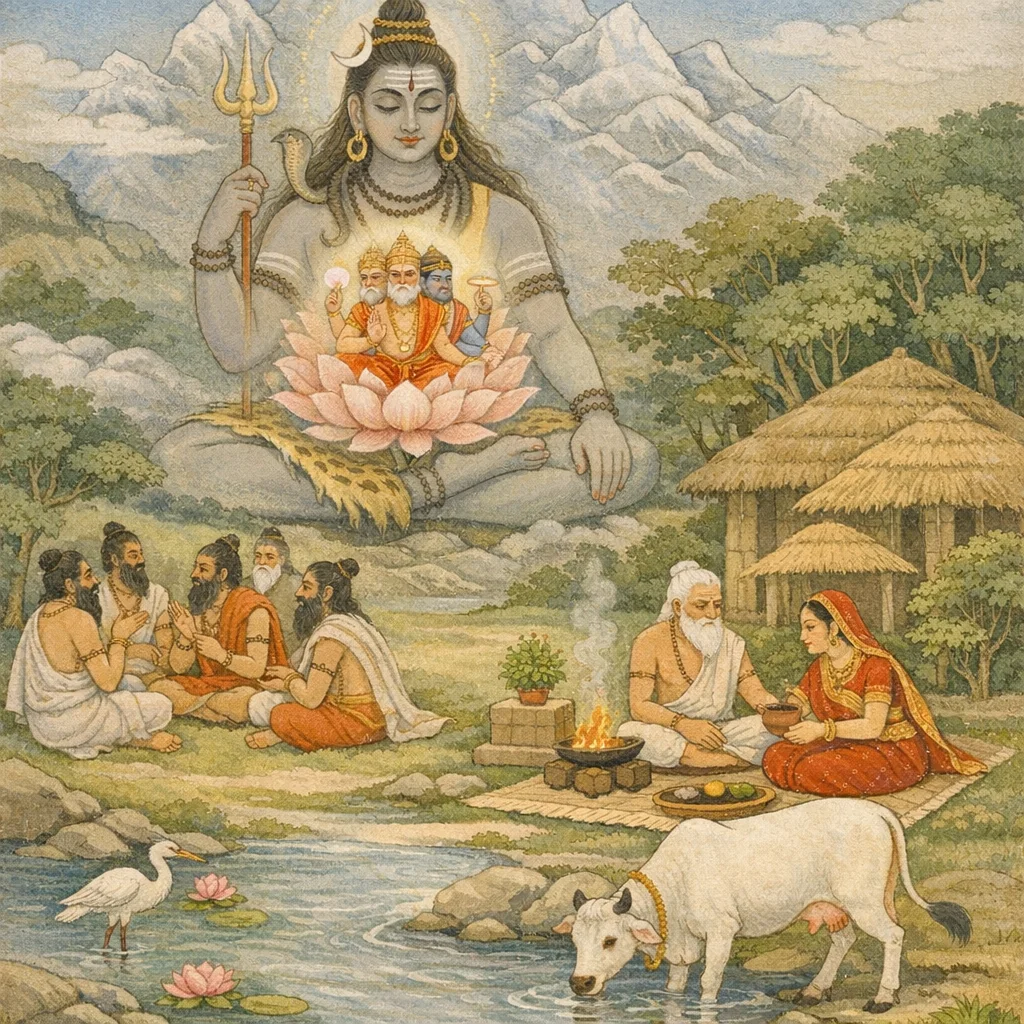
Adhyaya 71: Vision of the Trimūrti in Rudra, the Gautama Curse, the Manifestation of the Godāvarī, and the Niḥśvāsa-saṃhitā Account
Trimūrtidarśana, Gautamaśāpa, Godāvarīprādurbhāva, ca Niḥśvāsasaṃhitā-kathana
Ethical-Discourse (Dharma, Pāṣaṇḍa-critique) with Sacred-Geography (River Origin) and Ritual-Authority
Varāha tells Pṛthivī a didactic episode, framed as Agastya’s report to a king: sages behold Brahmā (Kamalāsana) and Nārāyaṇa within Rudra and ask how the three share the offerings of yajña and why teachings diverge. Rudra explains the non-duality of divine participation in sacrifice, then recounts a moral-historical exemplum: in the Daṇḍaka forest Gautama receives a boon of inexhaustible grain and sustains the ṛṣis through a twelve-year drought. Later the sages test him with an illusion of a cow’s death; misreading it, they demand expiation. By Gautama’s tapas Gaṅgā descends, the cow is revived, and the Godāvarī river manifests. When the deception is known, Gautama curses false-vow practitioners; Rudra then situates later Kali-age sectarian distortions, distinguishing Vedic discipline from pāṣaṇḍa conduct and linking ethical order to sacred landscape and communal integrity.
Primary Speakers
Key Concepts
Shlokas in Adhyaya 71
Verse 1
अगस्त्य उवाच । एवमुक्तस्ततो देवा ऋषयश्च पिनाकिना । अहं च नृपते तस्य देवस्य प्रणतोऽभवम् ॥ ७१.१ ॥
Agastya said: “Thus addressed by the bearer of the Pināka bow, the gods and the sages—and I as well, O king—bowed in reverence before that deity.”
Verse 2
प्रणम्य शिरसा देवं यावत् पश्यामहे नृप । तावत् तस्यैव रुद्रस्य देहस्थं कमलासनम् ॥ ७१.२ ॥
O king, having bowed our heads to the god, for as long as we continued to behold him, for that very duration we saw the Lotus-seated one (Brahmā) abiding within the body of Rudra.
Verse 3
नारायणं च हृदये त्रसरेणुसुसूक्ष्मकं । ज्वलद्भास्करवर्णाभं पश्याम भवदेहतः ॥ ७१.३ ॥
And within the heart we behold Nārāyaṇa—subtler than the minutest particle—radiant with the hue and splendor of a blazing sun, perceived from within your very body.
Verse 4
तं दृष्ट्वा विस्मिताः सर्वे याजका ऋषयो मम । जयशब्दरवांश्चक्रुः सामऋग्यजुषां स्वनम् ॥ ७१.४ ॥
Seeing him, all were astonished—my officiating priests and seers; they raised cries of victory and made resound the recitations of the Sāman, Ṛk, and Yajus.
Verse 5
कृत्वोचुस्ते तदा देवं किमिदं परमेश्वर । एकस्यामेव मूर्तौ ते लक्ष्यन्ते च त्रिमूर्त्तयः ॥ ७१.५ ॥
Then they addressed the god: “What is this, O Supreme Lord? For in a single form of yours, the three forms (the Trimūrti) are also perceived.”
Verse 6
रुद्र उवाच । यज्ञेऽस्मिन् यद्धुतं हव्यं मामुद्दिश्य महर्षयः । ते त्रयोऽपि वयं भागं गृहीणीमः कविसत्तमाः ॥ ७१.६ ॥
Rudra said: “In this sacrifice, whatever oblation is offered by the great seers with me as its intended recipient—of that, we three too partake as our share, O best of sages.”
Verse 7
नास्माकं विविधो भावो वर्तते मुनिसत्तमाः । सम्यग्दृशः प्रपश्यन्ति विपरीतेष्वनेकशः ॥ ७१.७ ॥
O best of sages, in us there is no manifold, divided disposition; those who see rightly discern the truth in many ways even amid contrary appearances or opinions.
Verse 8
एवमुक्ते तु रुद्रेण सर्वे ते मुनयो नृप । पप्रच्छुः शङ्करं देवं मोहशास्त्रप्रयोजनम् ॥ ७१.८ ॥
When Rudra had thus spoken, all those sages, O king, questioned the god Śaṅkara about the purpose and application of the “Moha-śāstra” (the doctrine or strategy that induces delusion).
Verse 9
ऋषय ऊचुः । मोहनार्थं तु लोकानां त्वया शास्त्रं पृथक् कृतम् । तत् त्वया हेतुना केन कृतं देव वदस्व नः ॥ ७१.९ ॥
The sages said: “For the sake of bewildering the people, you have composed a separate śāstra. For what reason did you compose it, O Divine One? Please tell us.”
Verse 10
रुद्र उवाच । अस्ति भारतवर्षेण वनं दण्डकसंज्ञितम् । तत्र तीव्रं तपो घोरं गौतमो नाम वै द्विजः ॥ ७१.१० ॥
Rudra said: “In Bhārata-varṣa there is a forest known as Daṇḍaka. There, a twice-born sage named Gautama practiced intense and formidable austerity.”
Verse 11
चकार तस्य ब्रह्मा तु परितोषं गतः प्रभुः । उवाच तं मुनिं ब्रह्मा वरं ब्रूहि तपोधन ॥ ७१.११ ॥
Then Brahmā, the lord, being fully satisfied with him, addressed that sage: “O wealth of austerity, state the boon (vara) you desire.”
Verse 12
एवमुक्तस्तदा तेन ब्रह्मणा लोककर्तृणा । उवाच सद्यः पङ्क्तिं मे धान्यानां देहि पद्मज ॥ ७१.१२ ॥
Thus addressed at that time by Brahmā, the maker of the worlds, he said at once: “Immediately grant me a row of grains, O Padmaja, the lotus-born.”
Verse 13
एवमुक्तो ददौ तस्य तमेवार्थं पितामहः । लब्ध्वा तु तं वरं विप्रः शतशृङ्गे महाश्रमम् ॥ ७१.१३ ॥
Thus addressed, Pitāmaha (Brahmā) granted him that very request. Having obtained that boon, the brāhmaṇa reached the great hermitage at Śataśṛṅga.
Verse 14
चकार तस्योषसि च पाकान्ते शालयो द्विजाः । लूयन्ते तेन मुनिना मध्याह्ने पच्यते तथा । सर्वातिथ्यमसौ विप्रो ब्राह्मणेभ्यो ददात्यलम् ॥ ७१.१४ ॥
At dawn he arranged the rice-fields; when the ripening was complete, that sage had the twice-born (brahmins) reap them. Likewise, at midday the cooking was done. That brahmin, offering sacred hospitality to all guests, gives sufficiently to the brahmins.
Verse 15
कस्यचित्त्वथ कालस्य महती द्वादशाब्दिका । अनावृष्टिर्द्विजवरा अभवल्लोमहर्षिणी ॥ ७१.१५ ॥
At a certain time, O best of the twice-born, there occurred a great drought lasting twelve years—so terrifying that it made one’s hair stand on end.
Verse 16
तां दृष्ट्वा मुनयः सर्वे अनावृष्टिं वनेचराः । क्षुधया पीड्यमानास्तु प्रययुर्गौतमं तदा ॥ ७१.१६ ॥
Seeing that drought, all the sages who dwelt in the forest, afflicted by hunger, then went to Gautama.
Verse 17
अथ तानागतान् दृष्ट्वा गौतमः शिरसा नतः । उवाच स्थीयतां मह्यं गृहे मुनिवरात्मजाः ॥ ७१.१७ ॥
Then, seeing them arrive, Gautama bowed his head in reverence and said: “Stay here, I pray you, in my house, O sons of the foremost sages.”
Verse 18
एवमुक्तास्तु ते तेन तस्थुर्विविधभोजनम् । भुञ्जमाना अनावृष्टिर्यावत्सा निवृताऽभवत् ॥ ७१.१८ ॥
Thus addressed by him, they remained there, partaking of various kinds of food, until that absence of rain came to an end.
Verse 19
निवृत्तायां तु वै तस्यामनावृष्ट्यां तु ते द्विजाः । तीर्थयात्रानिमित्तं तु प्रयातुं मनसोऽभवन् ॥ ७१.१९ ॥
But when that rainfall had ceased—when drought prevailed—those twice-born (Brahmin men), taking pilgrimage to the sacred tīrthas as their pretext, became minded to depart.
Verse 20
तत्र शाण्डिल्यनामानं तापसं मुनिसत्तमम् । प्रत्युवाचेतिसंचिन्त्य मिरीचः परमो मुनिः ॥ ७१.२० ॥
There, having reflected, the supreme sage Mīrīca replied, speaking of the ascetic named Śāṇḍilya, foremost among sages.
Verse 21
मारीच उवाच । शाण्डिल्य शोभनं वक्ष्ये पिता ते गौतमो मुनिः । तम् अनुक्त्वा न गच्छामस् तपश् चर्तुं तपोवनम् ॥ ७१.२१ ॥
Mārīca said: “O Śāṇḍilya, I shall tell you something auspicious: your father is the sage Gautama. Without informing him, we will not go to Tapovana, the forest of austerities, to undertake tapas.”
Verse 22
एवमुक्तेऽथ जहसुः सर्वे ते मुनयस्तदा । किमस्माभिः स्वको देहो विक्रीतोऽस्य अन्नभक्षणात् ॥ ७१.२२ ॥
When this had been said, all those sages then laughed: “Why should our own body be considered ‘sold off’ merely because we have eaten this man’s food?”
Verse 23
एवमुक्त्वा पुनश्चोचुः सोपाधिगमनं प्रति । कृत्वा मायामयीं गां तु तच्छालौ ते व्यसर्जयन् ॥ ७१.२३ ॥
Having spoken thus, they again spoke about approaching him under a pretext; and, having fashioned an illusory cow by māyā, they then released it into his cowshed.
Verse 24
तां चरन्तीं ततो दृष्ट्वा शालौ गां गौतमो मुनिः । गृहीत्वा सलिलं पाणौ याहि रुद्रेtyभाषत । ततो मायामयी सा गौः पपात जलबिन्दुभिः ॥ ७१.२४ ॥
Then, seeing that cow moving about in the Śāla-grove, the sage Gautama took water into his hand and said, “Go to Rudra.” Thereupon that cow—formed of māyā—fell down as drops of water fell upon it.
Verse 25
निहतां तां ततो दृष्ट्वा मुनीन् जिगमिषूंस्तथा । उवाच गौतमो धीमांस्तान् मुनीन् प्रणतः स्थितः ॥ ७१.२५ ॥
Then, seeing her slain, and also seeing the sages preparing to depart, the wise Gautama—standing with bowed reverence—addressed those sages.
Verse 26
किमर्थं गम्यते विप्राः साधु शंसत माचिरम् । मां विहाय सदा भक्तं प्रणतं च विशेषतः ॥ ७१.२६ ॥
“For what purpose are you going away, O brāhmaṇas? Tell me properly, without delay—leaving me behind, who am ever devoted and especially reverent toward you.”
Verse 27
ऋषय ऊचुः । गोवध्येमिह ब्रह्मन् यावत् तव शरीरगा । तावदन्नं न भुञ्जामो भवतोऽन्नं महामुने ॥ ७१.२७ ॥
The sages said: “O Brahmin, as long as we remain here within your bodily presence, we shall not partake of food—especially not the food belonging to you, O great sage.”
Verse 28
एवमुक्तो गौतमोऽथ तान् मुनीन् प्राह धर्मवित् । प्रायश्चित्तं गोवध्याया दीयतां मे तपोधनाः ॥ ७१.२८ ॥
Thus addressed, Gautama—knower of dharma—spoke to those sages: “O you whose wealth is austerity, prescribe for me the expiation (prāyaścitta) for the killing of a cow.”
Verse 29
इयं गौरमृता ब्रह्मन् मूर्च्छितेव व्यवस्थिताः । गङ्गाजलप्लुता चेयमुत्थास्यति न संशयः ॥ ७१.२९ ॥
O Brahmin, this cow lies as though unconscious, seeming dead; yet once she is sprinkled or immersed in the waters of the Gaṅgā, she will rise again—of this there is no doubt.
Verse 30
प्रायश्चित्तं मृतायाः स्यादमृतायाः कृतं त्विदम् । व्रतं वा मा कृथाः कोपमित्युक्त्वा प्रययुस्तु ते ॥ ७१.३० ॥
“This would be a prāyaścitta, an expiation, in the case of one who has died; but this has been performed for one who is not dead. Or else, let it be regarded as a vrata, a sacred vow. Do not become angry.” Having said so, they departed.
Verse 31
गतैस्तैर्गौतमो धीमान् हिमवन्तं महागिरिम् । मामाराधयिषुः प्रायात् तप्तुं चाशु महत् तपः ॥ ७१.३१ ॥
After they had departed, the wise Gautama set out for Himavant, the great mountain, wishing to propitiate me and quickly to undertake a great austerity.
Verse 32
शतमेकं तु वर्षाणामहमाराधितोऽभवम् । तुष्टेन च मया प्रोक्तो वरं वरय सुव्रत ॥ ७१.३२ ॥
“For a full hundred years, I was propitiated. Then, being satisfied, I said: ‘Choose a boon, O you of excellent observance.’”
Verse 33
सोऽब्रवीन्मां जकटासंस्थां देहि गङ्गां तपस्विनीम् । मया सार्धं प्रयात्वेषा पुण्या भागीरथी नदी ॥ ७१.३३ ॥
He said to me, “O ascetic one, grant me the Gaṅgā—Bhāgīrathī—who is stationed in the matted locks; let this sacred river proceed together with me.”
Verse 34
एवमुक्ते जटाखण्डमेकं स प्रददौ शिवः । तां गृहीत्वा गतवान् सोऽपि यत्रास्ते सा तु गौर्मृता ॥ ७१.३४ ॥
When this was spoken, Śiva granted a single lock—a fragment of his matted hair. Taking it, he too departed to the place where she was; but the cow had died.
Verse 35
तज्जलप्लाविता सा गौर्गता चोत्थाय भामिनी । नदी च महती जाता पुण्यतोया शुचिह्रदा ॥ ७१.३५ ॥
Flooded by that water, the cow—rising up, O radiant lady—went forth; and there arose a great river, with sanctifying waters and a pure basin.
Verse 36
तं दृष्ट्वा महदाश्चर्यं तत्र सप्तर्षयोऽमलाः । आजग्मुः खे विमानस्थाः साधुः साध्विति वादिनः ॥ ७१.३६ ॥
Having seen that great marvel, the stainless Seven Sages arrived there, stationed in the sky in aerial chariots, proclaiming, “Well done, well done.”
Verse 37
साधु गौतम साधूनां कोऽन्योऽस्ति सदृशस्तव । यदेवं जाह्नवीं देवीं दण्डके चावतारयत् ॥ ७१.३७ ॥
“Excellent, Gautama. Among the virtuous, who else is comparable to you—since you caused the goddess Jāhnavī (Gaṅgā) to descend in this manner, and brought her down also into the Daṇḍaka forest-region?”
Verse 38
एवमुक्तस्तदा तैस्तु गौतमः किमिदं त्विति । गोवध्याकारणं मह्यं तावत् पश्यति गौतमः ॥ ७१.३८ ॥
Thus addressed by them at that time, Gautama asked, “What is this, indeed?” Then Gautama perceived, to that extent, the reason for the slaughter of the cow.
Verse 39
ऋषीणां मायया सर्वमिदं जातं विचिन्त्य वै । शशाप तान् जटाभस्ममिथ्याव्रतधरास्तथा । भविष्यथ त्रयीबाह्या वेदकर्मबहिष्कृताः ॥ ७१.३९ ॥
Reflecting that all this had arisen through the sages’ māyā, he cursed them: “You too—bearing matted hair and ashes, and observing false vows—shall become outsiders to the Vedic triad, excluded from Vedic rites.”
Verse 40
तच्छ्रुत्वा क्रूरवचनं गौतमस्य महामुनेः । ऊचुः सप्तर्षयो मैवं सर्वकालं द्विजोत्तमाः । भवन्तु किं तु ते वाक्यं मोघं नास्त्यत्र संशयः ॥ ७१.४० ॥
Having heard the harsh statement of the great sage Gautama, the Seven Ṛṣis said: “Let it not be so, O best of the twice-born. Yet your utterance will not be in vain—of this there is no doubt.”
Verse 41
यदि नाम कलौ सर्वे भविष्यन्ति द्विजोत्तमाः । उपकारीणि ये ते हि अपकर्तार एव हि । इत्थंभूता अपि कलौ भक्तिभाजो भवन्तु ते ॥ ७१.४१ ॥
Even if, in the Kali age, all should come to be regarded as ‘excellent twice-born,’ those who are (outwardly) helpful are indeed the very ones who cause harm. Even so constituted in Kali, may they nevertheless become participants in devotion.
Verse 42
त्वद्वाक्यवह्निनिर्दग्धाः सदा कलियुगे द्विजाः । भविष्यन्ति क्रियाहीना वेदकर्मबहिष्कृताः ॥ ७१.४२ ॥
In the Kali age, the twice-born will invariably become as though scorched by the fire of your words; they will come to be devoid of prescribed rites, excluded from Vedic ritual obligations.
Verse 43
अस्याश्च गौणं नामेह नदी गोदावरीति च । गौर्दत्ता वरदानाच्च भवेद् गोदावरी नदी ॥ ७१.४३ ॥
Here, this river’s secondary (conventional) name is ‘Godāvarī’. Because she is ‘given by the cow’ and due to the granting of boons, the river becomes known as Godāvarī.
Verse 44
एतां प्राप्य कलौ ब्रह्मन् गां ददन्ति जनाश्च ये । यथाशक्त्या तु दानानि मोदन्ते त्रिदशैः सह ॥ ७१.४४ ॥
O Brāhman, those who in the Kali age obtain this merit and give a cow, offering gifts according to their capacity, rejoice together with the Tridaśas (the gods).
Verse 45
सिंहस्थे च गुरौ तत्र यो गच्छति समाहितः । स्नात्वा च विधिना तत्र पितॄन् स्तर्पयते तथा ॥ ७१.४५ ॥
When Guru (Jupiter) is stationed in Leo, whoever goes there with a collected mind and bathes there according to the prescribed rule likewise satisfies the ancestors through tarpaṇa, the offering of water.
Verse 46
स्वर्गं गच्छन्ति पितरो निरये पतिता अपि । स्वर्गस्थाः पितरस्तस्य मुक्तिभाजो न संशयः ॥ ७१.४६ ॥
Even ancestors who have fallen into a hell-state proceed to heaven; and that person’s ancestors, being in heaven, become participants in liberation (mukti)—of this there is no doubt.
Verse 47
त्वं ख्यातिं महतीं प्राप्य मुक्तिं यास्यसि शाश्वतीम् । एवमुक्त्वाऽथ मुनयो ययुः कैलासपर्वतम् । यत्राहमुमया सार्धं सदा तिष्ठामि सत्तमाः ॥ ७१.४७ ॥
“Having attained great renown, you will proceed to everlasting liberation.” Having spoken thus, the sages went to Mount Kailāsa, where I, together with Umā, always dwell, O best among the virtuous.
Verse 48
ऊचुर्मां ते च मुनयो भवितारो द्विजोत्तमाः । कलौ त्वद्रूपिणः सर्वे जटामुकुटधारिणः । स्वेच्छया प्रेतवेषाश्च मिथ्यालिङ्गधराः प्रभो ॥ ७१.४८ ॥
Those sages then said to me: “In the Kali age, O best of the twice-born, all will assume forms like yours, wearing matted locks (jaṭā) as a crown; yet, by mere whim, they will adopt ghastly disguises and bear false outward marks, O Lord.”
Verse 49
तेषामनुग्रहार्थाय किञ्चिच्छास्त्रं प्रदीयताम् । येनास्मद्वंशजाः सर्वे वर्तेयुः कलिपीडिताः ॥ ७१.४९ ॥
For the sake of showing them favor, let some teaching—a practical śāstra—be imparted, by which all the descendants of our lineage, afflicted by the Kali age, may continue to live and conduct themselves.
Verse 50
एवमभ्यर्थितस्तैस्तु पुराऽहं द्विजसत्तमाः । वेदक्रियासमायुक्तां कृतवानस्मि संहिताम् ॥ ७१.५० ॥
Thus, when I was formerly requested by them, O best of the twice-born, I composed a compendium (saṃhitā) endowed with Vedic rites and ritual procedures.
Verse 51
निःश्वासाख्यां ततस्तस्यां लीना बाभ्रव्यशाण्डिलाः । अल्पापराधाच्छ्रुत्वैव गता बैडालिका भवन ॥ ७१.५१ ॥
Then, into that (region/state) called “Niḥśvāsa,” the Bābhravya and Śāṇḍila (lineages/sages) entered. But upon merely hearing that the offense was minor, they went to the Baiḍālika abode.
Verse 52
मयैव मोहितास्ते हि भविष्यं जानता द्विजाः । लौल्यार्थिनस्तु शास्त्राणि करिष्यन्ति कलौ नराः ॥ ७१.५२ ॥
Indeed, those twice-born (learned men), though knowing what is to come, are deluded by me. In the Kali age, people—seeking profit out of greed—will compose treatises (śāstras).
Verse 53
निःश्वाससंहितायां हि लक्षमात्रं प्रमाणतः । सैव पाशुपती दीक्षा योगः पाशुपतस्त्विह ॥ ७१.५३ ॥
In the Niḥśvāsa-saṃhitā, its authoritative measure is said to be a hundred thousand (units/verses). That itself is the Pāśupata initiation (dīkṣā); and here, the discipline is the Pāśupata yoga.
Verse 54
एतस्माद्वेदमार्गाद्धि यदन्यदिह जायते । तत्क्षुद्रकर्म विज्ञेयं रौद्रं शौचविवर्जितम् ॥ ७१.५४ ॥
Therefore, whatever arises here apart from the Vedic path should be understood as petty action—violent in nature and devoid of purity.
Verse 55
ये रुद्रमुपजीवन्ति कलौ वैडालिका नराः । लौल्यार्थिनः स्वशास्त्राणि करिष्यन्ति कलौ नराः । उच्छुष्मरुद्रास्ते ज्ञेया नाहं तेषु व्यवस्थितः ॥ ७१.५५ ॥
In the Kali age, men who make their living by invoking Rudra—base and opportunistic—will, driven by greed, compose their own private ‘treatises’. They should be known as ‘ucchuṣma-rudras’ (defiled Rudras); I am not established among them.
Verse 56
भैरवेण स्वरूपेण देवकार्ये यदा पुरा । नर्तितं तु मया सोऽयं सम्बन्धः क्रूरकर्मणाम् ॥ ७१.५६ ॥
Formerly, when I assumed the form of Bhairava for the gods’ undertaking, I indeed performed the dance; from that arises this association with fierce deeds.
Verse 57
क्षयं निनीषता दैत्यानट्टहासो मया कृतः । यः पुरा तत्र ये मह्यं पतिता अश्रुबिन्दवः । असंख्यातास्तु ते रौद्रा भवितारो महीतले ॥ ७१.५७ ॥
When I intended the destruction of the Daityas, I let out a loud, mocking laugh. From that act, the tear-drops that then fell from me there—countless—will become fierce beings upon the earth.
Verse 58
uchChuShmaniratA raudrAH surAmAMsapriyAH sadA | strIlolAH pApakarmANaH saMbhUtA bhUtaleShu te || 71.58 ||
Attached to defilement, fierce in nature, ever fond of liquor and meat, lustful toward women and engaged in sinful deeds—such beings have arisen upon the earth.
Verse 59
तेषां गौतमशापाद्धि भविष्यन्त्यन्वये द्विजाः । तेषां मध्ये सदाचाराः ये ते मच्छासने रताः ॥ ७१.५९ ॥
Indeed, because of Gautama’s curse, brāhmaṇas (the twice-born) will arise in their lineage. Among them will be those of good conduct—those who delight in my instruction.
Verse 60
स्वर्गं चैवापवर्गं च इति वै संशयात् पुरा । वैडालिका अधो यास्यन्ति मम संततिदूषकाः ॥ ७१.६० ॥
Formerly there was indeed doubt: “heaven, and also liberation (apavarga).” But the Vaiḍālikas—those who corrupt my lineage—shall go downward, to a lower state.
Verse 61
प्राग्गौतमाग्निना दग्धाः पुनर्मद्वचनाद्द्विजाः । नरकं तु गमिष्यन्ति नात्र कार्या विचारणा ॥ ७१.६१ ॥
Previously the twice-born were burned by Gautama’s fire; yet again, by my utterance, they will proceed to hell—on this, no deliberation is to be made.
Verse 62
रुद्र उवाच । एवं मया ब्रह्मसुताः प्रोक्ता जग्मुर्यथागतम् । गौतमोऽपि स्वकं गेहं जगामाशु परंतपः ॥ ७१.६२ ॥
Rudra said: “Thus, having been instructed by me, the sons of Brahmā departed, returning as they had come. Gautama too quickly went to his own dwelling, O subduer of foes.”
Verse 63
एतद्वः कथितं विप्रा मया धर्मस्य लक्षणम् । एतस्माद्विपरीतो यः स पाषण्डरतो भवेत् ॥ ७१.६३ ॥
Thus, O brāhmaṇa sages, I have explained to you the defining characteristic of dharma. Whoever acts contrary to this becomes devoted to pāṣaṇḍa (heterodox or deceitful religiosity).
Frequently Asked Questions
The chapter presents a two-part instruction: (1) a theological-ritual claim that yajña offerings directed to Rudra are concurrently shared by the three (Rudra, Brahmā, Nārāyaṇa), suggesting a unified ground perceived by “samyag-dṛś” (right-seeing) observers; and (2) an ethical warning against deception, false vows, and outward insignia without discipline (mithyā-vrata, mithyāliṅga). The Gautama narrative functions as a case study in hospitality during ecological crisis, the dangers of misrecognition under māyā, and the social consequences of conduct deemed trayī-bāhya (outside Vedic normativity).
The narrative specifies a dvādaśābdikā anāvṛṣṭi (a twelve-year drought) as the major chronological marker. It also notes daily ritual-economy timing around food production and giving—grain is harvested in the morning (uṣasi), cooked at midday (madhyāhne), and distributed to guests—framing dharma as structured by diurnal cycles rather than explicit tithi-based calendrics. A later pilgrimage context is implied by the sages’ intention for tīrtha-yātrā, but no lunar tithis are named.
Environmental balance is treated through drought, water descent, and river formation as moral-ecological narrative. The twelve-year anāvṛṣṭi creates scarcity pressures; Gautama’s managed abundance supports community resilience (atithi-dharma as a response to ecological stress). The descent of Gaṅgā via Rudra’s jaṭā and the transformation into the Godāvarī links ascetic practice to hydrological renewal, presenting rivers as agents of purification and intergenerational benefit (pitṛ-tarpaṇa, uplift of ancestors). This framing supports an early ecological ethic: sustaining life during drought, safeguarding water sources, and sacralizing river stewardship through tīrtha practice.
Key sage figures include Agastya (narrator), Gautama (central ascetic), Mārīca, Śāṇḍilya, and the Saptarṣis. Divine figures include Rudra/Śaṅkara, Brahmā (Padmaja/Kamalāsana), and Nārāyaṇa. A royal addressee (nṛpati) appears as the audience in Agastya’s report. The chapter also references groups characterized as Vaiḍālika and “Uchchuṣma-rudrāḥ” in a Kali-yuga social typology, treating them as later descendants/imitators associated with false disciplinary forms.