Adhyaya 70: Nārāyaṇa as the Sacrificial Principle, Analysis of the Three Guṇas, and the Account of Delusion-Doctrines
Nārāyaṇa-yajñatva, Guṇa-traya-vivekaḥ, Mohāśāstra-nirūpaṇam
Philosophical-Theological Discourse (Guṇa theory, Vedic authority, sectarian integration)
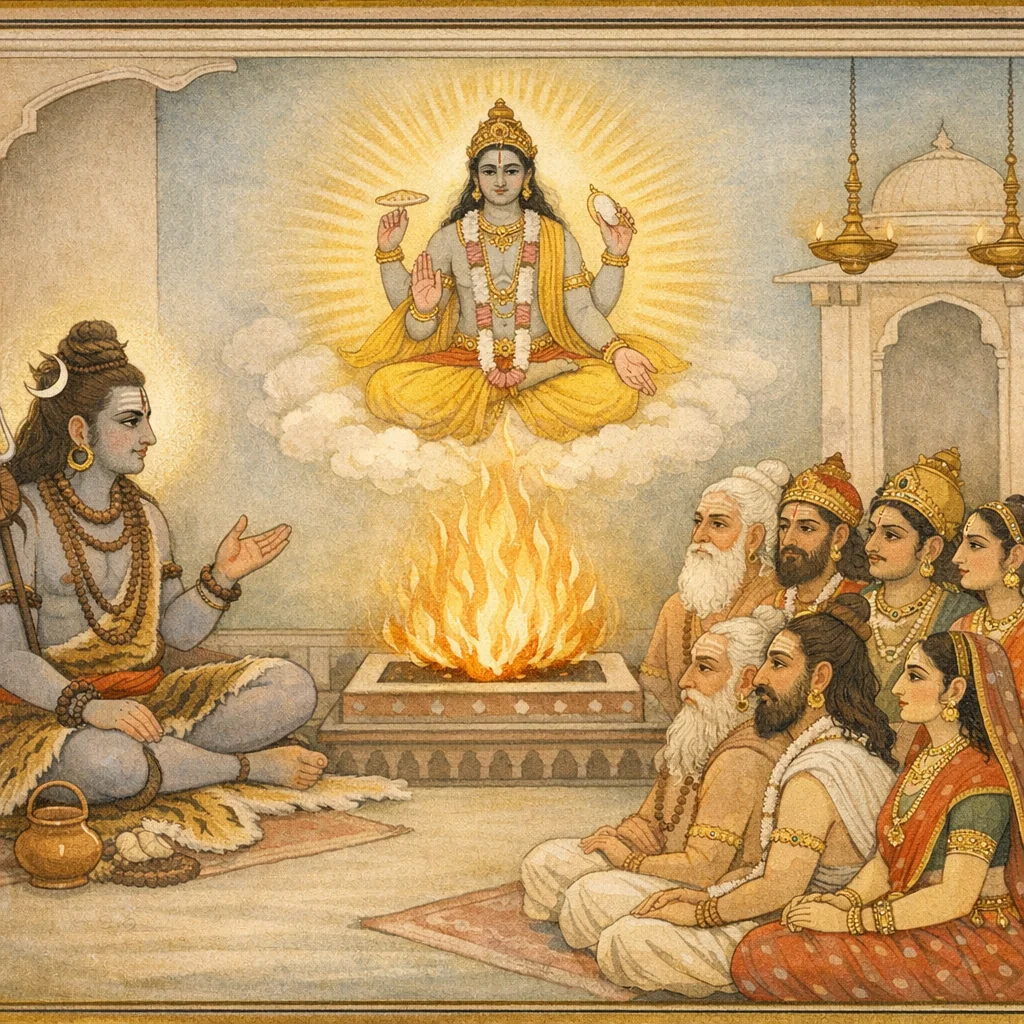
Set within the Varāha–Pṛthivī teaching frame, the chapter presents an embedded dialogue in which Bhadrāśva recounts prolonged worship of Viṣṇu and a sacrificial assembly where devas, ṛṣis, and Rudra appear, followed by Sanatkumāra’s arrival. A central question is raised: who is the proper recipient of worship among Viṣṇu, Brahmā, and Rudra? Rudra answers with a doctrinal exposition: Nārāyaṇa is the supreme source in whom creation arises and into whom it dissolves, while Brahmā and Rudra function through rajas and tamas within the guṇa scheme. The discourse affirms Vedic unity, warns against dividing the triad, and offers a cosmological rationale for Kali-yuga decline: Nārāyaṇa commissions Rudra to promulgate moha-śāstras that mislead those who stray from Vedic discipline, whereas liberation remains bound to seeing Nārāyaṇa as the integrating principle.
Primary Speakers
Key Concepts
Shlokas in Adhyaya 70
Verse 1
भद्राश्व उवाच । भगवन् किं कृतं लोकं त्वया तमनुपश्यता । व्रतं तपो वा धर्मो वा प्राप्त्यर्थं तस्य वै मुने ॥ ७०.१ ॥
Bhadrāśva said: “O Blessed One, while observing that world, what practice did you undertake? Was it a vow (vrata), an austerity (tapas), or some form of dharma—O sage—performed for the attainment of that goal?”
Verse 2
अनाराध्य हरिं भक्त्या को लोकान् कामयेद् बुधः । आराधिते हरौ लोकाः सर्वे करतलेऽभवन् ॥ ७०.२ ॥
Without worshipping Hari with devotion, what wise person would desire other worlds? When Hari is worshipped, all worlds become as though in the palm of one’s hand.
Verse 3
एवं सञ्चिन्त्य राजेन्द्र मया विष्णुः सनातनः । आराधितो वर्षशतं क्रतुभिर्भूरिदक्षिणैः ॥ ७०.३ ॥
Thus reflecting, O best of kings, I worshipped Viṣṇu, the Eternal, for a hundred years, through sacrificial rites (kratu) accompanied by abundant gifts of dakṣiṇā.
Verse 4
ततः कदाचिद् बहुना कालेन नृपनन्दन । यजतो मम देवेशं यज्ञमूर्तिं जनार्दनम् । आहूता आगता देवाः सममेव सवासवाः ॥ ७०.४ ॥
Then, after a long time had passed, O prince: while I was worshipping Janārdana—the Lord of the gods, whose very form is the sacrifice—the gods, together with Indra, having been invoked, arrived all at once.
Verse 5
स्वे स्वे स्थाने स्थिताः आसन् यावद् देवाः सवासवाः । तावत् तत्रैव भगवान् आगतो वृषभध्वजः ॥ ७०.५ ॥
While the gods—together with Indra—remained stationed in their respective places, at that very time and in that very place the Blessed One, the bearer of the bull-emblem (Vṛṣabhadhvaja), arrived.
Verse 6
महादेवो विरूपाक्षस्त्र्यम्बको नीललोहितः । सोऽपि रौद्रे स्थितः स्थाने बभूव परमेश्वरः ॥ ७०.६ ॥
Mahādeva—Virūpākṣa, Tryambaka, and Nīlalohita—indeed, established in the Rudra-form and abiding in that station, manifested as the Supreme Lord (Parameśvara).
Verse 7
तान् सर्वानागतान् दृष्ट्वा देवानृषिमहोरगान् । सनत्कुमारो भगवाञाजगामाब्जसम्भवः ॥ ७०.७ ॥
Seeing all who had arrived—gods, sages, and the great serpents—Sanatkumāra, the venerable one, born of the lotus, came forth.
Verse 8
त्रसरेणुप्रमाणेन विमानॆ सूर्यसन्निभे । अवस्थितो महायोगी भूतभव्यभविष्यवित् ॥ ७०.८ ॥
In a celestial vehicle, radiant like the sun and subtle in measure by the standard of a trasareṇu, the great yogin remained stationed—knower of what has been, what is, and what will be.
Verse 9
आगम्य शिरसा रुद्रं स ववन्दे महामुनिः । मया प्रणमितस्तस्थौ समीपे शूलपाणिनः ॥ ७०.९ ॥
Approaching Rudra, that great sage bowed with his head. Having been saluted by me, he remained standing near the bearer of the trident (Śiva).
Verse 10
तानहं संस्थितान् देवान् नारदादीनृषींस्तथा । सनत्कुमाररुद्रौ च दृष्ट्वा मे मनसि स्थितम् ॥ ७०.१० ॥
Seeing those gods standing there, and likewise the sages beginning with Nārada, as well as Sanatkumāra and Rudra, what had been abiding in my mind became clear and settled.
Verse 11
क एषां भवते याज्यो वरिष्ठश्च नृपोत्तम । केन तुष्टेन तुष्टाः स्युः सर्व एते सरुद्रकाः ॥ ७०.११ ॥
O best of kings, which among these is the most eminent and is to be worshipped by you? And when which one is satisfied, would all of these—together with the Rudras—become satisfied?
Verse 12
एवं कृत्वा स्थिते राजन् रुद्रः पृष्टो मया । अनघ । एवमर्थं क इज्योऽत्र युष्माकं सुरसत्तमाः ॥ ७०.१२ ॥
Having done so, O king, when the matter stood thus, Rudra was questioned by me, O blameless one: “In this circumstance, who among you—O best of the gods—is to be worshipped here?”
Verse 13
एवमुक्ते तदोवाच रुद्रो मां सुरसन्निधौ ॥ ७०.१३ ॥
When this had been said, then Rudra spoke to me in the presence of the gods.
Verse 14
रुद्र उवाच । शृण्वन्तु बिबुधाः सर्वे तथा देवर्षयोऽमलाः । ब्रह्मर्षयश्च विख्याताः सर्वे शृण्वन्तु मे वचः । त्वं चागस्त्य महाबुद्धे शृणु मे गदतो वचः ॥ ७०.१४ ॥
Rudra said: “Let all the enlightened beings listen, and likewise the stainless divine seers; let the renowned Brahma-seers also listen—indeed, let all hear my words. And you too, Agastya, of great intellect, listen to my words as I speak.”
Verse 15
यो यज्ञैर् ईड्यते देवो यस्मात् सर्वमिदं जगत् । उत्पन्नं सर्वदा यस्मिँल्लीनं भवति सामरम् ॥ ७०.१५ ॥
That deity who is praised through sacrificial rites—from whom this entire world has arisen, and in whom it is always dissolved, together with the hosts of gods.
Verse 16
नारायणः परो देवः सत्त्वरूपो जनार्दनः । त्रिधात्मानं स भगवाँन् ससर्ज परमेश्वरः ॥ ७०.१६ ॥
Nārāyaṇa is the supreme deity; Janārdana whose form is pure sattva. That Blessed Lord, the supreme ruler, brought forth the threefold self (the triadic constitution of embodied existence).
Verse 17
रजस्तमोभ्यां युक्तोऽभूद् रजः सत्त्वाधिकं विभुः । ससर्ज नाभिकमले ब्रह्माणं कमलासनम् ॥ ७०.१७ ॥
Endowed with rajas and tamas, the mighty one became predominantly rajas, with a greater measure of sattva; and upon the lotus of his navel he brought forth Brahmā, the lotus-seated one.
Verse 18
रजसा तमसा युक्तः सोऽपि मां त्वसृजत् प्रभुः । यत्सत्त्वं स हरिर्देवो यो हरिस्तत्परं पदम् ॥ ७०.१८ ॥
Endowed with rajas and tamas, that Lord, too, created me. That which is sattva—he is Hari, the divine; and Hari is that supreme state (the highest attainment).
Verse 19
ये सत्त्वराजसी सोऽपि ब्रह्मा कमलसम्भवः । यो ब्रह्मा सैव देवस्तु यो देवः स चतुर्मुखः । यद्रजस्तमसोपेतं सोऽहं नास्त्यत्र संशयः ॥ ७०.१९ ॥
He who is constituted of sattva and rajas is indeed Brahmā, the lotus-born. That one who is Brahmā is also the deity; and that deity is the four-faced one. And that which is endowed with rajas and tamas—that am I; of this there is no doubt.
Verse 20
सत्त्वं रजस्तमश्चैव त्रितयं चैददुच्यते । सत्त्वेन मुच्यते जन्तुः सत्त्वं नारायणात्मकम् ॥ ७०.२० ॥
Sattva, rajas, and tamas—this is the triad that is spoken of. A living being is liberated through sattva; and sattva is of the nature of Nārāyaṇa.
Verse 21
रजसा सत्त्वयुक्तेन भवेत् सृष्टिः रजोऽधिका । तच्च पैतामहं वृत्तं सर्वशास्त्रेषु पठ्यते ॥ ७०.२१ ॥
When rajas is conjoined with sattva, creation arises with rajas predominant. This account, attributed to the tradition of the Pitāmaha (Brahmā), is recited in all the śāstras.
Verse 22
यद्वेदबाह्यं कर्म स्याच्छास्त्रमुद्दिश्य सेव्यते । तद्रौद्रमिति विख्यातं कनिष्ठं गदितं नृणाम् ॥ ७०.२२ ॥
Any act that lies outside the Veda, yet is practiced while citing “śāstra”, is known as raudra; it is declared the lowest among human courses of conduct.
Verse 23
यद्धीनं रजसा कर्म केवलं तामसं तु यत् । तद् दुर्गतिपरं नॄणामिह लोके परत्र च ॥ ७०.२३ ॥
Action that is deficient in rajas, and action that is purely tāmasic—such conduct tends toward an unfortunate course for human beings, in this world and in the world beyond.
Verse 24
सत्त्वेन मुच्यते जन्तुः सत्त्वं नारायणात्मकम् । नारायणश्च भगवान् यज्ञरूपी विभाव्यते ॥ ७०.२४ ॥
A living being is liberated through sattva; and sattva is understood to be of the nature of Nārāyaṇa. Nārāyaṇa, the Blessed Lord, is contemplated as having the form of sacrifice (yajña).
Verse 25
कृते नारायणः शुद्धः सूक्ष्ममूर्तिरुपास्यते । त्रेतायां यज्ञरूपेण पञ्चरात्रैस्तु द्वापरे ॥ ७०.२५ ॥
In the Kṛta age, Nārāyaṇa—pure and subtle in form—is to be contemplated and worshipped; in the Tretā age, (he is worshipped) in the form of sacrifice (yajña); and in the Dvāpara age, through the Pañcarātra system.
Verse 26
कलौ मत्कृतमार्गेण बहुरूपेण तामसैः । इज्यते द्वेषबुद्ध्या स परमात्मा जनार्दनः ॥ ७०.२६ ॥
In the Kali age, that Supreme Self—Janārdana—is worshipped by tamasic persons in many forms, following a path fashioned by me, yet with a mind marked by hostility (dveṣa).
Verse 27
न तस्मात् परतो देवो भविता न भविष्यति । यो विष्णुः स स्वयं ब्रह्मा यो ब्रह्मा सोऽहमेव च ॥ ७०.२७ ॥
Beyond that supreme principle, no deity has arisen, nor will arise. He who is Viṣṇu is himself Brahmā; and he who is Brahmā—he is indeed I as well.
Verse 28
वेदत्रयेऽपि यज्ञेऽस्मिन् याज्यं वेदेषु निश्चयः । यो भेदं कुरुतेऽस्माकं त्रयाणां द्विजसत्तम । स पापकाऽरी दुष्टात्मा दुर्गतिं गतिमाप्नुयात् ॥ ७०.२८ ॥
Even within this sacrifice, grounded in the threefold Veda, what is to be offered is definitively established in the Vedic texts. O best of the twice-born, whoever creates a division among our three (Vedas) becomes a doer of wrongdoing, of corrupted disposition, and would attain an unfortunate course of destiny.
Verse 29
इदं च शृणु मेऽगस्त्य गदतः प्राक्तनं तथा । यथा कलौ हरेर्भक्तिं न कुर्वन्तीह मानवाः ॥ ७०.२९ ॥
And listen to this from me as well, O Agastya—an account from earlier times, as I relate it—showing how, in the Kali age, people here do not undertake devotion to Hari.
Verse 30
भूर्लोकवासिनः सर्वे पुरा यष्ट्वा जनार्दनम् । भुवर्लोकं प्रपद्यन्ते तत्रस्था अपि केशवम् ॥ आराध्य स्वर्गतिं यान्ति क्रमान्मुक्तिं व्रजन्ति च ॥ ७०.३० ॥
All the inhabitants of Bhūrloka, having formerly worshipped Janārdana, attain Bhuvarloka; and those who dwell there as well, having venerated Keśava, proceed to the heavenly state, and in due sequence they also go to liberation.
Verse 31
एवं मुक्तिपदे व्याप्ते सर्वलोकैस्तथैव च । मुक्तिभाजस्ततो देवास्तं दध्युः प्रयता हरिम् ॥ ७०.३१ ॥
Thus, when the “station of liberation” was likewise pervaded and filled by all the worlds, the gods—partakers of liberation—fixed their disciplined attention upon Hari.
Verse 32
सोऽपि सर्वगतत्वाच्च प्रादुर्भूतः सनातनः । उवाच ब्रूत किं कार्यं सर्वयोगिवराः सुराः ॥ ७०.३२ ॥
He too—eternal, and by virtue of his all-pervading nature—manifested and said: “Tell me, O gods, foremost among all yogins: what task is to be done?”
Verse 33
ते तं प्रणम्य देवेशमूचुश्च परमेश्वरम् । देवदेव जनः सर्वो मुक्तिमार्गे व्यवस्थितः । कथं सृष्टिः प्रभविता नरकेषु च को वसेत् ॥ ७०.३३ ॥
Having bowed to the Lord of the gods, they spoke to the Supreme Lord: “O God of gods—if all people are established on the path of liberation, how does creation arise, and who would dwell in the hell-realms?”
Verse 34
एवमुक्तस्ततो देवैस्तानुवाच जनार्दनः । युगानि त्रीणि बहवो मामुपेष्यन्ति मानवाः ॥ ७०.३४ ॥
Thus addressed by the gods, Janārdana spoke to them: “For three yugas, many human beings will come to me.”
Verse 35
अन्त्ये युगे प्रविरला भविष्यन्ति मदाश्रयाः । एष मोहं सृजाम्याशु यो जनं मोहयिष्यति ॥ ७०.३५ ॥
At the end of the age, those who take refuge in me will become exceedingly rare. I swiftly bring forth this delusion (moha), which will bewilder people.
Verse 36
त्वं च रुद्र महाबाहो मोहशास्त्राणि कारय । अल्पायासं दर्शयित्वा फलं दीर्घं प्रदर्शय ॥ ७०.३६ ॥
And you too, O Rudra, mighty-armed one, have delusive treatises composed; after showing them as requiring little effort, display to people a result that is long-lasting and far-reaching.
Verse 37
कुहकं चेन्द्रजालानि विरुद्धाचरणानि च । दर्शयित्वा जनं सर्वं मोहयाशु महेश्वर ॥ ७०.३७ ॥
Displaying deceit and conjurer’s illusions (Indrajāla), along with contradictory and improper modes of conduct, you quickly delude all people, O Maheśvara.
Verse 38
एवमुक्त्वा तदा तेन देवेन परमेष्ठिना । आत्मा तु गोपितः सद्यः प्रकाश्योऽहं कृतस्तदा ॥ ७०.३८ ॥
Having spoken thus at that time, that god Parameṣṭhin immediately kept the Self concealed; and I was then made manifest.
Verse 39
तस्मादारभ्य कालं तु मत्प्रणीतॆषु सत्तम । शास्त्रेष्वभिरतो लोको बाहुल्येन भवेदतः ॥ ७०.३९ ॥
“From that time onward, O best of the virtuous, people will for the most part become devoted to the treatises and disciplines promulgated by me.”
Verse 40
वेदानुवर्त्तिनं मार्गं देवं नारायणं तथा । एकीभावेन पश्यन्तो मुक्तिभाजो भवन्ति ते ॥ ७०.४० ॥
Those who, in a unified (non-dualizing) vision, perceive the path that accords with the Vedas and likewise perceive the deity Nārāyaṇa—those people become participants in liberation (mokṣa).
Verse 41
मां विष्णोर्व्यतिरिक्तं ये ब्रह्माणं च द्विजोत्तम । भजन्ते पापकर्माणस्ते यान्ति नरकं नराः ॥ ७०.४१ ॥
O best of the twice-born, those sinful men who worship me as separate from Viṣṇu and also worship Brahmā go to hell.
Verse 42
ये वेदमर्गनिर्मुक्तास्तेषां मोहार्थमेव च । नयसिद्धान्तसंज्ञाभिर्मया शास्त्रं तु दर्शितम् ॥ ७०.४२ ॥
For those who have strayed from the path of the Veda, and indeed to address their delusion, I have set forth this treatise under the names ‘naya’ and ‘siddhānta’.
Verse 43
पाशोऽयं पशुभावस्तु स यदा पतितो भवेत् । तदा पाशुपतं शास्त्रं जायते वेदसंज्ञितम् ॥ ७०.४३ ॥
This is the ‘bond’—the condition of being a bound creature. When that bonded state falls away, then the Pāśupata teaching arises, designated as a ‘Veda’.
Verse 44
वेदमूर्तिरहं विप्र नान्यशास्त्रार्थवादिभिः । ज्ञायते मत्स्वरूपं तु मुक्त्वा वेदमनादिमत् । वेदवेद्योऽस्मि विप्रर्षे ब्राह्मणैश्च विशेषतः ॥ ७०.४४ ॥
“O brāhmaṇa, I am embodied as the Veda. My true nature is not known by those who merely expound other treatises, apart from the beginningless Veda. O best of sages, I am to be known through the Veda—especially by brāhmaṇas.”
Verse 45
युगानि त्रीण्यहं विप्र ब्रह्मा विष्णुस्तथैव च । त्रयोऽपि सत्त्वादिगुणास्त्रयो वेदास्त्रयोऽग्नयः ॥ ७०.४५ ॥
“O brāhmaṇa, I am the three yugas; I am Brahmā and likewise Viṣṇu. The three guṇas—beginning with sattva—are also in me; the three Vedas and the three sacred fires as well.”
Verse 46
त्रयो लोकास्त्रयः सन्ध्यास्त्रयो वर्णास्तथैव च । सवनानि तु तावन्ति त्रिधा बद्धमिदं जगत् ॥ ७०.४६ ॥
The worlds are three; the sacred twilight junctions (sandhyā) are three; and the varṇas are likewise three. The savanas, the ritual times, are also that many; this universe is bound and ordered as a triad.
Verse 47
य एवṃ वेत्ति विप्रर्षे परं नारायणं तथा । अपरं पद्मयोनिं तु ब्रह्माणं त्वपरं तु माम् । गुणतो मुख्यतस्त्वेक एवाहं मोह इत्युत ॥ ७०.४७ ॥
O best of sages, whoever understands thus—Nārāyaṇa as the Supreme, Brahmā the lotus-born as subordinate, and me also as subordinate—while knowing that in essential primacy there is only the One, is said to be free from delusion (moha).
Frequently Asked Questions
The chapter’s central instruction is doctrinal and epistemic: it presents Nārāyaṇa as the supreme ground of creation and dissolution and frames Brahmā and Rudra as functional expressions within the guṇa economy. It also cautions against constructing divisive bheda among Viṣṇu–Brahmā–Rudra, asserting that liberation is associated with sattva aligned to Nārāyaṇa and with adherence to Vedic orientation.
The text does not specify tithis, nakṣatras, months, or seasonal observances. It references broad yuga chronology (kṛta, tretā, dvāpara, kali) and describes long-duration worship (varṣaśata, “a hundred years”) as a narrative marker rather than a calendrical prescription.
Environmental stewardship is implicit rather than explicit: the chapter links cosmic order to right knowledge and right ritual orientation (yajña and Vedic alignment). By depicting social and spiritual disorder in Kali-yuga as arising from moha and from deviation from integrative principles, it indirectly frames ‘balance’ as dependent on maintaining harmonized dharmic and epistemic systems—an ideological analogue to preserving equilibrium in the world (loka-saṃsthā).
The narrative references Bhadrāśva (as narrator), Agastya (addressed directly), Nārada and other ṛṣis in the assembly, Sanatkumāra, and the deva triad (Nārāyaṇa/Janārdana, Brahmā, Rudra). These function as exemplary cultural-theological authorities rather than as genealogical or dynastic lineages tied to a named kingdom in this passage.