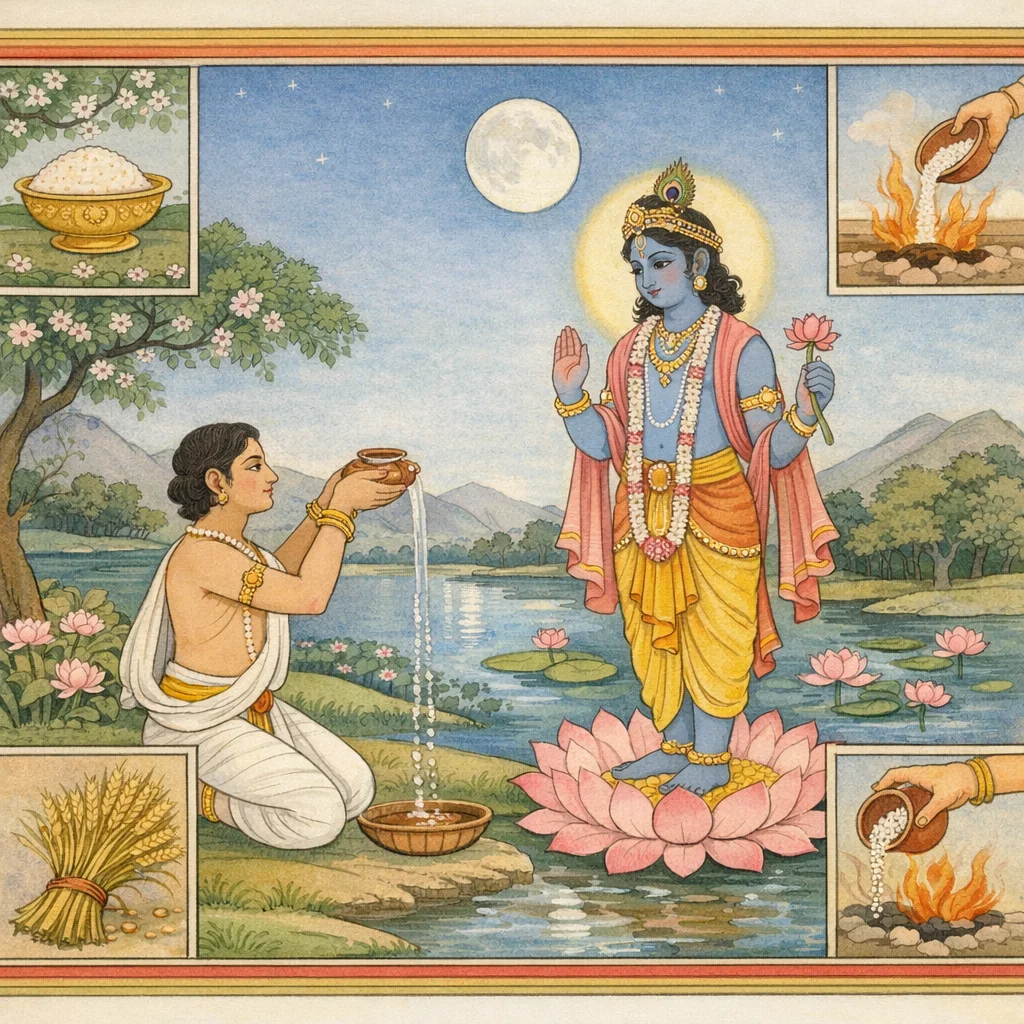
Adhyaya 57: The Observance for Attaining Radiance: The Soma Kānti-Vrata
Kāntivrata-vidhiḥ (Somakānti-prāpti-vrata)
Ritual-Manual (Vrata-vidhi) with Purāṇic Etiology
Set within the instructional dialogue of Varāha and Pṛthivī, this adhyāya, voiced by the sage Agastya to a king, gives a ritual manual (vrata-vidhi) for the Kāntivrata, a discipline said to restore kānti—radiance, health, and beauty—exemplified by Soma’s recovery from yakṣmā after Dakṣa’s curse. The observance is prescribed for Kārttika śukla-dvitīyā, featuring nocturnal fasting (nakta) and worship of Balakēśava with distinct offerings: to the feet for Baladeva and to the head for Keśava. An arghya is then offered to Soma with a specified mantra, followed by regulated diets and homa cycles arranged in seasonal quartets (phālgunādi, āṣāḍhādi) using payasa, śāli, yava, and tila. After a year, the vow concludes with a silver moon-image and gifts to a brāhmaṇa, linking bodily well-being to orderly seasonal practice and the steady rhythm of the earth.
Primary Speakers
Key Concepts
Shlokas in Adhyaya 57
Verse 1
अगस्त्य उवाच । अतः परं प्रवक्ष्यामि कान्तिव्रतम् अनुत्तमम् । यत्कृत्वा तु पुरा सोमः कान्तिमान् अभवत् पुनः ॥ ५७.१ ॥
Agastya said: “Next I shall explain the unsurpassed vow called the Kānti-vrata; by performing it in former times, Soma (the Moon) became radiant again.”
Verse 2
यक्ष्मणा दक्षशापेन पुराक्रान्तो निशाकरः । एतच्चीर्त्वा व्रतं सद्यः कान्तिमानभवत् किल ॥ ५७.२ ॥
Once, the Moon—the maker of night—was afflicted by yakṣman (consumption) due to Dakṣa’s curse. Having performed and proclaimed/observed this vow, he is said to have immediately regained his brilliance.
Verse 3
द्वितीयायां तु राजेन्द्र कार्त्तिकस्य सिते दिने । नक्तं कुर्वीत यत्नेन अर्चयन् बलकेशवम् ॥ ५७.३ ॥
On the second lunar day, O king, on the bright day of the month of Kārttika, one should carefully observe the night-meal vow (nakta) while worshipping Balakeśava.
Verse 4
बलदेवाय पादौ तु केशवाय शिरोऽर्चयेत् । एवमभ्यर्च्य मेधावी वैष्णवं रूपमुत्तमम् ॥ ५७.४ ॥
One should worship the feet for Baladeva, and worship the head for Keśava. Thus having worshipped, the wise person venerates the supreme Vaiṣṇava form.
Verse 5
परस्वरूपं सोमाख्यं द्विकलं तद्दिने हि यत् । तस्यार्घं दापयेद्धीमान् मन्त्रेण परमेष्ठिनः ॥ ५७.५ ॥
On that day, for what is called Soma—of the ‘other-form’ (parasvarūpa) and consisting of two parts (dvikala)—the wise person should have the arghya-offering presented, using the mantra addressed to Parameṣṭhin.
Verse 6
नमोऽस्त्वमृतरूपाय सर्वौषधिनृपाय च । यज्ञलोकाधिपतये सोमाय परमात्मने ॥ ५७.६ ॥
Homage to You whose form is immortality; homage to You, sovereign of all medicinal herbs; to the lord of the sacrificial realm—Soma—who is the supreme Self.
Verse 7
अनेनैव च मार्गेण दत्त्वार्घ्यं परमेष्ठिनः । रात्रौ सविप्रो भुञ्जीत यवान्नं सघृतं नरः ॥ ५७.७ ॥
Following this same procedure, having offered the arghya to Parameṣṭhin, a man—together with a brāhmaṇa—should eat at night a meal of barley (yava) accompanied by ghee.
Verse 8
फाल्गुनादिचतुष्के तु पायसं भोजयेच्छुचिः । शालिहोमं तु कुर्वीत कार्त्तिके तु यवैस्तथा ॥ ५७.८ ॥
In the four-month period beginning with Phālguna, a purified person should serve milk-rice as an offering of food. One should perform a homa with rice; and likewise, in Kārttika, perform it with barley.
Verse 9
आषाढादिचतुष्के तु तिलहोमं तु कारयेत् । तद्वत् तिलान्नं भुञ्जीत एष एव विधिक्रमः ॥ ५७.९ ॥
During the four-month period beginning with Āṣāḍha, one should have a sesame oblation (tila-homa) performed. Likewise, one should partake of food prepared with sesame. This alone is the prescribed order of procedure.
Verse 10
ततः संवत्सरे पूर्णे शशिनं कृतराजतं । सितवस्त्रयुगच्छन्नं सितपुष्पानुलेपनम् । एवमेव द्विजं पूज्य ततस्तं प्रतिपादयेत् ॥ ५७.१० ॥
Then, when a full year has been completed, one should prepare a moon-image fashioned of silver, covered with a pair of white garments and anointed with white flowers. In the same manner, having honored a brāhmaṇa, one should then present that moon-image to him.
Verse 11
कान्तिमानपि लोकेऽस्मिन् सर्वज्ञः प्रियदर्शनः । त्वत्प्रसादात् सोमरूपिन् नारायण नमोऽस्तु ते ॥ ५७.११ ॥
In this world, through your grace, one becomes radiant, all-knowing, and pleasing to behold. O Nārāyaṇa, O you whose form is like Soma (the Moon), salutations to you.
Verse 12
अनेन किल मन्त्रेण दत्त्वा विप्राय वाग्यतः । दत्तमात्रे ततस्तस्मिन् कान्तिमान् जायते नरः ॥ ५७.१२ ॥
“Indeed, having given a gift to a brāhmaṇa with this very mantra, with speech held in disciplined restraint, the moment the gift is made, that man then becomes radiant.”
Verse 13
आत्रेयेणापि सोमेन कृतमेतत् पुरा नृप । तस्य व्रतान्ते सन्तुष्टः स्वयमेव जनार्दनः । यक्ष्माणमपनीयाशु अमृताख्यां कलां ददौ ॥ ५७.१३ ॥
O king, in former times Soma, the descendant of Atri, also performed this observance. At the close of his vow, Janārdana himself, being pleased, swiftly removed the yakṣmā (consuming disease) and granted a portion (kalā) known as “Amṛta.”
Verse 14
तां कलां सोमराजोऽसौ तपसा लब्धवानिति । सोमत्वं चागमत सोऽस्य ओषधीनां पतिर् बभौ ॥ ५७.१४ ॥
It is said that that Moon-king obtained that portion through tapas (ascetic discipline); and, having attained the state of being Soma, he became the lord of the medicinal plants.
Verse 15
द्वितीयामश्विनौ सोमभुजौ कीर्त्येते तद्दिने नृप । तौ शेषविष्णू विख्यातौ मुख्यपक्षौ न संशयः ॥ ५७.१५ ॥
O king, on the second lunar day the Aśvins are praised as the drinkers of Soma. Those two are renowned as Śeṣa and Viṣṇu, the principal “wings/sides,” without doubt.
Verse 16
न विष्णोर्व्यतिरिक्तं स्याद् दैवतं नृपसत्तम । नामभेदेन सर्वत्र संस्थितः परमेश्वरः ॥ ५७.१६ ॥
O best of kings, there is no divinity that exists apart from Viṣṇu; only through differences of name is the Supreme Lord established everywhere.
Frequently Asked Questions
The text frames well-being and social order through disciplined observance aligned with calendrical and seasonal rhythms: regulated fasting, worship, offerings, and charitable gifting are presented as a structured means to restore “kānti,” linking personal health and social duty to cyclical terrestrial time.
The vrata begins on Kārttika śukla-dvitīyā (the bright fortnight’s second lunar day in Kārttika), includes a nightly observance (nakta), and runs for a full saṃvatsara (year). It specifies seasonal quartets: phālgunādi-catuṣka with payasa feeding and śāli-homa, Kārttika with yava offerings, and āṣāḍhādi-catuṣka with tila-homa and tila-based food.
While not explicitly ecological in modern terms, the chapter encodes an ethic of terrestrial balance by emphasizing seasonal regularity (grain/seed offerings tied to time), Soma’s identity as oṣadhīnāṃ pati (lord of medicinal plants), and the idea that health and vitality are sustained through harmonizing human practice with annual and lunar cycles.
The narrative references Agastya (as transmitter of the vrata), Soma (as exemplar), Dakṣa (as the source of the curse), Janārdana/Nārāyaṇa/Viṣṇu (as the divine agent removing yakṣmā), and the Aśvinau (named in connection with dvitīyā). A royal addressee (“rājendra,” “nṛpa”) is also invoked as the audience for the instruction.