Adhyaya 51: Recollection of the Dharaṇī-vrata and the Agastya–Bhadrāśva Dialogue on Liberation
Dharaṇīvrata-smṛtiḥ, Agastya-bhadrāśva-saṃvādaḥ
Ethical-Discourse (mokṣa-dharma framed through allegorical cosmology)
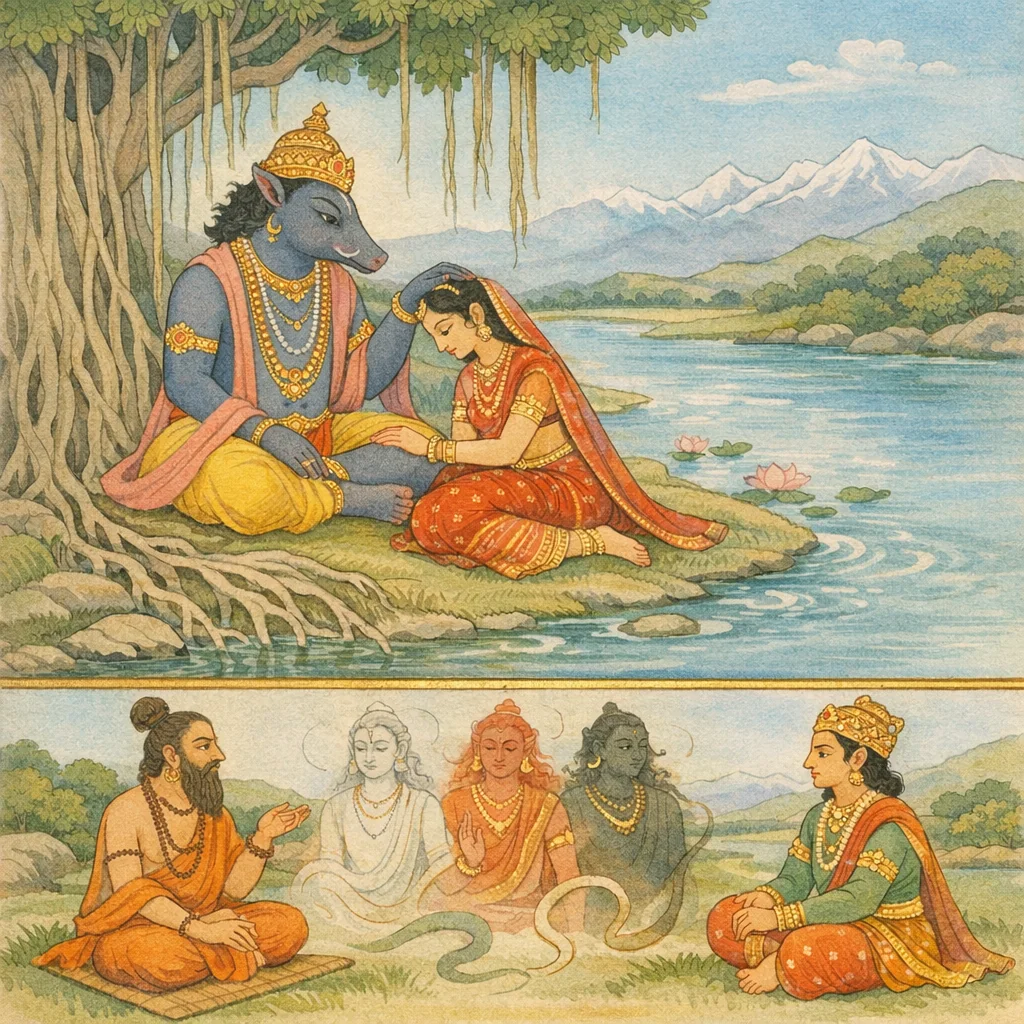
Varāha resumes his teaching after Durvāsas’ statement on the supreme Dharaṇī-vrata, describing Satyatapās’ journey to the Himavat region near the Puṣpabhadrā river, the Citrāśilā rock, and the Bhadravaṭa banyan. Pṛthivī then says that though she practiced this ancient vow through many kalpas, she had forgotten it; by Varāha’s grace she regains remembrance of former births (jātismaratā) and asks about Agastya’s return to King Bhadrāśva. Varāha relates how Bhadrāśva honors Agastya and inquires how karmic bondage and saṃsāra are cut off, and how one avoids grief in embodied and unembodied states. Agastya begins an allegorical account: a cattle-keeper king approaches the ocean, enters a serpent-filled forest, and meets tri-colored and manifold beings that envelop him—hinting at the interlocking of the guṇas/elements and the body—thus preparing a teaching on bondage and liberation.
Primary Speakers
Key Concepts
Shlokas in Adhyaya 51
Verse 1
श्रीवराह उवाच । श्रुत्वा दुर्वाससो वाक्यं धरणीव्रतमुत्तमम् । ययौ सत्यतपाः सद्यो हिमवत्पार्श्वमुत्तमम् ॥ ५१.१ ॥
Śrī Varāha said: Having heard the words of Durvāsas concerning the excellent observance called the Dharāṇī-vrata, Satyatapā immediately went to the most excellent vicinity of Himavat (the Himalayan region).
Verse 2
पुष्पभद्रा नदी यत्र शिला चित्रशिला तथा । वटो भद्रवटो यत्र तत्र तस्याश्रमो बभौ । तत्रोपरि महत्तस्य चरितं सम्भविष्यति ॥ ५१.२ ॥
Where the Puṣpabhadrā river is, and where there are the rocks called Śilā and Citraśilā; where the banyan tree known as Bhadravaṭa stands—there his hermitage came to be. Upon that place, a great account of his deeds will come to pass.
Verse 3
धरण्युवाच । बहुकल्पसहस्राणि व्रतस्यास्य सनातन । मया कृतस्य तपस्तन्मया विस्मृतं प्रभो ॥ ५१.३ ॥
Dharā (the Earth) said: “O Eternal One, over many thousands of kalpas, the austerity I performed in connection with this ancient observance has, by me, been forgotten, O Lord.”
Verse 4
इदानीं त्वत्प्रसादेन स्मरणं प्राक्तनं मम । जातं जातिस्मरा चास्मि विषोका परमेश्वर ॥ ५१.४ ॥
Now, by your gracious favor, my former remembrance has arisen; I have become one who remembers past births, and I am free from sorrow, O Supreme Lord.
Verse 5
यदि नाम परं देव कौतुकं हृदि वर्तते । अगस्त्यः पुनरागत्य भद्राश्वस्य निवेशनम् । यच्चकार स राजा च तन्ममाचक्ष्व भूधर ॥ ५१.५ ॥
If indeed, O supreme lord, curiosity abides in your heart—then tell me, O Bearer of the Earth, what Agastya did after returning to the residence of Bhadrāśva, and what that king also did.
Verse 6
श्रीवराह उवाच । प्रत्यागतं ऋषिं दृष्ट्वा भद्राश्वः श्वेतवाहनः । वरासनगतं दृष्ट्वा कृत्वा पूजां विशेषतः । अपृच्छन् मोक्षधर्माख्यं प्रश्नं सकलधारिणि ॥ ५१.६ ॥
Śrī Varāha said: Seeing the ṛṣi who had returned, Bhadrāśva—whose vehicle was white—beheld him seated upon the excellent seat; having offered him special reverence, he asked a question known as “mokṣa-dharma” (the dharma concerning liberation), O Sustainer of all.
Verse 7
भद्राश्व उवाच । भगवन् कर्मणा केन छिद्यते भवसंसृतिः । किं वा कृत्वा न शोचन्ति मूर्तामूर्तोपपत्तिषु ॥ ५१.७ ॥
Bhadrāśva said: “O Blessed One, by what kind of action is the cycle of worldly transmigration cut off? Or, having done what, do beings not grieve amid embodiments that are manifest (corporeal) and unmanifest (incorporeal)?”
Verse 8
अगस्त्य उवाच । शृणु राजन् कथां दिव्यां दूरासन्नव्यवस्थिताम् । दृश्यादृश्यविभागोत्थां समाहितमना नृप ॥ ५१.८ ॥
Agastya said: “Listen, O king, to a divine account—one that is situated in what is far and what is near—arising from the distinction between the seen and the unseen. Be attentive in mind, O ruler.”
Verse 9
नाहो न रात्रिर्न दिशोऽदिशश्च न द्यौर्न देवा न दिनं न सूर्यः । तस्मिन् काले पशुपालेति राजा स पालयामास पशूननेकान् ॥ ५१.९ ॥
There was neither day nor night, neither the directions nor the intermediate directions; neither heaven nor the gods, neither daytime nor the sun. At that time a king named Paśupāla protected many herds of animals.
Verse 10
तान् पालयन् स कदाचिद् दिदृक्षुः पूर्वं समुद्रं च जगाम तूर्णम् । अनन्तपारस्य महोदधेस्तु तीरे वनं तत्र वसन्ति सर्पाः ॥ ५१.१० ॥
While protecting them, he once—wishing to see the eastern ocean—went there swiftly. On the shore of the great sea, whose far boundary is endless, there is a forest; there serpents dwell.
Verse 11
अष्टौ द्रुमाः कामवहा नदी च तुर्यक् चोर्ध्वं बभ्रमुस्तत्र चान्ये । पञ्च प्रधानाः पुरुषास्तथैकां स्त्रियं बिभ्रते तेजसा दीप्यमानाम् ॥ ५१.११ ॥
There wandered eight wish-bearing trees, and a river, and beings moving in the “fourth mode,” and others moving upward. And five principal Puruṣas likewise uphold a single woman, blazing with radiance (tejas).
Verse 12
सा अपि स्त्री स्वे वक्षसि धारयन्ती सहस्रसूर्यप्रतिमं विशालम् । तस्याधरस्त्रिर्विकारस्त्रिवर्ण-स्तं राजानं पश्य परिभ्रमन्तम् ॥ ५१.१२ ॥
That woman too bore upon her own breast something vast, resembling a thousand suns. Behold that king as he wanders about—his lower lip is threefold in alteration and threefold in color.
Verse 13
तूष्णीम्भूता मृतकल्पा इवासन् नृपोऽप्यसौ तद्वनं संविवेश । तस्मिन् प्रविष्टे सर्व एते विविशु-र्भयादैक्यं गतवन्तः क्षणेन ॥ ५१.१३ ॥
They became silent, as if lifeless; and that king too entered that forest. When he had entered, all of them also went in—through fear they came to act as one within a moment.
Verse 14
तैः सर्पैः स नृपो दुर्विनीतैः संवेष्टितो दस्युभिश्चिन्तयानः । कथं चैतेन भविष्यन्ति येन कथं चैते संसृताः सम्भवेयुः ॥ ५१.१४ ॥
Enveloped by those ill-disciplined serpents and by bandits, the king, reflecting with anxiety, pondered: “How will these people survive because of him? And how might those entangled in the cycle of saṃsāra come to a favorable outcome?”
Verse 15
एवं राज्ञश्चिन्तयतस्त्रिवर्णः पुरुषः परः । श्वेतं रक्तं तथा कृष्णं त्रिवर्णं धारयन्नरः ॥ ५१.१५ ॥
As the king was thus reflecting, a transcendent Person of three hues appeared—a man bearing the triple coloration: white, red, and likewise black.
Verse 16
सा संज्ञां कृतवान् मह्यमपरोऽथ क्व यास्यसि । एवं तस्य ब्रुवाणस्य महन्नाम व्यजायत ॥ ५१.१६ ॥
“She has assigned a designation for me; but now, where will the other go?” As he spoke in this manner, a great Name came to be manifest.
Verse 17
तेनापि राजा संवृतः स बुध्यस्वेति चाब्रवीत् । एवमुक्ते ततः स्त्री तु तं राजानं रुरोध ह ॥ ५१.१७ ॥
Even by that, the king was restrained; and he said, “Be aware—understand clearly.” When this was said, then the woman indeed held back that king.
Verse 18
मायाततं तं मा भैष्ट ततोऽन्यः पुरुषो नृपम् । संवेष्ट्य स्थितवान् वीरस्ततः सर्वेश्वरेश्वरः ॥ ५१.१८ ॥
“Do not be afraid of that which has been spread forth by māyā, the power of illusion.” Then another Person—the heroic Lord, sovereign over all lords—stood there, having encircled and protected the king.
Verse 19
ततोऽन्ये पञ्च पुरुषा आगत्य नृपसत्तमम् । संविष्ट्य संस्थिताः सर्वे ततो राजा विरोधितः ॥ ५१.१९ ॥
Then five other men came to the excellent king; entering and taking their places, they all stood together—whereupon the king was met with opposition.
Verse 20
रुद्धे राजनि ते सर्वे एकीभूतास्तु दस्यवः । मथितुं शस्त्रमादाय लीना अन्योन्यं ततो भयात् ॥ ५१.२० ॥
When the king was restrained, all those bandits became united; taking up weapons to strike, they then, out of fear, hid among one another.
Verse 21
तैर्लीनैर्नृपतेर्वेश्म बभौ परमशोभनम् । अन्येषामपि पापानां कोटिः साग्राभवन्नृप ॥ ५१.२१ ॥
With those (sins) dissolved, the king’s palace became exceedingly splendid; and, O king, even a koṭi of other sins too were eliminated, together with their remainder.
Verse 22
गृहे भूसलिलं वह्निः सुखशीतश्च मारुतः । सावकाशानि शुभ्राणि पञ्चैकॊनगुणानि च ॥ ५१.२२ ॥
Within the household are earth and water, fire, and a wind that is pleasant and cool; and also auspicious, pure spaces associated with ākāśa—thus the qualities are reckoned as five, with an additional mention of a count “one less” as stated.
Verse 23
एकैव तेषां सुचिरं संवेष्ट्यासज्यसंस्थिता । एवं स पशुपालोऽसौ कृतवानञ्जसा नृप ॥ ५१.२३ ॥
Clinging closely and remaining bound to them for a long time, she alone did so. Thus that cowherd accomplished it with ease, O king.
Verse 24
तस्य तल्लाघवं दृष्ट्वा रूपं च नृपतेर्मृधे । त्रिवर्णः पुरुषो राजन्नब्रवीद्राजसत्तमम् ॥ ५१.२४ ॥
Having seen his agility and also the king’s form in battle, a tri-colored man, O King, spoke to the most excellent of kings.
Verse 25
त्वत्पुत्रोऽस्मि महाराज ब्रूहि किं करवाणि ते । अस्माभिर्बन्धुमिच्छद्भिर्भवन्तं निश्चयः कृतः ॥ ५१.२५ ॥
“I am your son, O great king; tell me—what shall I do for you? By us, who seek a kinsman, a decision has been made to choose you.”
Verse 26
यदि नाम कृताः सर्वे वयं देव पराजिताः । एवमेव शरीरेषु लीनास्तिष्ठाम पार्थिव ॥ ५१.२६ ॥
“Even if, O god, we have all been subdued, so be it: in that very manner, O king, we shall remain—merged within the bodies.”
Verse 27
मर्य्येके तव पुत्रत्वं गते सर्वेषु सम्भवः । एवमुक्तस्ततो राजा तं नरं पुनरब्रवीत् ॥ ५१.२७ ॥
“Some indeed have attained the status of being your sons; and when that has passed among all, there is again the possibility of rebirth.” Thus addressed, the king then spoke again to that man.
Verse 28
पुत्रो भवति मे कर्त्ता अन्येषामपि सत्तम । युष्मत्सुखैर्नरैर्भावैर्नाहं लिप्ये कदाचन ॥ ५१.२८ ॥
“My son becomes the agent of actions—even for others, O best of men; yet I am never tainted at any time by the human dispositions and conditions that arise from your pleasures.”
Verse 29
एवमुक्त्वा स नृपतिस्तमात्मजमथाकरॊत् । तैर्विमुक्तः स्वयं तेषां मध्ये स विरराम ह ॥ ५१.२९ ॥
Having spoken thus, the king then attended to his own son. Released by them, he himself came to rest in their midst.
Frequently Asked Questions
The chapter frames liberation inquiry (mokṣa-dharma) through Bhadrāśva’s questions to Agastya about how karmic action is severed and grief is avoided across states of embodiment. Agastya’s opening allegory—figures enveloping the king—functions as a model for how the person becomes bound by interrelated forces (often read as guṇas/elements and psychosomatic constituents), implying that discernment and disciplined conduct are prerequisites for release.
No explicit tithi, lunar phase, month, or seasonal timing is stated in the provided verses. Chronology is expressed instead through expansive temporal language (bahu-kalpa-sahasrāṇi) indicating repeated cycles across kalpas.
Environmental emphasis appears through the Dharaṇī-vrata frame: Pṛthivī’s vow is positioned as an ‘uttama’ practice tied to Earth (Dharaṇī) and remembered as a long-duration stewardship ethic. The narrative’s detailed placement in river, mountain, banyan, and coastal-forest ecologies foregrounds landscapes as moral-pedagogical settings, supporting a reading of terrestrial care as integral to dharma and memory of cosmic order.
The chapter references the sage Durvāsas (as prior speaker), Satyatapās (as an ascetic moving to Himavat), the sage Agastya (as instructor), and King Bhadrāśva Śvetavāhana (as royal interlocutor). No extended genealogy is supplied in the excerpt, but the king–sage instructional setting reflects a standard Purāṇic courtly pedagogy.