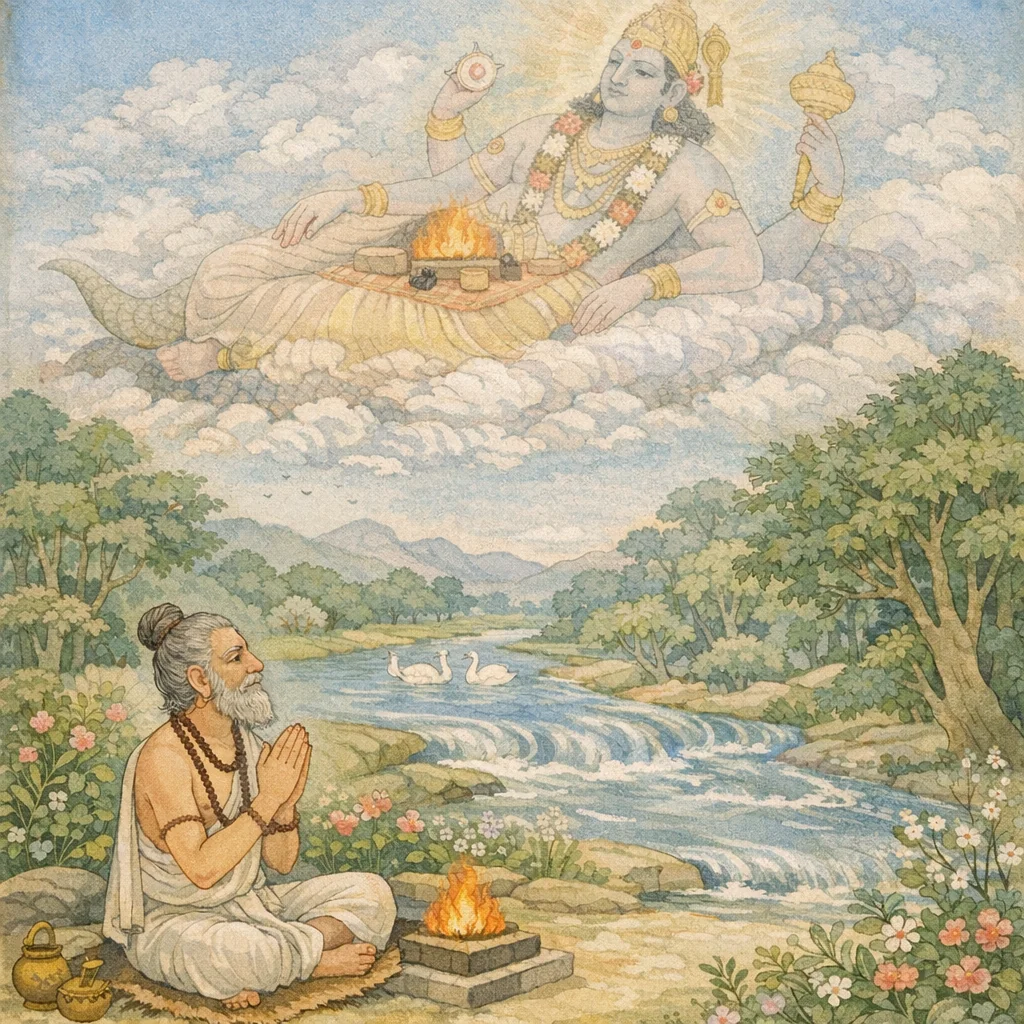
Adhyaya 5: Reconciliation of Action and Knowledge: Offering All Acts to Nārāyaṇa and the Hymn to the Yajña-Puruṣa
Karma-jñāna-samuccayaḥ: Nārāyaṇa-samarpaṇaṃ yajñanara-stavaś ca
Ethical-Discourse (Liberation Hermeneutics) + Stotra (Yajña-Theology)
Within the instructional frame of Varāha and Pṛthivī, King Aśvaśiras approaches Kapila to settle a central doubt about liberation: is mokṣa attained through karma (rites and works) or through jñāna (knowledge)? Kapila answers by citing an embedded precedent: Raibhya asks Bṛhaspati the same question, and Bṛhaspati teaches that actions, whether good or bad, do not bind when performed by depositing them in Nārāyaṇa (nārāyaṇe nyasya), offering their fruits to Him. A further exemplum recounts a debate between the Vedic student Saṃyamana and the hunter Niṣṭhuraka, using the analogy of “fire and an iron-net” to argue that when the root—egoic appropriation—is destroyed, the branching bondage ends. The chapter culminates with Aśvaśiras renouncing kingship, practicing austerity at Naimiṣa, and praising Nārāyaṇa as the cosmic Yajña-Puruṣa, dissolving his mind into that supreme principle.
Primary Speakers
Key Concepts
Shlokas in Adhyaya 5
Verse 1
अश्वशिरा उवाच । भवन्तौ मम सन्देहमेकं छेत्तुमिहार्हतः । येन छिन्नेन जायेत मम संसारविच्युतिः ॥ ५.१ ॥
Aśvaśirā said: “You two are fit to cut away one doubt of mine here; when it is severed, for me there will arise release from transmigratory existence (saṃsāra).”
Verse 2
एवमुक्ते नृपतिना तदा योगिवरो मुनिः । कपिलः प्राह धर्मात्मा राजानं यजतां वरम् ॥ ५.२ ॥
When the king had spoken thus, then the eminent yogin-sage Kapila, righteous in disposition, addressed the king—best among those who perform sacrifices (yajña).
Verse 3
कपिल उवाच । कस्ते मनसि सन्देहो राजन् परमधार्मिक । छिन्दामि येन तच्छ्रुत्वा ब्रूहि यत्तेऽभिवाञ्छितम् ॥ ५.३ ॥
Kapila said: “O king, supremely devoted to dharma, what doubt has arisen in your mind? Tell me what you wish to know; having heard it, I shall dispel it.”
Verse 4
राजोवाच । कर्मणा प्राप्यते मोक्ष उताहो ज्ञानिना मुने । एतन्मे संशयं छिन्धि यदि मेऽनुग्रहः कृतः ॥ ५.४ ॥
The King said: “O sage, is liberation (mokṣa) attained through action (karma), or rather through the knower (jñānin)? Cut through this doubt of mine, if you have shown me favor.”
Verse 5
कपिल उवाच । इमं प्रश्नं महाराज पुरा पृष्टो बृहस्पतिः । रैभ्येण ब्रह्मपुत्रेण राज्ञा च वसुनापुराः । वसुरासीन्नृपश्रेष्ठो विद्वान् दानपतिः पुरा ॥ ५.५ ॥
Kapila said: “O great king, this very question was once asked of Bṛhaspati in former times—by Raibhya, the son of Brahmā, and also by King Vasu. In those days Vasu was an eminent ruler, learned, and renowned as a lord of generosity (dāna).”
Verse 6
चाक्षुषस्य मनोः काले ब्रह्मणोऽन्वयवर्धनः । वसुश्च ब्रह्मणः सद्म गतवान्स्तद्दिदृक्षया ॥ ५.६ ॥
In the time of Cākṣuṣa Manu, Anvayavardhana—connected with Brahmā’s lineage—and Vasu went to Brahmā’s abode, desiring to behold Him.
Verse 7
पथि चैत्ररथं दृष्ट्वा विद्याधरवरं नृप । अपृच्छच्च वसुः प्रीत्या ब्रह्मणोऽवसरं प्रभो ॥ ५.७ ॥
O king, seeing on the road Caitraratha, the excellent Vidyādhara, Vasu—out of affectionate reverence—asked about an opportunity for audience with Brahmā, O lord.
Verse 8
सोऽब्रवीद् देवसमितिर्वर्तते ब्रह्मणो गृहे । एवं श्रुत्वा वसुस् तस्थौ द्वारि ब्रह्मौकसस् तदा । तावत् तत्रैव रैभ्यस् तु आजगाम महातपाः ॥ ५.८ ॥
He said, “The assembly of the gods is convening in Brahmā’s dwelling.” Hearing this, Vasu stood at the doorway of Brahmā’s abode. Meanwhile, the great ascetic Raibhya arrived there.
Verse 9
स राजा प्रीतमनसा वसुः सम्पूर्णमानसः । उवाच पूजयित्वाग्रे क्व प्रयातोऽसि वै मुने ॥ ५.९ ॥
King Vasu, pleased at heart and fully composed in mind, spoke—having first offered due honor: “O sage, where indeed are you going?”
Verse 10
रैभ्य उवाच । अहं बृहस्पतेः पार्श्वे आगतोऽस्मि महानृप । किञ्चित्कार्यान्तरं प्रष्टुमहं देवपुरोहितम् ॥ ५.१० ॥
Raibhya said: “O great king, I have come into the presence of Bṛhaspati, the preceptor of the gods, to ask the divine priest about another matter.”
Verse 11
एवं वदति रैभ्ये तु ब्रह्मणस्तन्महासदः । उत्तस्थौ स्वानि धिष्ण्यानि गता देवगणाः प्रभो ॥ ५.११ ॥
While Raibhya spoke thus, that great assembly of Brahmā rose; and the hosts of gods, O Lord, departed to their respective abodes.
Verse 12
तावद् बृहस्पतिस्तत्र रैभ्येण सह संविदम् । कृत्वा स्वधिष्ण्यमगमद् वसुनाच सुपूजितः ॥ ५.१२ ॥
Meanwhile, Bṛhaspati, having held a consultation there together with Raibhya, departed for his own abode—having also been duly honored by Vasu.
Verse 13
रैभ्य आङ्गिरसो राजा वसुश्चोपाविवेश ह । उपविष्टेषु राजेन्द्र तेषु तेष्वपि सोऽब्रवीत् ॥ ५.१३ ॥
King Raibhya, descended from Aṅgiras, and Vasu also took their seats. When those kings had seated themselves, O king of kings, he then addressed them as well.
Verse 14
बृहस्पतिर्देवगुरू रैभ्यं वचनमन्तिके । किं करोमि महाभाग वेदवेदाङ्गपारग ॥ ५.१४ ॥
Bṛhaspati, the preceptor of the gods, addressed Raibhya at close range: “What am I to do, O fortunate one, you who have mastered the Vedas and the auxiliary disciplines (Vedāṅgas)?”
Verse 15
रैभ्य उवाच । बृहस्पते कर्मणा किं प्राप्यते ज्ञानिना । अथवा । मोक्ष एतन्ममाचक्ष्व पृच्छतः संशयं प्रभो ॥ ५.१५ ॥
Raibhya said: “O Bṛhaspati, what is obtained by a knower through action? Or else—tell me about liberation (mokṣa), O lord, as I ask, dispelling my doubt.”
Verse 16
बृहस्पतिरुवाच । यत्किञ्चित् कुरुते कर्म पुरुषः साध्वसाधु वा । सर्वं नारायणे न्यस्य कुर्वन् नैव च लिप्यते ॥ ५.१६ ॥
Bṛhaspati said: Whatever action a person performs—whether commendable or not—if one entrusts it all to Nārāyaṇa and acts in the spirit of offering, one is not tainted or bound by that action.
Verse 17
श्रूयते च द्विजश्रेष्ठ संवादो विप्रलुब्धयोः । आत्रेयो ब्राह्मणः कश्चिद् वेदाभ्यासरतो मुनिः ॥ ५.१७ ॥
And it is also heard, O best of the twice-born, that there was a dialogue between two brāhmaṇas who had been deceived. Among them was a brāhmaṇa of the Ātreya lineage, a muni devoted to the study and recitation of the Vedas.
Verse 18
वसत्यविरतं प्रातःस्नायी त्रिषवणे रतः । नाम्ना संयमनः पूर्वमेकस्मिन् दिवसे नदीम् । धर्मारण्ये गतः स्नातुं धन्यां भागीरथीं शुभाम् ॥ ५.१८ ॥
Formerly, a man named Saṃyamana, unceasing in his observances—bathing at dawn and devoted to the rites of the three daily times—on a certain day went to Dharma-araṇya to bathe in the auspicious and blessed river Bhāgīrathī.
Verse 19
तत्रासीनं महायूथं हरिणानां विचक्षणः । लुब्धो निष्ठुरको नाम धनुःपाणिः कृतान्तवत् । आययौ तं जिघांसुः स धनुष्यायोज्य सायकम् ॥ ५.१९ ॥
There, seeing a great herd of deer resting, a sharp-eyed hunter named Niṣṭhuraka, bow in hand like Death itself, came intending to kill them, fitting an arrow to his bow.
Verse 20
ततः संयमनो विप्रो दृष्ट्वा तं मृगयारतम् । वारयामास मा भद्र जीवघातमिमं कुरु ॥ ५.२० ॥
Then the brāhmaṇa Saṃyamana, seeing him intent on hunting, restrained him, saying: “O good sir, do not commit this act of killing living beings.”
Verse 21
एतच्छ्रुत्वा वचो व्याधः स्मितपूर्वमिदं वचः । उवाच नाहं हिंसामि पृथग्जीवं द्विजोत्तम ॥ ५.२१ ॥
Having heard these words, the hunter (vyādha), smiling beforehand, said: “O best of the twice-born, I do not kill a living being as something separate from myself.”
Verse 22
परमात्मा त्वयं भूतैः क्रीडते भगवान् स्वयम् । क्रीता मृदा बलीवर्द्धास्तद्वदेतन्न संशयः ॥ ५.२२ ॥
You are the Supreme Self (Paramātman); the Blessed Lord (Bhagavān) Himself sports with beings. Just as oxen are bought with a clod of earth, so it is here—of this there is no doubt.
Verse 23
अहे भावः सदा ब्रह्मन्नविद्येयं मुमुक्षुणाम् । यात्राप्राणरतं सर्वं जगदेतद्विचेष्टितम् । तत्राहमिति यः शब्दः स साधुत्वं न गच्छति ॥ ५.२३ ॥
O Brahman, for those who seek liberation this condition of being is ever ignorance (avidyā): this whole world is absorbed in activity, clinging to livelihood as though it were its very life-breath. And the notion voiced as the word “I” does not attain true goodness (sādhutva).
Verse 24
इत्याकर्ण्य स विप्रेन्द्रो द्विजः संयमनस्तदा । विस्मयेनाब्रवीद्वाक्यं लुब्धं निष्ठुरकं द्विजः ॥ ५.२४ ॥
Hearing this, that foremost of brāhmaṇas—the twice-born man named Saṃyamana—spoke in astonishment, yet his words were driven by greed and harsh in tone.
Verse 25
किमेतदुच्यते भद्र प्रत्यक्षं हेतुमद्वचः । ततः श्रुत्वा मुनेर्विप्रं लुब्धकः प्राह धर्मवित् । कृत्वा लोहमयं जालं तस्याधो ज्वलनं ददौ ॥ ५.२५ ॥
“What is this, O good sir—this statement that is plain to see and supported by reason?” Then, having heard the brāhmaṇa sage, the hunter—one who knew dharma—replied; and, having made an iron net, he kindled fire beneath it.
Verse 26
दत्त्वा वह्निं द्विजं प्राह ज्वाल्यतां काष्ठसचयः । ततो विप्रो मुखेनाग्निं प्रज्वाल्य विरराम ह ॥ ५.२६ ॥
Having handed over the fire, he said to the twice-born (brāhmaṇa), “Let the heap of firewood be kindled.” Then the brāhmaṇa kindled the fire with his mouth and thereafter ceased.
Verse 27
ज्वलिते तु पुनर्वह्नौ तं जालं लोहसम्भवम् । पृथक्पृथक् सहस्राणि निन्येऽन्तर्जालकैर्द्विज । एकस्थानगतस्यापि वह्नेरायसजालकैः ॥ ५.२७ ॥
But when the fire blazed again, O brāhmaṇa, he carried off that net made of iron, drawing it away in thousands of separate parts by means of the inner meshes; though the fire remained in a single place, it was restrained by iron lattices.
Verse 28
ततो लुब्धोऽब्रवीद्विप्रं एकां ज्वालां महामुने । गृहाण येन शेषाणां करिष्यामीह नाशनम् ॥ ५.२८ ॥
Then the greedy one said to the brāhmaṇa, “O great sage, accept this single flame, by which I shall here bring about the destruction of the remainder.”
Verse 29
एवमुक्त्वा हुताशे तु तोयपूर्णं घटं द्रुतम् । चिक्षेप सहसा वह्निः प्रशशामाशु पूर्ववत् ॥ ५.२९ ॥
Having spoken thus, he quickly hurled a water-filled pot into the fire; the blaze was suddenly quenched and swiftly subsided as before.
Verse 30
ततोऽब्रवील्लुब्धकस्तु ब्राह्मणं तं तपोधनम् । भगवन् या त्वया ज्वाला गृहोतासीद्धुताशनात् । प्रयच्छ येन मार्गाणि मांसान्यानाय्य भक्षये ॥ ५.३० ॥
Then the hunter addressed that brāhmaṇa, rich in austerity: “Venerable sir, grant me the method by which, from the fire that arose in your house from that blazing flame, I may obtain the means to bring in meats and eat.”
Verse 31
एवमुक्तस्तदा विप्रो यावदायसजालकम् । पश्यत्येव न तत्राग्निर्मूलनाशे गतः क्षयम् ॥ ५.३१ ॥
Thus addressed, the brāhmaṇa looked upon the iron lattice and saw that there was no fire there; when its very root was destroyed, it had come to its end.
Verse 32
ततो विलक्षणभावेन ब्राह्मणः शंसितव्रतः । तूष्णीम्भूतस्थितस्तावल्लुब्धको वाक्यमब्रवीत् ॥ ५.३२ ॥
Then, with a markedly changed demeanor, the brāhmaṇa—whose vow had been commended—stood silent for a moment; meanwhile the hunter spoke these words.
Verse 33
एतस्मिञ्ज्वलितो वह्निर्बहुशाखश्च सत्तम । मूलनाशे भवेन्नाशस्तद्वदेतदपि द्विज ॥ ५.३३ ॥
Here a blazing fire spreads into many branches, O best of the virtuous. When the root is destroyed, destruction follows; so too is this the case here, O twice-born.
Verse 34
आत्मा स प्रकृतिस्थश्च भूतानां संश्रयो भवेत् । भूय एषा जगत्सृष्टिस्तत्रैव जगतो भवेत् ॥ ५.३४ ॥
That Self, abiding within Prakṛti (material nature), becomes the support of beings; and again, this creation of the world arises—therein indeed the world comes to be.
Verse 35
पिण्डग्रहणधर्मेण यदस्य विहितं व्रतम् । तत्तदात्मनि संयोज्य कुर्वाणो नावसीदति ॥ ५.३५ ॥
Whatever observance (vrata) has been prescribed for him according to the rule of accepting the piṇḍa (ritual offering), one who performs it by integrating each such act within oneself does not fall into distress or decline.
Verse 36
एवमुक्ते तु व्याधेन ब्राह्मणे राजसत्तम । पुष्पवृष्टिरथाकाशात् तस्योपरि पपात ह ॥ ५.३६ ॥
When the hunter had spoken thus, O best of kings, a shower of flowers fell from the sky upon that brāhmaṇa.
Verse 37
विमानानि च दिव्यानि कामगानि महान्ति च । बहुरत्नानि मुख्यानि ददृशे ब्राह्मणोत्तमः ॥ ५.३७ ॥
And the foremost brāhmaṇa beheld divine aerial chariots—great in size and moving at will—as well as many principal treasures and jewels.
Verse 38
तेषु निष्ठुरकं लुब्धं सर्वेषु समवस्थितम् । ददृशे ब्राह्मणस्तत्र कामरूपिणमुत्तमम् ॥ ५.३८ ॥
There, among them, the brāhmaṇa saw a cruel and greedy disposition pervading all; and in that place he beheld an excellent being—one able to assume forms at will.
Verse 39
अद्वैतवासना सिद्धं योगाद् बहुशरीरकम् । दृष्ट्र्वा विप्रो मुदा युक्तः प्रययौ निजमाश्रमम् ॥ ५.३९ ॥
Having seen—through yoga—the state of one perfected by the non-dual contemplative disposition, manifesting as ‘many-bodied,’ the brāhmaṇa, filled with joy, departed to his own hermitage.
Verse 40
एवं ज्ञानवतः कर्म कुर्वतोऽपि स्वजातिकम् । भवेन्मुक्तिर्द्विजश्रेष्ठ रैभ्य राजन् वसो ध्रुवम् ॥ ५.४० ॥
Thus, even for one who performs action while possessing knowledge—and even when acting within one’s own social condition—liberation arises, O best of the twice-born. O Raibhya, O King Vasu, this is certain.
Verse 41
एवं तौ संशयच्छेदं प्राप्तौ रैभ्यवसू नृप । बृहस्पतेस्ततो धिष्ण्याज्जग्मतुर्निजमाश्रमम् ॥ ५.४१ ॥
Thus, O king, those two—Raibhya and Vasu—having attained the cutting away of their doubt, then departed from Bṛhaspati’s sacred seat and went to their own hermitage.
Verse 42
तस्मात् त्वमपि राजेन्द्र देवं नारायणं प्रभुम् । अभेदेन स्वदेहस्थं पश्यन्नाराधय प्रभुम् ॥ ५.४२ ॥
Therefore, O best of kings, you too should venerate the Lord Nārāyaṇa—seeing him, without difference, as abiding within your own body—worship the Lord.
Verse 43
कपिलस्य वचः श्रुत्वा स राजाऽश्वशिरा विभुः । ज्येष्ठं पुत्रं समाहूय धन्यं स्थूलशिराह्वयम् । अभिषिच्य निजे राज्ये स राजा प्रययौ वनम् ॥ ५.४३ ॥
Having heard Kapila’s words, that sovereign king Aśvaśiras, the powerful one, summoned his eldest son—Dhanya, known by the name Sthūlaśiras—and, after consecrating him in his own kingdom, the king departed for the forest.
Verse 44
नैमिषाख्यं वरारोहे तत्र यज्ञतनुं गुरुम् । तपसाराधयामास यज्ञमूर्तिं स्तवेन् च ॥ ५.४४ ॥
O fair-hipped one, at the place called Naimiṣa, he there propitiated through austerity and also through praise the venerable teacher whose body is sacrifice—the very embodiment of the sacrifice (Yajña).
Verse 45
धरण्युवाच । कथं यज्ञतनॊः स्तोत्रं राज्ञा नारायणस्य ह । स्तुतिः कृता महाभाग पुनरेतच्च शंस मे ॥ ५.४५ ॥
Dharāṇī said: “How, indeed, was the hymn to Nārāyaṇa—whose form is the sacrifice—composed by the king? O noble one, recount this again to me.”
Verse 46
श्रीवराह उवाच । नमामि याज्यं त्रिदशाधिपस्य भवस्य सूर्यस्य हुताशनस्य । सोमस्य राज्ञो मरुतामनेक-रूपं हरिं यज्ञनरं नमस्ये ॥ ५.४६ ॥
Śrī Varāha said: I bow to Hari, the worthy recipient of worship—present as the lord of the gods, as Bhava (Śiva), as the Sun, as the sacrificial Fire, as Soma the king, and as the Maruts—manifold in form; I offer homage to Hari as the Yajña-Puruṣa, the Person embodied in sacrifice.
Verse 47
सुभीमदंष्ट्रं शशिसूर्यनेत्रं संवत्सरे छायनयुग्मकुक्षम् । दर्भाङ्गरोमाणमतैध्मशक्तिं सनातनं यज्ञनरं नमामि ॥ ५.४७ ॥
I bow to the eternal Yajña-Puruṣa: whose tusks are formidable; whose eyes are the Moon and the Sun; whose belly is the year with its pair of solstices; whose body-hair is darbha grass; and whose power is the fuel-wood that sustains the rite.
Verse 48
द्यावापृथिव्योरिदमन्तरं हि व्याप्तं शरीरेण दिशश्च सर्वाः । तमीद्यामीशं जगतां प्रसूतिं जनार्दनं तं प्रणतोऽस्मि नित्यम् ॥ ५.४८ ॥
Indeed, the space between heaven and earth is pervaded by his very body—and all the directions as well. To that praiseworthy Lord, the sovereign, the source of the worlds—Janārdana—to him I bow continually.
Verse 49
सुरासुराणां च जयाजयाय युगे युगे यः स्वशरीरमाद्यम् । सृजत्यनादिः परमेश्वरो य- स्तं यज्ञमूर्तिं प्रणतोऽस्मि नाथम् ॥ ५.४९ ॥
I bow to that Lord whose form is Yajña—He, the beginningless Supreme Ruler, who in every age brings forth his primordial body for the victory and defeat of the gods and the asuras.
Verse 50
दधार मायामयमुग्रतेजा जयाय चक्रं त्वमलांशुशुभ्रम् । गदासिशार्ङ्गादिचतुर्भुजोऽयं तं यज्ञमूर्तिं प्रणतोऽस्मि नित्यम् ॥ ५.५० ॥
Endowed with formidable radiance, you bore the discus for victory—pure, bright with stainless rays. This four-armed one, bearing the mace, sword, and Śārṅga bow and other weapons—before that embodiment of sacrifice (yajñamūrti), I bow always.
Verse 51
क्वचित् सहस्रं शिरसां दधार क्वचिन्महापर्वततुल्यकायम् । क्वचित् स एव त्रसरेणुतुल्यो यस्तं सदा यज्ञनरं नमामि ॥ ५.५१ ॥
At times he bore a thousand heads; at times his body was like a great mountain. At times that very One was as minute as a particle of dust. I ever bow to that sacrificial Person (yajña-nara).
Verse 52
चतुर्मुखो यः सृजते समग्रं रथाङ्गपाणिः प्रतिपालनाय । क्षयाय कालानलसन्निभो य-स्तं यज्ञमूर्तिं प्रणतोऽस्मि नित्यम् ॥ ५.५२ ॥
I ever bow to Yajñamūrti, the embodied form of sacrifice: who, as the four-faced one, brings forth the whole creation; who, with the discus in hand, preserves it; and who, like the fire of Time, brings about its dissolution.
Verse 53
संसारचक्रक्रमणक्रियायै य इज्यते सर्वगतः पुराणः । यो योगिभिर्ध्यायते चाप्रमेयस् तं यज्ञमूर्तिं प्रणतोऽस्मि नित्यम् ॥ ५.५३ ॥
I ever bow to that Yajñamūrti: the ancient, all-pervading, immeasurable One, worshipped as the operative principle behind the turning of the wheel of samsara, and contemplated by yogins in meditation.
Verse 54
सम्यङ्मनस्यर्पितवानहं ते यदा सुदृश्यं स्वतनौ नु तत्त्वम् । न चान्यदस्तॊति मतिः स्थिरा मे यतस्ततो मावतु शुद्धभावम् ॥ ५.५४ ॥
When I truly offered my mind to you, the principle of Reality became clearly visible within my own body. And my understanding has grown steady: there is nothing else. Therefore, from every direction, may that understanding protect my purified disposition.
Verse 55
इतीरितस्तस्य हुताशनार्चिः प्रख्यं तु तेजः पुरतो बभूव । तस्मिन् स राजा प्रविवेश बुद्धिं कृत्वा लयं प्राप्तवान् यज्ञमूर्तौ ॥ ५.५५ ॥
Thus addressed, before him there manifested a renowned radiance like a flame of fire. Into that radiant presence the king entered, fixing his mind, and attained dissolution—final merging—in Yajñamūrti, the embodied form of the sacrifice.
Frequently Asked Questions
The text frames liberation as compatible with action when action is performed without possessive appropriation and is ‘deposited’ in Nārāyaṇa (nārāyaṇe nyasya). Knowledge functions as the root-level correction—removing the ‘I’-claim (ahaṃ-śabda/ahaṃkāra) that generates binding consequences—so karma becomes non-binding when integrated with this orientation.
No explicit tithi, nakṣatra, or month is specified. The narrative mentions daily-regimen markers: the Brahmin Saṃyamana bathes in the morning (prātaḥ-snānī) and is devoted to the three daily rites (triṣavaṇa). A single ‘one day’ (ekasmin divase) episode is used to situate the exemplum.
Environmental concern appears indirectly through the Dharmāraṇya–Bhāgīrathī setting and the ethical confrontation over hunting. The text recasts harm and agency through a metaphysical lens (critiquing egoic authorship), yet it still foregrounds restraint and reflection on ‘jīvaghāta’ (killing of living beings). For digital stewardship themes, the chapter can be read as regulating human conduct in forest–river ecologies by linking ethical action to non-possessive, non-exploitative intention.
The chapter references Kapila; Bṛhaspati (devaguru); Raibhya (identified as a Brahmaputra and as Āṅgirasa); King Vasu (a learned donor-king); Cākṣuṣa Manu as a genealogical/chronological marker; and the king Aśvaśiras with his son Sthūlaśiras (installed as successor). It also includes the exemplum figures Saṃyamana (a Vedic practitioner) and Niṣṭhuraka (a hunter) to stage doctrinal instruction.