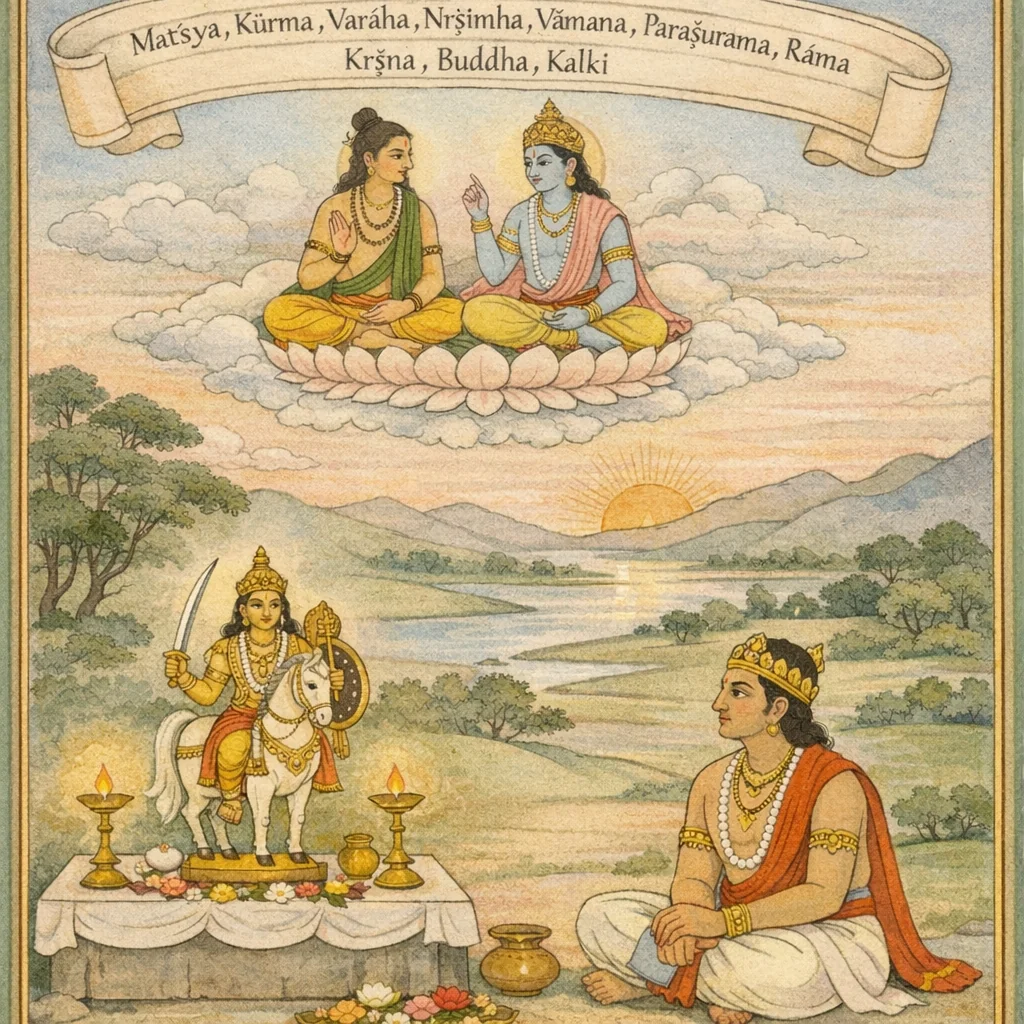
Adhyaya 48: The Kalki Dvādaśī Observance and the Episode of King Viśāla
Kalki-dvādaśī-vrata-vidhiḥ tathā Viśāla-rājopākhyānam
Ritual-Manual with Purāṇic Exemplum (Avatāra-Theology and Royal Ethics)
Within the Varāha–Pṛthivī teaching frame, the chapter lays down the Bhādrapada-śukla Dvādaśī observance centered on Kalki as a form of Viṣṇu: a name-by-name limb invocation in an aṅga-nyāsa style of praise, the installation of a golden image of Kalki, and its gifting to a learned brāhmaṇa. It then offers an exemplum of King Viśāla of Kāśī, who loses his realm and withdraws to Gandhamādana near Badarī, where he meets Nara and Nārāyaṇa; granted a boon, he asks for the capacity to perform yajñas with varied dakṣiṇās. Nara explains Viṣṇu’s avatāra sequence and connects distinct modes of worship to specific aims—knowledge, preservation of lineage, protection, prosperity, offspring, beauty, and the destruction of enemies. The chapter concludes that Viśāla’s Dvādaśī practice restores sovereignty and ultimately leads to liberation, presenting disciplined ritual as a support of social order and earthly stability.
Primary Speakers
Key Concepts
Shlokas in Adhyaya 48
Verse 1
दुर्वासा उवाच । तद्वद् भाद्रपदे मासि शुक्लपक्षे तु द्वादशीम् । सङ्कल्प्य विधिना देवं अर्च्छयेत् परमेश्वरम् ॥ ४८.१ ॥
Durvāsā said: “Likewise, in the month of Bhādrapada, on the Dvādaśī of the bright fortnight, having made the saṅkalpa (formal ritual intention), one should worship the Supreme Lord—Parameśvara—according to the prescribed procedure.”
Verse 2
नमोऽस्तु कल्किने पादौ हृषीकेशाय वै कटिम् । म्लेच्छविध्वंसनायेति जगन्मूर्त्ते तथोदरम् ॥ ४८.२ ॥
Homage to Kalkin—unto the feet; to Hṛṣīkeśa—indeed, unto the waist; as “the destroyer of the mlecchas”—and likewise, homage unto the belly of the One whose form is the universe.
Verse 3
शितिकण्ठाय कण्ठं तु खड्गपाणेति वै भुजौ । चतुर्भुजायेति हस्तौ विश्वमूर्त्ते तथा शिरः ॥ ४८.३ ॥
Let the throat be designated as “for Śitikaṇṭha”; indeed, the arms as “those of Khaḍgapāṇi (the sword-bearer)”; the hands as “those of the four-armed Lord”; and likewise the head as “of Viśvamūrti, the universal-formed One”.
Verse 4
एवमभ्यर्च्य मेधावी प्राग्वत् तस्याग्रतो घटम् । विन्यसेत् कल्किनं देवं सौवर्णं तत्र कारयेत् ॥ ४८.४ ॥
Having thus worshipped, the discerning practitioner should, as before, place a water-pot in front; there he should install the deity Kalkin and have a golden image of Him made there.
Verse 5
सितवस्त्रयुगच्छन्नं गन्धपुष्पोपशोभितम् । कृत्वा प्रभाते विप्राय प्रदेयं शास्त्रवित्तमे । एवं कृते भवेद्यस्तु तन्निबोध महामुने ॥ ४८.५ ॥
Having prepared it, covered with a pair of white garments and adorned with fragrance and flowers, it should be given at dawn to a brāhmaṇa learned in the śāstras. And what fruit arises when this is done thus—hear it, O great sage.
Verse 6
पूर्वं राजा विशालोऽभूत् काश्यां पुर्यां महाबलः । गोत्रजैर्हृतराज्योऽसौ गन्धमादनमाविशत् ॥ ४८.६ ॥
Formerly, in the city of Kāśī, there was a mighty king named Viśāla. Deprived of his kingship by members of his own lineage, he entered (went to) Gandhamādana.
Verse 7
तस्य द्रोण्यां महाराज बदरीं प्राप्य शोभनाम् । हृतराज्यो विशेषेण गतश्रीको नरोत्तमः ॥ ४८.७ ॥
O great king, having reached the splendid Badarī in that valley, the foremost of men—deprived of his kingdom and, in particular, bereft of his former prosperity—arrived there.
Verse 8
कदाचिदागतौ तत्र पुराणावृषिसत्तमौ । नरनारायणौ देवौ सर्वदेवनमस्कृतौ ॥ ४८.८ ॥
At one time, there arrived there the two foremost ancient sages—Nara and Nārāyaṇa—divine beings who are honored by all the gods.
Verse 9
तौ दृष्ट्वा तत्र राजानं पूर्वागतमरिंदमौ । ध्यायन्तं परमं ब्रह्म विष्ण्वाख्यं परमं पदम् ॥ ४८.९ ॥
Having seen there the king who had arrived earlier, those two subduers of enemies beheld him meditating upon the supreme Brahman, the highest abode known as Viṣṇu.
Verse 10
तौ प्रीतावूचतुस् तं तु राजानं क्षीणकल्मषम् । वरं वृणीष्व राजेन्द्र वरदौ स्वस्तवागतौ ॥ ४८.१० ॥
Pleased, the two addressed that king, whose impurities had been exhausted: “O lord of kings, choose a boon. We have arrived safely, and we are granters of boons.”
Verse 11
राजोवाच । भवन्तौ कौ न जानामि कस्य गृह्णाम्यहं वरम् । आराधयामि यत् तस्माद् वरमिच्छामि शोभनम् ॥ ४८.११ ॥
The King said: “I do not know who you two are; from whom should I accept a boon? Since I am offering reverence to the one whom I worship, therefore I desire an auspicious boon.”
Verse 12
एवमुक्तौ तु तौ राज्ञा कामाराधयसे प्रभो । कं वा वरं वृणुष्व त्वं कथयस्व कुतूहलात् ॥ ४८.१२ ॥
Thus addressed by the king, he said: “O Lord, be pleased to honor my request as you will. Choose whatever boon you desire, and tell it to me, for I am curious.”
Verse 13
एवमुक्तस्ततो राजा विष्णुमाराधयाम्यहम् । कथयित्वा स्थितस्तूष्णीं ततस्तावूचतुः पुनः ॥ ४८.१३ ॥
Thus addressed, the king said, “I shall worship Viṣṇu.” Having spoken, he fell silent; then those two spoke again.
Verse 14
राजन् तस्यैव देवस्य प्रसादादावयोर् वरः । दातव्यस् ते वरं ब्रूहि कस् ते मनसि वर्तते ॥ ४८.१४ ॥
“O King, by the grace of that very deity, it is for us two to grant you a boon. Speak—declare the boon: what abides in your mind?”
Verse 15
राजोवाच । यथा यज्ञेश्वरं देवं यज्ञैर्विविधदक्षिणैः । यष्टुं समर्थता मे स्यात् तथा मे ददतां वरम् ॥ ४८.१५ ॥
The king said: “Grant me a boon by which I may be able to worship the divine Lord of sacrifice (Yajñeśvara) through sacrificial rites, accompanied by diverse honorific gifts (dakṣiṇās).”
Verse 16
नर उवाच । स्वयं नारायणो देवो लोकमार्गप्रदर्शकः । मया सह तपः कुर्याद् बदर्यां लोकभावनः ॥ ४८.१६ ॥
Nara said: “May Nārāyaṇa himself—the divine revealer of the world’s path—perform ascetic practice (tapas) together with me at Badarī, he who sustains and blesses the worlds.”
Verse 17
अयं मत्स्योऽभवत् पूर्वं पुनः कूर्मस्वरूपवान् । वराहश्चाभवद् देवो नरसिंहस्ततोऽभवत् ॥ ४८.१७ ॥
Formerly he became Matsya, the Fish; again he assumed the form of Kūrma, the Tortoise. The God also became Varāha, the Boar; thereafter he became Narasiṁha, the Man-Lion.
Verse 18
वामनस्तु ततो जातो जामदग्न्यो महाबलः । पुनर्दाशरथिर्भूत्वा वासुदेवः पुनर्बभौ ॥ ४८.१८ ॥
Then Vāmana was born; then the mighty Jāmadagnya (Paraśurāma). Again, having become the son of Daśaratha (Rāma), Vāsudeva manifested once more.
Verse 19
बुद्धो भूत्वा जनं ह्येष मोहयामास पार्थिव । सपत्नान् दस्यवो म्लेच्छान् पुनर्हत्वा महीमिमाम् । प्रकृतिस्थां चकारायं स एष भगवान् हरिः ॥ ४८.१९ ॥
O king, having become the Buddha, he indeed caused the people to be deluded. Then, having again slain the rivals—bandits and mlecchas—he restored this earth to a settled order in accord with its own nature. This very one is Bhagavān Hari.
Verse 20
पूज्यते मत्स्यरूपेण सर्वज्ञत्वमभीप्सुभिः । स्ववंशोद्धरणार्थाय कूर्मरूपी तु पूज्यते ॥ ४८.२० ॥
He is worshipped in the form of Matsya, the Fish, by those who seek omniscience; and, for the sake of rescuing and preserving one’s own lineage, he is worshipped in the form of Kūrma, the Tortoise.
Verse 21
भवोदधिनिमग्नेन वाराहः पूज्यते हरिः । नारसिंहेन रूपेण तद्वत् पापभयाद् नरैः ॥ ४८.२१ ॥
One who has sunk into the ocean of worldly becoming (saṁsāra) should venerate Hari in the form of Varāha; likewise, men afflicted by fear of sin should venerate him in the form of Narasiṁha.
Verse 22
वामनं मोहनाशाय वित्तार्थे जगदग्निजम् । क्रूरशत्रुविनाशाय यजेद् दाशरथिं बुधः ॥ ४८.२२ ॥
For the removal of delusion, the wise should worship Vāmana; for the attainment of wealth, (they should worship) Jagadagnija; and for the destruction of cruel enemies, the wise should worship Dāśarathi (Rāma).
Verse 23
बालकृष्णौ यजेद् धीमान् पुत्रकामो न संशयः । रूपकामो यजेद् बुद्धं कल्किनं शत्रुघातने ॥ ४८.२३ ॥
A discerning person who desires a son should worship Bāla-Kṛṣṇa—without doubt. One who desires beauty should worship the Buddha; and (one should worship) Kalkin for the destruction of enemies.
Verse 24
एवमुक्त्वा नरस्तस्य इमामेवाब्रवीन् मुनिः । द्वादशीं कृतवान् सोऽपि चक्रवर्ती बभूव ह । तस्यैव नाम्ना बदरी विशालाख्या अभवन् मुने ॥ ४८.२४ ॥
Having spoken thus, Nara conveyed this very statement to him; and he too, having established the observance of the Dvādaśī, indeed became a universal sovereign (cakravartin). And by his very name, O sage, the place Badarī came to be known as “Viśālā”.
Verse 25
इह जन्मनि राजा असौ राज्यं कृत्वा इयाद् वनम् । यज्ञैश्च विविधैरिष्ट्वा परं निर्वाणमाप्तवान् ॥ ४८.२५ ॥
In this very life, that king—having exercised kingship—went to the forest; and, having performed various sacrifices, he attained the highest nirvāṇa (final release).
Frequently Asked Questions
The text frames disciplined ritual action (vrata, arcana, dāna, and yajña) as a mechanism for restoring social and political order while aligning human aims with a broader cosmic/terrestrial balance; the avatāra taxonomy is used to map specific intentions (knowledge, protection, prosperity, lineage, conflict resolution) to regulated forms of worship rather than impulsive action.
The observance is specified for Bhādrapada māsa during the śukla pakṣa on Dvādaśī tithi, with worship performed by rule (vidhinā) and the dāna (gift of the prepared item/image) given in the morning (prabhāte).
Although not a direct ecological manual, the chapter links dharma-centered rites and the avatāra principle to the re-establishment of the world in a stable condition (prakṛti-sthāpanā), implying that orderly governance, redistribution through dakṣiṇā/dāna, and restrained conduct contribute to Pṛthivī’s sustaining equilibrium—an Earth-centered ethic consistent with the Varāha–Pṛthivī framework.
The narrative references King Viśāla of Kāśī and the ascetic divine pair Nara and Nārāyaṇa at Badarī; it also enumerates culturally central avatāra figures of Viṣṇu (Matsya, Kūrma, Varāha, Narasiṃha, Vāmana, Jāmadagnya/Paraśurāma, Dāśarathi/Rāma, Vāsudeva/Kṛṣṇa, Buddha, and Kalki) as a doctrinal lineage of world-order interventions.