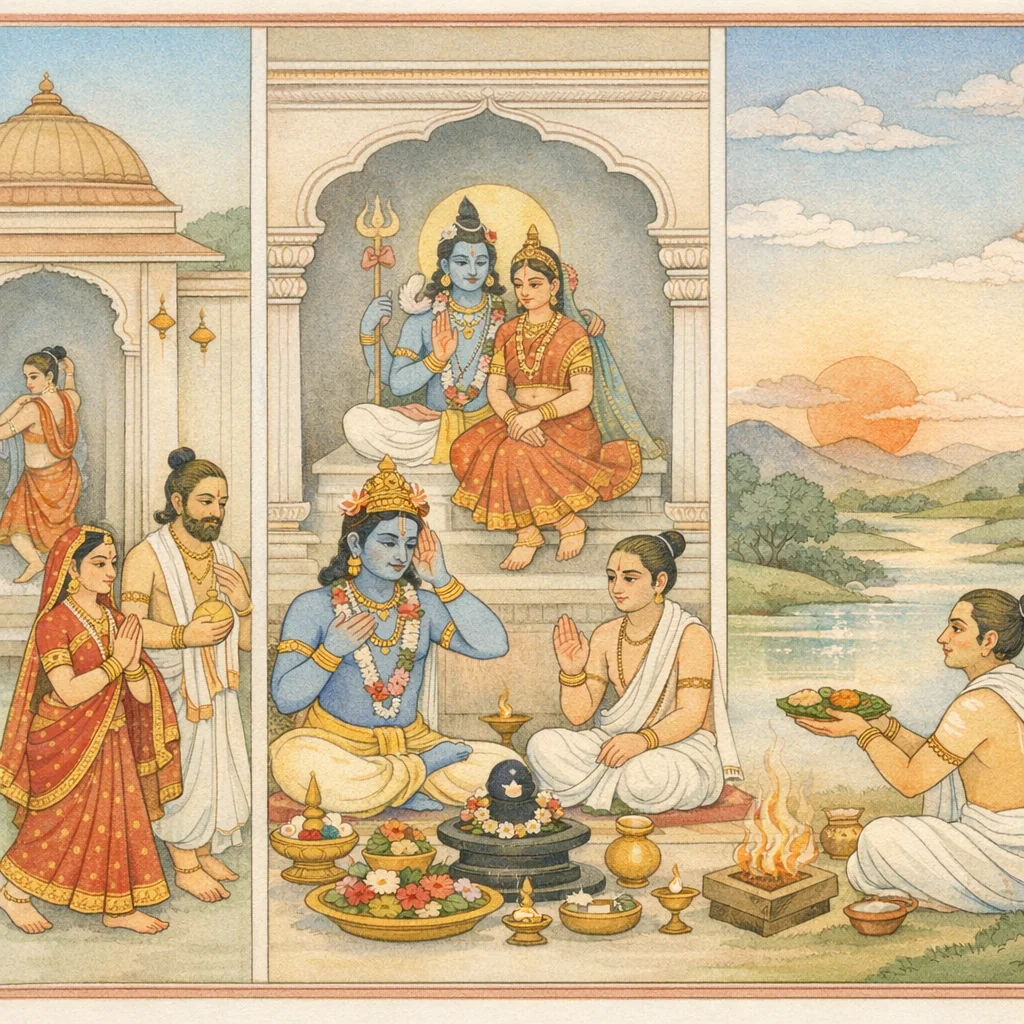
Adhyaya 44: The Vaiśākha Bright-Twelfth Observance: Worship of Hari as Jāmadagnya and Its Fruits
Vaiśākha-śukla-dvādaśī-vrata (Jāmadagnya-Hari-pūjā) phala-kathana
Ritual-Manual (Vrata-vidhi) with Phalaśruti Narrative
Within the Varāha–Pṛthivī teaching frame, this chapter sets out the ritual procedure for the bright-twelfth (dvādaśī) observance in Vaiśākha and illustrates its power through a royal example. After bathing and taking preparatory vows, the practitioner goes to a temple and worships Hari with a sequence of body-part invocations (pāda, udara, kaṭi, bāhu, kaṇṭha, śiras). A covered vessel (ghaṭa) is then installed, and Hari is established in a special vessel (vaiṇava-pātra), fashioned with a paraśu in the right hand and honored with fragrances and flowers. A night vigil (jāgara) follows, and at sunrise offerings are given to a brāhmaṇa. The narrative recounts King Vīrasena’s childlessness, Yājñavalkya’s counsel that this dvādaśī grants a son with minimal hardship, and the birth of Nala, expanding to postmortem rewards (sojourn in Brahmaloka, companionship of apsaras) and renewed sovereignty—presenting ritual discipline, regulated conduct, and gift-giving as stabilizing society and sustaining the Earth.
Primary Speakers
Key Concepts
Shlokas in Adhyaya 44
Verse 1
दुर्वासा उवाच । वैशाखेऽप्येवमेवं तु संकल्प्य विधिना नरः । तद्वत् स्नानादिकं कृत्वा ततो देवालयं व्रजेत् ॥ ४४.१ ॥
Durvāsā said: “In the month of Vaiśākha as well, having thus made the formal resolve (saṅkalpa) in accordance with the prescribed procedure, a man should perform bathing and the related observances in the same manner; thereafter he should proceed to a temple.”
Verse 2
तत्राराध्य हरिं भक्त्या एभिर्मन्त्रैर्विचक्षणः । जामदग्न्याय पादौ तु उदरं सर्वधारिणे । मधुसूदनायेति कटिमुरः श्रीवत्सधारिणे ॥ ४४.२ ॥
There, the discerning practitioner should worship Hari with devotion by these mantras: for the feet, recite “to Jāmadagnya”; for the belly, “to the All-Supporting One”; and for the waist and chest, “to Madhusūdana”—to Him who bears the mark of Śrīvatsa.
Verse 3
क्षत्रान्तकाय च भुजौ मणिकण्ठाय कण्ठकम् । स्वनाम्ना शङ्खचक्रौ तु शिरो ब्रह्माण्डधारिणे ॥ ४४.३ ॥
And (he should assign) the arms to Kṣatrāntaka, the neck-ornament to Maṇikaṇṭha; the conch and the discus are to be invoked by their own names; and the head to the Bearer of the cosmic egg (brahmāṇḍa).
Verse 4
एवमभ्यर्च्य मेधावी प्राग्वत् तस्याग्रतो घटम् । विन्यस्य स्थगितं तद्वद् वस्त्रयुग्मेन वेष्टितम् ॥ ४४.४ ॥
Having thus performed the worship, the wise person should, as before, place a water-pot in front; it too should be covered and wrapped with a pair of cloths.
Verse 5
वैणवेन तु पात्रेण तस्मिन् संस्थापयेद्धरिम् । जामदग्न्येति विख्यातं नाम्ना क्लेशविनाशनम् ॥ ४४.५ ॥
Then, using a Vaiṣṇava vessel, one should install Hari therein—Hari renowned by the name “Jāmadagnya,” a name said to destroy the kleśas, the afflictions.
Verse 6
दक्षिणे परशुं हस्ते तस्य देवस्य कारयेत् । सर्वगन्धैश्च सम्पूज्य पुष्पैर्नानाविधैः शुभैः ॥ ४४.६ ॥
In the right hand of that deity, one should have an axe (paraśu) fashioned; and, having duly worshipped with all kinds of fragrances, one should also worship with many varieties of auspicious flowers.
Verse 7
ततस्तस्याग्रतः कुर्याज्जागरं भक्तिमान्नरः । प्रभाते विमले सूर्ये ब्राह्मणाय निवेदयेत् । एवं नियमयुक्तस्य यत्फलं तन्निबोध मे ॥ ४४.७ ॥
Then a devoted person should keep vigil in its presence. At dawn, when the sun is clear and pure, one should present (the offering) to a brāhmaṇa. Now learn from me what fruit accrues to one who is disciplined by such observances.
Verse 8
आसीद् राजा महाभागो वीरसेनो महाबलः । अपुत्रः स पुरा तीव्रं तपस्तेपे महौजसा ॥ ४४.८ ॥
There once was a king, most fortunate and greatly powerful, named Vīrasena. Formerly childless, he performed intense austerity with great spiritual vigor.
Verse 9
चरस्तत्तपो घोरं याज्ञवल्क्यो महामुनिः । आजगाम महायोगी तं दृष्ट्वा नातिदूरतः ॥ ४४.९ ॥
While Yājñavalkya, the great sage, was engaged in that fierce austerity, a great yogin approached; seeing him from not too far away, he came near.
Verse 10
तमायान्तमथो दृष्ट्वा ऋषिं परमवर्चसम् । कृताञ्जलिपुटो भूत्वा राजाभ्युत्थानमाकरॊत् ॥ ४४.१० ॥
Then, seeing the sage approaching—one of exceptional radiance—the king, joining his hands in reverence, rose in respectful reception.
Verse 11
स पूजितो मुनिः प्राह किमर्थं तप्यते तपः । राजन् कथय धर्मज्ञ किं ते कार्यं विवक्षितम् ॥ ४४.११ ॥
Having been duly honored, the sage said: “For what purpose is this austerity being undertaken? O king, knower of dharma, speak—what is the matter you wish to declare?”
Verse 12
राजोवाच । अपुत्रोऽहं महाभाग नास्ति मे पुत्रसन्ततिः । तेन मे तप आस्थाय क्रिष्यते स्वतनुर्द्विज ॥ ४४.१२ ॥
The king said: “O fortunate one, I am without a son; there is no line of sons for me. Therefore, having undertaken austerity, my own body, O twice-born, is becoming emaciated.”
Verse 13
याज्ञवल्क्य उवाच । अलं ते तपसाऽनेन महाक्लेशेन पार्थिव । अल्पायासेन ते पुत्रो भविष्यति न संशयः ॥ ४४.१३ ॥
Yājñavalkya said: “Enough of this austerity for you, O king, with such great hardship. With only slight effort, a son will be born to you—there is no doubt.”
Verse 14
राजोवाच । कथं मे भविता पुत्रोऽल्पायासेन वै द्विज । एतन्मे कथय प्रीतो भगवन् प्रणतस्य ह ॥ ४४.१४ ॥
The king said: “O twice-born one, how will a son be born to me with little effort? Tell me this, O venerable sir, being pleased—(tell it) to me who has bowed down in submission.”
Verse 15
दुर्वासा उवाच । एवमुक्तो मुनिस्तेन पार्थिवेन यशस्विना । आचख्यौ द्वादशीं चेमां वैशाखे सितपक्षजाम् ॥ ४४.१५ ॥
Durvāsā said: Thus addressed by that illustrious king, the sage then explained this Dvādaśī observance—arising in the bright fortnight of the month of Vaiśākha.
Verse 16
स हि राजा विधानॆन पुत्रकामो विशेषतः । उपोष्य लब्धवान् पुत्रं नलं परमधार्मिकम् । योऽद्यापि कीर्त्यते लोके पुण्यश्लोको नरोत्तमः ॥ ४४.१६ ॥
For that king—especially desiring a son—observed the prescribed rite and, having fasted, obtained a son, Nala, supremely righteous; even today he is celebrated in the world as a man of noble excellence, renowned through meritorious fame.
Verse 17
प्रासङ्गिकं फलं ह्येतद्गतस्यास्य महामुने । सुपुत्रो जायते वित्तविद्यावान्कान्तिरुत्तमा ॥ ४४.१७ ॥
O great sage, this indeed is an incidental fruit for one who has gone there (or has undertaken this practice): a good son is born; one becomes endowed with wealth and learning; and excellent radiance (or beauty) arises.
Verse 18
इह जन्मनि किं चित्रं परलोके शृणुष्व मे । कल्पमेकं ब्रह्मलोके वसित्वाऽप्सरसां गणैः ॥ ४४.१८ ॥
What is remarkable about this life? Hear from me about the other world: having dwelt for a single kalpa in Brahmaloka, one lives among the companies of apsarases.
Verse 19
क्रीडत्यन्ते पुनः सृष्टौ चक्रवर्ती भवेद् ध्रुवम् । त्रिंशत्यब्दसहस्राणि जीवते नात्र संशयः ॥ ४४.१९ ॥
At the end (of an age), when creation arises again, he will certainly become a cakravartin (universal sovereign). He lives for thirty thousand years—of this there is no doubt.
Frequently Asked Questions
The text frames disciplined ritual practice (snāna, pūjā, jāgara, and dāna) as a structured form of ethical self-regulation that yields social goods—especially lineage continuity and stable kingship—while promoting orderly resource use and reciprocity through offerings and brāhmaṇa-nivedana.
The observance is specified for Vaiśākha during the bright fortnight (śukla-pakṣa), explicitly on dvādaśī (the twelfth lunar day). The rite culminates at prabhāta when the sun is clear (vimala sūrya), indicating a sunrise completion and gifting moment.
Although not explicit as an ecological treatise, the chapter implies Earth-oriented balance through regulated, calendrically timed conduct: bathing practices tied to seasonal cycles, restrained and formalized use of water, flowers, and fragrances, and a redistribution ethic (nivedana) that channels resources through socially recognized stewardship roles—an indirect model of sustainable ritual economy.
The narrative references Durvāsas as the narrator of the instruction, the sage Yājñavalkya as the advising authority, King Vīrasena as the exemplar, and Nala as the famed son produced through the dvādaśī observance; Hari is invoked with epithets including Jāmadagnya and Madhusūdana, and iconographically associated with the paraśu.