Adhyaya 42: Ritual Procedure for the Phālguna Bright-Fortnight Dvādaśī Narasiṃha Worship, with the Narrative of King Vatsa
Phālguṇa-śukla-dvādaśī-narasiṃha-pūjāvidhiḥ (Vatsa-nṛpa-kathā ca)
Ritual-Manual with Exemplary Royal Narrative (Vrata-Māhātmya)
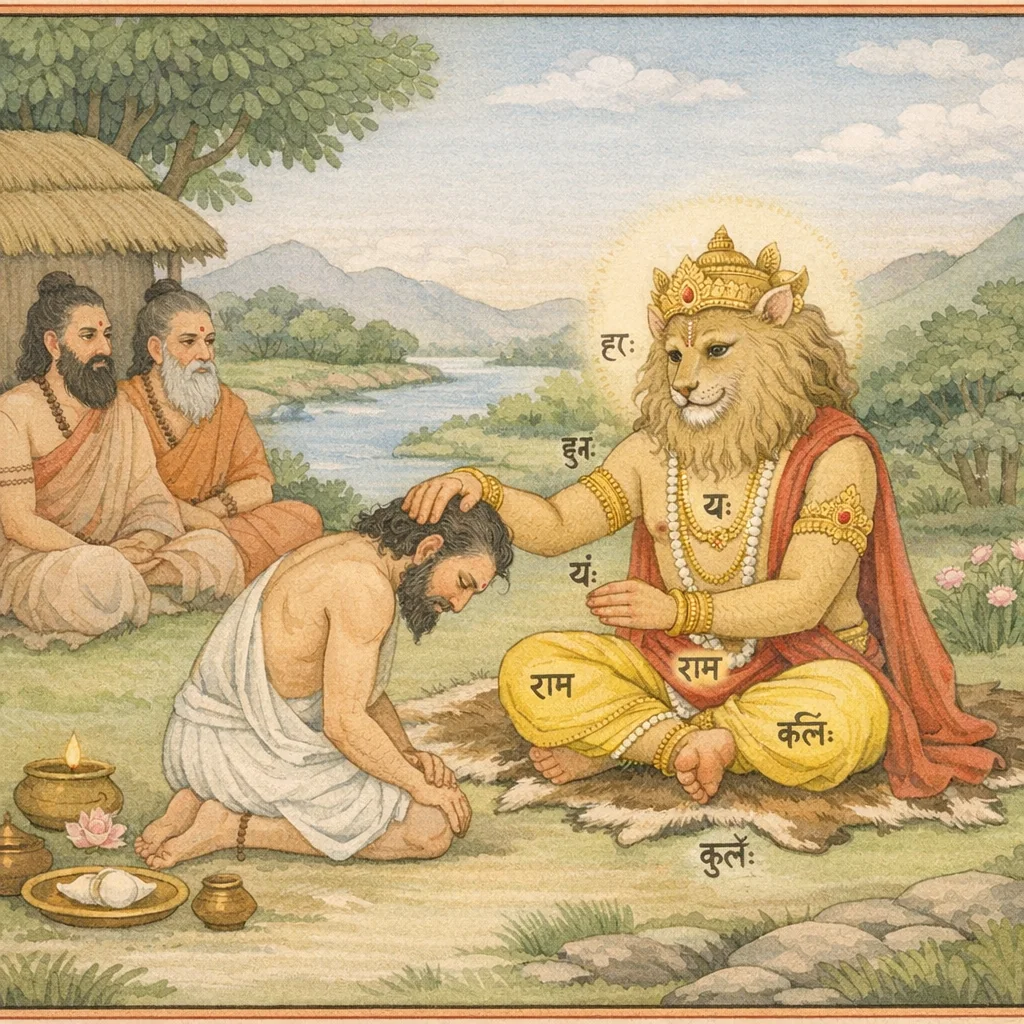
Within the Varāha–Pṛthivī teaching frame, Durvāsas sets forth the Phālguna śukla-dvādaśī observance: fasting, then a carefully ordered worship of Hari/Narasiṃha through body-part invocations (feet, thighs, waist, chest, throat, head), along with honoring the cakra and śaṅkha using gandha, puṣpa, and phala. The rite includes preparing a clothed ritual pot (ghaṭa) and installing a Narasiṃha image—ideally of gold, otherwise copper, or even wood/bamboo—culminating in gifting it on Dvādaśī to a Veda-knowing brāhmaṇa. To confirm its power, the chapter recounts King Vatsa of Kiṃpuruṣa-varṣa, dispossessed by enemies, taking refuge at Vasiṣṭha’s āśrama, performing the vrata, receiving a weapon-like cakra that restores political order, and attaining Viṣṇuloka, presenting the vow as a means to re-stabilize society and thus uphold Pṛthivī’s order.
Primary Speakers
Key Concepts
Shlokas in Adhyaya 42
Verse 1
दुर्वासा उवाच । तद्वत् फाल्गुनमासे तु शुक्लपक्षे तु द्वादशीम् । उपोष्य प्रोक्तविधिना हरिमाराधयेत् सुधीः ॥ ४२.१ ॥
Durvāsā said: “Likewise, in the month of Phālguna, on the twelfth lunar day (Dvādaśī) in the bright fortnight, having observed a fast according to the stated procedure, the wise person should worship Hari.”
Verse 2
नरसिंहाय पादौ तु गोविन्दायेत्युरू तथा । कटिं विश्वभुजे पूज्य अनिरुद्धेत्युरस्तथा ॥ ४२.२ ॥
One should designate the feet to Narasiṁha; likewise the thighs with the formula “to Govinda.” The waist is to be revered as belonging to Viśvabhuja; and the chest likewise with the formula “to Aniruddha.”
Verse 3
कण्ठं तु शितिकण्ठाय पिङ्गकेशाय वै शिरः । असुरध्वंसनायेति चक्रं तोयात्मने तथा । शङ्खमित्येव सम्पूज्य गन्धपुष्पफलैस्तथा ॥ ४२.३ ॥
One should worship the throat-region for Śitikaṇṭha and the head for Piṅgakeśa; likewise, worship the discus (cakra) with the formula “for the destroyer of the asuras,” and the conch (śaṅkha) for Toyātman—duly honoring these with fragrances, flowers, and fruits.
Verse 4
तदग्रे घटमादाय सितवस्त्रयुगान्वितम् । तस्योपरि नृसिंहं तु सौवर्णं ताम्रभाजने । सौवर्णशक्तितः कृत्वा दारुवंशमयेऽपि वा ॥ ४२.४ ॥
Then, in front, taking a water-pot (ghaṭa) furnished with a pair of white cloths, one should place above it a golden image of Nṛsiṃha in a copper vessel; if one has the means, it should be made of gold, or else it may be made of wood or bamboo.
Verse 5
रत्नगर्भघटे स्थाप्य तं संपूज्य च मानवः । द्वादश्यां वेदविदुषे ब्राह्मणाय निवेदयेत् ॥ ४२.५ ॥
Having placed it in a pot containing jewels (ratna-garbha ghaṭa) and having duly honored it, a person should, on the twelfth lunar day (Dvādaśī), present it to a learned Brāhmaṇa who is versed in the Vedas.
Verse 6
एवं कृते फलं प्राप्तं यत् पुरा पार्थिवेन तु । तस्याहं संप्रवक्ष्यामि वत्सनाम्ना महामुने ॥ ४२.६ ॥
When it is done in this manner, one attains the fruit that a king obtained in former times; of that fruit I shall now give a full account, O great sage, under the name “Vatsa”.
Verse 7
आसीत् किम्पुरुषे वर्षे राजा परमधार्मिकः । भारत इति च विख्यातस्तस्य वत्सः सुतोऽभवत् ॥ ४२.७ ॥
In the region called Kiṃpuruṣa-varṣa there was a king of exemplary dharmic conduct, renowned by the name Bhārata; and he had a son named Vatsa.
Verse 8
स शत्रुभिर्जितः सङ्ख्ये हृतकोशो द्विपादवान् । वनं प्रायात् सपत्नीको वसिष्ठस्याश्रमेऽवसत् ॥ ४२.८ ॥
Defeated by enemies in battle, his treasury seized though his elephants remained, he went to the forest with his wife and dwelt in the hermitage of Vasiṣṭha.
Verse 9
कालेन गच्छता सोऽथ वसिष्ठेन महर्षिणा । किं कार्यमिति स प्रोक्तो वसस्यास्मिन् महाश्रमे ॥ ४२.९ ॥
As time passed, the great seer Vasiṣṭha addressed him in this great hermitage of Vasu, asking: “What is to be done—what is your purpose here?”
Verse 10
राजोवाच । भगवन् हृतकोशोऽहं हृतराज्यो विशेषतः । शत्रुभिर्हतसंकल्पो भवन्तं शरणं गतः । उपदेशप्रदानेन प्रसादं कर्तुमर्हसि ॥ ४२.१० ॥
The king said: “O Blessed One, my treasury has been taken, and above all my kingdom has been taken. My resolve has been shattered by enemies; I have come to you for refuge. By granting instruction, be pleased to show me favor.”
Verse 11
एवमुक्तो वसिष्ठस्तु तस्येमां द्वादशीं मुने । विधिना प्रत्युवाचाथ सोऽपि सर्वं तथा अकरोत् ॥ ४२.११ ॥
Thus addressed, Vasiṣṭha replied to him, O sage, concerning this Dvādaśī observance according to proper procedure; and he too carried out everything in that very manner.
Verse 12
तस्य व्रतान्ते भगवान्नारसिंहस्तुतोष ह । चक्रं प्रादाच्च शत्रूणां विध्वंसनकरं परम् ॥ ४२.१२ ॥
At the conclusion of his vow, the Blessed Lord Narasiṁha was satisfied and granted a discus (cakra) supremely capable of destroying enemies.
Verse 13
तेनास्त्रेण स्वकं राज्यं जितवान् स नृपोत्तमः । राज्ये स्थित्वाऽश्वमेधानां सहस्रमकरोद्विभुः । अन्ते च विष्णुलोकाख्यं पदमाप च सत्तम ॥ ४२.१३ ॥
By that weapon, the excellent king conquered and secured his own kingdom. Established in his reign, the mighty one performed a thousand Aśvamedha sacrifices; and in the end, the best of men attained the state known as Viṣṇu’s world.
Verse 14
एषा धन्या पापहरा द्वादशी भवतो मुने । कथिता या प्रयत्नेन श्रुत्वा कुरु यथेप्सितम् ॥ ४२.१४ ॥
O sage, this is the auspicious Dvādaśī that removes sin; I have explained it to you with due effort. Having heard it, act as you wish.
Frequently Asked Questions
The text links disciplined observance (upavāsa, precise pūjā, and dāna) with the restoration of order: personal restraint and correct ritual gifting are presented as mechanisms that re-establish disrupted kingship and social stability, which implicitly supports Pṛthivī’s well-being through renewed governance and reduced conflict.
The observance is assigned to Phālguna-māsa during the śukla-pakṣa on Dvādaśī tithi. The procedure includes fasting on Dvādaśī and making the prescribed offering/gift to a vedavid brāhmaṇa specifically on that Dvādaśī.
While not explicitly ecological in vocabulary, the chapter frames terrestrial balance through socio-political stability: the king’s loss of treasury and realm leads to displacement and disorder, and the rite’s outcome restores governance and security. In the Varāha–Pṛthivī frame, such restoration functions as an indirect ethic of protecting Pṛthivī by re-aligning human conduct, redistribution (dāna), and lawful rule.
Durvāsas functions as the transmitting authority for the rite; Vasiṣṭha appears as the advising maharṣi at whose āśrama the dispossessed King Vatsa takes refuge; Vatsa is the exemplary ruler whose narrative demonstrates the vrata’s promised results (victory, restored rājya, and final attainment of Viṣṇuloka).