Adhyaya 31: The Manifestation of Viṣṇu’s Form for Cosmic Governance (the Vaiṣṇava Creation Narrative)
Vaiṣṇava-sarga-prādurbhāvaḥ (Manu-nāma-nimittaṃ Viṣṇoḥ mūrtidhāraṇam)
Cosmogony & Theological-Philosophical Discourse
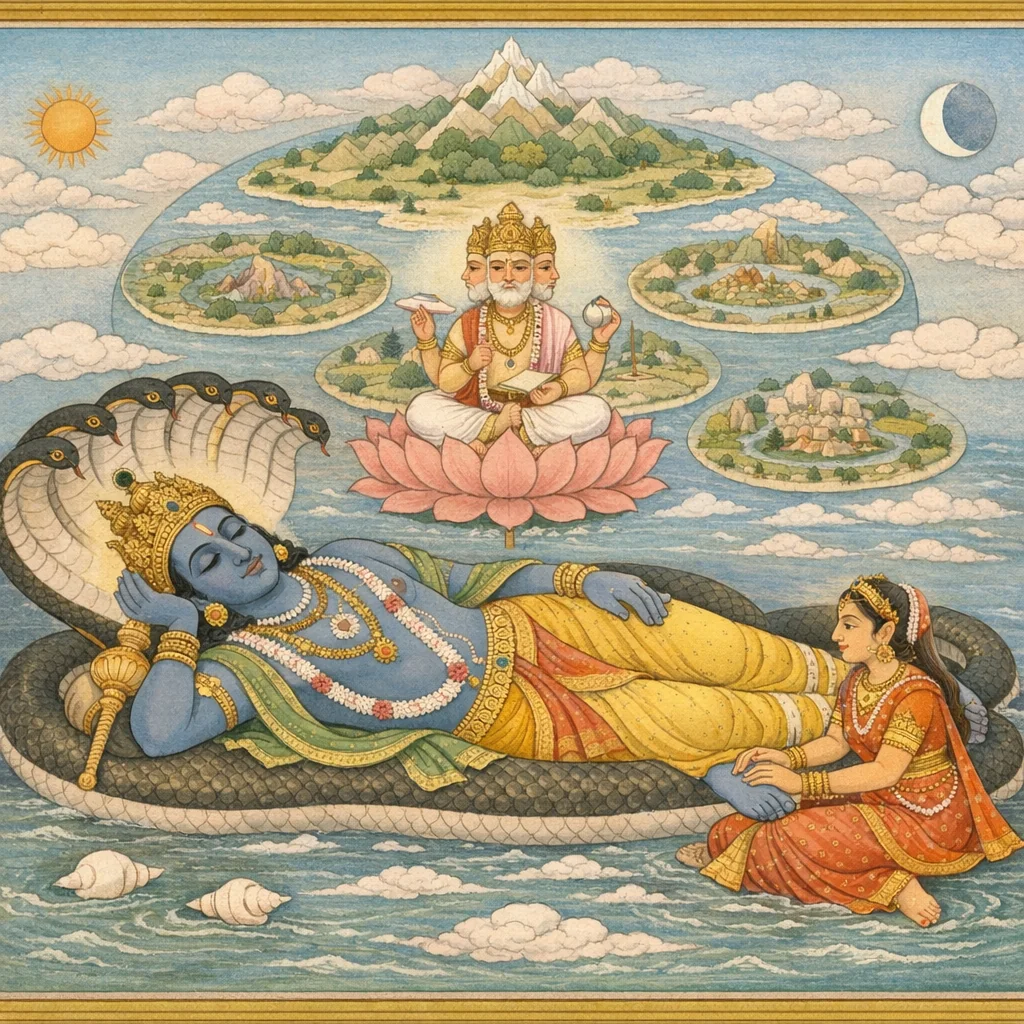
Set within the Purāṇic teaching frame of Varāha instructing Pṛthivī, this chapter gives a cosmogonic account of why Viṣṇu assumes a manifest form to sustain the created world. Mahātapā relates that Nārāyaṇa, contemplating creation and its maintenance, realizes that ritual action (karma-kāṇḍa) cannot proceed without embodiment; therefore he projects a single governing mūrti. As the Lord enters that form, the three worlds are said to be contained within his body, and a primordial boon is recalled and reaffirmed, establishing Viṣṇu’s omniscience and cosmic office. Viṣṇu then enters yoganidrā; from him arises the lotus-structure bearing the earth with seven continents, oceans, forests, and the underworld, with Meru at the center and Brahmā appearing within it. The narrative describes the emblematic weapons and auspicious marks (śaṅkha, khaḍga, cakra, gadā, Śrīvatsa, Kaustubha, Lakṣmī), extols the salvific observance of Dvādaśī, and ends with a phalaśruti promising merit for hearing this Vaiṣṇava creation account, linking cosmic order with the preservation of Pṛthivī’s balance.
Primary Speakers
Key Concepts
Shlokas in Adhyaya 31
Verse 1
महातपा उवाच । मनोर् नाम मनुत्वं च यदेतत् पठ्यते किल । प्रयोजनवशाद् विष्णुरसावेव तु मूर्त्तिमान् ॥ ३१.१ ॥
Mahātapā said: “Indeed, what is recited as ‘the name of Manu’ and ‘the state of being Manu’—that very one is Viṣṇu, embodied, assuming form in accordance with a particular purpose.”
Verse 2
योऽसौ नारायणो देवः परात्परतरॊ नृप । तस्य चिन्ता समुत्पन्ना सृष्टिं प्रति नरोत्तम ॥ ३१.२ ॥
O king, that Nārāyaṇa—higher than the highest—conceived an intention directed toward creation, O best of men.
Verse 3
सृष्टा चेयं मया सृष्टिः पालनिया मयैव ह । कर्मकाण्डं त्वमूर्त्तेन कर्तुं नैवेह शक्यते । तस्मान्मूर्त्तिं सृजाम्येकां यया पाल्यमिदं जगत् ॥ ३१.३ ॥
“This creation has been created by me, and indeed it must be protected by me. But ritual action (karmakāṇḍa) cannot be performed here by one who is formless. Therefore I create a single embodied form, by which this world may be governed and protected.”
Verse 4
एवं चिन्तयतस्तस्य सत्याभिध्यायिनो नृप । प्राक्सृष्टिजातं राजन् वै मूर्त्तिमत् तत्पुरो बभौ ॥ ३१.४ ॥
As he thus reflected, O king—one whose sacred intent (abhidhyāya) was unfailingly effective—there appeared before him indeed an embodied form, born of the primordial creation.
Verse 5
पुरोभूते ततस्तस्मिन् देवो नारायणः स्वयम् । प्रविशन्तं ददर्शाथ त्रैलोक्यं तस्य देहतः ॥ ३१.५ ॥
Then, when that manifestation came to the fore, the god Nārāyaṇa himself was seen entering; and from his body the three worlds were beheld.
Verse 6
ततः सस्मार भगवान् वरदानं पुरातनम् । वागादीनां ततस्तुष्टः प्रादात् तस्य पुनर्वरम् ॥ ३१.६ ॥
Then the Blessed Lord recalled the ancient granting of a boon; and thereafter, being satisfied with his speech and related conduct, he again bestowed upon him a boon.
Verse 7
सर्वज्ञः सर्वकर्त्ता त्वं सर्वलोकनमस्कृतः । त्रैलोक्यविघ्ननाशाच्च त्वं भव विष्णुः सनातनः ॥ ३१.७ ॥
You are omniscient; you are the maker of all; you are revered by all worlds. And as the remover of obstacles throughout the three worlds, be manifest as Viṣṇu, the Eternal.
Verse 8
देवानां सर्वदा कार्यं कर्त्तव्यं ब्रह्मणस्तथा । सर्वज्ञत्वं च भवतु तव देव न संशयः ॥ ३१.८ ॥
The duty of the gods should always be carried out, and likewise that of Brahmā. And may omniscience be yours, O Deva—there is no doubt about it.
Verse 9
एवमुक्त्वा ततो देवः प्रकृतिस्थो बभूव ह । विष्णुरप्यधुना पूर्वां बुद्धिं सस्मार च प्रभुः ॥ ३१.९ ॥
Having spoken thus, the god then entered a state grounded in Prakṛti, the primordial nature. And Viṣṇu too, the sovereign Lord, recalled the former Buddhi, the intellect that had existed before.
Verse 10
तदा सञ्चिन्त्य भगवान् योगनिद्रां महातपाः । तस्यां संस्थाप्य भगवानिन्द्रियार्थोद्भवाः प्रजाः । ध्यात्वा परेण रूपेण ततः सुष्वाप वै प्रभुः ॥ ३१.१० ॥
Then the Blessed Lord, the great ascetic, reflected upon yoga-nidrā, the yogic sleep. Having established within that state the beings born of the objects of the senses, and meditating upon the supreme form, the Lord indeed entered sleep.
Verse 11
तस्य सुप्तस्य जठरान्महत्पद्मं विविसृष्टम् । सप्तद्वीपवती पृथ्वी ससमुद्रा सकानना ॥ ३१.११ ॥
From the belly of him who lay asleep, a great lotus was emitted; and the Earth, possessing seven continents, came forth together with the oceans and the forests.
Verse 12
तस्य रूपस्य विस्तारं पातालं नालसंस्थितम् । कर्णिकायां तथा मेरुस्तन्मध्ये ब्रह्मणो भवः ॥ ३१.१२ ॥
In the expanse of that form, Pātāla is situated in the stalk; likewise Meru is in the pericarp, the central seed-cup. In its very middle lies the origin of Brahmā.
Verse 13
एवं दृष्ट्वा परं तस्य शरीरस्य तु सम्भवम् । मुमुचे तच्छरीरस्थो वायुर् वायुं समं सृजत् ॥ ३१.१३ ॥
Having thus beheld the further emergence of that body, the Wind, abiding within that body, was released, generating wind equal to itself.
Verse 14
अविद्याविजयं चेमं शङ्खरूपेण धारय । अज्ञानच्छेदनार्थाय खङ्गं तेऽस्तु सदा करे ॥ ३१.१४ ॥
Bear this victory over ignorance in the form of the conch; and, to cut through non-knowledge, may a sword ever remain in your hand.
Verse 15
कालचक्रमिमं घोरं चक्रं त्वं धारयाच्युत । अधर्मगजघातार्थं गदां धारय केशव ॥ ३१.१५ ॥
O Acyuta, bear this formidable Wheel of Time—the discus. O Keśava, bear the mace to strike down the ‘elephant’ of adharma (unrighteousness).
Verse 16
मालेयं भूतमाता ते कण्ठे तिष्ठतु सर्वदा । श्रीवत्सकौस्तुभौ चेमौ चन्द्रादित्यच्छलेन ह ॥ ३१.१६ ॥
O Mother of beings, may this garland remain upon your neck at all times; and may these two—Śrīvatsa and Kaustubha—be present under the guise of the Moon and the Sun.
Verse 17
मारुतस्ते गतिर्वीर गरुत्मान् स च कीर्तितः । त्रैलोक्यगामिनी देवी लक्ष्मीस्तेऽस्तु सदाश्रये । द्वादशी च तिथिस्तेऽस्तु कामरूपी च जायते ॥ ३१.१७ ॥
O hero, may Māruta (the Wind) be your course; and may Garutmān (Garuḍa) also be proclaimed for you. O perpetual refuge, may the goddess Lakṣmī—who moves through the three worlds—be yours. May the Dvādaśī lunar day be yours; and one becomes able to assume forms at will.
Verse 18
घृताशनो भवेद्यस्तु द्वादश्यां त्वल्परायणः । स स्वर्गवासी भवतु पुमान् स्त्री वा विशेषतः ॥ ३१.१८ ॥
Whoever, though of modest means, takes ghee as food on Dvādaśī—the twelfth lunar day—whether a man or, especially, a woman, may become a dweller in heaven.
Verse 19
एष विष्णुस्तवाख्यातो मूर्तयो देवदानवान् । हन्ति पाति शरीराणि सृजत्यन्यानि चात्मनः ॥ ३१.१९ ॥
This is Viṣṇu, thus declared to you: through embodied forms among the gods and the dānavas, he strikes down and protects bodies, and from himself also brings forth other forms.
Verse 20
युगे युगे सर्वगोऽयं वेदान्ते पुरुषो ह्यसौ । न हीनबुद्ध्या वक्तव्यो मनुष्योऽयं कदाचन ॥ ३१.२० ॥
In every age this Puruṣa is all-pervading; indeed, in the Vedānta he is taught as the supreme Puruṣa. He should never be spoken of as merely a human being through an inferior understanding.
Verse 21
य एवँ शृणुयात् सर्गं वैष्णवं पापनाशनम् । स कीर्तिमिह संप्राप्य स्वर्गलोके महीयते ॥ ३१.२१ ॥
Whoever hears this Vaiṣṇava account of creation, said to destroy demerit, attains renown in this world and is honored in the heavenly realm.
Frequently Asked Questions
The chapter frames cosmic stability as requiring embodied governance: the narrative explains that sustaining creation and enabling ritual-social order (karma-kāṇḍa) presupposes a manifest agency (mūrti). It thereby links metaphysical cosmology to practical maintenance of world-order, implying that terrestrial balance (pṛthivī-pālana) depends on structured, intelligible governance rather than unmediated abstraction.
A specific lunar marker is named: Dvādaśī tithi. The text states that one devoted to Viṣṇu on Dvādaśī—described with a ghṛtāśana (ghee-based dietary observance) motif—attains heavenly merit, indicating a calendrical anchoring of devotional-ritual practice.
Environmental balance is approached through cosmographic-terrestrial containment: Earth with oceans and forests (sasamudrā sakānanā) is described as emerging within the deity’s cosmic body and being sustained through deliberate maintenance. By presenting creation as something that must be ‘protected/maintained’ (pālanīyā), the chapter implicitly models an early ecological ethic in which Pṛthivī’s integrity is preserved through ordered stewardship.
The chapter references Manu (via the inquiry into ‘Manu’ and ‘manutva’) and the creator figure Brahmā (arising in the lotus-cosmology). It also names Nārāyaṇa/Viṣṇu and Lakṣmī in the iconographic-theological register; no dynastic royal genealogy or regional court lineage is developed within this excerpt.