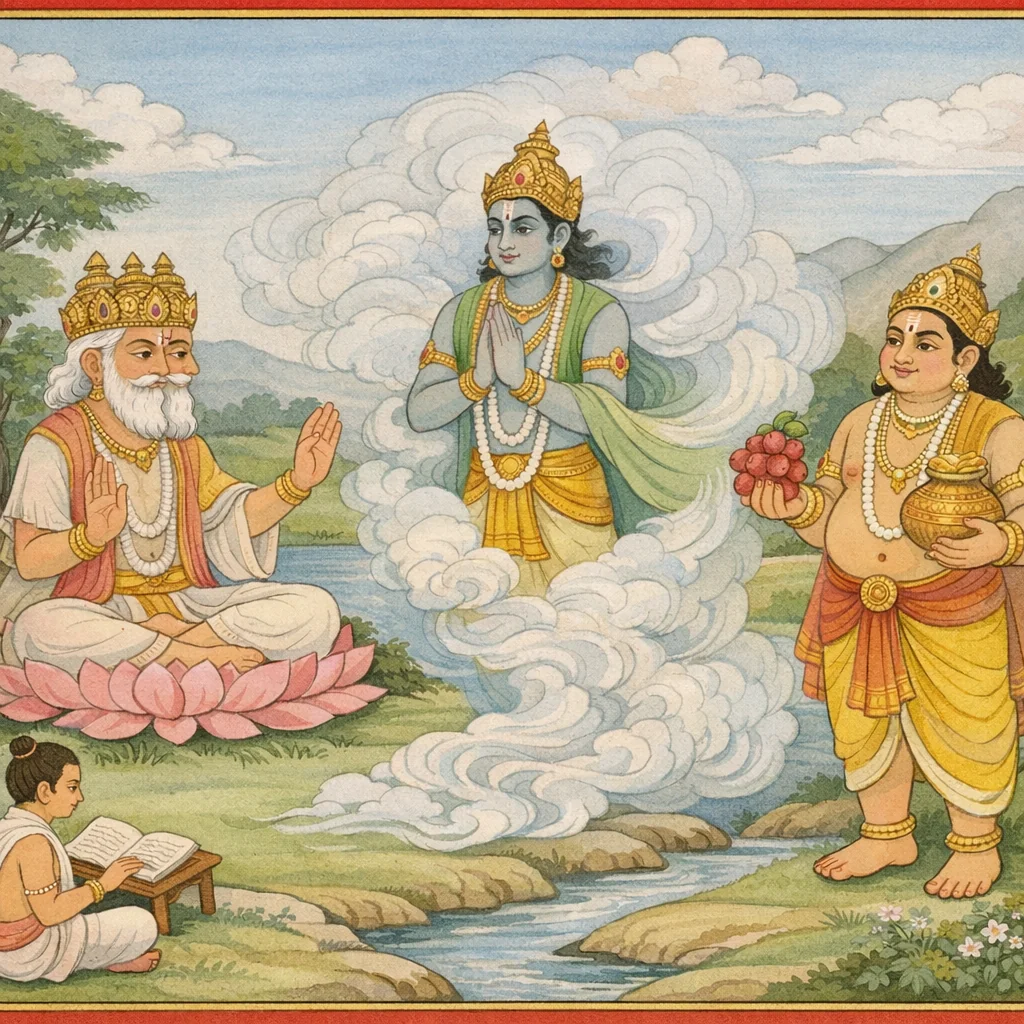
Adhyaya 30: The Origin of Dhanada (Kubera) from Vāyu and the Observance of the Ekādaśī Vow
Dhanadasya (Vāyoḥ) Utpattiḥ Ekādaśī-vrata-vidhiś ca
Ritual-Manual (Vrata) with Cosmogonic Etiology
Within the Varāha–Pṛthivī teaching frame, the sage Mahātapā gives a didactic etiological account showing that lordship over wealth (dhanapatitva) rests on cosmic function. He narrates the purifying origin of Dhanada (Kubera) from Vāyu’s embodiment: a primordial, violent wind-force is regulated by Brahmā into a calm, formed presence. Brahmā then appoints Vāyu as protective steward of the “wealth and fruits” (vitta, phala) of all beings, establishing Dhanada as guardian of resources and an implicit model for earthly balance and careful governance of abundance. The chapter next prescribes the Ekādaśī observance—ritual timing and purity discipline—promising worldly fulfillment and heavenly ascent to those who hear or recite the account with devotion.
Primary Speakers
Key Concepts
Shlokas in Adhyaya 30
Verse 1
महातपा उवाच । शृणु चान्यां वसुपतेरुत्पत्तिं पापनाशिनीम् । यथा वायुः शरीरस्थो धनदः सम्बभूव ह ॥ ३०.१ ॥
Mahātapā said: “Listen also to another account of the origin of Vasupati, the lord of wealth—a sin-destroying narrative—telling how Dhanada, the giver of riches, came to be, like the vital wind abiding within the body.”
Verse 2
आद्यं शरीरं यत् तस्मिन् वायुरन्तः स्थितोऽभवत् । प्रयोजनान्मूर्त्तिमत्त्वमादिष्टं क्षेत्रदेवता ॥ ३०.२ ॥
In that primordial body, the vital wind (Vāyu) came to abide within. For the sake of its appointed function, embodied form (mūrttimatva) was prescribed—so declares the deity of the sacred field (kṣetra-devatā).
Verse 3
तत्र मूर्त्तस्य वायोस्तु उत्पत्तिः कीर्त्यये मया । तां शृणुष्व महाभाग कथ्यमानां मयानघ ॥ ३०.३ ॥
There I shall recount the origin of Vāyu’s embodied form. Listen, O fortunate one—O blameless one—as I now narrate it.
Verse 4
ब्रह्मणः सृष्टिकामस्य मुखाद् वायुर् विनिर्ययौ । प्रचण्डशर्करावर्षी तं ब्रह्मा प्रत्यषेधयत् । मूर्तो भवस्व शान्तश्च तत्रोक्तो मूर्तिमान् भवत् ॥ ३०.४ ॥
From the mouth of Brahmā, who longed to create, Vāyu issued forth, raining down fierce gravel; Brahmā restrained him. Then, addressed with the words, “Become embodied and be calm,” Vāyu became possessed of form.
Verse 5
सर्वेषां चैव देवानां यद्वित्तं फलमेव च । तత్సर्वं पाहि येनोक्तं तस्माद्धनपतिर्भवेत् ॥ ३०.५ ॥
And whatever wealth and whatever fruits belong to all the gods—protect all of it, as has been enjoined; therefore one becomes a lord of wealth (dhanapati).
Verse 6
तस्य ब्रह्मा ददौ तुष्टस्तिथिमेकादशीं प्रभुः । तस्यामनग्निपक्वाशी यो भवॆन्नियतः शुचिः ॥ ३०.६ ॥
Pleased, the lord Brahmā granted him the lunar tithi of Ekādaśī. On that day, one who is disciplined and pure should subsist on food not cooked by fire.
Verse 7
तस्याशु धनदो देवस्तुष्टः सर्वं प्रयच्छति । एषा धनपतेर्मूर्तिः सर्वकिल्बिषनाशिनी ॥ ३०.७ ॥
Pleased with that observance, the deity Dhanada swiftly grants all things. This is the embodied form of Dhanapati, the destroyer of every kilbiṣa, every moral taint.
Verse 8
य एतां शृणुयाद् भक्त्या पुरुषः पठतेऽपि वा । सर्वकाममवाप्नोति स्वर्गलोकं च गच्छति ॥ ३०.८ ॥
Whoever hears this with devotion—or even recites it—attains the fulfillment of all desired aims and also goes to the heavenly realm.
Frequently Asked Questions
The text frames wealth (vitta) and yield (phala) as entities requiring guardianship and regulation: Brahmā assigns a protective duty that links cosmic order (pacifying and embodying Vāyu) with responsible stewardship of resources, implying that abundance is maintained through disciplined governance rather than unchecked force.
The chapter specifies Ekādaśī (the eleventh lunar day) as the key tithi. It also notes observance markers of restraint and purity (niyata, śuci), including a dietary discipline described as amanagnipakvāśī (as transmitted in the manuscript), indicating regulated consumption tied to the Ekādaśī practice.
By making Dhanada the protector of “all wealth and fruits” (sarveṣāṃ devānāṃ vittaṃ phalam), the narrative conceptually treats terrestrial produce as a safeguarded commons under cosmic oversight; the pacification of a destructive wind into a stable, embodied force functions as an allegory for stabilizing natural forces to preserve Earth’s productivity.
The chapter references Brahmā as the creative authority and Vāyu as the elemental agent who becomes associated with Dhanada (dhanapati). A sage narrator, Mahātapā, is named as the speaker of the origin account; no royal genealogies or dynastic lineages are mentioned in these verses.