Adhyaya 25: The Birth of Ahaṅkāra as Guha/Skanda and His Appointment as Divine Commander
Ahaṅkāra-janmato Guha-Senāpatitvaṃ (Skandotpattiḥ)
Cosmogony-Theology (Sāṃkhya-influenced metaphysics) and Devotional Hymn (Stotra) with Ritual Observance
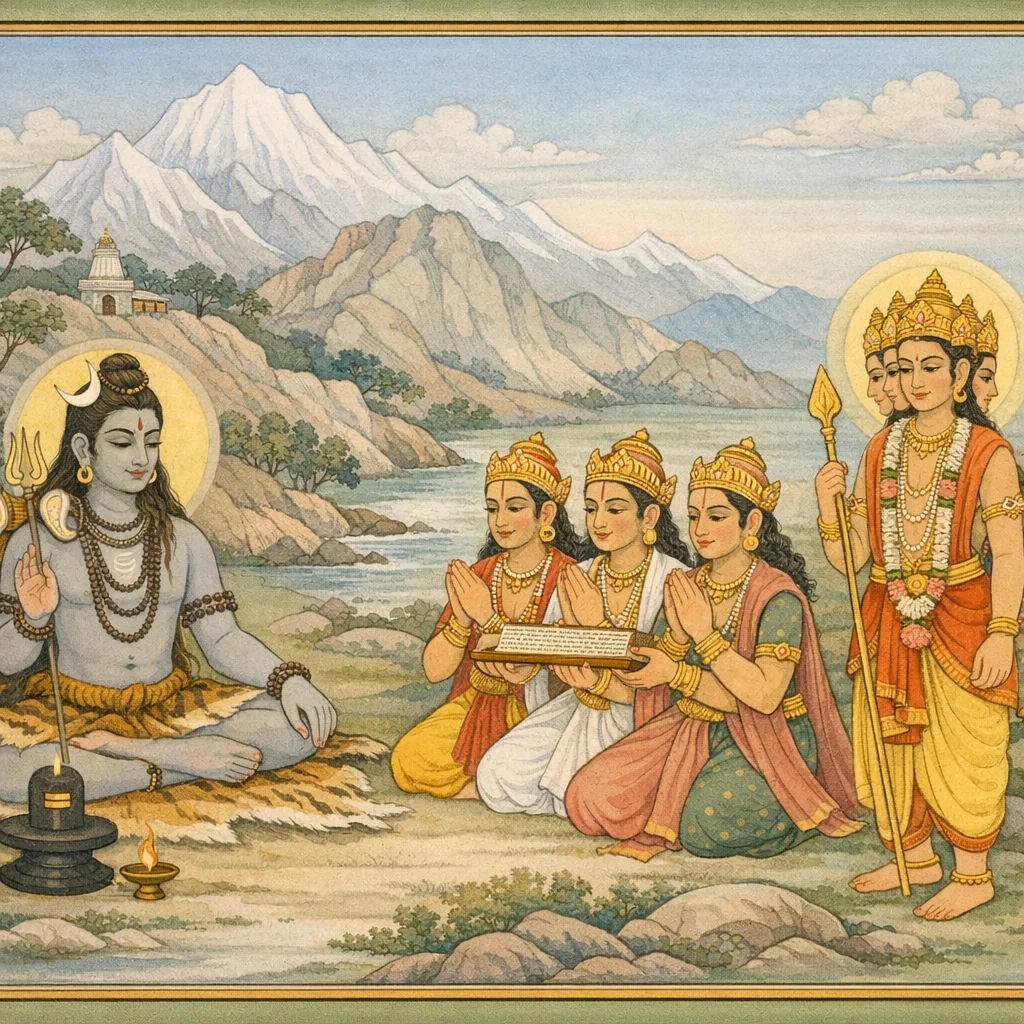
Framed as a teaching dialogue between Varāha and Pṛthivī, this chapter explains how cosmic principles give rise to embodied agency and social order. In response to Pṛthivī’s question about the origin of Ahaṅkāra, a Sāṃkhya-like sequence is given: from Puruṣa and Avyakta arises Mahat, identified as Ahaṅkāra, which functions as Guha/Skanda in the role of senāpati (divine commander). The narrative then turns to a cosmic conflict in which the devas, lacking unified leadership, seek a general; they approach Brahmā and then Rudra (Śiva) on Kailāsa, praising him in an extended stotra as the support of the elements and the cosmic functions. Rudra brings forth a radiant Kumāra (Skanda), bestows emblems and attendants, and installs Skanda as commander. The chapter closes with ritual-calendrical notes on the Ṣaṣṭhī tithi and the benefits of reciting the stotra, linking metaphysical origins to communal stability and Earth’s protective equilibrium.
Primary Speakers
Key Concepts
Shlokas in Adhyaya 25
Verse 1
प्रजापाल उवाच । अहंकारात् कथं जज्ञे कार्त्तिकेयो द्विजोत्तम । एतन्मे संशयं छिन्धि पृच्छतो वै महामुने ॥ २५.१ ॥
Prajāpāla said: “O best of the twice-born, how was Kārttikeya born from ahaṃkāra, the ego-principle? Please cut through this doubt of mine, O great sage, as I ask.”
Verse 2
महातपा उवाच । सर्वेषामेव तत्त्वानां यः परः पुरुषः स्मृतः । तस्मादव्यक्तमुत्पन्नं तत्त्वादि त्रिविधं तु तत् ॥ २५.२ ॥
Mahātapā said: “That supreme Puruṣa is remembered as transcending all principles (tattvas). From Him the Unmanifest (Avyakta) arose; and that foundational category—beginning with the principles—is described as threefold.”
Verse 3
पुरुषाव्यक्तयोर्मध्ये महत्त्वं समपद्यत । स चाहङ्कार इत्युक्तो यो महान् समुदाहृतः ॥ २५.३ ॥
Between Puruṣa and the Unmanifest (Avyakta), the principle of Mahat arises; and that very principle, designated as ‘ahaṃkāra’, is also described as the Great (Mahān).
Verse 4
पुरुषो विष्णुरित्युक्तः शिवो वा नामतः स्मृतः । अव्यक्तं तु उमा देवी श्रीर्वा पद्मनिभेक्षणा ॥ २५.४ ॥
‘Puruṣa’ is said to be Viṣṇu; and by name He is also remembered as Śiva. And the ‘Unmanifest’ (Avyakta) is the goddess Umā; or Śrī, the lotus-eyed goddess.
Verse 5
तत्संयोगादहंकारः स च सेनापतिर्गुहः । तस्योत्पत्तिं प्रवक्ष्यामि शृणु राजन् महामते ॥ २५.५ ॥
From that conjunction arises ahaṃkāra, the principle of ‘I’-sense; and with it is associated Guha, the commander of the divine hosts. I shall explain his origin; listen, O king of great understanding.
Verse 6
आद्यो नारायणो देवस्तस्माद् ब्रह्मा ततोऽभवत् । अतः स्वयम्भुवश्चान्ये मरीच्याद्यार्कसम्भवाः ॥ २५.६ ॥
Nārāyaṇa is the primordial deity; from Him Brahmā then came into being. From that lineage arose Svayambhuva (Manu), and others as well—beginning with Marīci—born from Arka (the Sun).
Verse 7
तेष्वारभ्य सुरा दैत्या गन्धर्वा मानुषाः खगाः । पशवः सर्वभूतानि सृष्टिरेषा प्रकीर्तिता ॥ २५.७ ॥
Beginning from them arose the Devas, the Daityas, the Gandharvas, human beings, birds, animals, and indeed all living creatures—thus has this creation been enumerated.
Verse 8
सृष्ट्यां विस्तारितायां तु देवदैत्याः महाबलाः । सापत्न्यं भावमास्थाय युयुधुर्विजिगीषवः ॥ २५.८ ॥
When creation had expanded, the mighty Devas and Daityas, taking up a spirit of rivalry, fought with the desire to conquer.
Verse 9
दैत्यानां बलिनः सन्ति नायका युद्धदुर्मदाः । हिरण्यकशिपुः पूर्वं हिरण्याक्षो महाबलः । विप्रचित्तिर्विचित्तिश्च भीमाक्षः क्रौञ्च एव च ॥ २५.९ ॥
Among the Daityas are powerful leaders, fiercely arrogant in battle: first Hiraṇyakaśipu; then Hiraṇyākṣa of great strength; and also Vipracitti, Vicitti, Bhīmākṣa, and Krauñca.
Verse 10
एतेऽतिबलिनः शूरा देवसैन्यं महामृधे । अनारतं सितैर्बाणैर्जयन्तेऽनुदिनं मृधे ॥ २५.१० ॥
These exceedingly mighty and heroic warriors, in the great battle, continually overcome the army of the gods in combat—day after day—by means of their bright white arrows.
Verse 11
तेषां पराजयं दृष्ट्वा देवानां तु बृहस्पतिः । उवाच हीनं वः सैन्यं नायकेन विना सुराः ॥ २५.११ ॥
Seeing the gods’ defeat, Bṛhaspati, the preceptor of the Devas, said: “O gods, your army is lacking—without a leader.”
Verse 12
एकेनेन्द्रेण दिव्यं तु सैन्यं पातुं न शक्यते । अतः सेनापतिं किञ्चिदन्वेषयत माचिरम् ॥ २५.१२ ॥
By Indra alone, it is not possible to protect the divine army. Therefore, quickly seek out a suitable commander (senāpati).
Verse 13
एवमुक्तास्ततो देवा जग्मुर्लोकपितामहम् । सेनापतिं च नो देहि वाक्यमूचुः ससम्भ्रमम् ॥ २५.१३ ॥
Having been addressed thus, the gods then went to the Grandfather of the worlds (Brahmā) and, with urgency, spoke these words: “Grant us a commander of the army.”
Verse 14
ततो दध्यौ चतुर्वक्त्रः किमेषां क्रियते मया । ब्रह्मा । अथ चिन्तयामास रुद्रं प्रति मनोगतम् ॥ २५.१४ ॥
Then the four-faced (Brahmā) reflected: “What should be done by me for these?” Thereupon Brahmā contemplated what was in his mind, directing it toward Rudra.
Verse 15
ततो देवाः सगन्धर्वा ऋषयः सिद्धचारणाः । ब्रह्माणं पुरतः कृत्वा जग्मुः कैलासपर्वतम् ॥ २५.१५ ॥
Then the gods—together with the Gandharvas—along with the Ṛṣis, the Siddhas, and the Cāraṇas, placing Brahmā at their forefront, proceeded to Mount Kailāsa.
Verse 16
तत्र दृष्ट्वा महादेवं शिवं पशुपतिं विभुम् । तुष्टवुर्विविधैस्तोत्रैः शक्राद्यास्त्रिदिवौकसः ॥ २५.१६ ॥
There, having seen Mahādeva—Śiva, Paśupati, the all-pervading Lord—the dwellers of the three heavens, beginning with Śakra (Indra), praised him with hymns of many kinds.
Verse 17
देवा ऊचुः । नमाम सर्वे शरणार्थिनो वयं महेश्वरं त्र्यम्बकभूतभावनम् । उमापते विश्वपते मरुत्पते जगत्पते शङ्कर पाहि नः स्वयम् ॥ २५.१७ ॥
The gods said: “We all bow down, seeking refuge, to Maheśvara—Tryambaka, the one who brings beings into flourishing. O Lord of Umā, Lord of the universe, Lord of the Maruts, Lord of the world—O Śaṅkara, protect us yourself.”
Verse 18
जटाकलापाग्रशशाङ्कदीधिति-प्रकाशिताशेषजगत्त्रयामल । त्रिशूलपाणे पुरुषोत्तमाच्युत प्रपाहि दैत्याच्च जगत्त्रयोदरे ॥ २५.१८ ॥
O bearer of the trident—Puruṣottama, the unfailing (Acyuta)—whose matted locks are illumined by the moon’s radiance at their crest, and by whose light the entire triad of worlds is made pure: protect us from the demon, here within the womb of the three worlds.
Verse 19
त्वमादिदेवः पुरुषोत्तमो हरिर्भवो महेशस्त्रिपुरान्तको विभुः । भगाक्षिहा दैत्यरिपुः पुरातनो वृषध्वजः पाहि सुरोत्तमोत्तम ॥ २५.१९ ॥
You are the primordial deity; the Supreme Person—Hari; Bhava; Maheśa; the mighty one who brought Tripura to its end; the slayer of Bhaga’s eye; the ancient enemy of the Daityas; the bearer of the bull as your emblem. Protect us, O best of the best among the gods.
Verse 20
गिरीशजानाथ गिरिप्रियाप्रिय प्रभो समस्तामरलोकपूजित । गणेश भूतेश शिवाक्षयाव्यय प्रपाहि नो दैत्यवरान्तकाच्युत ॥ २५.२० ॥
O lord—kinsman of Girīśa (Śiva), master, dear and not-dear to the mountain-born (Pārvatī), revered by all the worlds of the immortals; O Gaṇeśa, lord of beings, auspicious, imperishable and undecaying—protect us, O Acyuta, the slayer of the foremost of the Daityas.
Verse 21
पृथ्व्यादितत्त्वेषु भवान् प्रतिष्ठितो ध्वनिस्वरूपो गगने विशेषतः । वायौ द्विधा तेजसि च त्रिधा जले चतुः क्षितौ पञ्चगुणः प्रपाहि नः ॥ २५.२१ ॥
You are established within the principles beginning with earth; in particular, in the sky you are of the nature of sound. In wind you are twofold, in fire threefold, in water fourfold, and in earth fivefold—protect us.
Verse 22
अग्निस्वरूपोऽसि तरौ तथोपले सत्त्वस्वरूपोऽसि तथा जलेष्वपि । तेजःस्वरूपो भगवान् महेश्वरः प्रपाहि नो दैत्यगणार्दितान् हर ॥ २५.२२ ॥
You are of the form of fire in wood, and likewise in stone; you are of the form of vital essence, and likewise even in the waters. O blessed Maheśvara, whose nature is radiance—O Hara, protect us who are afflicted by the hosts of Daityas.
Verse 23
नासीद्यदा अकाण्डमिदं त्रिलोचन प्रभाकरेंद्रद्रविणाधिपाः कुतः । तदा भवान् एव विरुद्धलोचन प्रमाणबाधादिविवर्जितः स्थितः ॥ २५.२३ ॥
When this manifestation of the world did not exist at all, O Three-eyed One, how could there then be the Sun, Indra, or the Lord of Wealth? At that time you alone, O one with distinctive eyes, remained—free from the negation by valid means of knowledge and the like.
Verse 24
कपालमालिन् शशिखण्डशेखर श्मशानवासिन् सितभस्मगुण्ठित । फणीन्द्रसंवीततनॊऽन्तकापह प्रपाहि नो दक्षधिया सुरेश्वर ॥ २५.२४ ॥
O bearer of a garland of skulls, whose crest is adorned with the digit of the moon; dweller of the cremation-ground, covered with white ash; whose body is encircled by the lord of serpents; remover of the fear of Death—O Lord of the gods, protect us with sound discernment.
Verse 25
भवान् पुमान् शक्तिरियं गिरेः सुता सर्वाङ्गरूपा भगवंस्तथा त्वयि । त्रिशूलरूपेण जगत्त्रयं करे स्थितं त्रिनेत्रेषु मखाग्नयस्त्रयः ॥ २५.२५ ॥
You are the male principle (Puruṣa); this is the Power (Śakti), the daughter of the Mountain, whose form pervades all limbs; and so too, O Blessed One, she abides in you. In the form of the trident, the three worlds stand set in your hand; and in your three eyes are established the three sacrificial fires.
Verse 26
जटास्वरूपेण समस्तसागराः कुलाचलाः सिन्धुवहाश्च सर्वशः । शशी परं ज्ञानमिदं तव स्थितं न देव पश्यन्ति कुदृष्टयो जनाः ॥ २५.२६ ॥
In the form of your matted locks (jaṭā) are present all the oceans, the mountain ranges, and the river-bearing streams in every way. O Deva, this supreme knowledge abides with you; yet people of distorted vision do not perceive it.
Verse 27
नारायणस्त्वं जगतां समुद्भवस् तथा भवः सैव चतुर्मुखो भवान् । सत्त्वादिभेदेन तथाग्निभेदतो युगादिभेदेन च संस्थितस्त्रिधा ॥ २५.२७ ॥
You are Nārāyaṇa, the source from which the worlds arise; likewise you are Bhava (Śiva), and you yourself are the four-faced one (Brahmā). By distinctions such as the guṇas beginning with sattva, by differentiations of fire, and by divisions such as the yugas, you are established in a threefold form.
Verse 28
भवन्तमेतॆ सुरनायकाः प्रभो भवार्थिनोऽन्यस्य वदन्ति तोषयन् । यतस्ततो नो भव भूतिभूषण प्रपाहि विश्वेश्वर रुद्र ते नमः ॥ २५.२८ ॥
O Lord, these leaders of the gods—seeking well-being—praise you and none other, in order to please you. Therefore, O Bhava, you whose ornament is sacred ash, protect us in every way; O Lord of the universe, O Rudra—obeisance to you.
Verse 29
महातपा उवाच । एवं स्तुतस्तदा देवो रुद्रः पशुपतिः सुरैः । उवाच देवानव्यग्रः किं कार्यं ब्रूत मा चिरम् ॥ २५.२९ ॥
Mahātapā said: Thus praised at that time by the gods, the deity Rudra—Paśupati—addressed the gods without agitation: “What task is to be done? Tell me; do not delay.”
Verse 30
देवा ऊचुः । सेनापतिं नो देवेश देहि दैत्यवधाय वै । देवानां ब्रह्ममुख्यानामेतदेव हितं भवेत् ॥ २५.३० ॥
The gods said: “O Lord of the gods, grant us a commander-in-chief for the slaying of the Daityas. For the gods—led by Brahmā—this alone would be beneficial.”
Verse 31
रुद्र उवाच । ददामि सेनानाथं वो देवा भवत विज्वराः । भविष्य्यमस्ति पौराणं योगादीनामचिन्तयन् ॥ २५.३१ ॥
Rudra said: “I grant you a commander of the armies; O gods, become free from affliction. In the future there will be a Purāṇic account of this, while contemplating yoga and related disciplines.”
Verse 32
एवमुक्त्वा हरो देवान् विसृज्य स्वाङ्गसंस्थिताम् । शक्तिं संक्षोभयामास पुत्रहेतोः परंतप ॥ २५.३२ ॥
Thus having spoken, Hara dismissed the gods and then stirred the Śakti abiding within his own body, for the purpose of begetting a son—O scorcher of foes.
Verse 33
तस्य क्षोभयतः शक्तिं ज्वलनार्कसमप्रभः । कुमारः सहजां शक्तिं बिभ्रज्ज्ञानैकशालिनीम् ॥ २५.३३ ॥
As he stirred that Power, the Kumāra—whose radiance was like fire and the sun—bore an innate (sahaja) Śakti, endowed solely with knowledge.
Verse 34
उत्पत्तिस्तस्य राजेन्द्र बहुरूपा व्यवस्थिताः । मन्वन्तरेष्वनेकेषु देवसेनापतिः किल ॥ २५.३४ ॥
O lord of kings, his origin is established in many forms; indeed, in many Manvantaras he is spoken of as the commander of the army of the gods.
Verse 35
योऽसौ शरीरगो देवः अहंकार इति कीर्तितः । प्रयोजनवशाद् देवः सैव सेनापतिर्विभो ॥ २५.३५ ॥
That divine principle which abides within the body is proclaimed as “ahaṃkāra” (the ego-principle). By virtue of its functional purpose, O mighty one, it indeed serves as the commander (senāpati) of the faculties.
Verse 36
तस्मिन् जाते स्वयं ब्रह्मा सर्वदैवैः समन्वितः । पूजयामास देवेशं शिवं पशुपतिं तदा ॥ २५.३६ ॥
When that had occurred, Brahmā himself—accompanied by all the gods—then worshipped the Lord of the gods, Śiva, known as Paśupati.
Verse 37
सर्वैश्च देवै ऋषिभिश्च सिद्धैः सेनापतिर्वरदानेन तेन । आप्यायितः सोऽपि सुरानुवाच सखायार्थं क्रडने कार्यमेव ॥ २५.३७ ॥
Honoured by all the gods, the ṛṣis, and the siddhas through that boon-bestowing grace, the commander was strengthened; and he, in turn, addressed the gods: “For a friend’s sake, action in this matter of the contest must indeed be undertaken.”
Verse 38
श्रुत्वा वचस्तस्य महानुभावो महादेवो वाक्यमिदं जगाद । ददामि ते क्रीडनकं तु कुक्कुटं तथानुगौ शाखविशाखसंज्ञौ । कुमार भूतग्रहणायको भवान् भवस्व देवेश्वर सेनयापतिः ॥ २५.३८ ॥
Having heard his words, the great-souled Mahādeva spoke: “I grant you a plaything—a rooster—and also two attendants named Śākha and Viśākha. O Kumāra, become the leader of the hosts of bhūtas and the commander of the army of the Lord of the gods.”
Verse 39
एवमुक्त्वा ततो देवः सर्वे देवाश्च पार्थिव । तुष्टुवुर्वाग्भिरिष्टाभिः स्कन्दं सेनापतिं तदा ॥ २५.३९ ॥
Having spoken thus, then the god—and all the gods as well, O King—praised Skanda at that time, the commander of the army, with words of reverent approval.
Verse 40
देवा ऊचुः । भवस्व देवसेनानीर्महेश्वरसुत प्रभो । षण्मुख स्कन्द विश्वेश कुक्कुटध्वज पावके ॥ २५.४० ॥
The gods said: “Be the commander of the divine armies, O Lord—son of Maheśvara; O Ṣaṇmukha, Skanda, Lord of the universe, bearer of the cock-banner, O Pāvaka.”
Verse 41
कम्पितारे कुमारेश स्कन्द बालग्रहानुग । जितारे क्रौञ्चविध्वंस कृत्तिकासुत मातृर्ज ॥ २५.४१ ॥
O Skanda, lord of Kumāra, who makes the followers of the child-seizing spirits tremble; O conqueror, destroyer of Kraun̄ca; O son of the Kṛttikās, born of the Mothers—salutation.
Verse 42
भूतग्रहपतिश्रेष्ठ पावकि प्रियदर्शन । महाभूतपतेः पुत्र त्रिलोचन नमोऽस्तु ते ॥ २५.४२ ॥
O foremost lord of beings and of seizing spirits; O Pāvaki, fair to behold; O son of the Lord of the Great Elements; O Three-eyed One—homage be to you.
Verse 43
एवं स्तुतस्तदा देवैर्ववर्ध भवानन्दनः । द्वादशादित्यसंकाशो बभूवाद्भुतदर्शनः । त्रैलोक्यमपि तत्तेजस्तापयामास पार्थिव ॥ २५.४३ ॥
Thus praised at that time by the gods, Bhavānandana grew in stature; radiant like twelve suns, he became a wondrous sight. O King, that very brilliance heated even the three worlds.
Verse 44
प्रजापाल उवाच । कथं तं कृत्तिकापुत्रमुक्तवन्तः सुरं गुरुम् । कथं च पावकिरसौ कथं वा मातृनन्दनः ॥ २५.४४ ॥
Prajāpāla said: “How did they address that son of the Kṛttikās, the divine teacher? And how is he (also) called ‘Pāvakir’? Or how (is he known as) the ‘mother’s delight’?”
Verse 45
महातपा उवाच । आदिमन्वन्तरे देव उत्पत्तिर्या मयोदिता । परोक्षदर्शिभिर्देवैरेवमेव स्तुतः प्रभुः ॥ २५.४५ ॥
Mahātapā said: “O deity, in the first Manvantara, the account of origination which has been stated by me—just so was the Lord praised by the gods who are seers of what is beyond direct perception.”
Verse 46
कृत्तिका पावकस्त्वन्यमातरो गिरिजा तथा । द्वितीयजन्मनि गुहस्यैते उत्पत्तिहेतवः ॥ २५.४६ ॥
Kṛttikā, Fire (Pāvaka), the other mothers, and likewise Girijā (Pārvatī)—these are the causal factors for Guha’s second birth.
Verse 47
एवमेतत् तवाख्यातं पृच्छतः पार्थिवोत्तम । आत्मविद्यामृतं गुह्यमहङ्कारस्य सम्भवः ॥ २५.४७ ॥
Thus, O best of kings, as you inquired, it has been explained to you: the secret “nectar” of self-knowledge—namely, the arising of ahaṅkāra (egoity).
Verse 48
स्वयं स्कन्दो महादेवः सर्वपापप्रणाशनः । तस्य षष्ठीं तिथिं प्रादादभिषेके पितामहः ॥ २५.४८ ॥
Skanda himself is Mahādeva, the destroyer of all sins. At the time of consecration (abhiṣeka), Pitāmaha, the Grandsire, granted him the sixth lunar day (Ṣaṣṭhī) as his sacred tithi.
Verse 49
एतां फलाशनो यस्तु क्षयेन्नियतमानसः । अपुत्रोऽपि लभेत् पुत्रानधनोऽपि धनं लभेत् । यं यमिच्छेत मनसा तं तं लभति मानवः ॥ २५.४९ ॥
But whoever, with a disciplined mind, completes this observance while subsisting on fruits—though childless, may obtain sons; though poor, may obtain wealth. Whatever a person desires in the mind, that very thing is attained.
Verse 50
यश्चैतत् पठति स्तोत्रं कार्त्तिकेयस्य मानवः । तस्य गेहे कुमाराणां क्षेमारोग्यं भविष्यति ॥ २५.५० ॥
And whoever recites this hymn to Kārttikeya—within that person’s household, the children’s well-being and freedom from illness will come to be.
Frequently Asked Questions
The text presents a metaphysical rationale for ordered agency: Ahaṅkāra (as Mahat’s designation) becomes a functional principle of leadership embodied as Guha/Skanda. The narrative uses the deva–daitya conflict to argue that collective protection and stability require legitimate command and disciplined organization, linking cosmic ontology to governance and social order.
The chapter specifies Ṣaṣṭhī tithi as the calendrical marker associated with Skanda’s abhiṣeka (anointment), and it recommends observance connected with that tithi; it also states benefits for reciting the Kārttikeya stotra.
Although not framed as explicit environmental regulation, the chapter models ‘Earth-balance’ through cosmic and political order: devas seek a senāpati to end destabilizing conflict, and Rudra’s manifestation of Skanda restores equilibrium across the worlds. This can be read as an early ecological-ethical motif where terrestrial stability depends on disciplined leadership, restraint, and the re-establishment of harmonious cosmic functions.
The narrative references Nārāyaṇa, Brahmā (Svayambhū), Rudra/Śiva, Bṛhaspati, and creation-line figures such as Marīci; it also names prominent daityas including Hiraṇyakaśipu, Hiraṇyākṣa, Vipracitti, Vicitti, Bhīmākṣa, and Krauñca, situating the episode within mythic genealogies and leadership paradigms.