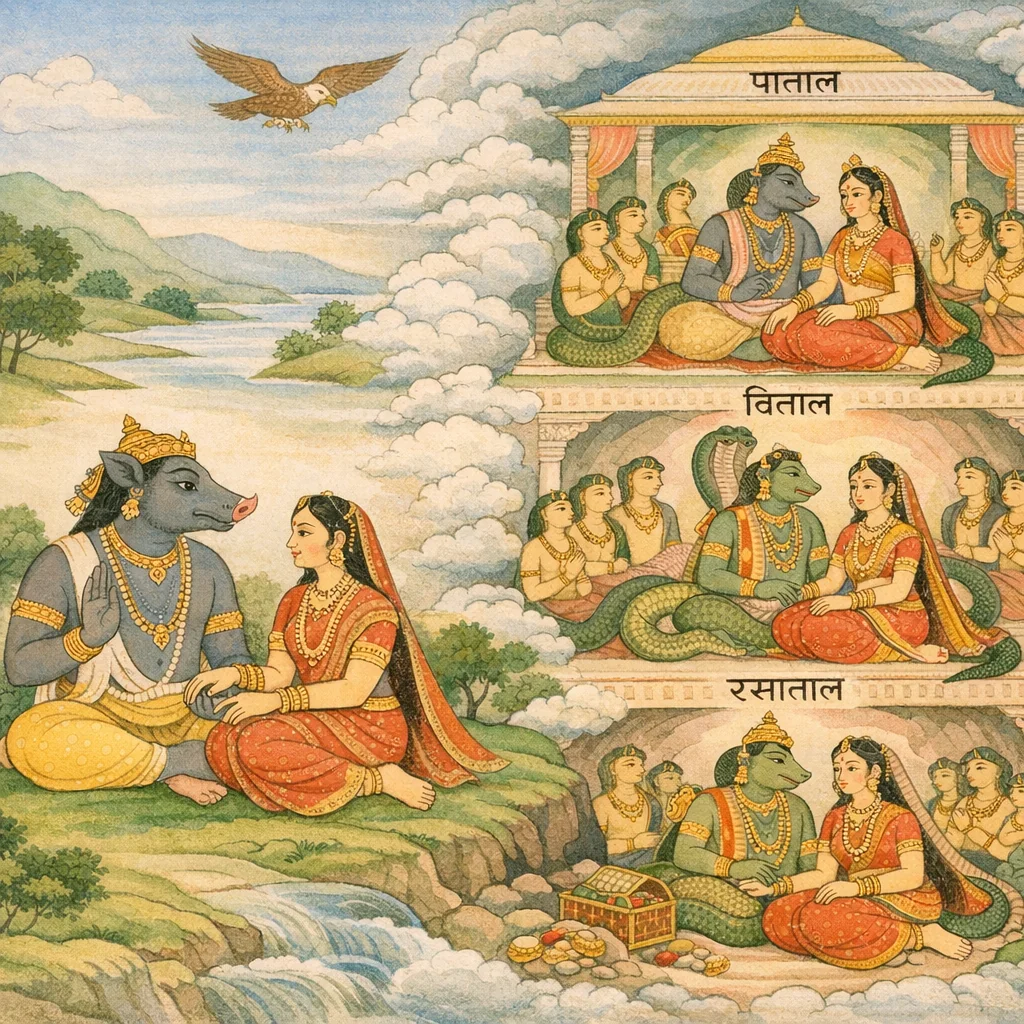
Adhyaya 24: The Birth of the Nāgas, Brahmā’s Curse, and the Pañcamī Observance
Nāgajanma–Brahmaśāpa–Pañcamīvrata
Ritual-Etiology and Cosmic Governance (Dharma/Prāyaścitta)
Framed by Pṛthivī’s question, Varāha explains how mighty beings, through contact and karmic disposition, came to be embodied as nāgas. The narration then turns to an embedded tale: after Gaṇapati’s birth is heard, King Prajāpāla asks a sage how Tārkṣya-linked beings assumed serpent form. The sage recounts Brahmā’s creative lineage—Marīci, Kaśyapa, and Kadru—who bears the chief nāgas: Ananta, Vāsuki, Kambala, Karkoṭaka, Padma, Mahāpadma, Śaṅkha, Kulika, and Aparājita. Their venomous aggression brings daily human decline, so beings seek refuge in Brahmā/Viṣṇu. Brahmā sets limits: he assigns them subterranean realms (Pātāla, Vitala, Harmya), establishes a human–nāga compact, and foretells their future subjugation by Garuḍa and Citrabhānu. The chapter ends by sanctifying Pañcamī as a purifying tithi and prescribing a restraint-and-bathing observance that fosters human–nāga amity and preserves terrestrial order.
Primary Speakers
Key Concepts
Shlokas in Adhyaya 24
Verse 1
धरण्युवाच । कथं ते गात्रसंस्पर्शान्मूर्त्तिमन्तो महाबलाः । नागा बभूवुर्देवेश कारणं ते महीधर ॥ २४.१ ॥
The Earth said: “O Lord of the gods, how did the Nāgas—embodied and of great strength—come to be through contact with your limbs? O bearer of the Earth, what is the cause of this?”
Verse 2
श्रीवराह उवाच । श्रुत्वा गणपतेर्जन्म प्रजापालो नराधिपः । उवाच श्लक्ष्णया वाचा तं मुनिं संहितव्रतम् ॥ २४.२ ॥
Śrī Varāha said: Having heard of the birth of Gaṇapati, the king Prajāpāla, ruler among men, addressed that sage—whose vows were well-disciplined—with refined speech.
Verse 3
प्रजापाल उवाच । भगवँस्तार्क्षविषयाः कथं मूर्त्तिमुपागताः । नागा बभूवुः कुटिला एतदाख्यातुमर्हसि ॥ २४.३ ॥
Prajāpāla said: “O Blessed One, how did those connected with Tārkṣya (Garuḍa) come to assume embodied form? How did the Nāgas become serpentine and coiling in shape? Please relate this to me.”
Verse 4
महातपा उवाच । सृजता ब्रह्मणा सृष्टिं मरीचिः सूतिकारणम् । प्रथमं मनसा ध्यातस्तस्य पुत्रस्तु कश्यपः ॥ २४.४ ॥
Mahātapā said: “When Brahmā was bringing forth the creation, Marīci became a causal source in the begetting of beings. First he was conceived by the mind; and his son, indeed, was Kaśyapa.”
Verse 5
तस्य दाक्षायणी भार्या कद्रूर्नाम शुचिस्मिता । मारीचो जनयामास तस्यां पुत्रान् महाबलान् ॥ २४.५ ॥
His wife, the Dākṣāyaṇī named Kadrū, of pure smile—upon her Marīci begot sons of great strength.
Verse 6
अनन्तं वासुकिं चैव कम्बलं च महाबलम् । कर्कोटकं च राजेन्द्र पद्मं चान्यं सरीसृपम् ॥ २४.६ ॥
“(They are named) Ananta and Vāsuki, and also Kambala, the mighty; and Karkoṭaka too, O lord of kings, and Padma—another among the creeping beings (serpents).”
Verse 7
महापद्मं तथा शङ्खं कुलिकं चापराजितम् । एते कश्यपदायादाः प्रधानाः परिकीर्तिताः ॥ २४.७ ॥
“Likewise (there are) Mahāpadma, Śaṅkha, Kulika, and Aparājita. These—descendants of Kaśyapa—have been proclaimed as the principal ones.”
Verse 8
एतेषां तु प्रसूत्या तु इदमापूरितं जगत् । कुटिला हीनकर्माणस्तिक्ष्णास्योत्थविषोल्बणाः । दृष्ट्वा संदश्य मनुजान् कुर्युर्भस्म क्षणाद्ध्रुवम् ॥ २४.८ ॥
“Indeed, by the procreation of these, this world has become filled. Crooked in nature, base in conduct, with sharp mouths and swollen with potent venom—on seeing humans, they would bite them and, in an instant, would surely reduce them to ashes.”
Verse 9
शब्दगामी यथा स्पर्शं मनुष्याणां नराधिप । अहन्यहनि जायेत क्षयः परमदारुणः ॥ २४.९ ॥
O lord of men, just as sound proceeds and reaches touch among human beings, so too, day after day, a most dreadful decline would arise.
Verse 10
आत्मनस्तु क्षयं दृष्ट्वा प्रजाः सर्वाः समन्ततः । जग्मुः शरण्यं शरणं परं तु परमेश्वरम् ॥ २४.१० ॥
Seeing the decline of their own condition, all creatures on every side went to seek refuge—to the supreme refuge, the Supreme Lord, Parameśvara.
Verse 11
इममेवार्थमुद्दिश्य प्रजाः सर्वा महीपते । उचुः कमलजं विष्णुं पुराणं ब्रह्मसंज्ञितम् ॥ २४.११ ॥
With this very purpose, O king, all the people addressed Viṣṇu—born of the lotus—and spoke of the Purāṇa known by the name “Brahma”.
Verse 12
देवा ऊचुः । देवदेवेश लोकानां प्रसूति परमेश्वर । त्राहि नस्तीक्ष्णदंष्ट्राणां भुजङ्गानां महात्मनाम् ॥ २४.१२ ॥
The gods said: “O Lord of the gods, O source of the worlds, O Supreme Lord—protect us from the great serpents whose fangs are sharp.”
Verse 13
अहन्यहनि ये देव पश्येयुरुरगादृशा । मनुष्यपशुरूपं वा तत्सर्वं भस्मसाद् भवेत् ॥ २४.१३ ॥
O Deva, whatever they behold day after day with a serpent-like gaze—whether in the form of a human or of an animal—all of it would be reduced to ashes.
Verse 14
त्वया सृष्टिः कृता देव नीयते सा भुजङ्गमैः । एतज्ज्ञात्वा तु दुर्वृत्तं तत्कुरुष्व महामते ॥ २४.१४ ॥
O Deva, the creation made by you is being carried along by the serpent-beings. Knowing this, O great-minded one, take action to rectify that ill conduct, that disorder.
Verse 15
ब्रह्मोवाच । अहं रक्षां विधास्यामि भवतीनां न संशयः । व्रजध्वं स्वानि धिष्ण्यानि प्रजा माभूत् ससाध्वसा ॥ २४.१५ ॥
Brahmā said: “I will provide protection for you—there is no doubt. Return to your own abodes; let the people not be overcome by fear.”
Verse 16
एवमुक्त्वा प्रजास्तेन ब्रह्मणाऽव्यक्तमूर्त्तिना । आजग्मुः परमप्रीत्या नत्वा चैव स्वयम्भुवे ॥ २४.१६ ॥
Having thus been addressed by that Brahmā of unmanifest form, the beings departed with supreme joy, having bowed to the Self-born (Svayambhū).
Verse 17
अगतासु प्रजास्वाद्यस्तानाहूय भुजङ्गमान् । शशाप परमक्रुद्धो वासुकिप्रमुखांस्तदा ॥ २४.१७ ॥
Then, when the people had departed, Ādya (the foremost one) summoned those serpents and, being exceedingly enraged, pronounced a curse upon them—Vāsuki foremost among them.
Verse 18
ब्रह्मोवाच । यतो मत्प्रभवान् नित्यं क्षयं नयत मानुषान् । भवान्तरेऽथान्यस्मिन् मातुः शापात् सुदारुणात् । भविताऽतिक्षयं घोरं नूनं स्वायम्भुवेऽन्तरे ॥ २४.१८ ॥
Brahmā said: “Since those beings who arise from me continually bring human beings to decline, then, in another existence, because of a very severe curse from the mother, there will certainly be a dreadful, excessive destruction during the interval of Svāyambhuva Manu.”
Verse 19
एवमुक्तास्तु वेपन्तो ब्रह्माणं भुजगोत्तमाः । निपत्य पादयोस्तस्य इदमूचुर्वचस्तदा ॥ २४.१९ ॥
Thus addressed, the foremost serpents—trembling—fell at Brahmā’s feet and then spoke these words.
Verse 20
नागा ऊचुः । भगवन् कुटिला जातिरस्माकं भवता कृता । विषोल्बणत्वं क्रूरत्वं दृक्शस्त्रत्वं च नस्त्वया । सम्पादितं त्वया देव इदानीं शमयाच्युत ॥ २४.२० ॥
The Nāgas said: “O Blessed Lord, by you our kind has been made crooked in nature. By you have been brought about our excessive venom, our cruelty, and the weapon-like power of our gaze. Therefore, O God—O Acyuta—pacify it now.”
Verse 21
ब्रह्मोवाच । यदि नाम मया सृष्टा भवन्तः कुटिलाशयाः । ततः किं मनुजान् नित्यं भक्षयध्वं गतव्यथाः ॥ २४.२१ ॥
Brahmā said: “Even if it is true that you were created by me with crooked intentions, what follows from that? Why do you continually devour human beings, acting as though free from distress and consequence?”},{
Verse 22
नागा ऊचुः । मर्यादां कुरु देवेश स्थानं चैव पृथक् पृथक् । मनुष्याणां तथाऽस्माकं समयं च पृथक् पृथक् । नागानां वचनं श्रुत्वा देवो वचनमब्रवीत् ॥ २४.२२ ॥
The Nāgas said: “O Lord of the gods, establish proper boundaries and assign separate dwelling-places, distinct for each. Likewise, set distinct agreements (rules) for humans and for us.” Having heard the words of the Nāgas, the deity spoke in reply.
Verse 23
अहं करोमि वो नागाः समयं मनुजैः सह । तदेकमनसः सर्वे शृणुध्वं मम शासनम् ॥ २४.२३ ॥
“O Nāgas, I establish for you an agreement together with the humans. Therefore, with unified intent, all of you listen to my directive.”
Verse 24
पातालं वितलं चैव हर्म्याख्यं च तृतीयकम् । दत्तं चैव सदा रम्यं गृहं तत्र गमिष्यथ ॥ २४.२४ ॥
“There are Pātāla and Vitāla, and the third region called Harmya. A dwelling—ever delightful—has also been granted; you shall go there.”
Verse 25
तत्र भोगान् बहुविधान् भुञ्जाना मम शासनात् । तिष्ठध्वं सप्तमं यावद् रात्र्यन्तं तु पुनः पुनः ॥ २४.२५ ॥
There, enjoying many kinds of comforts in accordance with my command, remain until the seventh night; and at the end of each night, again and again, continue as instructed.
Verse 26
ततो वैवस्वतस्यादौ काश्यपेया भविष्यथ । दायादाः सर्वदेवानां सुपर्णस्य च धीमतः ॥ २४.२६ ॥
Then, at the beginning of Vaivasvata (Manu’s era), you will become the Kāśyapeyas—heirs of all the gods—and also heirs of the wise Suparṇa (Garuḍa).
Verse 27
तदा प्रसूतिर् वः सर्वा भोक्ष्यते चित्रभानुना । भवतां नैव दोषोऽयं भविष्यति न संशयः ॥ २४.२७ ॥
Then all of your progeny will be consumed by Citrabhānu; yet for you there will be no fault in this—of this there is no doubt.
Verse 28
ये वै क्रूरा भोगिनो दुर्विनीता—स्तेषामन्तो भविता नान्यथैतत् । कालप्राप्तं भक्षयध्वं दशध्वं तथा अपकारे च कृते मनुष्यम् ॥ २४.२८ ॥
“Those who are cruel, indulgent in sense-enjoyment, and ill-disciplined—their end will surely come; it cannot be otherwise. When the destined time arrives, devour them, bite them; and likewise when a human has committed harm.”
Verse 29
मन्त्रौषधैर्गारुडमण्डलैश्च बद्धैर्दृष्टैर्मानवा ये चरन्ति । तेषां भीतैर्वर्त्तितव्यं न चान्यच्छ्चिन्त्यं कार्यं चान्यथा वो विनाशः ॥ २४.२९ ॥
Those humans who move about protected by mantras, medicinal substances, and Garuḍa-diagrams—secured by such bindings and safeguards—must be approached with cautious restraint; nothing else is to be devised or undertaken, for otherwise there will be your ruin.
Verse 30
इतीरिते ब्रह्मणा ते भुजङ्गा जग्मुः स्थानं क्ष्मातलाख्यं हि सर्वे । तस्थुर्भोगान् भुञ्जमानाः समग्रान् रसातले लीलया संस्थितास्ते ॥ २४.३० ॥
When Brahmā had thus spoken, all those serpent-beings (bhujaṅgas) went to the place called Kṣmātala. There they remained in Rasātala, playfully established, enjoying their complete allotment of pleasures.
Verse 31
एवं शापं तु ते लब्ध्वा प्रसादं च चतुर्मुखात् । तस्थुः पातालनिलये मुदितेनान्तरात्मना ॥ २४.३१ ॥
Thus, having received that curse, and also a favor from the Four-faced one (Brahmā), they remained in the dwelling of Pātāla, inwardly rejoicing in their hearts.
Verse 32
एतत्सर्वं च पञ्चम्यां तेषां जातं महात्मनाम् । अतस्त्वियं तिथिर्धन्या सर्वपापहरा शुभा ॥ २४.३२ ॥
All of this occurred for those great-souled ones on the fifth lunar day (pañcamī). Therefore, this lunar date is considered blessed—auspicious and described as removing all wrongdoing.
Verse 33
एतस्यां संयतो यस्तु अम्लं तु परिवर्जयेत् । क्षीरेण स्नापयेन्नागांस्तस्य यास्यन्ति मित्रताम् ॥ २४.३३ ॥
But whoever, being self-restrained in this observance, avoids sour foods and bathes the nāgas with milk—those nāgas will come to him in friendship.
Frequently Asked Questions
The text models conflict regulation through maryādā (limits) and samaya (compact): harmful nonhuman power (nāga venom/aggression) is constrained by spatial assignment (subterranean realms) and behavioral conditions, framing dharma as governance that protects human life while enabling coexistence rather than total annihilation.
The chapter explicitly elevates Pañcamī (the fifth lunar day) as a dhanyā and śubhā tithi. It prescribes a Pañcamī discipline: practicing restraint (saṃyata), avoiding sour foods (amla-parivarjana), and bathing nāgas with milk (kṣīra-snāpana) to cultivate amity.
Through Pṛthivī’s framing and the embedded crisis of daily human decline, the narrative treats unchecked venomous predation as destabilizing the world’s continuity. Brahmā’s intervention establishes ecological-territorial zoning (Pātāla/Vitala/Rasātala) and interspecies rules, presenting balance as a managed distribution of habitats and restrained interaction.
The genealogy runs Brahmā → Marīci → Kaśyapa, with Kadru (a Dākṣāyaṇī) as mother of the nāgas. Named nāga figures include Ananta, Vāsuki, Kambala, Karkoṭaka, Padma, Mahāpadma, Śaṅkha, Kulika, and Aparājita. Other referenced figures include Garuḍa (Suparṇa) and Citrabhānu, along with King Prajāpāla and a sage narrator (Mahātapā).