Adhyaya 218: Index of Topics and Reading Protocols (Anukramaṇikā Chapter)
Anukramaṇikā (Purāṇapaṭhanādiviṣayānukramaṇikādhyāyaḥ)
Textual-Index / Ritual-Manual / Sacred-Geography (Māhātmya)
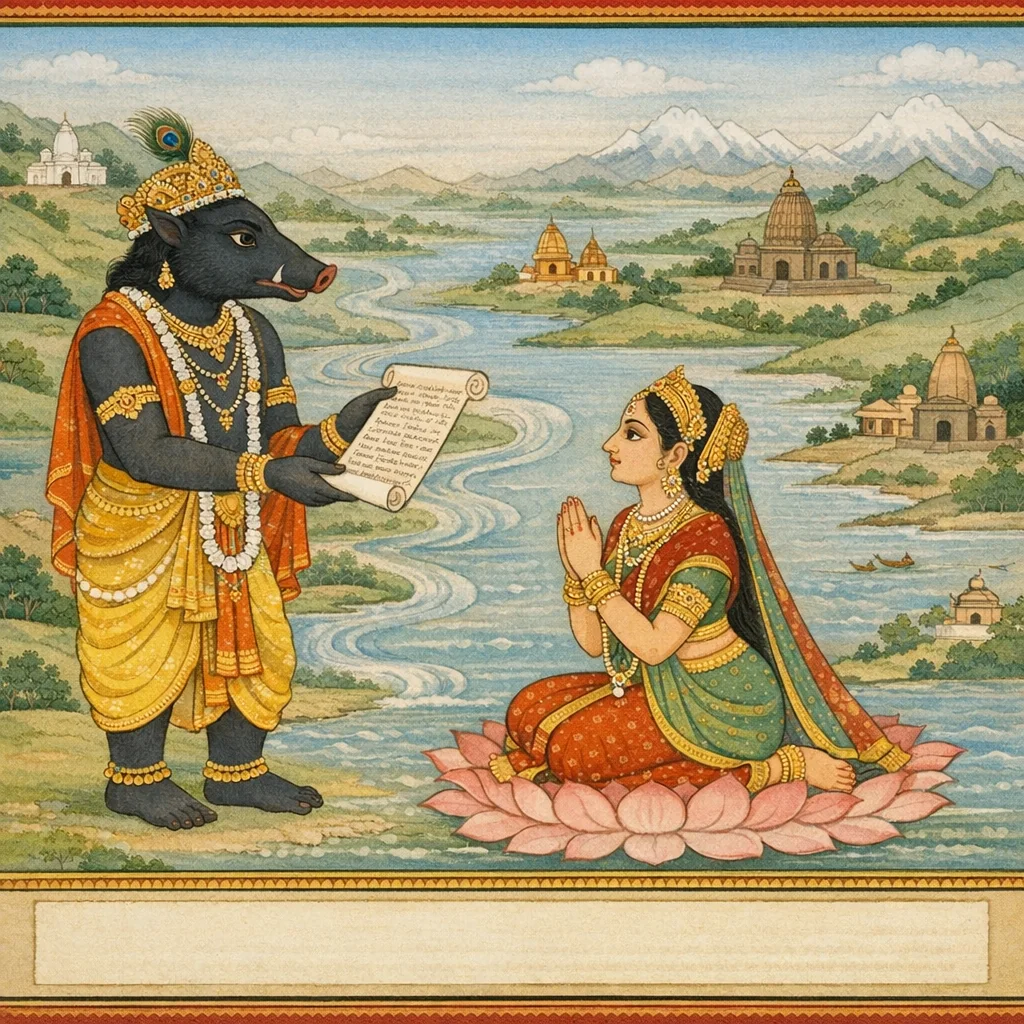
This adhyāya serves as an anukramaṇikā, a structured table of contents that recapitulates the Varāha Purāṇa’s major narrative and instructional units in the pedagogical voice attributed to Varāha, oriented toward Pṛthivī as the recipient of dharmic and earthly guidance. It enumerates cosmogonic accounts of first creation (ādi-sṛṣṭi), origin stories of deities and cosmic principles, and a sequence of vrata and dvādaśī observances connected with avatāra traditions. It then catalogs doctrinal topics (prakṛti-nirṇaya, bhūvanakośa), ethical classifications (aparādha, bhojya/abhojya), and extensive prāyaścitta rules governing ritual purity and social conduct. A substantial portion indexes tīrtha-māhātmya material—rivers, kṣetras, and pilgrimage ecologies—linking sacred geography to the maintenance of worldly order and Earth’s stability. The chapter ends with a colophon-like completion statement and a scribe’s note affirming faithful transmission.
Primary Speakers
Key Concepts
Shlokas in Adhyaya 218
Verse 1
यमुनोद्भेदमहिमा कालिञ्जरसमुद्भवाः ॥ गङ्गोद्भेदस्य महिमा शापः स्याम्बस्य वै तथा
The greatness of the Yamunā’s emergence and the origins connected with Kāliñjara; the greatness of the Gaṅgā’s emergence, and likewise the curse of Syāmba.
Verse 2
समाप्तमिदं वराहमहापुराणम् ॥ अथ पुराणपठनादिविषयानुक्रमणिकाध्यायः ॥ त्रिःसप्तषट्क्षितिमिते नृपविक्रमस्य काले गते भगवतो हरिबोधनस्य ॥ वीरेश्वरेण सह माधवभद्रनाम्ना काश्यां वराहकथितं लिखितं पुराणम् ॥
This Varāha Mahāpurāṇa is concluded. Now follows the chapter that serves as an index of topics such as the reading of the Purāṇa. When the time of King Vikrama, expressed by the chronogram 3-7-6, had passed, on the occasion of the awakening of Lord Hari—together with Vīreśvara—a Purāṇa called Mādhavabhadra, spoken by Varāha, was written in Kāśī.
Verse 3
समाप्तं वाराहं महापुराणं शुभम् ॥ यादृशं पुस्तके दृष्टं तादृशं लिखितं मया ॥ यदि शुद्धमशुद्धं वा मम दोषो न विद्यते ॥
The auspicious Vārāha Mahāpurāṇa is completed. As it was seen in the exemplar manuscript, so it has been written by me. Whether correct or incorrect, no fault belongs to me.
Verse 4
वराहस्य पुराणस्य वृत्तान्तान् प्रब्रवीम्यहम् ॥ आदौ सम्बन्धकथनं वृत्तान्तश्चादिकल्पकः ॥
I shall recount the narrative contents of the Varāha Purāṇa. First comes the account establishing the connection (context), and then the narrative concerning the primordial aeon, the beginning of the kalpa.
Verse 5
आदिसृष्टिस्ततः प्रोक्ता चरितं दुर्जनस्य च ॥ वृत्तान्तोद्देशभागश्च श्राद्धकल्पस्ततः परम् ॥
Then the primordial creation is taught, and also the narrative concerning the wicked person; further, a section that gives a synopsis of accounts, and thereafter the ritual procedure for śrāddha.
Verse 6
आदिवृत्तान्तकथने सारमाख्यानमेव च ॥ महातपोपाख्यानं च अग्न्युत्पत्तिस्ततः परम् ॥
Within the telling of the primordial accounts there is also a concise narrative; and the episode of great austerity, and thereafter the account of the origin of fire.
Verse 7
अश्विनोरपि चोत्पत्तिः गौर्युत्पत्तिस्तथैव च ॥ विनायकस्य चोत्पत्तिर्नागोत्पत्तिस्तथैव च ॥
Also (there is) the origin of the Aśvins, and likewise the origin of Gaurī; the origin of Vināyaka, and likewise the origin of the Nāgas.
Verse 8
स्कन्दोत्पत्तिश्च भानोष्च उत्पत्तिः समुदाहृता ॥ कामादीनां तथोत्पत्तिः देव्युत्पत्तिस्तथैव च ॥
The origin of Skanda, and the origin of Bhānu (the Sun) is also recounted; likewise the origin of Kāma and related figures, and likewise the origin of the Goddess.
Verse 9
धनदस्य तथोत्पत्तिः परापरविनिर्णयः ॥ धर्मोत्पत्तिस्तथोत्पत्ती रुद्रस्य च ततः स्मृता ॥
Likewise, the origin of Dhanada (Kubera) is set forth, and the discernment of what is higher and lower; the origin of Dharma, and thereafter the origin of Rudra is remembered (as a topic).
Verse 10
सोमोत्पत्तिरहस्यं च क्षितेश्चापि समासतः ॥ उक्तः प्रागितिहासश्च व्याधोपाख्यानमेव च ॥
And the secret teaching concerning the origin of Soma, and also, in brief, matters concerning the Earth; an account of ancient history is told, and also the narrative of the hunter.
Verse 11
ततः सत्यतपोपाख्या मत्स्यद्वादशिका तथा ॥ कूर्मद्वादशिका चापि वराहद्वादशी तथा ॥
Thereafter comes the episode concerning true austerity; likewise the Matsya Dvādaśikā, the Kūrma Dvādaśikā as well, and likewise the Varāha Dvādaśī observance.
Verse 12
कृष्णद्वादशिका चापि बुद्धद्वादशिका तथा ॥ कल्कि द्वादशिका चापि पद्मनाभस्य द्वादशी ॥
Also (there are) the Kṛṣṇa Dvādaśikā, likewise the Buddha Dvādaśikā; also the Kalki Dvādaśikā, and the Dvādaśī of Padmanābha.
Verse 13
ततो व्रतं धराण्याश्च गीतागस्त्यस्य चोत्तमा ॥ पशुपालस्य चाख्यानं भर्तृप्राप्तिव्रतं तथा ॥
Then (comes) the observance of Dharāṇī, and the excellent ‘Song/Teaching of Agastya’; also the narrative of the cowherd (paśupāla), and likewise the vow for attaining a husband.
Verse 14
शुभव्रतं धन्यव्रतं कान्तिव्रतमतः स्मृतम् ॥ सौभाग्यव्रतमाख्यातमविघ्नव्रतमेव च
Thereafter are enumerated the vows called the Auspicious Vow, the Fortunate Vow, and the Vow of Radiance; also declared are the Vow of Good Fortune and the Vow for the Removal of Obstacles.
Verse 15
शान्तिव्रतं कामव्रतमारोग्यव्रतमेव च ॥ पुत्रप्राप्तिव्रतं शौर्यव्रतं वै सार्वभौमिकम्
Also listed are the Vow for Peace, the Vow concerning Desire, and the Vow for Health; likewise the Vow for the Attainment of a Son, and the Vow of Valor—indeed, one described as universal in scope.
Verse 16
पुराणस्तवनं चैव नारायणेश्वरेण च ॥ रुद्रगीता ततः पुंसां प्रकृतिश्चापि निर्णयः
Then there is the hymn of praise to the Purāṇa, and also (a section connected) with Nārāyaṇeśvara; thereafter the Rudra-gītā, and for people, a determination concerning (their) nature—also a doctrinal decision regarding prakṛti.
Verse 17
ततो भुवनकोशस्य वर्णनं समुदाहृतम् ॥ जम्बूद्वीपस्य मर्यादावर्णनं परिकार्तितम्
Thereafter is set forth the description of the cosmic ‘sheath’ (bhuvana-kośa); and the delineation—its boundaries and order—of Jambūdvīpa is narrated in detail.
Verse 18
भारतादिसमुद्देशः सृष्टिसम्भाग एव च ॥ नारदस्य च संवादो महिषेण प्रकीर्तितः
There is also an enumeration of Bhārata and other regions, and likewise an account of the divisions within creation; and the dialogue of Nārada is proclaimed, (here) as spoken by Mahiṣa.
Verse 19
शक्तिमाहात्म्यकथनं महिषासुरघातनम् ॥ रुद्रमाहात्म्यकथनं पर्वाध्यायस्ततः परम्
There is the narration of Śakti’s greatness and the slaying of Mahiṣāsura; then the narration of Rudra’s greatness; and thereafter, the chapter concerning mountains (parva).
Verse 20
श्वेतोपाख्यानमत्रोक्तं तिलधेनुविधिस्ततः ॥ जलधेनोरसधेनोर्गुडधेनोर्विधिः परम्
Here the ‘Śveta’ episode is stated; then the procedure for the ‘sesame-cow’ (tiladhenu) gift is given; next are the procedures for the water-cow, the juice-cow, and the jaggery-cow gifts.
Verse 21
धान्यधेनुश्च भगवच्छास्त्रलक्षणमेव च ॥ विष्णोस्तोत्रं ततो नाना प्रश्नाः प्रोक्ता हरिं प्रति
Also (there is) the ‘grain-cow’ (dhānyadhenu) gift, and indeed the characteristics of the revered scripture; then a hymn to Viṣṇu; thereafter, various questions are stated, addressed to Hari.
Verse 22
ततो भागवतानां च लक्षणं परिकीर्तितम् ॥ लक्षणं सुखदुःखानां द्वात्रिंशदपराधकाः
Then the defining characteristics of the Bhāgavatas are recounted; (also) the characteristics of pleasure and pain, and the thirty-two classes of offenses are enumerated.
Verse 23
नानामन्त्रास्ततः प्रोक्ता देवोपकरणे विधिः ॥ भोज्याभोज्यस्य कथनं सन्ध्योपस्थानकारणम्
Thereafter, various mantras are taught, along with the procedure regarding implements for worship; the classification of what is fit or unfit to eat is explained, as well as the rationale for saṃdhyā attendance (twilight observance).
Verse 24
वियोनिगर्भमोक्षश्च कोकामुखप्रशंसनम् ॥ भगवच्छास्त्रकथने माहात्म्यं पुष्पगन्धयोः
“(Here are treated) liberation from the condition of being in an improper womb, and the praise of Kokāmukha; and, in the exposition of the Lord’s śāstra, the celebrated greatness of flowers and of fragrances.”
Verse 25
रूपकारणमत्रोक्तं मायाचक्रं ततः परम् ॥ कुब्जाम्रकस्य माहात्म्यं वर्णदीक्षा ततः परम्
“Here the cause of (a particular) form is stated; thereafter, the ‘wheel of māyā’ is described. Then (follows) the greatness of Kubjāmraka, and thereafter the initiation (dīkṣā) connected with varṇa.”
Verse 26
कङ्क्रीताञ्जनदर्पाणां मन्त्राः प्रोक्तास्ततः परम् ॥ राजान्नभक्षणे प्रायश्चित्तं प्रोक्तं ततः परम्
“Thereafter, mantras are taught concerning kaṅkrīta-, añjana (collyrium), and mirrors; and thereafter, an expiation (prāyaścitta) is taught for the consumption of rājānna (royal/forbidden food).”
Verse 27
दन्तकाष्ठाद्यकरणे प्रायश्चित्तं ततः परम् ॥ शवादिस्पर्शने मन्त्रत्यागे चोक्तं ततः परम्
“Thereafter, an expiation (prāyaścitta) is stated for failing to perform duties such as using a tooth-stick; and thereafter, what is prescribed regarding contact with a corpse and the abandonment of mantras is also stated.”
Verse 28
नीलवस्त्रपरिधाने क्रोधयुक्तस्य चार्चने ॥ रक्तवस्त्रपरिधाने अन्धकारे प्रपूजने
“(Rules are stated) concerning the wearing of blue garments, and also concerning worship performed by one possessed of anger; concerning the wearing of red garments, and concerning worship carried out in darkness.”
Verse 29
कृष्णवस्त्रपरिधाने धौतवस्त्रस्य धारणे ॥ क्रोडादिमांसभक्षे च प्रायश्चित्तं प्रकीर्तितम्
Expiation (prāyaścitta) is declared regarding the wearing of black garments, the wearing of washed garments, and also the eating of meat such as that of the boar and similar animals.
Verse 30
पिण्याकभक्षणे चैव उपानद्गूढपादके ॥ भगवच्छास्त्रविहिताकरणे शोधने ततः
And also (there are rules) concerning the eating of piṇyāka (oil-cake), and concerning footwear and keeping the feet covered; thereafter, purification is stated for failing to perform what is enjoined in the Lord’s scripture.
Verse 31
सूकरक्षेत्रमहिमा ततो जम्बूकगृध्रयोः ॥ खञ्जरीटस्य चाख्यानं पुनः कोकामुखस्य च
Then (comes) the greatness of Sūkarakṣetra; then accounts concerning the jackal and the vulture; the narrative of Khañjarīṭa, and again that of Kokāmukha.
Verse 32
बदरीषण्डमाहात्म्यं गुह्यधर्मप्रकीर्तनम् ॥ मन्दारगुह्यमहिमा शालग्रामप्रसंशनम्
(There is) the greatness of the Badarī grove; the proclamation of esoteric dharma; the greatness of the secret (site) of Mandāra; and the praise of Śālagrāma.
Verse 33
सोमेश्वरस्य महिमा मुक्तिक्षेत्रस्य चापि हि ॥ त्रिवेण्याश्चैव माहात्म्यं माहात्म्यं गण्डकीभवम्
(There is) the greatness of Someśvara, and also of the “field of liberation” (muktikṣetra); likewise the greatness of Triveṇī, and the greatness arising from (the river) Gaṇḍakī.
Verse 34
चक्रतीर्थस्य महिमा हरिक्षेत्रसमुद्भवः ॥ देवरदस्य चाख्यानं रुरुक्षेत्रस्य चापि हि
“[Here follows] the sacred greatness of Cakratīrtha, arising in connection with Harikṣetra; and also the account of Devahrada, as well as that of Rurukṣetra.”
Verse 35
गोनिष्क्रमस्य महिमा द्वारवत्यास्ततः परम् ॥ तत्रत्य तीर्थमहिमा लौहार्गलमतः परम्
“Then [is described] the sacred greatness of Goniṣkrama; thereafter, [the account of] Dvāravatī; then the greatness of the local tīrthas there; and thereafter, that of Lauhārgala.”
Verse 36
मथुरातीर्थमाहात्म्यं प्रादुर्भावस्तथैव च ॥ यमुनातीर्थमाहात्म्यमक्रूरस्य च तीर्थकम्
“[Then are described] the sacred greatness of the Mathurā tīrtha and its manifestation; likewise, the greatness of the Yamunā tīrtha, and also the tīrtha associated with Akrūra.”
Verse 37
देवारण्यस्य माहात्म्यं चक्रतीर्थस्य चोत्तमम् ॥ कपिलस्यापि महिमा तथा गोवर्धनस्य च
“[Then are described] the greatness of Devāraṇya, and the excellent greatness of Cakratīrtha; also the greatness connected with Kapila, and likewise that of Govardhana.”
Verse 38
तथा आख्यायिकायुक्तं विश्रान्तेश्च ततः परम् ॥ गोकर्णस्य च माहात्म्यं सरस्वत्यास्तथैव च
“Likewise, [material] furnished with narrative episodes; thereafter, [the account of] Viśrānti; and then the greatness of Gokarṇa, and likewise that of the Sarasvatī river.”
Verse 39
मधुकप्रतिमायाश्च स्थापनाṃ संप्रकीर्तितम् ॥ शैलार्च्चा स्थापनाṃ चापि मृण्मयार्च्चास्थितिस्तथा
The installation (pratiṣṭhā) of a Madhuka image is fully set forth; likewise the installation of a stone image, and in the same manner the prescribed establishment of a clay (earthen) image.
Verse 40
ताम्रार्चास्थापनं चापि कांस्यार्चास्थापनं तथा ॥ रौप्यर्चास्थापनं चाथ सौवर्णप्रतिमास्थितिः
Also taught are the installation of a copper image, likewise the installation of a bronze image; then the installation of a silver image, and the prescribed establishment of a golden image.
Verse 41
श्राद्धोत्पत्ति स्ततः प्रोक्तं पिण्डं संकल्प एव च ॥ पिण्डोत्पत्तिस्ततः प्रोक्ता पितृयज्ञविनिर्णयः
Thereafter the origin of the śrāddha rite is explained; and also the piṇḍa and the very act of resolve (saṅkalpa). Then the origin of the piṇḍa is explained, and the determination of the ancestral offering (pitṛyajña).
Verse 42
मधुपर्कफलṃ दाने संसारचक्रवर्णनम् ॥ दुष्कृत्यकरणं चैव सुखवर्णनमेव च
[Then are stated] the results of giving madhuparka; a description of the wheel of saṃsāra; and also the performance of wrongful acts, as well as the description of happiness.
Verse 43
कृतान्तदूतकथनं यातनारूपमेव च ॥ वर्णनं नरकाणां च किंकराणां च वर्णनम्
[Then come] the account of the messengers of Kṛtānta (Death), and the very forms of torment; a description of the hells, and a description of the attendants (kiṃkaras) who execute punishments.
Verse 44
तथा कर्मविपाकं च यादृशं कर्म तादृशम् ॥ पापकृत्यस्य कथनं दूतप्रेषणकर्म च
And also (it teaches) the ripening of karmic results—such as the deed, so its fruit; together with an account of sinful conduct and the act of dispatching messengers.
Verse 45
शुभाशुभस्य कथनं शुभकर्मफलोदयम् ॥ लोभनं पुरुषस्यापि निमेराख्यानमद्भुतम्
The exposition of what is auspicious and inauspicious, the arising of the fruits of good actions, and also the enticing of a person; as well as the wondrous narrative of Nimi.
Verse 46
पापनाशकथां दिव्यां गोकर्णेशसमुद्भवम् ॥ नन्दिना वरदानं च जलशैलेशयोस्तथा
The divine account that destroys sin, arising in connection with Gokarṇeśa; and the granting of a boon by Nandin, likewise in relation to Jala and Śaileśa.
Verse 47
शृङ्गेश्वरस्य महिमा चैवं वृत्तान्तसंग्रहः ॥ एतच्छ्रुत्वाप्नुयान्मर्त्यो वाराहश्रुतिजं फलम्
Thus (is proclaimed) the greatness of Śṛṅgeśvara and this compendium of accounts; having heard this, a mortal obtains the fruit that arises from hearing the Varāha Purāṇa.
Verse 48
इत्यनुक्रमणिका नाम अष्टादशाधिकद्विशततमोऽध्यायः
Thus ends the chapter called “Anukramaṇikā,” the two-hundred-and-eighteenth chapter.
Verse 49
नृसिंहद्वादशी चापि वामनद्वादशी तथा ॥ भार्गवद्वादशी चापि श्रीरामद्वादशी तथा
Also mentioned are the Nṛsiṃha-Dvādaśī, likewise the Vāmana-Dvādaśī; also the Bhārgava-Dvādaśī, and likewise the Śrīrāma-Dvādaśī.
Verse 50
ततश्च शर्क्कराधेनोर्मधुधेनोस्ततः परम् ॥ दधिधेनोश्च लवणधेनोः कार्पासधेनुका
Then (the text treats) the sugar-cow, thereafter the honey-cow; and the curd-cow, the salt-cow, and the cotton-cow (as gift types).
Verse 51
दीपोच्छिष्टस्य तैलस्य करलेपेन पूजने ॥ श्मशानगमने स्पृष्टपूजने चैव शोधने
(It treats matters such as) worship with the hand smeared by oil left over from a lamp; going to a cremation ground; worship that has been touched/contaminated; and also the procedures of purification.
Verse 52
यमुनोद्भेदमहिमा कालिञ्जरसमुद्भवाः ॥ गङ्गोद्भेदस्य महिमा शापः स्याम्बस्य वै तथा
The greatness of the Yamunā’s emergence, and origins connected with Kāliñjara; the greatness of the Gaṅgā’s emergence, and likewise the curse of Syāmba.
Frequently Asked Questions
Rather than presenting a single new doctrine, the chapter indexes the text’s ethical architecture: dharma is maintained through regulated vrata practice, careful distinctions of permissible/impermissible conduct (bhojya–abhojya), and prāyaścitta procedures for repairing transgressions. The internal logic connects moral causality (karma-vipāka) with social order and the stability of the lived world.
The chapter explicitly highlights dvādaśī observances (the 12th lunar day) in a sequence associated with avatāra-themed dvādaśīs (e.g., Matsya, Kūrma, Varāha, Nṛsiṃha, Vāmana, Bhārgava, Śrīrāma, Kṛṣṇa, Buddha, Kalki, and Padmanābha). It also includes multiple vrata headings, implying calendrical scheduling, though detailed month-by-month timing is not specified in this index-style summary.
Environmental balance is implied through the catalog of tīrtha-māhātmya and river/region narratives (Gaṅgā, Yamunā, Sarasvatī, Gaṇḍakī; forests such as Devāraṇya; mountains such as Govardhana). By treating landscapes as ethically regulated spaces—maintained via pilgrimage norms, purity disciplines, and ritual stewardship—the text frames terrestrial well-being (Pṛthivī’s domain) as sustained by correct conduct and place-based care.
The opening colophon-style verse references a historical copying context linked to Kāśī and figures named Vīreśvara and Mādhavabhadra, and it also mentions a royal time-marker associated with “nṛpa Vikrama.” Within the indexed topics, culturally significant figures include Nārada, Akrūra, Kapila, Agastya, and Nandin, along with place-based divine epithets (e.g., Gokarṇeśa, Śṛṅgeśvara, Somēśvara).