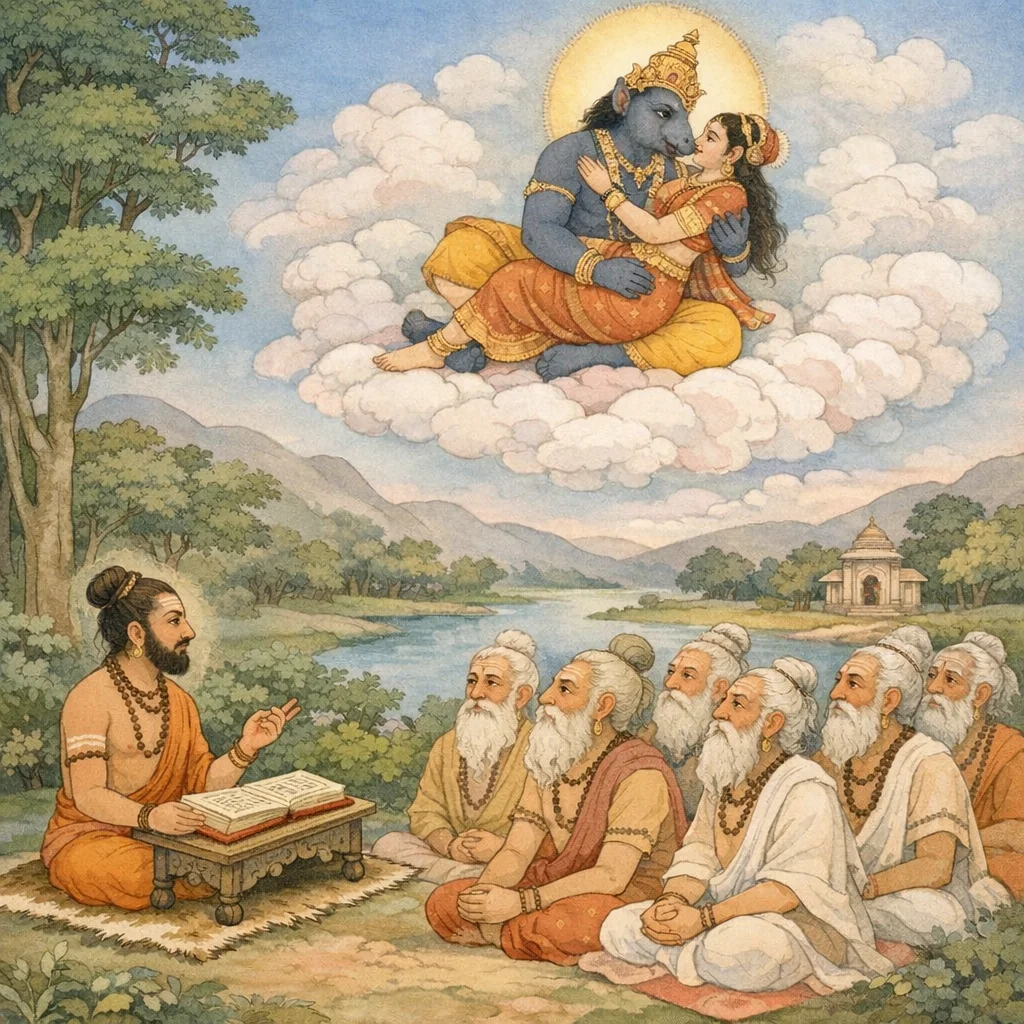
Adhyaya 217: Eulogy of the Merits (Phalaśruti) of the Dharāṇī–Varāha Dialogue
Dharāṇī–Varāha-saṃvāda-phalaśruti-varṇanam
Phalaśruti (Recitation-Merit) and Tīrtha-Comparative Praise
This adhyāya serves as a formal phalaśruti, framing the Dharāṇī–Varāha saṃvāda as a pedagogical teaching whose hearing, recitation, and preservation bring ethical purification and social welfare. Sanatkumāra relates that Brahmā (Parameṣṭhin/Prajāpati) has already settled the inquiry and entrusts the remaining exposition to Pulastya, stressing that the distilled “sāra” of the dialogue is to be heard continually by properly disciplined groups. The saṃvāda is praised as auspicious, dharma–kāma–artha-sādhaka, removing moral taint (pāpa) and promoting prosperity and longevity. Its merit is likened to major sacrifices, gifts, and tīrtha-ablutions, and stewardship of the text—writing it, housing it, and honoring the manuscript—is linked to sustained divine favor, implicitly presenting reverence for Earth (Dharāṇī) and her protection as a civilizational ethic within the Varāha-centered narrative.
Primary Speakers
Key Concepts
Shlokas in Adhyaya 217
Verse 1
अथ धरणीवराहसंवादफलश्रुतिवर्णनम् ॥ सनत्कुमार उवाच ॥ उक्तं भगवता सर्वं यथावत्परमेष्ठिना ॥ पृष्टेन संशयं सम्यक्परं कृत्वार्थनिश्चयम् ॥
Now follows the account of the phalaśruti—the declared benefits—of the dialogue between Dharaṇī and Varāha. Sanatkumāra said: All was spoken rightly by the Blessed One, the Supreme Lord; when questioned, he fully dispelled the doubt and established the correct determination of the matter.
Verse 2
भगवद्विश्वरूपस्य स्थाणोरप्रतिमौजसः ॥ क्रीडतो लोकनाथस्य कानने मृगरूपिणः ॥
Of the Blessed One in universal form—of Sthāṇu, whose energy is without equal—of the Lord of the world who, taking the form of a beast, sports within the forest.
Verse 3
यथा शरीरं शृङ्गं च पुण्यक्षेत्रे प्रतिष्ठितम् ॥ हिताय जगतस्तत्र तीर्थानि च यथाभवन् ॥
How the body and the horn were established in the holy region, and how, there, the tīrthas came into being for the welfare of the world—tell me.
Verse 4
तन्मे ब्रूहि महाभाग यथातत्त्वं जगत्पते ॥ ब्रह्मोवाच ॥ पुलस्त्यो वक्ष्यते शेषं यदतोऽन्यन्महामुने ॥
Tell me that, O fortunate one, O Lord of the world, exactly as it truly is. Brahmā said: Pulastya will explain the remainder, and what lies further beyond this, O great sage.
Verse 5
सर्वेषामेव तीर्थानामेषां फलविनिश्चयम् ॥ कुरु राज्यं पुरस्कृत्य मुनीनां पुरतो वने ॥
Determine the fruits of all these tīrthas; do so with kingship set foremost, in the forest, before the assembly of sages.
Verse 6
पुत्रो मे मत्समः सम्यग्वेदवेदाङ्गतत्त्ववित् ॥ यच्छ्रुत्वा पुरुषस्तात विमुक्तः सर्वकिल्बिषैः
“My son is equal to me, truly a knower of the realities of the Veda and its auxiliaries. Hearing this, dear one, a person is freed from all sins.”
Verse 7
यशस्वी कीर्त्तिमान्भूत्वा वन्द्यते प्रेत्य चेह च ॥ श्रोतव्यमेतत्सततं चातुर्वर्ण्यैः सुसंयुतैः
“Becoming possessed of renown and fame, one is honored both after death and here in this world. This should be listened to continually by those properly aligned with the four social orders.”
Verse 8
माङ्गल्यं च शिवं चैव धर्मकामार्थसाधकम् ॥ श्रीभूतिजननं पुण्यमायुष्यं विजयावहम्
“It is auspicious and beneficent, accomplishing dharma, desire, and material aims; it generates prosperity and well-being, is meritorious, promotes longevity, and brings success.”
Verse 9
धन्यं यशस्यं पापघ्नं स्वस्तिकृच्छान्तिकारकम् ॥ श्रुत्वैवं पुरुषः सम्यङ्न दुर्गतिमवाप्नुयात्
“It is fortunate, fame-bestowing, sin-destroying, and a maker of well-being and peace. Having heard thus, a person rightly would not fall into misfortune.”
Verse 10
सनत्कुमारं संदिश्य विरराम महायशाः ॥ एतद्वः कथितं सर्वं मया तत्त्वेन सत्तमाः
“Having instructed Sanatkumāra, the illustrious one ceased. ‘All of this has been told to you by me in accordance with the truth, O best of beings.’”
Verse 11
वराहभूमिसंवादं सारमुद्धृत्य सत्तमाः ॥ यश्चैव कीर्त्तयेन्नित्यं श्रृणुयाद्वापि भक्तितः
O best of beings, having drawn out the essence of the dialogue between Varāha and the Earth—whoever regularly recites it, or also listens to it with devotion…
Verse 12
सर्वपापविनिर्मुक्तः स याति परमां गतिम् ॥ प्रभासे नैमिषारण्ये गङ्गाद्वारेऽथ पुष्करे
Freed from all sins, that person goes to the highest state. (This is so) at Prabhāsa, in Naimiṣāraṇya, at Gaṅgādvāra, and also at Puṣkara…
Verse 13
प्रयागे ब्रह्मतीर्थे च तीर्थे चामरकण्टके ॥ यत्पुण्यफलमाप्नोति तत्कोटिगुणितं भवेत्
At Prayāga, at Brahma-tīrtha, and at the tīrtha at Amarakaṇṭaka—whatever meritorious result one obtains there, that becomes multiplied a crore-fold (ten million times).
Verse 14
कपिलां द्विजमुख्याय सम्यग्दत्त्वा तु यत्फलम् ॥ प्राप्नोति सकलं श्रुत्वा चाध्यायं तु न संशयः
Whatever result is obtained by properly giving a kapilā (tawny) cow to a foremost brāhmaṇa—one obtains all of that by hearing this chapter; of this there is no doubt.
Verse 15
श्रुत्वाऽस्यैव दशाध्यायं शुचिर्भूत्वा समाहितः ॥ अग्निष्टोमातिरात्राभ्यां फलं प्राप्नोति मानवः
Having heard these ten chapters, becoming purified and concentrated, a person obtains the fruit comparable to the sacrifices Agniṣṭoma and Atirātra.
Verse 16
यः पुनः सततं शृण्वन्नैरन्तर्येण बुद्धिमान् ॥ पारयेत्परया भक्त्या तस्यापि शृणु यत्फलम् ॥
But whoever, being discerning, listens constantly without interruption and completes (this text) with the highest devotion—hear also the fruit that accrues to him.
Verse 17
सर्वयज्ञेषु यत्पुण्यं सर्वदानेषु यत्फलम् ॥ सर्वतीर्थाभिषेकेन यत्फलं मुनिभिः स्मृतम् ॥
Whatever merit there is in all sacrifices, whatever result there is in all forms of giving, and whatever result sages have remembered to arise from bathing/ablution at all sacred tīrthas—
Verse 18
तत्प्राप्नोति न सन्देहो वराहवचनं यथा ॥ यदेतत्पारयेद्भक्त्या मम माहात्म्यमुत्तमम् ॥
He attains that—there is no doubt—according to the statement of Varāha, if he completes with devotion this highest māhātmya, my supreme eulogy.
Verse 19
तस्य नारायणो देवः सन्तुष्टः स्याद्धि सर्वदा ॥ यश्चैतच्छृणुयाद्भक्त्या नैरन्तर्येण मानवः ॥
For him, indeed, the god Nārāyaṇa would be continually satisfied—namely, the person who listens to this with devotion and without interruption.
Verse 20
श्रुत्वा तु पूजयेत्शास्त्रं यथा विष्णुं सनातनम् ॥ गन्धपुष्पैस्तथा वस्त्रैर्ब्राह्मणानां च तर्पणैः ॥
After hearing, one should honor the śāstra as one would honor the eternal Viṣṇu—by fragrances and flowers, likewise by cloth, and by offerings that bring satisfaction to brāhmaṇas.
Verse 21
यथाशक्ति नृपो ग्रामैः पूजयेत्च वसुन्धरे ॥ श्रुत्वा तु पूजयेद्यः पौराणिकं नियतः शुचिः ॥
According to his capacity, a king should honor the Earth (Vasundharā) by means of villages, that is, through grants of land and settlements. And whoever, disciplined and pure, honors the Purāṇika (reciter/expositor) after hearing—
Verse 22
कीर्तयित्वा व्रजेत्त्वर्गं कल्यमुत्थाय मानवः ॥ सूत उवाच ॥ इत्युक्त्वा भगवान्देवः परमेष्ठी प्रजापतिः ॥
Having proclaimed it, a person, rising at an auspicious time, would go to heaven. Sūta said: Having thus spoken, the blessed divine Lord—Parameṣṭhin, the Prajāpati—
Verse 23
अपुत्रस्य भवेत्पुत्रः सपौत्रस्य सुपौत्रकः ॥ यस्येदं लिखितं गेहे तिष्ठेत्सम्पूज्यते सदा ॥
For one without a son, there will be a son; for one with grandsons, there will be great-grandsons—for him in whose house this written text remains and is always duly honored.
Frequently Asked Questions
The chapter frames the Dharāṇī–Varāha dialogue as a normative instructional text: sustained hearing/recitation and respectful preservation of the teaching are presented as practices that cultivate moral purification (pāpa-kṣaya), social auspiciousness, and ordered life-goals (dharma–kāma–artha). It also advances an implicit Earth-centered ethic by treating the Dharāṇī-related discourse as a civilizational ‘sāra’ worthy of continual study and protection.
No explicit tithi, nakṣatra, month (māsa), or seasonal (ṛtu) markers are given. The recommended practice is framed as continuous (satataṃ; nairantaryeṇa) rather than tied to a calendrical observance.
Direct ecological prescriptions are not detailed here; instead, the chapter elevates the Dharāṇī–Varāha saṃvāda as a foundational teaching whose continual transmission benefits the world (jagat-hitāya). By sacralizing the Earth-centered dialogue and linking it to collective welfare, the text indirectly supports an ethic of terrestrial respect and preservation through cultural memory and disciplined practice.
The narrative references major Purāṇic authorities and transmitters—Brahmā (Parameṣṭhin/Prajāpati), Sanatkumāra, Pulastya, and Sūta—functioning as a lineage of instruction and authentication. A royal figure (nṛpa/rājya context) is also invoked in relation to patronage and honoring the tradition, but no specific dynasty is named.