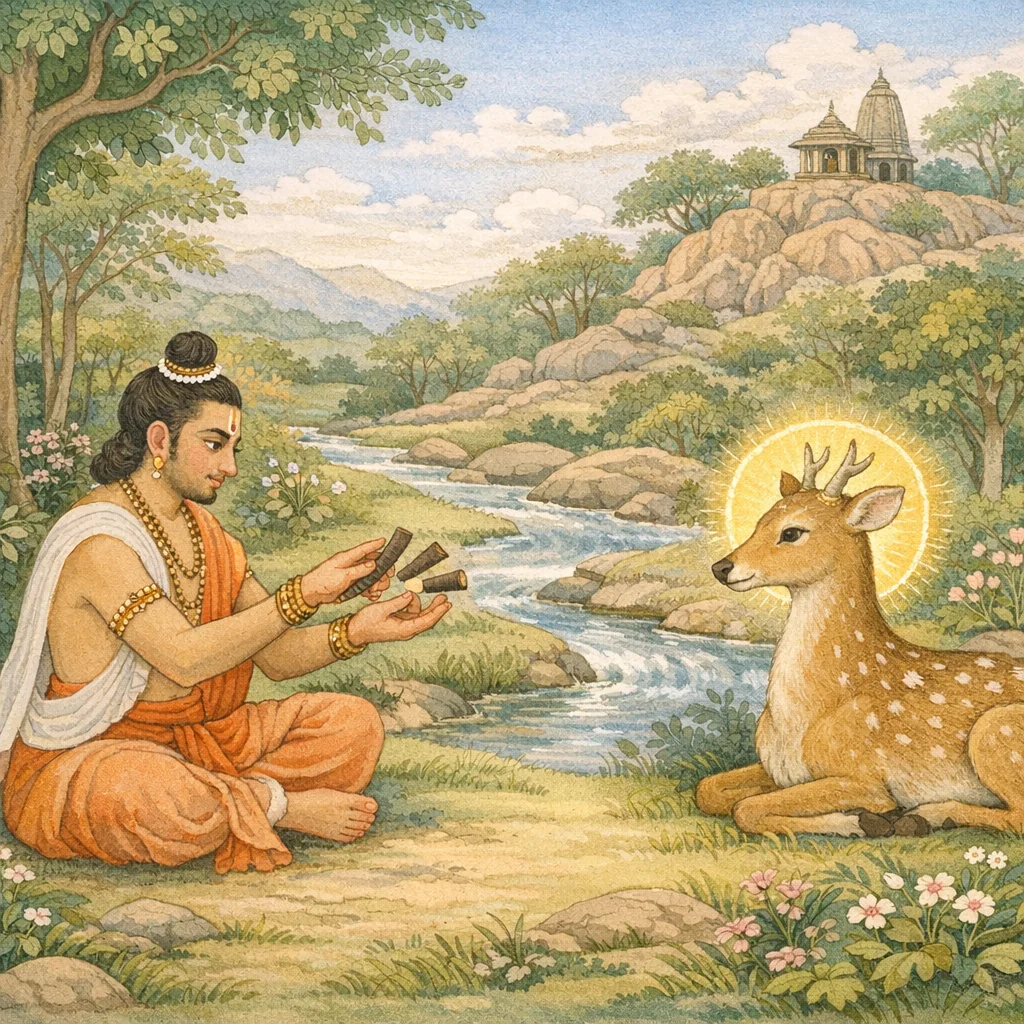
Adhyaya 215: Description of the Māhātmya of Gokarṇeśvara and Jaleśvara (Śaileśvara) in the Śleṣmātaka Forest
Gokarṇeśvara–Jaleśvara-māhātmya-varṇanam
Sacred-Geography (Tīrtha-māhātmya) and Ritual-Manual (snāna–dāna–arcana prescriptions)
Within the Varāha–Pṛthivī teaching frame, this chapter proclaims the tīrtha-māhātmya of Gokarṇeśvara and Jaleśvara (Śaileśvara) in the Śleṣmātaka forest. Indra (Śakra) and the gods search the worlds for Śaṅkara and fail until they reach Śleṣmātaka, where they meet Umā and then a wondrous deer-like being with a horn. Indra, Brahmā, and Viṣṇu seize and divide the horn; the being rebukes them and commands that the horn(s) be established for loka-anugraha, the welfare of beings. The text then lays out a sacred geography around the Vāgmatī river, its confluences, and springs, prescribing ritual bathing (snāna), worship (arcana), lamp-offering, ancestor rites (śrāddha), and conduct-based prerequisites. It asserts that these observances remove moral blemish, stabilize social order, and enact care for Earth through regulated pilgrimage, clean waters, and protected sacred groves.
Primary Speakers
Key Concepts
Shlokas in Adhyaya 215
Verse 1
अथ गोकरणेश्वरजलेश्वरमाहात्म्यवर्णनम्॥ ब्रह्मोवाच॥ ततः शक्रः सुरगणैः सह सर्वैः समेत्य च॥ बुद्धिं चकार गमने मार्गितुं यत्र शङ्करः॥
Now, the account of the greatness of Gokarṇeśvara and Jaleśvara. Brahmā said: Then Śakra (Indra), having assembled with all the hosts of gods, resolved to set out and seek the place where Śaṅkara was.
Verse 2
तत उत्थाय ते देवाः सर्व एव शिलोच्चयात्॥ विहायसा ययुः शीघ्रं तेनैव सह नन्दिना॥
Then those gods—all of them—rose from the mountain peak and swiftly went through the sky, accompanied by that very Nandin.
Verse 3
स्वर्लोकं ब्रह्मलोकं च नागलोकं च सर्वशः ॥ बभ्रमुस्त्रिदशाः सर्वे रुद्रान्वेषणतत्पराः ॥
They wandered everywhere—through Svarga-loka, Brahma-loka, and Nāga-loka— all the gods intent on seeking Rudra.
Verse 4
खिन्नाः क्लिष्टाश्च सुभृशं न पुनस्तत्पदं विदुः ॥ चतुःसमुद्रपर्यन्तसप्तद्वीपवतीं महीम् ॥
Exhausted and sorely strained, they still did not know that place; (they searched) the earth bounded by the four oceans, possessed of the seven continents.
Verse 5
सशैलकाननोपेतां मार्गयद्भिर्हि तं सुरम् ॥ कन्दरेषु महाद्रीणां तुङ्गेषु शिखरेषु च ॥
Indeed, while searching for that deity, they ranged over the earth furnished with mountains and forests—through the caves of great mountains and upon lofty peaks.
Verse 6
विततेषु निकुञ्जेषु विहारेषु च सर्वतः ॥ विचिन्वद्भिः क्षितिमिमां तृणं द्विविदलीकृतम् ॥
In spreading groves and pleasure-grounds everywhere, as they searched this earth, even the grass was split in two—as though everything had been thoroughly combed through.
Verse 7
न प्रवृत्तिः क्वचिदपि शम्भोरासाद्यते सुरैः ॥ यदा निर्विण्णमनसो मार्गमाणाः सुरास्तदा ॥
Nowhere did the gods obtain any trace of Śambhu; and when, their minds grown despondent, the gods continued searching then—
Verse 8
न पश्यन्ति शिवं तत्र तदेषां भयमाविशत् ॥ भीतास्ते संविदं कृत्वा सञ्चिन्त्य गुरुलाघवम् ॥
They did not see Śiva there, and fear entered them. Frightened, they made a pact among themselves, weighing what was weighty and what was light—the pros and cons.
Verse 9
सम्भूयान्योऽन्यममराः मामेव शरणं ययुः ॥ तमेकाग्रेण मनसा शङ्करं लोकशङ्करम् ॥
Gathering together, the immortals came to me alone for refuge, seeking Śaṅkara, the benefactor of the worlds, with minds fixed in one-pointed concentration.
Verse 10
सर्वं त्रैलोक्यमस्माभिर्विचितं वै निरन्तरम् । श्लेष्मातकवनोद्देशं स्थानं मुक्त्वा महीतले ॥
We have searched the entire threefold world without pause; only one place on earth was left aside—the region of the Śleṣmātaka forest.
Verse 11
आगच्छध्वं गमिष्यामस्तमुद्देशं सुरोत्तमाः ॥ इत्येवमुक्त्वा तैः सर्वैस्तामाशां प्रस्थिताः वयम् ॥
“Come; we shall go to that region, O best of the gods.” Having spoken thus, we set out in that direction together with them all.
Verse 12
तत्क्षणादेव सम्प्राप्ता विमानैः शीघ्रयायिभिः ॥ श्लेष्मातकवनं पुण्यं सिद्धचारणसेवितम् ॥
At that very moment we arrived in swift-moving aerial cars (vimānas) at the sacred Śleṣmātaka forest, frequented by Siddhas and Cāraṇas.
Verse 13
तस्मिन्सुरमणीयानि विविधानि शुचीनि च ॥ ध्यानस्थानानि रम्याणि बहूनि गुणवन्ति च
There were many exceedingly beautiful places—varied and pure—and many delightful sites for meditation as well, rich in excellent qualities.
Verse 14
आश्रमारण्यभागेषु दरीणां विवरेषु च ॥ विभ्राजद्वनराजाकी नद्यश्च विमलोदकाः
In the tracts of hermitages and forests, and in the clefts of mountain-caves as well, rivers shone forth, bearing clear and pure water.
Verse 15
सिंहशार्दूलमहिषगोलाङ्गूलर्क्षवानरैः ॥ नादितं गजयूथैश्च मृगयूथैश्च तद्वनम्
That forest resounded with lions, tigers, buffaloes, monkeys, bears, and apes; and also with herds of elephants and herds of deer.
Verse 16
प्रमुखे वासवं कृत्वा विविशुस्ते सुरास्तदा ॥ विमुच्य रथयानानि पद्भिः सिद्धादिसङ्कटम्
Then those gods entered, placing Vāsava (Indra) at their head; abandoning their chariots, they proceeded on foot through the crowded region filled with Siddhas and others.
Verse 17
कन्दरोदरकूटेषु तरूणां गहनेषु च ॥ सर्वदेवमयं रुद्रं मार्गमाणाः शनैः शनैः
In the hollows and peaks of caves, and in the dense growth of trees, they searched—slowly, step by step—for Rudra, who embodies all the gods.
Verse 18
प्रविशन्तश्च ते देवा वनॊद्देशं क्वचिच्छुभे ॥ कदलीवनसञ्च्छन्ने फुल्लपादपशोभिते
As those gods proceeded, they entered an auspicious tract of forest, covered with banana-groves and adorned with flowering trees.
Verse 19
मुक्ताचूर्णनिकाशाभिर्वालुकाभिस्ततस्ततः ॥ विक्रीडमानां ददृशुः कन्यां काश्चिन्मनोरमाम्
Here and there, amid sands resembling powdered pearls, they saw a charming maiden playing about.
Verse 20
तत्र ते विबुधा दृष्ट्वा सर्वे मां समचोदयन् ॥ आद्योऽहं सर्वदेवानां कथमेतद्भवेदिति
There, upon seeing her, all those wise beings urged me to explain, saying: “I am the foremost among all the gods—how could this be so?”
Verse 21
मुहूर्त्तं ध्यानमास्थाय विज्ञाता सा मया तदा ॥ ध्रुवं शैलेन्द्रपुत्रीयमुमाविश्वेश्वरेश्वरि
Entering meditation for a moment, I then recognized her: surely she was Umā, the daughter of the lord of mountains, the sovereign even over the Lord of the universe (Viśveśvara).
Verse 22
ततस्तदुच्छशिखरमारुह्य विबुधेश्वराः ॥ अधो विलोक्य ते सर्वे ददृशुस्तं सुरोत्तमम्
Then the lords among the gods climbed that lofty summit; looking down, all of them saw that foremost among the gods.
Verse 23
मध्ये मृगसमूहस्य गोप्तारमिव संस्थितम् ॥ एकशृङ्गैकचरणं तप्तहाटकवर्चसम् ॥
Standing in the midst of the herd of deer as though it were their protector, there appeared a creature with a single horn and a single foot, whose body shone like armor of heated gold.
Verse 24
चारुवक्त्राक्षिदशनं पृष्ठतः शुक्लबिन्दुभिः ॥ शुक्लेनोदरभागेन राजतैरुपशोभितम् ॥
It had a pleasing face, eyes, and teeth; its back was marked with white spots, and its belly-region, white and silvery, was beautifully adorned.
Verse 25
पीनोन्नतकटीस्कन्धं निमग्नांसशिरोधरम् ॥ बिम्बोष्ठं ताम्रजिह्वास्यं दंष्ट्राङ्कुरविराजितम् ॥
Its hips and shoulders were full and raised; its neck and head seemed set low between the shoulders. It had lips like a bimba fruit, a copper-colored tongue, and was radiant with budding tusks.
Verse 26
तं दृष्ट्वा विबुधाः सर्वे शिखरात्प्रतिधाविताः ॥ सर्वोद्यामेन तरसा तं मृगेन्द्रजिघृक्षवः ॥
On seeing it, all the gods rushed down from the peak; with full exertion and great speed, they sought to seize that lordly beast.
Verse 27
शृङ्गाग्रं प्रथमं धृत्वा गृहीत्वा वज्रपाणिना ॥ मध्यं मया तस्य तदा गृहीतं प्रणतात्मना ॥
First, the tip of the horn was grasped by the wielder of the thunderbolt (Vajrapāṇi); then I, with a bowed and reverent disposition, seized its middle portion.
Verse 28
शक्रस्याग्रं स्थितं हस्ते मध्यं हस्ते मम स्थितम् ॥ विष्णोर्मूलं स्थितं हस्ते प्रविभक्तं त्रिधागतम् ॥
The tip remained in Śakra’s hand; the middle remained in my hand; the base remained in Viṣṇu’s hand—thus it was divided and came to be in three parts.
Verse 29
शृङ्गस्यैव गृहीतस्य त्रिधास्माकं मृगाधिपः ॥ विषाणरहितस्तस्य प्रणष्टः पुनरत्र वै ॥
Though only the horn, seized by us, was divided into three parts, that lord of beasts—now bereft of its horn—vanished again from this place.
Verse 30
अन्तर्हितोऽन्तरिक्षस्थः प्रोवाचास्मानुपालभन् ॥ भो भो देवा मया यूयं वच्यमानानवाप्स्यथ ॥
Hidden and stationed in mid-air, it spoke to us in reproach: “Ho, ho, gods—what I declare, you will not attain (as you are).”
Verse 31
सशरीरोऽहं युष्माभिर्वशाप्तः प्रगतस्त्वितः ॥ शृङ्गमात्रेण सन्तुष्टा भवन्तस्तेन वञ्चिताः ॥
“I, with my body, escaped from your control and went away from here; you, satisfied with only the horn, have thereby been deceived.”
Verse 32
यद्यहं सशरीरः स्यां गृहीत्वा स्थापितोऽभवम् ॥ तदा चतुष्पात्सकलो धर्मः स्यात्प्रतिपादितः ॥
“If I, with my body, had been seized and set in place, then the entire Dharma—standing on four feet—would have been established.”
Verse 33
कामं शृङ्गाणि मेऽत्रैव श्लेष्मात्मकवनेऽमराः ॥ न्यायतः स्थापयिष्यध्वं लोकानुग्रहकाम्यया ॥
“Let my horns remain here indeed, in this forest of Śleṣmātman. O immortals, set them in place according to proper order, with the wish to benefit the world.”
Verse 34
अत्रापि महती व्युष्टिर्भविष्यति न संशयः ॥ पुण्यक्षेत्रे सुमहति मत्प्रभावानुभाविते ॥
“Here too there will be great flourishing—without doubt—within this exceedingly great sacred kṣetra, made illustrious by the experience of my power.”
Verse 35
यावन्ति भुवि तीर्थानि ह्यासमुद्रसरांसि च ॥ क्षेत्रेऽस्मिंस्तानि तीर्थानि चागमिष्यन्ति मत्कृते ॥
“As many tīrthas as exist on earth—together with lakes and waters up to the ocean—those tīrthas will come to this field for my sake.”
Verse 36
अहं पुनः शैलपतेः पादे हिमवतः शुभे ॥ नेपालाख्ये समुत्पत्स्ये स्वयमेव महीतलात् ॥
“And I, again, shall arise of my own accord from the surface of the earth at the auspicious foot of Himavat, lord of mountains, in the place called Nepāla.”
Verse 37
तत्र नागह्रदे घोरे स्थास्याम्यन्तर्जले ह्यहम् ॥ त्रिंशद्वर्षसहस्राणि सर्वभूतहिते रतः ॥
“There, in the fearsome lake of the Nāgas, I shall indeed remain within the waters for thirty thousand years, devoted to the welfare of all beings.”
Verse 38
यदा वृष्णिकुलोत्पन्नः कृष्णचक्रेण पर्वतान् ॥ पाटयित्वेन्द्रवचनाद्दानवान्निहनिष्यति ॥
When one born in the Vṛṣṇi lineage, with Kṛṣṇa’s discus, will cleave the mountains and, at Indra’s command, will slay the Dānavas.
Verse 39
तदा स देशो भविता सर्वम्लेच्छैरधिष्ठितः ॥ ततोऽन्ये सूर्यवंशीया क्षत्रियास्तान्निहत्य च ॥
Then that land will be wholly occupied by the mlecchas; thereafter other Kṣatriyas of the Sūryavaṁśa will slay them.
Verse 40
ततो जनपदस्तत्र भविष्यति महांस्तदा ॥ स्फीतो ब्राह्मणभूयिष्ठसर्ववर्णाश्रमैर्युतः ॥
Then, there, a great janapada will arise—prosperous—abounding in Brahmins and furnished with all varṇas and āśramas.
Verse 41
वसिष्यन्ति च तं देशं ब्राह्मणैः संप्रवर्त्तितान् ॥ धर्मान्संस्थापयिष्यन्ति राज्यं प्राप्स्यन्ति शाश्वतम् ॥
And they will dwell in that land, guided by practices set in motion by Brahmins; they will establish the dharmas and attain enduring rule.
Verse 42
ततो लिङ्गार्च्चनं तत्र प्रतिष्ठास्यन्ति पार्थिवाः ॥ क्षत्रियाः सूर्यवंशीया शून्ये लप्स्यन्ति मां नृपाः ॥
Thereafter, the kings will establish there the worship of the liṅga. Those Sūryavaṁśa Kṣatriya rulers, when the place is uninhabited, will obtain me—my presence and grace.
Verse 43
सम्यक्प्रवृत्ता राजानो भविष्यन्त्यायतौ स्थिताः ॥ एवं सम्यक्स्थिते तस्मिन्देशे पौरजने तथा
When the kings act in a well-ordered manner, remaining firmly established in proper conduct, and when that region and its townspeople are likewise settled in right order—
Verse 44
तत्र मामर्च्छयिष्यंति सर्वभूतानि सर्वदा ॥ तत्राहं यैः सकृद्दृष्टो विधिवद्वंदितस्तु यैः
There, all beings will continually honor me. And there, those by whom I have been seen even once, and those by whom I have been saluted according to proper rite—
Verse 45
गत्वा शिवपुरं ते मां द्रक्ष्यंते दग्धकिल्बिषाः ॥ उत्तरेण तु गङ्गाया दक्षिणे चाश्विनीमुखात्
Having gone to Śivapura, they will behold me, their demerit burned away. It lies to the north of the Gaṅgā and to the south of Aśvinī-mukha—
Verse 46
भागीरथ्याः शतगुणं पवित्रं तज्जलं स्मृतम् ॥ तत्र स्नात्वा हरेर्लोकानुपस्पृश्य दिवसपतेः
That water is remembered as a hundredfold more purifying than the Bhāgīrathī. Having bathed there, and having performed the prescribed water-touching rite, one attains the worlds of Hari and of the Lord of Day (the Sun)—
Verse 47
मुक्त्वा देहं नरा यांति मम लोकं न संशयः ॥ अपि दुष्कृतकर्माणः क्षेत्रेऽस्मिन्निवसन्ति ये
Casting off the body, people go to my world—of this there is no doubt. Even those whose actions have been wrongful, if they dwell in this sacred region—
Verse 48
नियतं पुरुहूतस्य श्रिताः स्थाने वसन्ति ते ॥ देवदानवगन्धर्वाः सिद्धविद्याधरोरगाः
They dwell there, having taken refuge in the established abode of Puruhūta (Indra): Devas, Dānavas, Gandharvas, Siddhas, Vidyādharas, and Nāgas—
Verse 49
मुनयोऽप्सरसो यक्षाः मोहिताः मम मायया ॥ तद्वै गुह्यं न जानंति यत्र सन्निहितो ह्यहम्
Sages, Apsarases, and Yakṣas—deluded by my māyā—do not know that secret: the place where I am indeed present.
Verse 50
तपस्तपोधनानां च सिद्धक्षेत्रं हि तत्कृतम् ॥ प्रभासाच्च प्रयागाच्च नैमिषात्पुष्करादपि
For ascetics and those rich in austerity, it has indeed been made a siddha-kṣetra (a perfected sacred field). Even more than Prabhāsa, Prayāga, Naimiṣa, and Puṣkara—
Verse 51
कुरुक्षेत्रादपि बुधाः क्षेत्रमेतद्विशिष्यते ॥ श्वशुरो मे स्थितो यत्र हिमवान् भूधरेश्वरः
Even more than Kurukṣetra, this sacred region is considered distinguished, O wise ones. For there stands Himavān, lord of mountains—my father-in-law—
Verse 52
प्रभवन्ति यतः सर्वा गङ्गाद्याः सरितां वराः ॥ तस्मिन्क्षेत्रवरे पुण्ये पुण्याः सर्वाः सरिद्वराः
From there arise all the excellent rivers, beginning with the Gaṅgā. In that supremely excellent and sacred region, all the excellent rivers are holy.
Verse 53
सर्वे प्रस्रवणाः पुण्याः सर्वे पुण्याः शिलोच्चयाः ॥ आश्रमस्तत्र भविता सिद्धचारणसेवितः
All the springs there are meritorious; all the rocky heights are likewise meritorious. There shall be an āśrama there, frequented by Siddhas and Cāraṇas.
Verse 54
शैलेश्वर इति ख्यातः शरीरं यत्र मे स्थितम् ॥ स्रवन्तीनां वरा पुण्या वाग्मती पर्वतोत्तमात्
It is known as Śaileśvara, where my body is established. Among rivers, the blessed Vāgmatī is the foremost, flowing from an excellent mountain.
Verse 55
पानावगाहनात्तस्यास्तारयेत्सप्त वै कुलान् ॥ लोकपालस्तु चरति तीर्थख्यातिं च तत्स्वयम्
By drinking its water and by immersing in that river, one is said to deliver seven lineages. The Lokapāla himself moves about there, and that place attains renown as a tīrtha on its own.
Verse 56
तत्र स्नात्वा दिवं यान्ति मृतास्ते त्वपुनर्भवाः ॥ स्नात्वा स्नात्वा तु ये तत्र नित्यमभ्यर्चयन्ति माम्
Having bathed there, the deceased are said to go to heaven and not return to rebirth. And those who bathe there again and again and continually worship me—
Verse 57
उद्धराम्यहमेतान्वै प्रीतः संसारसागरात् ॥ यस्तस्य वारिणा पूर्णमेकं च घटमुद्धरेत्
Pleased, I lift them up from the ocean of saṁsāra. Whoever draws up even a single pot filled with its water—
Verse 58
स्नापनार्थे मम शुचिः श्रद्धधानोऽनसूयकः ॥ वेदवेदाङ्गविदुषा श्रोत्रियेण विशेषतः
For the rite of bathing offered to Me, one should be pure, faithful, and free from malice. In particular, it should be performed by a śrotriya learned in the Veda and its auxiliaries (Vedāṅgas).
Verse 59
आहृतस्याग्निहोत्रस्य यत्फलं तस्य तद्भवेत् ॥ तस्यास्तीरे जलोद्भेदं मन्मूलादभिनिःसृतम्
Whatever fruit belongs to an Agnihotra duly completed, that very fruit arises from this act. On its bank there is an upsurge of water, issuing forth from My own root and foundation.
Verse 60
मृगशृङ्गोदकं नाम नित्यं मुनिजनप्रियम् ॥ तत्राभिषेकं कुर्वीत उपस्पृश्य समाहितः
It is called Mṛgaśṛṅgodaka, ever dear to the communities of sages. There, having performed upaspṛśya—the purificatory touch with water—one should carry out the abhiṣeka ablution with a focused mind.
Verse 61
यावज्जीवकृतं पापं तत्क्षणादेव नश्यति ॥ तीर्थं पञ्चनदं प्राप्य पुण्यं ब्रह्मर्षिसेवितम्
The sin committed throughout one’s life perishes at that very moment. Having reached the tīrtha called Pañcanada—meritorious and frequented by Brahmarṣis—
Verse 62
अग्निष्टोमफलं तत्र स्नातमात्रः प्रपद्यते ॥ षष्टिं धेनुसहस्राणि यानि रक्षन्ति वाग्मतीम्
There, merely by bathing, one attains the fruit of the Agniṣṭoma rite. Sixty thousand cows—those that protect the Vāgmatī—
Verse 63
न तां पापाः कृतघ्नो वा कदाचित्प्राप्नुयान्नरः॥ शुचयः श्रद्धधानाश्च सत्यसंधाश्च ये नराः॥
A sinful person—or one who is ungrateful—should never obtain that merit. But those who are pure, faithful, and steadfast in truth are fit for it.
Verse 64
वाग्मत्याः सलिले स्नात्वा ये मां पश्यन्ति संस्कृताः॥ तेषां शान्तिर्भवेन्नित्यं पुरुषाणां न संशयः॥
Those who, after bathing in the waters of Vāgmatī, behold me—being duly prepared—attain constant peace; of this, for such persons, there is no doubt.
Verse 65
मत्प्रभावात्तु स्नातस्य सर्वं नश्यति किल्बिषम्॥ ईतयः समुदीर्णाश्च प्रशमं यान्ति सर्वशः॥
But by my power, for one who has bathed, all sin is destroyed; and afflictions that have arisen subside entirely, everywhere coming to calm.
Verse 66
तत्र तत्र फलं दद्याद्राजसूयाश्वमेधयोः॥ योजनाभ्यन्तरं क्षेत्रं समन्तात्सर्वतोदिशम्॥
In that place, it bestows the fruit of the Rājasūya and Aśvamedha sacrifices. The sacred precinct extends for one yojana in every direction all around.
Verse 67
मूलक्षेत्रं तु विज्ञेयं रुद्रेणाधिष्ठितं स्वयम्॥ तत्र पूर्वोत्तरे पार्श्वे वासुकिर्नाम नागराट्॥
Know that the root sacred precinct is presided over by Rudra himself. There, on the northeastern side, is the nāga-king named Vāsuki.
Verse 68
वृतो नागसहस्रैस्तु द्वारि तिष्ठति मे सदा॥ स विघ्नं कुरुते नृणां तत्क्षेत्रं विशतां सदा॥
Surrounded by thousands of nāgas, he always stands at my gate. He continually creates obstacles for people who seek to enter that sacred precinct.
Verse 69
प्रथमं स नमस्कार्यस्ततोऽहं तदनन्तरम्॥ अनेन विधिना पुंसामविघ्नं विशतां भवेत्॥
First he should be saluted, and then I should be saluted thereafter. By this procedure, those who enter will do so without obstacles.
Verse 70
वन्दते परया भक्त्या यो मां तत्र नरः सदा॥ पृथिव्यां स भवेद्राजा सर्वलोकनमस्कृतः॥
The man who there always venerates me with supreme devotion becomes a king on earth, revered by all people.
Verse 71
गन्धैर्माल्यैश्च मे मूर्त्तिमभ्यर्च्चयति यो नरः॥ उत्पत्स्यते स देवेṣu तुषितेषु न संशयः॥
Whoever worships my image with fragrances and garlands will be reborn among the satisfied gods, the Tuṣitas; of this there is no doubt.
Verse 72
गीतवादित्रनृत्यैस्तु स्तुतिभिर्जागरेण वा॥ ये मे कुर्वन्ति सेवां वै मत्संस्थास्ते भवन्ति हि॥
Those who render service to me—through singing, instrumental music, dance, hymns, or keeping vigil—indeed become established in my presence.
Verse 73
दध्ना क्षीरेण मधुना सर्पिषा सलिलेन वा ॥ स्नापनं ये प्रयच्छन्ति ते तरन्ति जरान्तकौ ॥
Those who provide ritual bathing (snāpana) with curd, milk, honey, ghee, or even water—such persons are said to cross beyond decay and death.
Verse 74
यः श्राद्धे भोजनं दद्याद्विप्रेभ्यः श्रद्धयान्वितः ॥ सोऽमृताशी भवेनूनं त्रिदिवे सुरपूजितः ॥
Whoever, with sincere intent, gives food to brāhmaṇas at a śrāddha rite—he indeed becomes one who partakes of immortality, honored among the gods in heaven.
Verse 75
व्रतोपवासैर्होमैर्वा नैवेद्यैश्चारुभिस्तथा ॥ यजन्ते ब्राह्मणा ये मां परया श्रद्धयान्विताः ॥
Those brāhmaṇas who worship me with supreme sincerity—by vows and fasts, by fire-offerings (homa), and likewise by offerings of food (naivedya) and cooked oblations—perform worship through these disciplines.
Verse 76
षष्टिवर्षसहस्राणि चोषित्वा दिवि ते ततः ॥ ऐश्वर्यं प्रतिपद्यन्ते मर्त्यलोके पुनः पुनः ॥
Having dwelt in heaven for sixty thousand years, they thereafter attain prosperity again and again in the human world.
Verse 77
ब्राह्मणः क्षत्रियो वैश्यः शूद्रः स्त्री वापि सङ्गताः ॥ शैलेश्वरं तु तत्स्थानं भक्तितः समुपासते ॥
Brāhmaṇas, kṣatriyas, vaiśyas, śūdras, and women as well—gathered together—devotionally venerate Śaileśvara and that sacred abode.
Verse 78
मत्पार्षदास्ते जायन्ते सततं सहिताः सुरैः ॥ शैलेश्वरं परं गुह्यं गतिः शैलेश्वरः परा ॥ शैलेश्वरात्परं क्षेत्रं न क्वचिद्भुवि विद्यते ॥
They are continually born as my attendants, accompanied by the gods. Śaileśvara is the supreme secret; Śaileśvara is the highest destination. Nowhere on earth is any sacred field found that surpasses Śaileśvara.
Verse 79
ब्रह्महा गुरुहा गोग्नः स्पृष्टो वै सर्वपातकैः ॥ क्षेत्रमेतदनुप्राप्य निर्मलो जायते नरः ॥
Even one who has slain a brāhmaṇa, slain a teacher, killed a cow, or is tainted by every grave sin—upon reaching this sacred region, a person becomes purified.
Verse 80
विविधान्यत्र तीर्थानि सन्ति पुण्यानि देवताः ॥ येषान्तोयैर्नरः स्पृष्टः सर्वपापैः प्रमुच्यते ॥
Here there are various tīrthas (sacred fords) and auspicious deities; by the waters belonging to them, a person who is touched—i.e., ritually bathed—is released from all sins.
Verse 81
तत्र स्नात्वा शुचिर्दान्तः सत्यसन्धो जितेन्द्रियः ॥ विमुक्तः किल्बिषैः सर्वैः सर्वमेव फलं लभेत् ॥
Having bathed there, being clean, self-restrained, committed to truth, and master of the senses—freed from all faults—one indeed obtains the full fruit of the rite.
Verse 82
अनाशकं व्रजेद्यस्तु दक्षिणेन महात्मनः ॥ शैलेश्वरस्य पुरुषः स गच्छेत्परमां गतिम् ॥
But the person who goes to Anāśaka, to the south of the great Śaileśvara, attains the highest destination.
Verse 83
भृगुप्रपतनं कृत्वा कामक्रोधविवर्जितः॥ विमानॆन दिवं गच्छेद्धृतः सोऽप्सरसाङ्गनैः॥
Having performed the rite called “Bhṛgu’s descent (prapatana),” and being free from desire and anger, one goes to heaven in a celestial vimāna, borne along by companies of apsarases.
Verse 84
भृगुमूले परं तीर्थं ब्रह्मणा निर्मितं स्वयम्॥ ब्रह्मोद्भेदेति विख्यातं तस्यापि शृणु यत्फलम्॥
At Bhṛgu’s base there is a supreme tīrtha, fashioned by Brahmā himself; it is renowned as “Brahmodbheda.” Hear also the fruit (merit) of that sacred ford.
Verse 85
संवत्सरं तु यस्तत्र स्नास्यंस्तु नियतेन्द्रियः॥ स ब्रह्मलोके विरजे गच्छेन्नास्त्यत्र संशयः॥
But whoever, with senses restrained, bathes there for a full year goes to the stainless Brahma-world (Brahmaloka); of this there is no doubt.
Verse 86
तत्र गोरक्षकं नाम गोवृषः पदविक्षतम्॥ दृष्ट्वा च तानि हि पुमान् गोसहस्रफलं लभेत्॥
There is a bull named Gorakṣaka, whose hoofprints are visible; on seeing those marks, a person gains merit equivalent to the gift of a thousand cows.
Verse 87
गौर्यास्तु शिखरं तत्र गच्छेत्सिद्धनिषेवितम्॥ यत्र सन्निहिता नित्यं पार्वती शिखरप्रिया॥
One should go there to Gaurī’s peak, frequented by siddhas, where Pārvatī—fond of mountain summits—is said to be ever-present.
Verse 88
लोकमाता भगवती लोकरक्षार्थमुद्यता॥ तस्याः सालोक्यमायाति दृष्ट्वा स्पृष्ट्वाभिवाद्य च॥
She—the venerable Mother of the world, intent on safeguarding the world—(one) attains sālokya, dwelling in her realm, by seeing her, touching her, and offering reverent salutation.
Verse 89
त्यजते पतितुं तस्या अधस्ताद्वाग्मतीतटे॥ उमालोकं व्रजेदाशु विमानॆन विहायसा॥
Below her, on the bank of the Vāgmatī, one abandons the tendency to fall into misfortune; swiftly one goes to Umā’s world, borne through the sky in a celestial vimāna.
Verse 90
तीर्थं पञ्चनदं प्राप्य पुण्यं ब्रह्मर्षिसेवितम्॥ अग्निहोत्रफलं तत्र स्नानमात्रेण लभ्यते॥
Having reached the sacred tīrtha called Pañcanada—holy and frequented by brahmarṣis—there the fruit of the Agnihotra is obtained by bathing alone.
Verse 91
नकुलोहेन मतिमान्स्नापयेत्प्रयतात्मवान्॥ जातिस्मरः स तु भवेत्सिध्यते चास्य मानसम्॥
A wise, self-disciplined person should bathe there with the water called ‘nakulāha’; then he becomes one who remembers former births, and his mental aim is fulfilled.
Verse 92
तस्यैवोत्तरत्तस्तीर्थमपरं सिद्धसेवितम्॥ नाम्ना प्रान्तकपानीयं गुह्यं गुह्यकरक्षितम्॥
Just to the north of that is another tīrtha, frequented by siddhas, called Prāntaka-pānīya—secret, and guarded by the Guhyakas.
Verse 93
संवत्सरं यस्तु पूर्णं तत्र स्नायान्नरः सदा ॥ गुह्यकः स भवेदाशु रुद्रस्यानुचरः सुधीः ॥
A man who bathes there continually for a full year quickly becomes a Guhyaka, a wise attendant in Rudra’s retinue.
Verse 94
देव्याः शिखरवासिन्या ज्ञेयं पूर्वोत्तरेण वै ॥ दक्षिणेन तु वाग्मत्याः प्रसृतं कन्दरॊदरात् ॥
To the northeast lies what should be recognized as belonging to the Goddess who dwells upon the peak; and to the south, the Vāgmatī issues forth, flowing out from within a cavern’s interior.
Verse 95
तीर्थं ब्रह्मोदयम् नाम पुण्यं पापप्रणाशनम् ॥ तत्र गत्वा जलं स्पृष्ट्वा स्नात्वा चाभ्युक्श्य मानवः ॥
There is a sacred ford called Brahmodaya, auspicious and destructive of wrongdoing. Having gone there, a person—after touching the water, bathing, and sprinkling it upon oneself—
Verse 96
मृत्युलोकं न पश्येत्स कृच्छ्रेषु च न सीदति ॥ गत्वा सुन्दरिकातीर्थं विधिना तीर्थमादिमम् ॥
—he would not behold the realm of death, nor does he sink in times of hardship—having gone in due manner to the Sundarikā-tīrtha, the primordial sacred ford.
Verse 97
तत्र स्नात्वा भवेत् तोये रूपवानुत्तमद्युतिः ॥ त्रिसन्ध्यं तत्र गच्छेत् तु पूर्वेण विधिवन्नरः ॥
Having bathed there in the water, one becomes handsome and of excellent radiance. A person should go there at the three sandhyā times, proceeding by the eastern route, in accordance with proper rule.
Verse 98
तत्र सन्ध्यामुपास्याथ द्विजो मुच्येत किल्विषात् ॥ वाग्मत्या मणिवत्याश्च सम्भेदे पापनाशने ॥
Then, having performed the sandhyā worship there, the twice-born is released from fault. This is at the purifying confluence of the Vāgmatī and the Maṇivatī, which destroys sin.
Verse 99
तारितं च कुलं तेन सर्वं भवति साधुना ॥ वर्णावरोऽपि यः कश्चित्स्नात्वा दद्यात्तिलोदकम् ॥
By that virtuous person, the entire family line is said to be carried across to well-being. Even one of lower social rank—whoever he may be—having bathed, should offer water with sesame.
Verse 100
तर्पिताः पितरस्तेन भवेयुर्नात्र संशयः ॥ यत्र यत्र च वाग्मत्यां स्नाति वै मानवोत्तमः ॥
By that act, the ancestors are satisfied—of this there is no doubt. And wherever the excellent person bathes in the Vāgmatī,
Verse 101
तिर्यग्योनिं न गच्छेत् तु समृद्धे जायते कुले ॥ वाग्मतीमणिवत्योश्च सम्भेदश्चर्षिसेवितः ॥
He does not go to an animal womb (a non-human rebirth), but is born in a prosperous family. And the confluence of the Vāgmatī and the Maṇivatī is frequented by seers (ṛṣis).
Verse 102
धीमान्गच्छेत् तु विधिना कामक्रोधविवर्जितः ॥ गङ्गाद्वारे तु यत्प्रोक्तं स्नानपुण्यफलम् महत् ॥
A wise person should proceed according to proper rule, free from desire and anger. The great merit-fruit of bathing that is spoken of at Gaṅgādvāra—
Verse 103
स्नानस्य तद्दशगुणं भवेदत्र न संशयः ॥ अत्र विद्याधराः सिद्धा गन्धर्वा मुनयः सुराः
Here, the fruit of bathing becomes tenfold—of this there is no doubt. Here are found the Vidyādharas, Siddhas, Gandharvas, sages, and gods.
Verse 104
स्नानमेतदुपासन्ते यक्षाश्च भुजगैः सह ॥ स्वल्पमप्यत्र यत्किञ्चिद्द्विजेभ्यो दीयते धनम्
Even the Yakṣas, together with the Nāgas (serpent-beings), revere this bathing. And whatever wealth—however little—is given here to the twice-born (dvijas) is praised.
Verse 105
तदक्षयं भवेद्दातुर्दानपुण्यफलं महत् ॥ तस्मात्सर्वप्रयत्नेन करणीयं च देवताः
That gift becomes imperishable for the giver; great is the meritorious fruit of donation (dāna). Therefore, with every effort, it should be undertaken, O deities.
Verse 106
वरिष्ठं क्षेत्रमेतस्मान्नान्यदेव हि विद्यते ॥ तस्मिन् श्लेष्मातकवने पुण्ये त्रिदशसेविते
No other sacred field (kṣetra) is known to be superior to this. In that holy Śleṣmātaka-grove, frequented by the thirty gods (devas)…
Verse 107
यत्र यत्र मया देवाश्चरता मृगरूपिणा ॥ आसितं स्वपितं यातं विहृतं वा समन्ततः
Wherever I, O gods, while roaming in the form of a beast, sat, slept, went, or sported all around—
Verse 108
गोकर्णेश्वर इत्येतत्पृथिव्यां ख्यातिमेष्यति ॥ एवं सन्दिश्य विबुधान्देवदेवः सनातनः
“This place will attain renown on earth as Gokarṇeśvara.” Having thus instructed the gods, the eternal God of gods…
Verse 109
अदृश्य एव विबुधैः प्रययावुत्तरां दिशम्
Becoming invisible to the gods, he departed toward the northern direction.
Verse 110
उपायमात्रं दृष्टं मे ध्यायंस्तद्वेषभूषणैः ॥ यथा यत्र च सोऽस्माभिर्द्रष्टव्यो वृषभध्वजः
I have perceived only a means, while meditating upon his attire and ornaments—how and where that Bull-bannered One, Śiva, is to be beheld by us.
Verse 111
स्तनकुण्डे उमायास्तु यः स्नायात्खलु मानवः ॥ स्कन्दलोकमवाप्नोति भूत्वा वैश्वानरद्युतिः
Indeed, the person who bathes in Umā’s Stanakuṇḍa attains the world of Skanda, becoming radiant like Vaiśvānara (fire).
Verse 112
अहोरात्रं वसेद्यस्तु रुद्रजापो द्विजः शुचिः ॥ स भवेद्वेदविद्विद्वान्यज्वा पार्थिवपूजितः
But the pure twice-born who resides there for a full day and night, engaged in Rudra-recitation, becomes a knower of the Veda, learned, a sacrificer, and honored by kings.
Verse 113
तत्र तत्राभवत्सर्वं पुण्यक्षेत्रं च सर्वशः ॥ शृङ्गमेतत्त्रिधाभूतं सम्यक्संश्रूयतां सुराः ॥
Here and there, everywhere, the entire region became a meritorious sacred field. This peak was divided into three; hear it rightly, O gods.
Verse 114
गिरिनद्यास्तु पुलिने हंसकुन्देन्दुसन्निभे ॥ गन्धामोदेन पुष्पाणां वासितं मधुगन्धिमत् ॥
On the sandy bank of the mountain river—like a swan, jasmine, and the moon—the place was perfumed by the wafting fragrance of flowers, rich with a honey-like scent.
Verse 115
जग्राह केशवश्चापि मूलं तस्य महात्मनः ॥ त्रिभिरेवं गृहीतं तु त्रिधा भूतमभज्यत ॥
Keśava too took hold of the root of that great being. Thus, when it was taken in three ways, it became divided into three.
Verse 116
दीप्ततेजोमयशिराः शरीरं च चतुर्मुखम् ॥ शरीरेश इति ख्यातः सर्वत्र भुवनत्रये ॥
With a head radiant with fiery splendor and a body that is four-faced, he is renowned as “Śarīreśa” throughout the three worlds.
Verse 117
क्षेत्रं हि मम तज्ज्ञेयं योजनानि चतुर्दश ॥ हिमाद्रेस्तुङ्गशिखरात्प्रोद्भूता वाग्मती नदी ॥
This should be known as my sacred region (kṣetra), extending fourteen yojanas. From the lofty summit of the Himālaya arose the river Vāgmatī.
Verse 118
भागीरथी वेगवती कलुषं दहते नृणाम् ॥ कीर्तनादेव संशुद्धे दर्शनाद्भूतिमाप्स्यति ॥
Bhāgīrathī, swift-flowing, burns away the impurity of people. By praise alone one is purified; by beholding her one attains well-being and prosperity.
Verse 119
वाग्मत्यां ते नराः स्नान्ति लभन्ते चोत्तमां गतिम् ॥ आर्ता भीताश्च संतप्ता व्याधितोऽव्याधितोऽपि वा ॥
Those who bathe in the Vāgmatī attain the highest course of well-being. Whether distressed, fearful, afflicted, sick, or even not sick—all are included.
Verse 120
यस्तु दद्याद्प्रदीपं मे पर्वते श्रद्धयान्वितः ॥ सूर्यप्रभेषु देवेषु तस्योत्पत्तिर्विधीयते ॥
Whoever, endowed with sincere faith, offers a lamp to me on the mountain—his rebirth is ordained among the deities radiant like the sun.
Verse 121
क्रोशं क्रोशं सुरै रूपं तच्च संहृत्य निर्मितम् ॥ तीर्थं क्रोशोदकं नाम पुण्यं मुनिजनप्रियम् ॥
At each krośa interval, the gods fashioned a form, gathering it together and creating it. Thus a sacred ford was made, named ‘Krośodaka’—meritorious and beloved of sages.
Verse 122
वाग्मत्याः सलिले स्नात्वा ये मां पश्यन्ति संस्कृताः ॥ वाग्मती सरितां श्रेष्ठा यत्र यत्रावगाह्यते ॥
Having bathed in the waters of the Vāgmatī, those who then behold me become refined and purified. Vāgmatī is the best among rivers, wherever it is entered for bathing.
Frequently Asked Questions
The text frames ethical efficacy through disciplined interaction with place: purity (śauca), truthfulness (satya), restraint (jitendriyatā), and respectful sequencing of rites (e.g., honoring the guardian Vāsuki before entering) are presented as conditions under which pilgrimage, bathing, and offerings become socially stabilizing and morally reparative (pāpa-kṣaya).
No explicit lunar tithi, nakṣatra, or seasonal calendrics are specified. The text instead uses duration markers (e.g., ahorātra-vāsa for a dvija performing rudra-japa; multi-thousand-year divine durations in the prophecy section) and repeated practice formulas (“snātvā snātvā”) rather than festival dating.
Environmental stewardship appears indirectly through sacralized hydrology and grove-protection logic: the Vāgmatī and associated springs/confluences are treated as purifying systems requiring orderly access, clean bathing, and regulated offerings; the Śleṣmātaka-vana is depicted as a protected sacred habitat whose sanctity expands wherever the deity ‘moved, rested, or played,’ effectively turning landscape care into a dharma practice.
The chapter references major deities as narrative agents (Indra, Brahmā, Viṣṇu, Umā) and invokes Bhṛgu (via Bhṛgu-prapatana). It also contains a polity-and-lineage motif: Sūryavaṃśī kṣatriyas are said to later restore order after a period of mleccha control, establish dharma, and institute liṅga worship in the region.