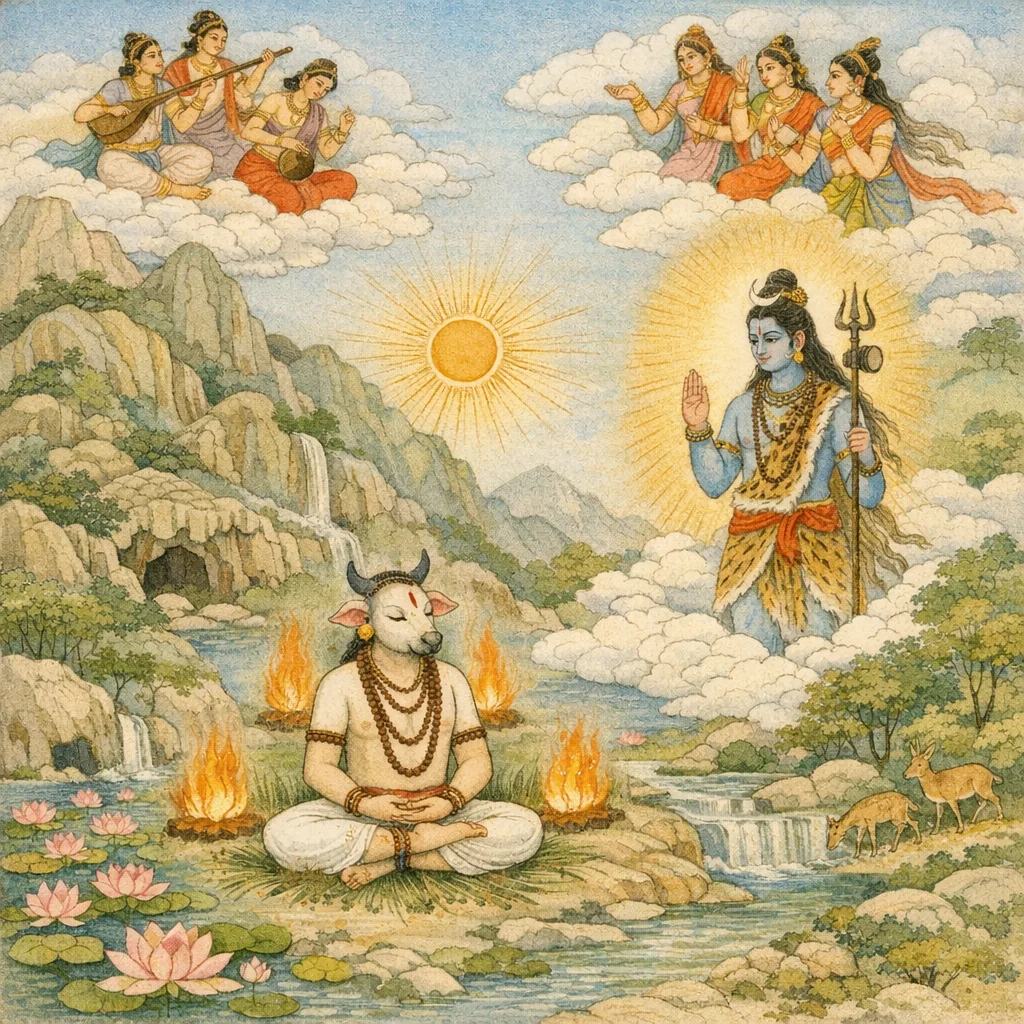
Adhyaya 213: The Glory of Gokarṇeśvara: Nandin’s Austerities and Śiva’s Boons
Gokarṇeśvara-māhātmya (Nandīśvara-varapradāna)
Tīrtha-māhātmya / Sacred Geography and Devotional-Austerity Narrative
Set within the Varāha Purāṇa’s purāṇic instruction (Varāha teaching Pṛthivī), this adhyāya contains an embedded dialogue in which Sanatkumāra asks Brahmā about northern and southern Gokarṇa, the extent of the kṣetra, the fruit of its tīrthas, and why Paśupati appears there in mṛga-rūpa (deer form). Brahmā describes the sacred terrain: Muñjavān peak north of Mandara, abundant in springs, forests, birds, and celestial presences, a dharma-forest and tapo-kṣetra where Śiva (Sthāṇu), with Pārvatī and attendants, is ever-present. The focus then turns to Nandin’s severe tapas and ritual worship, culminating in Śiva’s epiphany, a hymn of praise, and the granting of boons—especially unwavering bhakti and obstacle-free ascetic practice—by which Nandin is raised as Nandīśvara, Śiva’s chief gaṇa and guardian at the southern gate.
Primary Speakers
Key Concepts
Shlokas in Adhyaya 213
Verse 1
अथ गोकरणेश्वरमाहात्म्यम् ॥ सूत उवाच ॥ पुरा देवैर्विनिहते संग्रामे तारकामये ॥ अत्युच्छ्रिते प्रतिबले दानवानां बले तथा
Now (begins) the Māhātmya of Gokarṇeśvara. Sūta said: Formerly, when in the war concerning Tāraka the gods were struck down, and the power of the Dānavas had risen exceedingly, becoming formidable—
Verse 2
सहस्राक्षे लब्धपदे क्षीणशत्रौ गतास्पदे ॥ सम्यक्प्रसूति मापन्ने त्रैलोक्ये सचराचरे
When Sahasrākṣa (Indra) had regained his station—his enemies diminished and his footing secured—and when the three worlds, with all that moves and does not move, had duly returned to orderly generation and stability,
Verse 3
शृङ्गे चैवाचलेन्द्रस्य मेरोः सर्वहिरण्यये ॥ मणिविद्रुमविद्धे च विपुले पङ्कजासने
—upon the summit of Meru, lord of mountains, wholly golden—on a vast lotus-seat, inlaid with gems and coral,
Verse 4
सुखोपविष्टमेकाग्रं स्थिरचित्तं कृतिक्शणम् ॥ निवृत्तकार्यं मुदितं सूर्यवैश्वानरद्युतिम्
comfortably seated, single-pointed, steady in mind, with a fulfilled gaze; his tasks completed, serene and joyful, radiant like the sun and the inner fire, Vaiśvānara.
Verse 5
प्रणम्य मूर्ध्ना चरणावुपगृह्य समाहितः ॥ ब्रह्माणं परिपप्रच्छ कुमारो नतिपूर्वकः
Having bowed with his head and respectfully clasped the feet, composed in mind, the youthful sage questioned Brahmā thoroughly, with due reverence.
Verse 6
सनत्कुमार उवाच ॥ भगवञ्छ्रोतुमिच्छामि पुराणमृषिसंस्तुतम् ॥ पुराणं तु महाभाग त्वत्तस्तत्त्वविदां वर
Sanatkumāra said: “Venerable one, I wish to hear the Purāṇa praised by sages—indeed, that Purāṇa from you, O fortunate one, best among the knowers of truth.”
Verse 7
कथमुत्तर गोकर्णं दक्षिणं च कथं विभो ॥ शृङ्गेश्वरस्य परमं कथं सम्यक्प्रतिष्ठितम्
“How is Gokarṇa understood as the northern site, and how as the southern, O mighty one? And how was the supreme seat of Śṛṅgeśvara properly established?”
Verse 8
क्षेत्रस्य कि प्रमाणं स्यात्किञ्च तीर्थफलं स्मृतम् ॥ कथं पशुपतिस्तत्र भगवान्मृगरूपधृक्
“What is the measure (extent) of the sacred field, and what fruit of the tīrtha is recorded? And how is the Lord Paśupati there—Bhagavān—bearing the form of a deer?”
Verse 9
सर्वैस्त्वत्प्रमुखैर्देवैः कथमासादितं पुनः ॥ मृगरूपं कथं चास्य शरीरं क्व प्रतिष्ठितम्
“How again was it approached/attained by all the gods with you at their head? And how did this deer-form come about—and where is that body established?”
Verse 10
एवमुक्तः स भगवान्ब्रह्मा ब्रह्मविदां वरः ॥ उवाच तस्मै पुत्राय गुह्यमेतत्पुरातनम्
Thus addressed, that venerable Brahmā—best among the knowers of sacred knowledge—spoke to his son this ancient, confidential teaching.
Verse 11
ब्रह्मोवाच ॥ शृणु वत्स महाभाग यथातत्त्वं ब्रवीमि ते ॥ पुराणमेतद्बह्मर्षे सरहस्यं यथाश्रुतम्
Brahmā said: “Listen, dear child, noble one; I shall tell you it according to reality. This Purāṇa, O brahmarṣi, together with its confidential import, I relate as it has been heard in tradition.”
Verse 12
अस्ति भूधरराजस्य मन्दरस्योत्तरे शुचौ ॥ मुञ्जवान्नाम शिखरो नन्दनोपवनद्युतिः ॥
To the north of Mandara, the king of mountains, in a pure region, there is a peak named Muñjavān, radiant like the Nandana grove.
Verse 13
वज्रस्फटिकपाषाणः प्रवालाङ्कुरशर्क्करः ॥ नीलामलशिलावर्णो गुहानिर्झरकन्दरः ॥
Its rocks are like diamond and crystal; its gravel is like coral shoots. It has the hue of blue, stainless stone, and is filled with caves, waterfalls, and ravines.
Verse 14
विचित्रकुसुमोपेतैर्लतामञ्जीरधारिभिः ॥ रेजे यः प्रांशुभिः शृङ्गैरुल्लिखद्भिरिवाम्बरम् ॥
Adorned with creepers bearing anklets of varied blossoms, it shone—its lofty peaks seeming to scratch the sky.
Verse 15
दार्यस्तत्राधिकं रेजुर्नानाधातुपरिस्रवैः ॥ शिलीन्ध्रकुसुमोपेताश्चित्रिता इव सर्वतः ॥
There, the clefts and gorges shone all the more with runnels of many-colored minerals, appearing everywhere as though painted, adorned with śilīndhra-flowers.
Verse 16
तेऽत्र केतकि खण्डाश्च कुन्दखण्डाश्च पुष्पिताः ॥ उन्मीलिता इवाभान्ति धातकीवनराजिभिः ॥
Here, thickets of ketakī and thickets of kunda stand in bloom; with bands of dhātakī-forests they appear as though newly opened.
Verse 17
भिन्नेन्द्रनीलविमलैर्धौतैः प्रस्रवणाम्बुभिः ॥ चित्रैः कुसुमसंच्छन्नैः शिलाप्रस्तरविस्तरैः ॥
Washed by the clear waters of springs—pure like split sapphire—there were broad expanses of stone terraces, variegated and covered with flowers.
Verse 18
शक्रचापनिभै रम्यैः कुबेरभवनद्युतौ ॥ तस्मिन्नगवरे रम्ये महोरगनिषेविते ॥
Lovely like Indra’s bow, shining like Kubera’s mansion—on that delightful, excellent mountain, frequented by great serpents.
Verse 19
कल्हारकुसुमोपेते हंससारससेविते ॥ प्रसन्नसलिलाकीर्णे सरोभिः फुल्लपङ्कजैः ॥
With lakes adorned by kalhāra blossoms, frequented by swans and cranes, filled with clear waters and blooming lotuses.
Verse 20
गजयूथानुकीर्णाभिर्जुष्टाभिर्मृगपक्षिभिः ॥ सेविताभिर्मुनिगणैः सरिद्भिरुपशोभिते ॥
Adorned by rivers, crowded with herds of elephants, inhabited by deer and birds, and visited by groups of sages.
Verse 21
किन्नरोद्गीतकुहरे परपुष्टनिनादिते ॥ विद्याधरशताकीर्णे देवगन्धर्वसेविते ॥
Its caves resounded with the songs of Kinnaras; it rang with the calls of the parapuṣṭa bird. It was thronged with hundreds of Vidyādharas and frequented by Devas and Gandharvas.
Verse 22
धारापातैश्च तोयानां विस्फुलिङ्गैः सहस्रशः ।। प्रज्वालितेऽतुले शृङ्गे रम्ये हरितशाद्वले
Amid torrents of water and thousands of sparks, on that incomparable peak—ablaze yet delightful—green and carpeted with fresh grass.
Verse 23
सर्वर्तुकवनोद्यानें पुष्पाकरसुशोभिते ।। यज्ञकिम्पुरुषावासे गुह्यकानामथाश्रये
In a woodland-garden of all seasons, splendid with masses of flowers—(a place) regarded as the dwelling of yajñas and of the Kimpuruṣas, and as a refuge of the Guhyakas.
Verse 24
तस्मिङ्गिरिवरे रम्ये सेवितव्ये सुशोभने ।। धर्मारण्ये तपःक्षेत्रे मुनिसिद्धनिषेविते
On that excellent mountain—lovely, splendid, and worthy of resort—within the ‘Forest of Dharma’, a field for ascetic practice, frequented by sages and perfected beings.
Verse 25
वरदस्तत्र भगवान्स्थाणुर्नाम महेश्वरः ।। सर्वामरगुरुर्देवो नित्यं सन्निहितः प्रभुः
There, the boon-giving Lord—Maheśvara named Sthāṇu—abides: the god who is the teacher of all the immortals, ever present as sovereign.
Verse 26
भक्तानुकम्पी स श्रीमान्गिरीन्द्रसुतया सह ।। स ह्यध्यास्ते गिरिवरं पार्षदैश्च गुहेन च
Compassionate toward devotees, that illustrious one dwells upon the excellent mountain together with the daughter of the Lord of Mountains, and with his attendants—and also with Guha.
Verse 27
विमानयायिनः सर्वे तं देवमजमव्ययम् ।। आजग्मुः सेवितुं देवा वरेण्यमजमव्ययम्
All who travel in celestial vehicles—the gods—came to worship that deity, the Unborn and Imperishable, the venerable One, Unborn and Imperishable.
Verse 28
आरिराधयिषुः शर्वं तपस्तेपे सुदारुणम् ।। ग्रीष्मे पञ्चतपास्तिष्ठेच्छिशिरे सलिलाश्रयः
Wishing to propitiate Śarva, he undertook exceedingly severe austerity: in summer he observed the discipline of the “five fires”; in winter he took refuge in water.
Verse 29
ऊर्ध्वबाहुर्निरालम्बस्तोया-अनिलहुताशनैः ।। व्रतैश्च विविधैरुग्रैस्तपोभिर्नियमैस्तथा
With arms held aloft, without support, enduring water, wind, and fire; and likewise through various fierce vows, austerities, and disciplined observances.
Verse 30
जपपुष्पोपहारैश्च कालेकाले मुनिः सदा ।। शङ्करं विधिवद्भक्त्या सोऽर्च्चयद्द्विजपुङ्गवः
And with recitations and offerings of flowers—at the proper times, continually—the sage, an eminent Brahmin, worshipped Śaṅkara with devotion according to prescribed procedure.
Verse 31
उग्रेण तपसात्मानं योजयामास सुव्रतः ।। काष्ठभूतो यदा विप्रः कृशो धर्मसुसन्ततः
That steadfast observer of vows applied himself to intense austerity; and when the Brahmin became as if turned to wood—emaciated, and wholly continuous in dharma—(the narrative proceeds).
Verse 32
क्षामोऽभूत्कृष्णवर्णश्च ततः प्रीतश्च शङ्करः ॥ सम्यगाराधितो भक्त्या नियमेन च तोषितः ॥
He became emaciated and dark-complexioned; then Śaṅkara was pleased. Properly worshipped with devotion and satisfied by disciplined observances, he was contented.
Verse 33
तदात्मदर्शनं प्रादात्स मुनेर्वृषभध्वजः ॥ उक्तवांश्च मुनिं शर्वश्चक्षुर्दिव्यं ददामि ते ॥
Then Vṛṣabhadhvaja (Śiva, ‘whose banner is the bull’) granted the sage a vision of his own Self; and Śarva said to the muni, “I give you divine sight.”
Verse 34
अदृश्यं पश्य मे रूपं वत्स प्रीतोऽस्मि ते मुने ॥ यत्पश्यन्तीह विद्वांसो रूपमप्रतिमौजसम् ॥
“Behold my form, though it is ordinarily unseen, dear one; O sage, I am pleased with you—this form of incomparable power that the learned perceive here.”
Verse 35
सहस्रसूर्यकिरणं ज्वालामालिनमूर्जितम् ॥ बालार्कमण्डलाकारं प्रभामण्डलमण्डितम् ॥
It shone with the rays of a thousand suns, powerful and wreathed in flames—shaped like the disc of the rising sun, adorned with a halo of radiance.
Verse 36
जटाजूटतटाश्लिष्टं चन्द्रालङ्कृतशेखरम् ॥ जगदालोचनं श्रीमत्प्रदीप्तस्वत्रिलोचनम् ॥
His crest was adorned with the moon, embraced by the mass of his matted locks; he was the auspicious ‘eye of the world,’ his own three eyes blazing.
Verse 37
अणीयसामणीयांसं बृहतां तु बृहत्तरम् ॥ अक्षामालापवित्राङ्गं कमण्डलुकरोद्यम् ॥
Smaller than the smallest and greater than the great, his body bore the rosary and the sacred thread, and his raised hand held a water-pot (kamaṇḍalu).
Verse 38
सिंहचर्माम्बरधरं व्यालयज्ञोपवीतिनम् ॥ दृष्ट्वा देवं महादेवं हृष्टरोमा महातपाः ॥
Wearing a lion-skin as his garment and bearing a serpent as his sacred thread, on seeing the god—the Great God (Mahādeva)—the great ascetic’s hairs stood on end in exhilaration.
Verse 39
प्राञ्जलिः प्रणतो भूत्वाऽगृणाद्ब्रह्म सनातनम् ॥ नमो धात्रे विधात्रे च संभवे वरदाय च ॥
With hands folded and having bowed, the great ascetic sang praise to the eternal Brahman, saying: “Homage to the Sustainer and the Ordainer; homage to Saṃbhava and to the Giver of boons.”
Verse 40
जगद्भोक्त्रे त्रिनेत्राय शङ्कराय शिवाय च ॥ भवाय भवगोप्त्रे च मुनये कृतिवाससे ॥
“Homage to the Lord of the world, to the Three-Eyed, to Śaṅkara and to Śiva; to Bhava and the Protector of beings; to the sage, the wearer of skins (Kṛttivāsas).”
Verse 41
नीलकण्ठाय भीमाय भूतभव्यभवाय च ॥ लम्बभ्रुवे करालाय हरिनेत्राय मीढुषे ॥
“Homage to the Blue-throated, to the Terrible; to him who is the past, the future, and the present; to the long-browed, the formidable; to the tawny-eyed, to the beneficent giver (Mīḍhuṣ).”
Verse 42
कपर्दिने विशालाय मुञ्जकेशाय धीमते ॥ शूलिने पशुपतये विभवे स्थाणवे तथा
Salutations to the matted-haired One, the Vast One, the Wise One whose hair is like muñja grass; to the Trident-bearer, to Paśupati, to the Mighty One, and likewise to Sthāṇu, the Steadfast.
Verse 43
गणानां पतये स्रष्ट्रे संक्षेप्त्रे भीषणाय च ॥ सौम्याय सौम्यतपसे भीमाय त्र्यम्बकाय च
Salutations to the Lord of the gaṇas, to the Creator, to the One who gathers and compacts, and to the Formidable; to the Gentle One, to gentle ascetic power (tapas), to the Terrible One, and to Tryambaka, the Three-Eyed.
Verse 44
प्रेतावासनिवासाय रुद्राय वरदाय च ॥ कपालमालिने तस्मै हरिश्मश्रुधराय च
Salutations to the One whose dwelling is the haunt of spirits, to Rudra, and to the Giver of boons; to Him who wears a garland of skulls, and to Him who bears tawny (hari) moustache and beard.
Verse 45
भक्तप्रियाय सततं नमोऽस्तु परमात्मने ॥ एवं नन्दी भवं स्तुत्वा नमस्कृत्य च सर्वशः
Unceasing salutations to the Supreme Self, beloved of devotees. Thus Nandī, having praised Bhava (Śiva) and bowed in every way, proceeded onward.
Verse 46
उवाच च वचः साक्षात्तमृषिं वरदः प्रभुः ॥ वरान्वृणीष्व विप्रेन्द्र यानिच्छसि महामुने
Then the boon-giving Lord spoke directly to that seer: “Choose your boons, O best of brahmins—whatever you desire, O great sage.”
Verse 47
तांस्ते सर्वान्प्रयच्छामि दुर्ल्लभानपि मारिष ॥ प्रभुत्वममरत्वं वा शक्रत्वमपि वा प्रभो
I grant you all those boons, even those hard to obtain, O venerable one—lordship, or immortality, or even the status of Śakra (Indra), O noble lord.
Verse 48
ब्रह्मत्वं लोकपालत्वमपवर्गमथापि वा ॥ अथाष्टगुणमैश्वर्यं गाणपत्यामथापि वा
Or brahmā-hood, or the office of a world-guardian; or even apavarga, final release. Or the eightfold qualified sovereignty, or even gaṇapati-ship, lordship over the gaṇas.
Verse 49
यदिच्छसि मुने शीघ्रं तद्ब्रूहि द्विजपुङ्गव ॥ इत्युक्तोऽसौ भगवता शर्वेण मुनिपुङ्गवः
“Whatever you wish, O sage—say it quickly, O foremost of the twice-born.” Thus addressed by the Blessed Śarva (Śiva), that foremost of sages replied.
Verse 50
प्रोवाच वरदं देवं प्रहृष्टेनान्तरात्मना ॥ न प्रभुत्वं न देवत्वं नेन्द्रत्वमपि वा प्रभो
With an inwardly delighted heart, he spoke to the boon-giving god: “Not lordship, not divinity, nor even Indra-hood, O noble lord.”
Verse 51
ब्रह्मत्वं लोकपालत्वं नापवर्गं वरप्रद ॥ नैवाष्टगुणमैश्वर्यं गाणपत्यं न च प्रभो
“Not brahmā-hood, not the office of a world-guardian, not even apavarga, final release, O giver of boons; nor the eightfold sovereignty, nor gaṇapati-ship either, O noble lord.”
Verse 52
स्पृहये देवदेवेश प्रसन्ने त्वयि शङ्कर ॥ यदि प्रीतोऽसि भगवन्ननुक्रोशतया मम
O Lord of the gods, O Śaṅkara—since you are graciously pleased—if you are satisfied, O Blessed One, then, out of compassion toward me…
Verse 53
अनुग्राह्यो ह्ययं देव त्वयावश्यं सुराधिप ॥ यथान्ये न भवेद्भक्तिस्त्वत्तो नित्यं महेश्वर
This one, O God, must indeed be shown favor by you, O ruler of the gods—so that devotion may not arise from any other source, but always from you, O Maheśvara.
Verse 54
तथाहं भक्तिमिच्छामि सर्वभूताशये त्वयि ॥ यथा च न भवेद्विघ्नं तपस्यानिरतस्य मे
So too, I desire devotion toward you, who abide in the hearts of all beings; and I ask that no obstacle may arise for me, who am engaged in ascetic practice.
Verse 55
प्रहस्योवाच तं प्रीत्या ततो मधुरया गिरा ॥ प्रीतोऽस्म्युत्तिष्ठ विप्रर्षे तप्यमानेन सुव्रत
Smiling, he addressed him affectionately, then in a gentle voice: “I am pleased. Rise, O brahmin-sage; O you of good vows, you have performed austerity.”
Verse 56
आराधितश्च भक्त्याहं त्वया शुद्धेन चेतसा ॥ पर्याप्तं ते महाभाग तपः कर्तुं तपोधन
And I have been duly worshiped with devotion by you, with a purified mind. It is enough, O fortunate one—O treasure of austerity—to perform further tapas.
Verse 57
निवर्त्तयति मां वत्स मत्पादाराधने रतः ॥ जप्ता ते त्रिगुणा कोटि रुद्राणां पुरतो मम
“O dear one, you—intent on worship at my feet—have, as it were, caused me to relent. Before me you have recited a threefold crore of Rudras (i.e., Rudra-mantras/recitations in Rudra’s name).”
Verse 58
पूर्णं वर्षसहस्रं च तपस्तीव्रं महामुने ॥ न कृतं यत्पुरा देवैर्नासुरैरृषिभिर्न च
“For a full thousand years, O great sage, you performed intense austerity (tapas)—such as was not done in former times by the gods, nor by the asuras, nor even by the seers.”
Verse 59
कृतं सुमहदाश्चर्यं त्वया कर्म सुदुष्करम् ॥ सङ्क्षोभितमिदं सर्वं त्रैलोक्यं सचराचरम्
“You have accomplished a very great wonder—an exceedingly difficult deed. This entire threefold world, with all that moves and all that is unmoving, has been stirred (by your austerity).”
Verse 60
आगमिष्यन्ति ते द्रष्टुं देवाः सर्वे सवासवाः ॥ अक्षयश्चाव्ययश्च त्वमतर्क्यः ससुरासुरैः
“All the gods, together with Vāsava (Indra), will come to see you. You are imperishable and undecaying; you are beyond reasoning even for gods and asuras.”
Verse 61
दिव्यतेजोवपुः श्रीमान्दिव्याभरणभूषितः ॥ मत्तुल्यो मत्प्रभावश्च त्वमेकः ससुरासुरैः
“Possessing a body of divine radiance, splendid and adorned with divine ornaments—you alone, among gods and asuras, are equal to me and share my power.”
Verse 62
मद्रूपधारी मत्तेजास्त्र्यक्षः सर्वगुणोत्तमः ॥ भविष्यसि न सन्देहो देवदानवपूजितः ॥
Assuming my own form, endowed with my splendor, three-eyed and supreme in every virtue, you shall indeed become so—without doubt—revered by gods and dānavas alike.
Verse 63
अनेनैव शरीरेण जरामरणवर्जितः ॥ दुष्प्राप्येयमवाप्ता ते देवैर्गाणेश्वरी गतिः ॥
With this very body, free from old age and death, you have attained the ‘gāṇeśvarī’ state—an attainment difficult to obtain even for the gods.
Verse 64
प्राप्तमष्टगुणं सत्यमैश्वर्यं ते तपोधन ॥ द्वितीयां मे तनुं त्वां तु नमस्यन्ति च देवताः ॥
O tapodhana, truly you have obtained the eightfold excellence of sovereignty; and as a second body of mine, even the deities bow to you.
Verse 65
अद्यप्रभृति देवाग्र्य देवकार्येषु सर्वतः ॥ प्रभुस्त्वं भविता लोके मत्प्रसादान्मुनीश्वर ॥
From today onward, O foremost among the gods, in all divine tasks everywhere, you shall be an authority in the world—through my favor, O lord of sages.
Verse 66
त्वामेवाभ्यर्च्छयिष्यन्ति सर्वभूतानि सर्वतः ॥ मत्तः समभिवाञ्छन्ति प्रसादं पार्षदाधिप ॥
All beings, everywhere, will worship you alone; and they will seek from me the granting of favor toward you, O lord of attendants.
Verse 67
वरान्वरार्थिनां दाता विधाता जगतः सदा ॥ भविष्यसि च धर्मज्ञ भीतानामभयप्रदः ॥
You shall be a giver of boons to those who seek boons, a continual sustainer of the world’s order; and, O knower of dharma, a grantor of fearlessness to the frightened.
Verse 68
यस्त्वां द्वेष्टि स मां द्वेष्टि यस्त्वामनु स मामनु ॥ नावयोरन्तरं किञ्चिदम्बरानिलयोरिव ॥
Whoever hates you, hates me; whoever follows you, follows me. There is no difference at all between us—like the sky and the wind.
Verse 69
द्वारे तु दक्षिणे नित्यं त्वया स्थेयं गणाधिप ॥ वामे तु विभुना चापि महाकालेन सर्वदा ॥
At the southern gate you are to stand always, O leader of the gaṇas; and at the left side stands the mighty Mahākāla, at all times.
Verse 70
प्रतीहारो भवानद्य सर्वदा त्रिदशोत्तमः ॥ शिरो मे रक्षतु भवान्महाकालेऽपि मे गणः ॥
From today you are my doorkeeper—always, O best among the thirty (gods). May you protect my head; and may my gaṇa protect me even at the time of great peril (mahākāla).
Verse 71
न वज्रेण न दण्डेन न चक्रेण न चाग्निना ॥ काञ्चिच्छक्नोति वै बाधां कर्तुं वै भुवनत्रये ॥
Neither by the thunderbolt (vajra), nor by the staff, nor by the discus, nor by fire can anyone inflict any harm in the three worlds.
Verse 72
देवदानवगन्धर्वा यक्षराक्षसपन्नगाः ॥ त्वामेव संश्रयिष्यन्ति मद्भक्ताः पुरुषाश्च ये ॥
Devas, Dānavas, Gandharvas, Yakṣas, Rākṣasas, and Nāgas—indeed all such beings—will take refuge in you; and so too will those persons who are devoted to me.
Verse 73
एवं तस्मै वरान् दत्त्वा प्रीतः स्वयमुमापतिः ॥ उवाच भूयः स्पष्टेन स्वरेणाम्बरचारिणा ॥
Thus, having granted him boons, Umāpati himself—well pleased—spoke again, in a clear voice that moved through the sky.
Verse 74
आगतान् विद्धि सर्वान्वै त्रिदशान् समरुद्गणान् ॥ दिदृक्षया च भद्रं ते कृतकृत्यश्च साम्प्रतम् ॥
Know that all the gods—the Thirty, together with the hosts of the Maruts—have arrived, and they have come wishing to see you. Blessings to you; at present you are one whose purpose has been fulfilled.
Verse 75
यदीरितं मया वत्स वरं प्रतिवचस्त्वयि ॥ प्रविष्टं न श्रुतिपथं दिवि सर्वदिवौकसाम् ॥
The boon that was spoken by me, dear one, as a response to you, has not entered the range of hearing in heaven among all the dwellers of the sky.
Verse 76
नारायणं पुरस्कृत्य सेन्द्रास्ते समरुद्गणाः ॥ प्रेमार्थे चागमिष्यन्ति वरार्थं तपसा अमराः ॥
With Nārāyaṇa placed at the forefront, those gods—together with Indra and the hosts of the Maruts—will come both out of affection and, as immortals, for the sake of obtaining a boon through austerity.
Verse 77
यक्षविद्याधरगणाः सिद्धगन्धर्वपन्नगाः ॥ मुनयश्च महात्मानस्तपोलब्धाः सहस्रशः ॥
Present are hosts of Yakṣas and Vidyādharas, Siddhas, Gandharvas, and Nāgas—and thousands of great-souled sages, enriched by the attainments born of austerity.
Verse 78
ते बुद्ध्वा त्वद्गतामृद्धिं प्रतप्ताः परमर्ष्यया ॥ तपांसि विविधान्यत्र विविधान्नियमांस्तथा ॥
Having understood the prosperity that has come to you, they burned with intense jealousy; and here they undertake various austerities, and likewise various restraints and observances.
Verse 79
चर्तुं समभिवाञ्छन्ति सदाभ्यासे वरार्थिनः ॥ वरदं यामभिज्ञाय गिरौ मौञ्जवति स्थितम् ॥
Seeking boons, they long to practice continually; and, having come to know the boon-giver established on the mountain called Mauñjavat, they set out toward him.
Verse 80
अत्रैते यावदागम्य न मां पश्यन्ति मानवाः ॥ तावदेव त्वितः शीघ्रं गमिष्यामि महामुने ॥
So long as these people, having arrived here, do not see me, for just that long will I remain; then from here I shall depart quickly, O great sage.
Verse 81
अद्य ते तु मया सर्वे देवा ब्रह्मपुरोगमाः ॥ द्रष्टव्याश्चानुमन्तव्या मत्तोऽनुग्रहकाङ्क्षिणः ॥
But today, all the gods—led by Brahmā—are to be seen by you and granted leave, for they seek favor and grace from me.
Verse 82
यथा यत्र च यस्तत्र विधिः सम्यगनुष्ठितः ॥ तत्सर्वं निखिलेनाशु ब्रूहि मे वाग्विदां वर ॥
How, where, and by whom the prescribed rite was duly performed there—tell me all of that in full, and quickly, O best among those learned in speech.
Verse 83
क्रीडद्भिर्देवमिथुनैर्नृत्यद्भिश्चाप्सरोगणैः ॥ कूजद्भिः शिखिभिर्मत्तैः सेविते च नगोत्तमे ॥
On that excellent mountain he was attended by divine couples at play, by companies of Apsarases dancing, and by intoxicated peacocks calling out.
Verse 84
अन्ये देवनिकायाश्च सेवितुं प्रपतन्ति तम् ॥ ततस्त्रेतायुगे काले नन्दी नाम महामुनिः ॥
Other hosts of gods too hasten to attend him. Then, in the time of the Tretā Yuga, there was a great sage named Nandī.
Verse 85
प्रादेशमात्रं रुचिरं शतशीर्षं शतोदरम् ॥ सहस्रबाहुचरणं सहस्राक्षिशिरोमुखम् ॥
(He beheld) a radiant form of the measure of a span, with a hundred heads and a hundred bellies; with a thousand arms and feet, and with a thousand eyes, heads, and faces.
Verse 86
प्रणम्य शिरसा देवं पुनः पुनरवन्दत ॥ ततस्तु भगवान्प्रीतस्तस्मै विप्राय शंकरः ॥
Having bowed with his head, he again and again paid homage to the deity. Then Śaṅkara, the Blessed One, pleased with him, bestowed his favor upon that brāhmaṇa.
Verse 87
कोटिजप्येन रुद्राणामाराधनपरस्य च ॥ एतत्तु वचनं श्रुत्वा नन्दिनः स महेश्वरः ॥
And because he was devoted to propitiating the Rudras through repeated japa—amounting to ten million recitations. Having heard this statement concerning Nandī, Maheśvara responded…
Verse 88
पार्षदानां वरिष्ठस्त्वं मामकानां द्विजोत्तम ॥ नन्दीश्वर इति ख्यातो भविष्यसि न संशयः ॥
You are the foremost among my attendants, O best of the twice-born. You shall be renowned as “Nandīśvara”—of this there is no doubt.
Verse 89
त्वयि तुष्टे ह्यहं तुष्टः कुपिते कुपितस्त्वहम् ॥ त्वत्तः प्रियतरो नास्ति ममान्यो द्विजपुंगव ॥
When you are satisfied, I am satisfied; when you are angered, I am angered. None other is dearer to me than you, O bull among the twice-born.
Verse 90
अभिप्रायं च सर्वेषां जानामि द्विजसत्तम ॥ अनुगुह्य वरैस्तैश्च तत्रैवान्तरधीयत ॥
I know the intentions of all, O best of brāhmaṇas. Having also shown favor by granting those boons, he vanished there itself.
Frequently Asked Questions
The chapter prioritizes devotion (bhakti) and disciplined practice (tapas/niyama) over sovereignty or supernatural attainment. Nandin explicitly refuses rulership, godhood, liberation claims, or powers, requesting instead unwavering devotion to Śiva and freedom from obstacles in ascetic life; Śiva affirms this orientation by granting status and responsibility rather than mere domination.
Seasonal markers (ṛtu) structure Nandin’s austerities: in summer (grīṣma) he performs the pañcatapa discipline; in winter (śiśira) he remains in water (salilāśraya). The text also notes sustained duration—an intense tapas extending to a thousand years (varṣa-sahasra)—and repeated japa quantified as three crores (triguṇā koṭi) of Rudra recitations.
Through sacred-geography description, the narrative frames the mountain-forest ecosystem—springs, rivers, lakes, flowering groves, birds, and animals—as a dharmic landscape (dharmāraṇya, tapo-kṣetra) that supports disciplined human conduct. This portrayal implicitly links ethical restraint and worship with the flourishing of waterscapes and biodiversity, presenting the site as an ordered, life-sustaining ecology rather than a purely abstract holy location.
The principal figures are Brahmā (teacher), Sanatkumāra (inquirer), Śiva as Sthāṇu/Paśupati (grantor of boons), Pārvatī (present with Śiva), and Nandin (ascetic who becomes Nandīśvara). The narrative also references collective groups—devas led by Indra (Śakra), gandharvas, apsarases, yakṣas, vidyādharas, siddhas, nāgas/pannagas, and munis—indicating a pan-cosmic audience rather than a single dynastic or royal lineage.