Adhyaya 212: An Awakening Description within the Allegory of the Wheel of Saṃsāra
Saṃsāracakropākhyāne Prabodhanīya-varṇanam
Ethical-Discourse (Tapas, Dharma, and Soteriological Orientation)
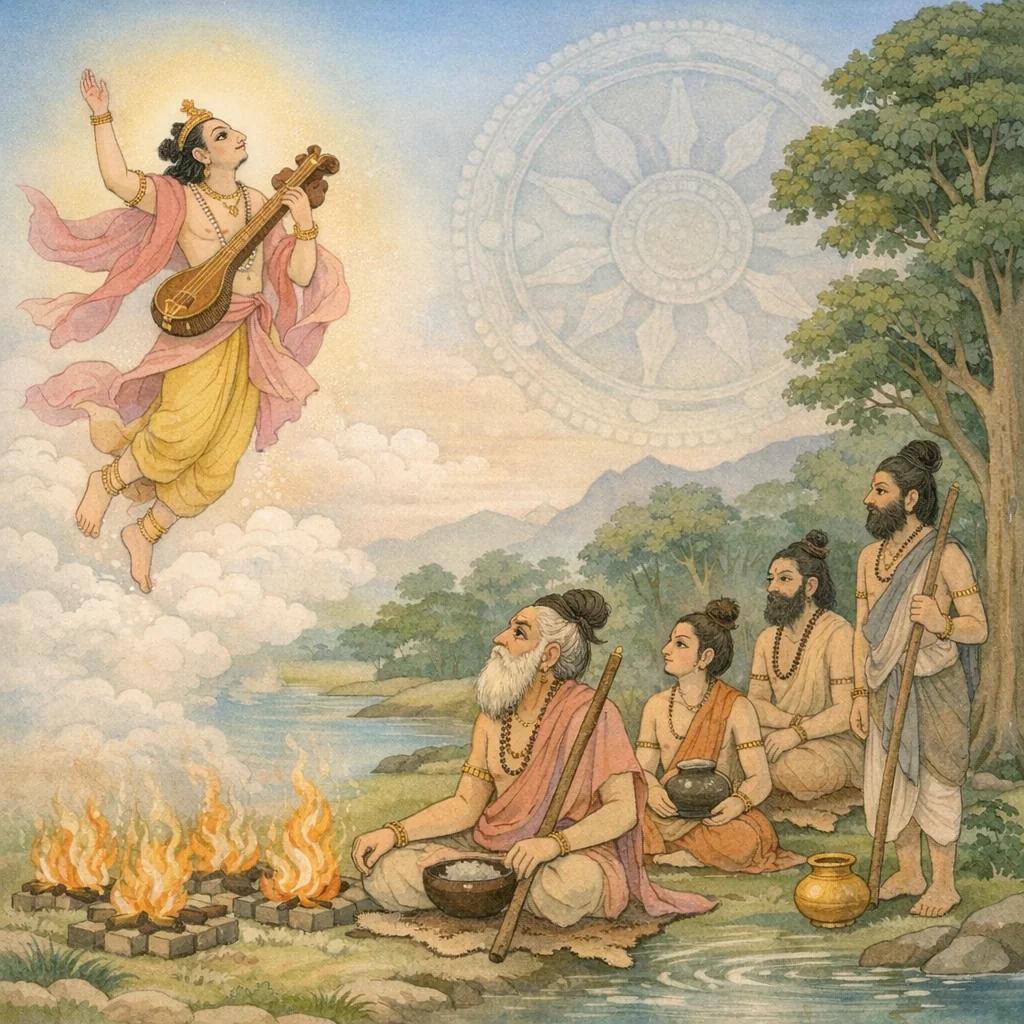
Set within the Varāha–Pṛthivī teaching frame, this adhyāya serves as the reception and aftermath of the prior dharma narrative known as the “saṃsāracakra” allegory. Nārada praises the king for delivering a divinely framed dharma-saṃhitā, expresses joy at his steadfastness on the path of dharma, and departs through the sky with sun-like radiance. The scene then turns to an assembly of ascetics who, on hearing the account, respond with wonder and renewed affirmation, and are listed by their varied disciplines: vānaprastha modes, alms and gleaning, vows of silence, water-dwelling, pañcāgni austerities, leaf-and-fruit diets, and subsistence on wind and water. Tapas is presented as a means to contemplate birth and death, concluding with the claim that hearing or reciting this “paramākhyāna” grants desired aims and nurtures bhakti toward Bhagavān.
Primary Speakers
Key Concepts
Shlokas in Adhyaya 212
Verse 1
अथ संसारचक्रोपाख्याने प्रबोधनीयवर्णनम् ॥ नारद उवाच ॥ साधु साधु महाराज सर्वधर्मविदां वर ॥ त्वया तु कथिता दिव्या कथेयं धर्मसंहिता ॥
Now, in the narrative called the ‘Cycle of Saṁsāra’, the description of (the rite/day) Prabodhinī. Nārada said: “Well said, well said, O great king—best among knowers of all dharmas. This divine discourse, a compendium of dharma, has indeed been recounted by you.”
Verse 2
अतोऽहमपि सुप्रीतस्तव धर्मपथे स्थितः ॥ तव वाक्यान्निस्सृतानि प्रोक्तानि च श्रुतानि च ॥
Therefore I too am greatly pleased, established upon your path of dharma; from your words there have issued teachings—both spoken and heard (that is, transmitted through discourse and reception).
Verse 3
त्वयाहं चैव राजेन्द्र पूजितश्च विशेषतः ॥ गच्छामि त्वरितो लोकान्यत्र मे रमते मनः ॥
O best of kings, you have indeed honoured me—especially with particular regard. Now I depart swiftly to those worlds where my mind finds delight.
Verse 4
स्वस्ति तेऽस्तु महाराज त्वकम्पो भव सुव्रत ॥ एवमुक्त्वा ततो यातो नारदो मुनिसत्तमः ॥
Welfare be to you, great king; be unshaken, O you of good vows. Having spoken thus, Nārada, best among sages, then departed.
Verse 5
तेजसा द्योतयन्सर्वं गगनं भास्करो यथा ॥ विचचार दिवं रम्यां कामचारो महामुनिः ॥
Illuminating the entire sky with his radiance, like the sun, the great sage—free to move at will—wandered through the lovely heavens.
Verse 6
गते तस्मिंस्तु सुचिरं स राजा धर्मवत्सलः ॥ मां दृष्ट्वा सुमना विप्रा वाक्यैश्चित्रैरवन्दयन् ॥
After he had gone, for a long while that king—fond of dharma—upon seeing me, became cheerful; and the brahmins offered reverence with varied and eloquent words.
Verse 7
कृत्वा पूजां च मे युक्तां प्रियमुक्त्वा च सुव्रत ॥ विसर्जयामास विभुः सुप्रीतेनान्तरात्मना ॥
Having performed fitting worship for me and having spoken pleasing words, the powerful one dismissed me, with an inward self fully satisfied.
Verse 8
एतद्वः कथितं विप्रास्तस्य राज्ञः पुरोत्तमे ॥ यथा दृष्टं श्रुतं चैव यथा चेहागतो ह्यहम् ॥
This has been related to you, O brahmins, in the presence of that excellent king—just as it was seen and heard, and just as I indeed came here.
Verse 9
वैशम्पायन उवाच ॥ तस्य तद्वचनं श्रुत्वा हृष्टपुष्टास्तपोधनाः ॥ केचिद्वैखानसास्तत्र केचिदासन्निरासनाः ॥
Vaiśaṃpāyana said: Hearing his words, the ascetics—rich in austerity—became joyful and strengthened. Some there were Vaikhānasas; some lived without seats, without the comfort of sitting places.
Verse 10
शालानीश्च तथा केचित्कापोतीवृत्तिमास्थिताः ॥ तथा चान्ये जगुर्वृत्तिं सर्वभूतदयां शुभाम् ॥
Some were śālānīs, and some adopted the “pigeon-like” mode of living. Others likewise advocated a livelihood grounded in auspicious compassion toward all beings.
Verse 11
शिलोञ्छाश्च तथैवान्ये काष्ठान्ताश्च महौजसः ॥ अपाकपाचिनः केचित्पाकिनश्च क्वचित्पुनः ॥
Some were śiloñchas, and likewise others were kāṣṭhāntas, possessed of great vigor. Some lived without cooking, subsisting on uncooked fare, while at times others did cook.
Verse 12
नानाविधिधराः केचिज्जितात्मानस्तु केचन ॥ स्थानमौनव्रताः केचित्तथान्ये जलशायिनः ॥
Some maintained various observances; some were self-conquered. Some undertook vows of standing and silence; and others likewise slept upon water, practicing water-austerities.
Verse 13
तथोर्ध्वशायिकाश्चान्ये तथान्ये मृगचारिणः ॥ पञ्चाग्नयस्तथा केचित् केचित्पर्णफलाशिनः
Likewise, some practiced the discipline of sleeping with the body held upright; others lived roaming like deer. Some undertook the austerity of the five fires, and some subsisted on leaves and fruits.
Verse 14
अब्भक्षाः वायुभक्षाश्च तथान्ये शाकभक्षिणः ॥ अतोऽन्येऽप्यतितीव्रं वै तपश्चैव प्रपेदिरे
Some lived on water, some on air, and others ate only vegetables and herbs. Thus, still others undertook austerities of extreme intensity.
Verse 15
तपसोऽन्यन्न चास्तीति चिन्तयित्वा पुनः पुनः ॥ जन्मनो मरणाच्चैव केचिद्धीराः महर्षयः
Reflecting again and again that there is nothing higher than austerity (tapas), certain steadfast great seers contemplated birth and death as well.
Verse 16
त्यक्त्वा धर्ममधर्मं च शाश्वतीं धियमास्थिताः ॥ श्रुत्वा चैव कथामेतामृषयो दिव्यवर्चसः
Having set aside the (duality of) dharma and adharma, they abided in enduring insight. And having heard this narrative, the sages of radiant splendor responded.
Verse 17
जगृहुर्नियमांस्तांस्तान्भयहेतोरणिन्दिताः ॥ नाचिकेतोऽपि धर्मात्मा पुत्रो दृष्ट्वा तपोधनम्
The blameless adopted those various observances (niyamas), with fear as the motivating cause. Even Nāciketa, the righteous-minded son, upon seeing the wealth of austerity (tapas)—its power and merit—turned his mind toward dharma.
Verse 18
प्रीत्या परमया युक्तो धर्ममेवान्वचिन्तयत् ॥ वेदार्थममितं विष्णुं शुद्धं चिन्मयमीश्वरम्
United with the highest joy, he reflected upon dharma alone—upon Viṣṇu, immeasurable, the very meaning of the Veda; pure, consisting of consciousness, the Lord.
Verse 19
शृणुयाच्छ्रावयेद्वापि सर्वकामानवाप्नुयात्
One who listens to it—or causes it to be recited—may obtain all desired aims.
Verse 20
साधु साध्विति चैवोक्त्वा विस्मयोत्फुल्ललोचनाः ॥ यायावरास्तथा चान्ये वानप्रस्थास्तथापरे
Saying, ‘Excellent, excellent,’ with eyes widened in astonishment—some were wandering ascetics, and others were forest-dwellers (vānaprasthas).
Verse 21
चिन्तयामास धर्मात्मा तपः परममास्थितः ॥ इदं तु परमाख्यानं भगवद्भक्तिकारकम्
The righteous-minded one reflected, established in the highest austerity: ‘This, indeed, is a supreme account—one that fosters devotion to the Lord.’
Frequently Asked Questions
The passage emphasizes dharma articulated as a teachable compendium (dharma-saṃhitā) and presents tapas and niyama as disciplined responses to the existential problem of janma and maraṇa. It further frames hearing/reciting the narrative as spiritually efficacious, orienting the audience toward bhagavad-bhakti as a transformative disposition.
No explicit calendrical markers (tithi, nakṣatra, māsa) or seasonal timings are stated in the provided verses. The only temporal cues are narrative (“after a long time,” suchiraṃ) and the motif of celestial movement (divaṃ/gaganaṃ) without ritual dating.
Direct ecological instructions are not explicit here; however, the catalog of low-impact ascetic livelihoods (gleaning, leaf/fruit diets, minimal cooking, restraint practices) can be read as a model of reduced consumption. Within a Varāha–Pṛthivī framework, this supports an indirect ethic of terrestrial restraint and preservation through moderated resource use.
The narrative references Nārada (devarṣi), Vaiśaṃpāyana as a narrator voice, and Naciketas (known from broader Sanskrit tradition) as a dharmic figure reflecting on dharma after encountering ascetics. Ascetic communities are named by typology (e.g., vaikhānasa, vānaprastha, yāyāvara) rather than by dynastic lineage.