Adhyaya 211: Methods for the Removal of Sin and the Eulogy of Prabodhinī Ekādaśī/Dvādaśī
Pāpanāśopāya-varṇanaṃ tathā Prabodhinī-Ekādaśī/Dvādaśī-māhātmyaṃ
Ritual-Manual (Vrata-Māhātmya) with Ethical-Discourse
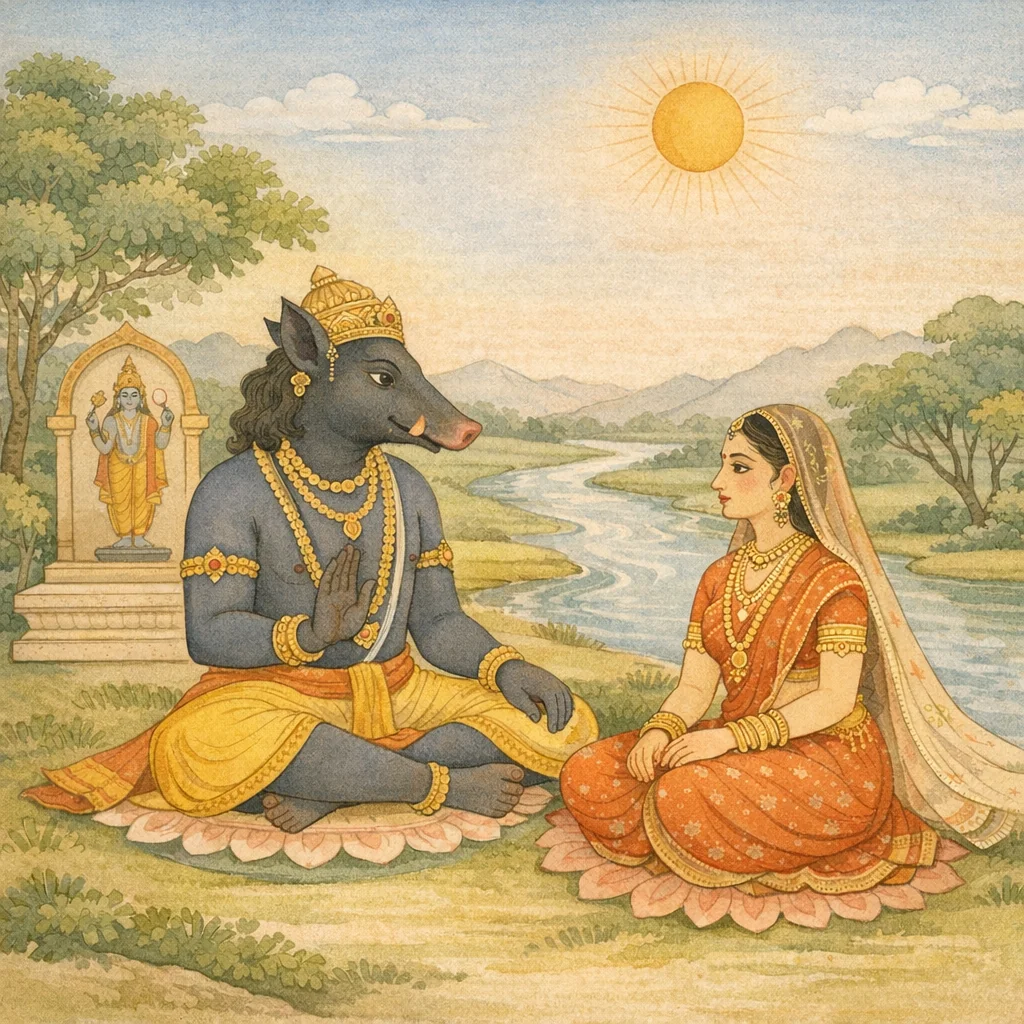
The chapter opens with Nārada addressing Dharmarāja (Yama), seeking welfare-giving instruction that extends even to Śūdras, in keeping with Yama’s declared impartiality toward all beings. Yama replies with a catalog of expiations centered on bovine sanctity—pañcagavya, cow-related ablutions and purificatory acts, and reverential observances—along with solar veneration and rites to be performed at auspicious times under specific lunar and astral conditions. The dialogue then shifts to the Varāha–Pṛthivī frame: Pṛthivī asks how, in Kali-yuga, morally degraded people can still attain a favorable destiny despite grave social transgressions. Varāha prescribes Ekādaśī/Dvādaśī observance, especially Kārttika’s Prabodhinī, as a disciplined path of restraint, worship, and gifting, praised as a corrective ethic that steadies human conduct and thereby upholds terrestrial order and Pṛthivī’s well-being.
Primary Speakers
Key Concepts
Shlokas in Adhyaya 211
Verse 1
पुनः पापनाशोपायवर्णनम् ॥ ऋषिपुत्र उवाच ॥ एतच्छ्रुत्वा शुभं वाक्यं धर्मराजस्य नारदः ॥ इदं भावेन भक्त्या च पुनर्वचनमब्रवीत् ॥
Again, the description of the means for the removal of sin. The sage’s son said: Having heard this auspicious statement of Dharmarāja, Nārada—moved by heartfelt feeling and reverent devotion—spoke these words once more in reply.
Verse 2
नारद उवाच ॥ समः सर्वेषु भूतेषु स्थावरेषु चरेषु च ॥ धर्मराज महाबाहो पितृतुल्यपराक्रम ॥
Nārada said: “You are impartial toward all beings, both the immobile and the mobile. O Dharmarāja, mighty-armed one, whose valor is comparable to that of the Pitṛs (Fathers/Ancestors)….”
Verse 3
ब्राह्मणानां हितार्थाय यदुक्तं मे प्रदक्षिणम् ॥ इदं श्रेयतमाख्यानं श्रुतं श्रुतपरं पदम् ॥
“For the welfare of the brāhmaṇas, what was spoken to me concerning pradakṣiṇā—this is a most beneficial account, heard as a teaching of supreme authority within the tradition.”
Verse 4
त्रयो वर्णा महाभाग यज्ञसामान्यभागिनः ॥ शूद्रा वेदपवित्रेभ्यो ब्राह्मणैस्तु बहिष्कृताः ॥
“Three varṇas, O fortunate one, partake in the common shares of the sacrifice (yajña); but śūdras are excluded by brāhmaṇas from the Vedic rites of consecration and purification.”
Verse 5
यथैव सर्वसमता तव भूतेषु मानद ॥ तथैव तेषामपि हि श्रेयो वाच्यं महामते ॥
“Just as you show complete impartiality toward beings, O bestower of honor, so too what is beneficial should indeed be spoken for them as well, O great-minded one.”
Verse 6
यथा कर्म हितं वाक्यं शूद्राणामपि कथ्यताम् ॥ यम उवाच ॥ अहं ते कथयिष्यामि चातुर्वर्ण्यस्य नित्यशः ॥
“Let a beneficial teaching, in accordance with action and duty, be stated even for śūdras.” Yama said: “I will explain to you, consistently, the enduring principles concerning cāturvarṇya, the fourfold varṇa order.”
Verse 7
यद्धितं धर्मयुक्तं च नित्यं भवति सुव्रत ॥ केवलं श्रुतिसंयोगाच्छ्रद्धया नियमेन च ॥
That which is beneficial and consonant with dharma becomes enduring, O one of good vows—through connection with sacred tradition (śruti), through faith, and through disciplined observance.
Verse 8
करोति पापनाशार्थमिदं वक्ष्यामि तच्छृणु ॥ गावः पवित्रा मङ्गल्या देवानामपि देवताः ॥
This is done for the purpose of destroying wrongdoing; I shall state it—listen to it. Cows are purifying and auspicious, revered even among the gods.
Verse 9
यस्ताः शुश्रूषते भक्त्या स पापेभ्यः प्रमुच्यते ॥ सौम्ये मुहूर्ते संयुक्ते पञ्चगव्यं तु यः पिबेत् ॥
Whoever attends upon them (the cows) with devotion is freed from wrongdoings. And whoever drinks pañcagavya at an auspicious, well-conjoined muhūrta (ritual time)…
Verse 10
सर्वतीर्थफलṃ प्राप्य स पापेभ्यः प्रमुच्यते ॥ प्रस्रवेण च यः स्नायाद्रोहिण्यां मानवॆ द्विज ॥
Having obtained the fruit of all sacred bathing places (tīrthas), one is freed from wrongdoings. And whoever bathes by means of a flowing spring or stream (prasrava), on (the lunar mansion) Rohiṇī, O human, O twice-born (dvija)…
Verse 11
सर्वपापकृतान्दोषान्दहत्याशु न संशयः ॥ धेनुस्तनाद्विनिष्क्रान्तां धारां क्षीरस्य यो नरः ॥
It quickly burns away the faults produced by all wrongdoings—there is no doubt. The man who receives or makes use of the stream of milk that has issued from a cow’s teat…
Verse 12
शिरसा प्रतिगृह्णाति स पापेभ्यः प्रमुच्यते ॥ ब्राह्मणस्तु सदा स्नातो भक्त्या परमया युतः ॥
One who receives it with head bowed is released from sins. A brāhmaṇa—ever purified by ritual bathing—acts endowed with supreme devotion.
Verse 13
नमस्येत्प्रयतो भूत्वा स पापेभ्यः प्रमुच्यते ॥ उदयान्निःसृतं सूर्यं भक्त्या परमया युतः ॥
Having become disciplined, one should bow in reverence; he is released from sins—revering the Sun as it emerges at sunrise, endowed with supreme devotion.
Verse 14
नमस्येत्प्रयतो भूत्वा स पापेभ्यः प्रमुच्यते ॥ दध्यक्षताञ्जलीभिस्तु त्रिभिः पूजयते शुचिः ॥
Having become disciplined, one should bow; he is freed from sins. Being pure, one worships with three handfuls (añjalis) of curd mixed with akṣata (unhusked rice).
Verse 15
तस्य भानुः प्रसन्नश्च ह्यशुभं यत्समर्जितम् ॥ तस्य भानुः स संदह्य दूरीकुर्यात्सदा द्विज ॥
For him the Sun becomes gracious; and whatever inauspiciousness has been accumulated—his Sun burns it and always drives it far away, O twice-born.
Verse 16
तावकं दधिमिश्रं तु पात्रे औदुम्बरे स्थितम् ॥ सोमाय पौर्णमास्यां हि दत्वा पापैः प्रमुच्यते ॥
But on the full-moon day, having given to Soma that offering—mixed with curd and placed in a vessel of udumbara wood—one is released from sins.
Verse 17
अरुन्धतीं बुधं चैव तथा सर्वान्महामुनीन् ॥ अभ्यर्च्य वेदविधिना तेभ्यो दत्त्वा च तावकम् ॥
Having duly honored Arundhatī and Budha, and likewise all the great sages, according to Vedic procedure, and having given that offering to them as well, (one attains purification).
Verse 18
एकाग्रमानसो भूत्वा यो नमस्येत्कृताञ्जलिः ॥ किल्बिषं तस्य वै सर्वं तत्क्षणादेव नश्यति ॥
Whoever, having become single-pointed in mind, bows with hands joined in añjali—indeed all his moral blemish (kilbiṣa) perishes at that very moment.
Verse 19
विषुवेषु च योगेषु शुचिर्दत्त्वा पयो नरः ॥ तस्य जन्मकृतं पापं तत्क्षणादेव नश्यति ॥
On the viṣuva turning-points (equinoxes/solstices) and on auspicious yoga-days, a person—being pure—having given milk, his sin accrued from birth perishes at that very moment.
Verse 20
प्राचीनीग्राङ्कुशान् कृत्वा स्थापयित्वा वृषं नरः ॥ द्विजैः सह नमस्कृत्य सर्वपापैः प्रमुच्यते ॥
Having made the east-facing aṅkuśa-like markers and having installed a bull, a person—having bowed together with the twice-born (dvija)—is released from all sins.
Verse 21
दक्षिणावर्तसव्येन कृत्वा प्राक्स्रोतसं नदीम् ॥ कृत्वा अभिषेकं विधिवत्ततः पापात्प्रमुच्यते ॥
Having arranged the rite with a rightward-circling (dakṣiṇāvarta) movement, making the river’s current oriented eastward, and having performed the abhiṣeka according to rule—thereafter one is freed from sin.
Verse 22
दक्षिणावर्तशङ्खेन कृत्वा चैव करे जलम् ॥ शिरसा तद्गृहीत्वा तु विप्रो हृष्टमनाः शुचिः ॥
By means of a right-turning conch he takes water into his hand; then, receiving it upon his head, the brāhmaṇa—pure and gladdened in mind—performs the rite.
Verse 23
तस्य जन्मकृतं पापं तत्क्षणादेव नश्यति ॥ प्राक्स्रोतसं नदीं गत्वा नाभिमात्रजले स्थितः ॥
His sin accumulated from birth is destroyed at that very moment; having gone to a river whose current flows eastward, he stands in water up to the navel.
Verse 24
स्नात्वा कृष्णतिलैर्मिश्राः दद्यात्सप्ताञ्जलीर्नरः ॥ प्राणायामत्रयं कृत्वा ब्रह्मचारी जितेन्द्रियः ॥
Having bathed, a man should offer seven handfuls of water mixed with black sesame; having performed three cycles of prāṇāyāma, he should be a brahmacārin, with the senses controlled.
Verse 25
यावज्जीवकृतं पापं तत्क्षणादेव नश्यति ॥ अच्छिद्रपद्मपत्रेण सर्वरत्नोदकेन तु ॥
Sin committed over the course of one’s life is destroyed at that very moment; (this is done) with an unpierced lotus-leaf and with water described as ‘all-jewel water’.
Verse 26
त्रिधा यस्तु नरः स्नायात्सर्वपापैः प्रमुच्यते ॥ अन्यच्च ते प्रवक्ष्यामि गुह्याद्गुह्यतरं मुने ॥
But the man who bathes three times is released from all sins. And further, I shall tell you something—more secret than what is secret, O sage.
Verse 27
कार्त्तिकेऽमलपक्षे तु स्मृता ह्येकादशी तिथिः ॥ भुक्तिमुक्तिप्रदा या तु नाम्ना ख्याता प्रबोधिनी ॥
In Kārttika, in the bright (pure) fortnight, the Ekādaśī tithi is remembered—she who grants both worldly well-being and liberation, and is renowned by the name “Prabodhinī”.
Verse 28
ये उपोष्यन्ति विधिवन्नारायणपरायणाः ॥ न तेषामशुभं किञ्चिज्जन्मकोटिकृतं मुने ॥
Those who fast in due manner, devoted to Nārāyaṇa—no inauspiciousness whatsoever, even accumulated through crores of births, remains for them, O sage.
Verse 29
एकादशीं समाश्रित्य पुरा पृष्टो महेश्वरः ॥ वाराहरूपी धरया सर्वलोकहिताय वै ॥
Formerly, with reference to Ekādaśī, Maheśvara was questioned; and Dharā (Earth) addressed the One in the form of Varāha, indeed for the welfare of all worlds.
Verse 30
धरण्युवाच ॥ अस्मिन्कलियुगे घोरे नराः पापरताः प्रभो ॥ ब्रह्मस्वहरणे युक्ता तथा ब्राह्मणघातकाः ॥
Dharā said: “In this dreadful Kali age, people are devoted to sin, O Lord—engaged in stealing sacred property belonging to Brahman, and likewise in killing brāhmaṇas.”
Verse 31
गुरुद्रोहरता देव मित्रद्रोहरतास्तथा ॥ स्वामिद्रोहरताश्चैव परदाराभिमर्शकाः ॥
They are treacherous toward teachers, O God, and likewise treacherous toward friends; treacherous toward their masters as well, and violators who approach others’ wives.
Verse 32
परद्रव्यापहरणे संसक्ताश्च सुरेश्वर ॥ अभक्ष्यभक्षणरता वेदब्राह्मणनिन्दकाः
O Lord of the gods, there are people devoted to stealing others’ property; they delight in eating what is forbidden and they revile the Veda and the Brāhmaṇas.
Verse 33
दाम्भिका भिन्नमर्यादा नायमस्तीति वादिनः ॥ असत्प्रतिग्रहे सक्ता अगम्यागमने रताः
They are hypocritical, transgressing established boundaries; they argue that “this (moral order) does not exist”; they are attached to improper acceptance of gifts and delight in going to those with whom one should not have sexual relations.
Verse 34
एतैश्चान्यैश्च पापैश्च संसक्ता ये नरा विभो ॥ किमासाद्य गतिर्देव तेषां वद सुरेश्वर
O mighty one—those men who are entangled in these and other sins: having reached what, O god, is their destiny? Tell (me), O Lord of the gods.
Verse 35
श्रीवराह उवाच ॥ साधु देवि महाभागे यत्पृष्टोऽहं वरानने ॥ रहस्यं ते प्रवक्ष्यामि लोकानां हितकाम्यया
Śrī Varāha said: Well asked, O Devī of great fortune, O fair-faced one. I shall declare to you a secret teaching, with the intention of promoting the welfare of the worlds.
Verse 36
महापातकयुक्ता ये नराः सुकृतवर्जिताः ॥ तेषां मया हितार्थाय निर्मितं तच्छृणुष्व मे
Those people who are burdened with great transgressions and devoid of meritorious deeds—for their welfare I have established a means; listen to that from me.
Verse 37
तामुपोष्य नरा भद्रे महापापरताश्च ये ॥ पुण्यपापविनिर्मुक्ता गच्छन्ति पदमव्ययम्
O noble lady, those people—even those devoted to great sins—having fasted in that observance, become freed from both merit and sin and go to the imperishable state.
Verse 38
उपायोऽतः परो नान्यो विद्यते हि वसुन्धरे ॥ एकादशीं विना येन सर्वपापक्शयो भवेत्
O Vasundharā, there is no higher means than this; apart from Ekādaśī, by which the destruction of all sins occurs, no such means is found.
Verse 39
यथा शुक्ला तथा कृष्णा ह्युपोष्या सा प्रयत्नतः ॥ शुक्ला भक्तिप्रदा नित्यं कृष्णा मुक्तिं प्रयच्छति
Just as the bright-fortnight Ekādaśī, so too the dark-fortnight Ekādaśī should be observed with effort. The bright one continually grants devotion; the dark one bestows liberation.
Verse 40
तस्मात्सर्वप्रयत्नेन कर्त्तव्या द्वादशी सदा ॥ यदीच्छेद्वैष्णवं लोकं गन्तुं वै भूतधारिणि
Therefore, with every effort, Dvādaśī should always be observed—if one wishes to go to the Vaiṣṇava world, O bearer of beings (Earth).
Verse 41
मनसा वचसा चैव कर्मणा समुपार्जितम् ॥ पापं मासकृतं पुंसां दहत्येकादशी कृता
Sin accumulated by people over a month—by mind, by speech, and by action—is burned away when Ekādaśī is observed.
Verse 42
दहन्तीह पुराणानि भूयोभूयो वरानने ॥ न भोक्तव्यं न भोक्तव्यं सम्प्राप्ते हरिवासरे
O fair-faced one, eating on that occasion repeatedly burns away the merits spoken of in the Purāṇas; when Harivāsara has arrived, one should not eat—one should not eat.
Verse 43
यदीच्छथ नराः गन्तुं तद्विष्णोः परमं पदम् ॥ न भोक्तव्यं न भोक्तव्यं तदा केशववासरे
If people wish to go to Viṣṇu’s supreme abode, then—on Keśava’s sacred day—one should not eat, one should not eat.
Verse 44
ऊर्ध्वबाहुर्विरौम्येष प्रलापं मे शृणुष्व तम् ॥ आराधयस्व विश्वेशमेकादश्यामतन्द्रितः
Raising my arms, I proclaim this; listen to my declaration: worship Viśveśa on Ekādaśī, without negligence.
Verse 45
न शङ्खेन पिबेत्तोयं न हन्यान्मत्स्यसूकरौ ॥ एकादश्यां न भुञ्जीत पक्षयोरुभयोऽपि
One should not drink water using a conch; one should not kill fish or boars. On Ekādaśī one should not eat—whether in either fortnight (waxing or waning).
Verse 46
किं तेन न कृतं पापं दुर्वृत्तेनात्मघातिना ॥ एकादश्यां विशालाक्षि भुक्तं येन विजानता
O large-eyed one, what sin has not been committed by that ill-conducted, self-destructive person—who knowingly ate on Ekādaśī?
Verse 47
एकादशीं च यः शुक्लामसमर्थं उपोषितुम् ॥ तदा नक्तं प्रकर्तव्यं तथाऽयाचितमेव वा
And if someone is unable to fast on the Ekādaśī of the bright fortnight (śukla-pakṣa), then one should observe nakta—a single night-meal; or else one may partake only of what is not solicited (ayācita).
Verse 48
एकभक्तेन दानेन कर्तव्यं द्वादशीव्रतम् ॥ न करोति यदा भूमे व्रतं वा दानमेव वा
The Dvādāśī vow should be observed with a single meal (eka-bhakta) and with giving (dāna). O Earth, when one performs neither the vow nor even the giving—
Verse 49
एका सा द्वादशी पुण्या उपोष्या सा प्रबोधिनी ॥ तस्यामाराध्य विश्वेशं जगतामीश्वरश्वरम्
That single Dvādāśī is holy and highly meritorious; on her one should fast—she is Prabodhinī. On that day, having worshipped Viśveśa, the Lord over the lords of the worlds—
Verse 50
प्राप्नोति सकलं चैतद्द्वादशद्वादशीफलम् ॥ पूर्वाभाद्रपदायोगे सैव या द्वादशी भवेत
One attains all of this—the fruit of twelve Dvādāśīs—when that very Dvādāśī occurs in conjunction with Pūrvābhādrapadā (nakṣatra-yoga).
Verse 51
अतीव महती तस्यां सर्वं कृतमिहाक्षयम् ॥ उत्तराभाद्रसहिता यदि सैकादशी भवेत
On that occasion it is exceedingly great; everything done here becomes imperishable—if that Ekādaśī occurs together with Uttarābhādrapadā.
Verse 52
तदा कोटिगुणं पुण्यं केशवात् लभते फलम् ॥ सकृद्देवेऽर्च्चिते तस्यां लभते भूतधारिणि
Then the merit is multiplied ten millionfold; from Keśava one obtains its fruit. O Bhūtadhāriṇī (Earth, bearer of beings), by worshipping the Deva even once on that day, one attains the result.
Verse 53
यथा प्रबोधिनी पुण्या तथा यस्यां स्वपेद्धरिः ॥ उपोष्या हि महाभागे त्वनन्तफलदा हि सा
Just as the Prabodhinī day is meritorious, so too is the day on which Hari is said to sleep. O noble one, it should indeed be observed with fasting, for it bestows endless results.
Verse 54
तस्मात्सर्वप्रयत्नेन द्वादशीं समुपोषयेत् ॥ यदीच्छेत्तु विशालाक्षि शाश्वतीं गतिमात्मनः
Therefore, with every effort one should fully observe the fast on Dvādaśī. O wide-eyed one, if one desires an everlasting destination for oneself, this is the means.
Verse 55
एकादशी सोमयुता कार्त्तिके मासि भामिनि ॥ उत्तराभाद्रसंयोगे अनन्तफलदा हि सा
O radiant one, when Ekādaśī in the month of Kārttika is conjoined with Monday and coincides with the Uttarabhādrapadā conjunction, that observance indeed bestows endless results.
Verse 56
तस्यां यत्क्रियते भद्रे तदनन्तगुणं स्मृतम् ॥ एकादशी भौमयुता यदा स्याद्भूतधारिणि
O auspicious one, whatever is done on that occasion is remembered as having endless multiplication. O Bhūtadhāriṇī (Earth, bearer of beings), when Ekādaśī is conjoined with Tuesday (Bhauma)…
Verse 57
स्नात्वा देवे समभ्यर्च्य प्राप्नोति परमं फलम् ॥ प्राप्नोति सकलं चैव द्वादशद्वादशीफलम्
Having bathed and duly worshipped the Deva, one attains the supreme result. Indeed, one fully obtains the fruit of the rite of Dvādaśa and Dvādaśī.
Verse 58
जलपूर्णं तथा कुम्भं स्थापयित्वा विचक्षणः ॥ पञ्चरत्नसमोपेतं घृतपात्रयुतं तथा
Having set in place a water-filled pot (kumbha), the discerning practitioner prepares it furnished with the five gems, and likewise accompanied by a vessel of ghee.
Verse 59
तस्योपरि न्यसेन्मत्स्यस्वरूपं तु जनार्दनम् ॥ निष्कमात्रसुवर्णेन घटितं तु वरानने
Upon it one should place Janārdana in the form of Matsya. O fair-faced one, it is to be fashioned from gold to the measure of a niṣka.
Verse 60
पञ्चामृतेन संस्नाप्य कुंकुमेन विलेपितम् ॥ पीतवस्त्रयुगच्छन्नं छत्रोपानद्युगान्वितम्
Having bathed it with pañcāmṛta and anointed it with kunkuma, it should be covered with a pair of yellow garments, and furnished with a parasol and a pair of footwear.
Verse 61
पूजयेत् कमलैर्देवि मद्भक्तः संयतेन्द्रियः ॥ मत्स्यं कूर्मं वराहं च नरसिंहं च वामनम्
O goddess, my devotee—self-restrained in the senses—should worship with lotuses, remembering Matsya, Kūrma, Varāha, Narasiṁha, and Vāmana.
Verse 62
रामं रामं च कृष्णं च बुद्धं चैव च कल्किनम् ॥ एवं दशावतारांश्च पूजयेद्भक्तिसंयुतः ॥
Endowed with devotion, one should worship Rāma, Rāma, Kṛṣṇa, Buddha, and also Kalkin—thus honouring the ten avatāras.
Verse 63
रात्रौ चोत्थापनं कार्यं देवदेवस्य सुव्रते ॥ प्रभाते विमले स्नात्वा भक्त्या सम्पूज्य केशवम् ॥
O you of good vow, during the night an awakening rite should be performed for the God of gods; at dawn, having bathed in purity, one should worship Keśava with devotion.
Verse 64
अनेनैव विधानेन कुर्यादेकादशीव्रतम् ॥ तस्य पुण्यं भवेद्यत्तु तच्छृणुष्व वसुन्धरे ॥
By this very procedure one should undertake the Ekādaśī vow. And what merit arises from it—hear that, O Vasundharā.
Verse 65
पुष्पधूपादिनैवेद्यैः फलैर्नानाविधैः शुभैः ॥ ततस्तु पूजयेद्विद्वानाचार्यं भक्तिसंयुतः ॥
With offerings such as flowers, incense, food-oblations, and various auspicious fruits, then the learned person—endowed with devotion—should honour the teacher (ācārya).
Verse 66
अलङ्कारोपहारैश्च वस्त्राद्यैश्च स्वशक्तितः ॥ पूजयित्वा विधानेन तं देवं प्रतिपादयेत् ॥
With ornaments and gifts, and with garments and the like according to one’s capacity, having worshipped in due manner, one should formally present and hand over that deity, as prescribed.
Verse 67
जगदादिर्जगद्रूपो जगदादिरनादिमान् ॥ जगदादिर्जगद्योनिः प्रीयतां मे जनार्दनः ॥
The Origin of the world, the very form of the world; the Origin of the world, beginningless; the Origin of the world, the womb and source of the world—may Janārdana be pleased with me.
Verse 68
यदि वक्त्रसहस्राणां सहस्राणि भवन्ति तैः ॥ सङ्ख्यातुं नैव शक्यन्ते प्रबोधिन्यास्तथा गुणाः ॥
Even if there were thousands upon thousands of mouths, even by them the qualities and merits of Prabodhinī could not be fully enumerated.
Verse 69
तथाप्युद्देशमात्रेण शक्त्या वक्ष्यामि तच्छृणु ॥ चन्द्रतारार्कसङ्काशमधिष्ठायानुजीविभिः ॥
Even so, only by way of a brief indication, I shall describe them according to my ability—listen. One attains a radiant state comparable to the moon, the stars, and the sun, dwelling there together with attendants and dependents.
Verse 70
सहैव यानमागच्छेन्मम लोकं वसुन्धरे ॥ ततः कल्पसहस्रान्ते सप्तद्वीपेश्वरो भवेत् ॥
O Vasundharā, together with a celestial conveyance one would reach my world; then, at the end of a thousand kalpas, one would become a sovereign over the seven continents (saptadvīpa).
Verse 71
आयुरारोग्यसम्पन्नो जन्मातीतो भवेत् ततः ॥ ब्रह्मघ्नश्च सुरापश्च स्तेयी च गुरुतल्पगः ॥
Thereafter one becomes endowed with longevity and health, and becomes ‘beyond (re)birth’. Even one who has killed a brāhmaṇa, one who drinks intoxicants, a thief, and one who violates the teacher’s bed (a grave sexual transgression) are included within the scope of this stated efficacy.
Verse 72
पश्ये च धीमानधनोऽपि भक्त्या स्पृशेन्मनुष्यं इह चिन्त्यमानः॥ शृणोति भक्तस्य मतिं ददाति विकल्मषः सोऽपि दिवं प्रयाति॥
I observe that even a wise person, though poor, when remembered here with devotion, may be touched by a human being. He listens to the devotee’s intent and grants understanding; freed from impurity, that person too attains the heavenly state.
Verse 73
दुःस्वप्नः प्रशममुपैति पठ्यमाने माहात्म्ये भवभयहारके नरस्य॥ यः कुर्याद्व्रतवरमेतदव्ययाया बोधिन्याः किमुत फलं तु तस्य वाच्यम्॥
Bad dreams subside when the Māhātmya—one that removes a person’s fear of worldly becoming—is being recited. If someone were to undertake this excellent vow of the imperishable Bodhinī, how much more would its result be beyond telling?
Verse 74
ते धन्यास्ते कृतार्थाश्च तैरेव सुकृतं कृतम्॥ तैरात्मजन्म सफलं कृतं ये व्रतकाःरकाः॥
Blessed are they; fulfilled are they—by them indeed merit has been accomplished. By them their own birth has been made fruitful, those who perform the vow.
Verse 75
नारायणाच्युतानन्त वासुदेवेत यो नरः॥ सततं कीर्त्तयेद्भूमे याति मल्लयतां प्रिये॥
O Earth, whoever among humans continually praises by recitation—“Nārāyaṇa, Acyuta, Ananta, Vāsudeva”—that one, dear (to me), attains mallayatā.
Verse 76
किं पुनः श्रद्धया युक्तः पूजयेनमामनन्यधीः॥ गुरूपदिष्टमार्गेण याति मल्लयतां नरः॥
How much more, then, would a person—endowed with faith, with an undivided intention—worship me: by the path taught by a guru, that person attains mallayatā.
Verse 77
तस्य यज्ञवराहस्य विष्णोरमिततेजसः॥ प्रयाणं ये च कुर्वन्ति ते पूज्याः सततं सुरैः॥
Those who perform the departure rites at the passing of that sacrificial Varāha—Viṣṇu of immeasurable splendor—are ever worthy of honor, even among the gods.
Verse 78
तस्मात् सुनियतैर्भाव्यं वैष्णवं मार्गमास्पदम्॥ दुर्ल्लभं वैष्णवत्वं हि त्रिषु लोकेषु सुन्दरी॥
Therefore one should be well-disciplined, taking the Vaiṣṇava path as one’s foundation; for Vaiṣṇava identity is indeed difficult to obtain in the three worlds, O fair one.
Verse 79
जन्मान्तरसहस्रेषु समाराध्य वृषध्वजम्॥ वैष्णवत्वं लभेत्कश्चित्सर्वपापक्शये सति॥
Over thousands of other births, having duly propitiated Vṛṣadhvaja, someone may obtain Vaiṣṇava identity—when the destruction of all sins has occurred.
Verse 80
पापक्शयमवाप्नोति चेश्वराराधने कृते॥ ज्ञानमन्विच्छता रुद्रं पूजयेत्परमेश्वरम्॥
One attains the destruction of sins when the worship of the Lord has been performed. Seeking knowledge, one should worship Rudra, the supreme Lord.
Verse 81
संस्मृतः कीर्तितो वापि दृष्टः स्पृष्टोऽपि वा प्रिये॥ पुनाति भगवद्भक्तश्चाण्डालोऽपि यदृच्छया॥
O dear one, whether remembered, praised, seen, or even touched, the Lord’s devotee purifies; even a cāṇḍāla, if encountered by chance, has this purifying capacity.
Verse 82
एतज्ज्ञात्वा तु विद्वद्भिः पूजनीयो जनार्दनः॥ वेदोक्तविधिना भद्रे आगमोक्तेन वा सुधीः॥
Having understood this, the learned should worship Janārdana—either by the procedure taught in the Veda or, O auspicious one, by that taught in the Āgamas; thus should the wise act.
Verse 83
यम उवाच॥ एतच्छ्रुत्वा महाभागा धरणी संहितव्रता॥ समाराध्य जगन्नाथं विधिना तल्लयङ्गता॥
Yama said: Having heard this, the fortunate Earth (Dharaṇī), steadfast in her vow, duly worshipped Jagannātha according to the prescribed procedure, becoming absorbed in him.
Verse 84
महापातकभागी स्यात्सुगतिं नाप्नुयात्क्वचित्॥ उपवासासमर्थानां तथैव पृथुलोचने॥
One would become a sharer in great sin and would not attain a good destiny anywhere; likewise it is said concerning those who are unable to undertake fasting, O wide-eyed one.
Verse 85
अतो यत्नेन वै साध्यं वैष्णवत्वं विपश्चिता॥ ये वैष्णवा महात्मानो विष्णुपूजनतत्पराः॥
Therefore, O discerning one, Vaiṣṇava discipline should be cultivated with effort; those Vaiṣṇavas—great-souled persons—are devoted to the worship of Viṣṇu.
Verse 86
तेषां नैवास्त्ययं लोको यान्ति तत्परमं पदम्॥ ये सकृद्द्वादशीमेतामुपोष्यन्ति विधानतः॥
For them this world is no longer their final state; they go to that supreme abode—those who, even once, fast on this Dvādaśī in accordance with the injunction.
Verse 87
प्रबोधनाख्यां सुधियस्ते यान्ति परमं पदम्॥ न यमं यातनादण्डान्नरकं न च किङ्करान्॥
The wise, having observed the Dvādaśī known as Prabodhanā, go to the supreme abode; they do not encounter Yama, the punishments of torment, nor hell, nor his attendants.
Verse 88
पश्यन्ति द्विजशार्दूल इति सत्यं मयोदितम्॥ एतत्ते सर्वमाख्यातं यथादृष्टं यथाश्रुतम्॥
“They see none of these, O tiger among the twice-born”—this is the truth as spoken by me. All this has been told to you, as I have seen it and as I have heard it.
Verse 89
कथितं मे महाभाग यत्त्वया परिपृच्छितम्॥ स्वयम्भुवा यथा प्रोक्तं गुह्याख्यानं महामुने॥
O fortunate one, what you asked has been told by me—this secret account, as it was spoken by Svayambhū (Brahmā), O great sage.
Verse 90
तत्ते सर्वं समासेन व्याख्यातं धर्मवत्सल॥
All of that has been explained to you in brief, O lover of dharma.
Verse 91
यावज्जीव कृतात्पापात्तत्क्षणादेव मुच्यते॥ लाङ्गूलेनोद्धृतं तोयं मूर्ध्ना गृह्णाति यो नरः॥
A person is released at once from sins committed throughout life—namely, one who receives upon the head the water lifted up by the tail (of Varāha).
Verse 92
द्विजं शुश्रूषते यस्तु तर्पयित्वातिभक्तितः ॥ नमस्येत्प्रयतो भूत्वा स पापेभ्यः प्रमुच्यते ॥
Whoever devotedly attends upon a twice-born (brāhmaṇa), having satisfied him with deep bhakti, and then—becoming disciplined—bows in reverence, is released from sins.
Verse 93
या सा विष्णोः परा मूर्तिरव्यक्तानेकरूपिणी ॥ सा क्षिप्ता मानुषे लोके द्वादशी मुनिपुङ्गव ॥
That supreme manifestation of Viṣṇu—unmanifest yet of many forms—has been set forth in the human world as “Dvādāśī,” O foremost of sages.
Verse 94
या सा विष्णोः परा शक्तिरव्यक्तानेकरूपिणी ॥ सा मर्त्ये निर्मिता भूमे द्वादशीरूपधारिणी ॥
That supreme power (śakti) of Viṣṇu—unmanifest and many-formed—has been fashioned in the mortal realm, O Earth, bearing the form of Dvādāśī.
Verse 95
स ब्रह्महा सुरापश्च स स्तेयी गुरुतल्पगः ॥ एकादश्यां तु यो भुङ्क्ते पक्षयोरुभयोऽपि ॥
Whoever eats on Ekādaśī, in either fortnight, is to be regarded as a slayer of a brāhmaṇa, a drinker of intoxicants, a thief, and one who violates the teacher’s bed.
Verse 96
शयने बोधने चैव हरेस्तु परिवर्तने ॥ उपोष्यैव विधानॆन नरो निर्मलतां व्रजेत् ॥
At the observances of Hari’s reclining, awakening, and turning, a person—fasting in accordance with the prescribed procedure—attains purity.
Verse 97
पुष्पैर्धूपैस्तथा दीपनैवद्यैर्विविधैरपि ॥ सम्पूज्यैवमलङ्कारैर्विविधैरुपशोभितम् ॥
Thus, having duly worshipped with flowers, incense, lamps, and various food-offerings, and having adorned (the deity) with diverse ornaments so as to enhance its splendor—
Verse 98
पापान्येतानि सर्वाणि श्रवणेनैव नाशयेत् ॥
All these sins—by hearing alone—one would cause to be destroyed.
Verse 99
मामाराध्य तथा याति तद्विष्णोः परमं पदम् ॥ वैष्णवा हि महाभागाः पुनन्ति सकलं जगत् ॥
Having duly propitiated me, one goes likewise to that supreme station of Viṣṇu. For the Vaiṣṇavas—indeed, the greatly fortunate—purify the entire world.
Frequently Asked Questions
The text frames moral repair as achievable through disciplined restraint and regulated ritual action: expiatory practices (notably cow-associated purifications and solar veneration) culminate in the prescription of Ekādaśī/Dvādaśī observance—especially Prabodhinī—as a repeatable ethical technology for reducing harmful conduct in Kali-yuga and re-aligning social life with dharma.
Key markers include Kārttika (month) and its śukla-pakṣa Ekādaśī known as Prabodhinī; the paired Dvādaśī context; references to pauṇamāsī (full-moon observance), viṣuva (solstice/equinox points), specified muhūrta (auspicious time), and astral conjunction notes involving Rohiṇī and Uttarabhādrapadā (as stated in the text’s timing claims).
Pṛthivī’s question positions Earth as a concerned witness to human misconduct. Varāha’s response links terrestrial well-being to human self-regulation: fasting, reduced consumption on Harivāsara, and structured worship/dāna are presented as practices that curb socially destructive behaviors, implying an early ecological-ethical logic where restraint and reverence support the stability of the inhabited world (Pṛthivī).
The chapter references Nārada and Dharmarāja (Yama) in the opening dialogue, then centers Varāha and Pṛthivī. It also invokes Mahādeva/Īśvara (as a prior point of inquiry about Ekādaśī), and enumerates the daśāvatāra sequence (Matsya, Kūrma, Varāha, Narasiṃha, Vāmana, Rāma, Kṛṣṇa, Buddha, Kalkin) as liturgical-cultural figures rather than dynastic lineages.