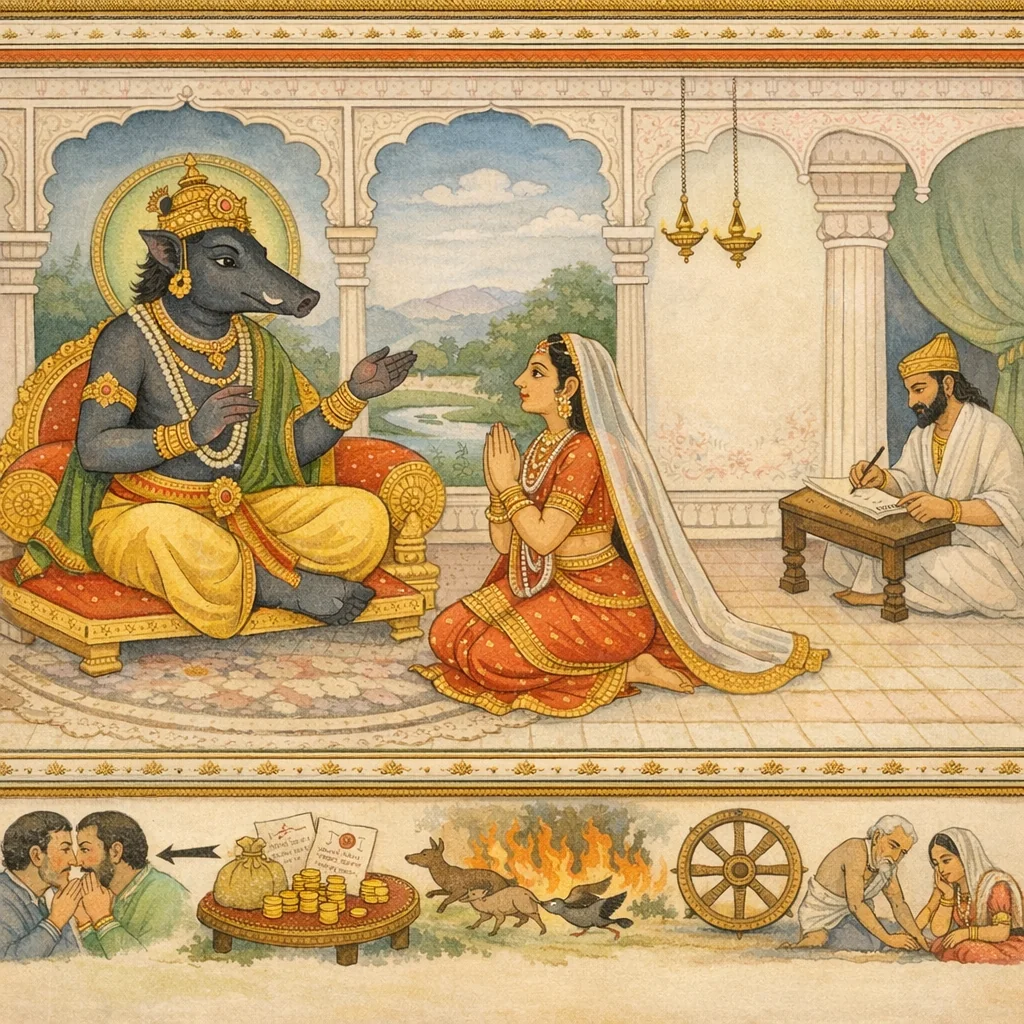
Adhyaya 203: Enumeration and Description of Classes of Sins and Their Consequences
Pāpasamūhānukrama-varṇanam
Ethical-Discourse (Karmic Retribution and Social Harm)
In the Purāṇic didactic frame of Varāha’s instruction to Pṛthivī, this chapter extends earlier lists by presenting an itemized taxonomy of pāpa (harmful deeds) and their karmic results. The administrative disclosure of sins is attributed to Citragupta, after which are detailed groups marked by lack of self-restraint, violence, deceitful speech, theft, fraud, and sexual coercion. The text repeatedly follows a cycle: naming a wrongdoing (such as cruelty, slander, falsification, arson, poaching, and corruption), describing naraka-yātanā (hell-torments), and explaining rebirth signs—disease, disability, social marginalization, insecurity, and chronic fear. Ecological harms, especially setting forest fires and killing animals, are explicitly included as antisocial acts with long-lasting consequences for embodied life and communal stability.
Primary Speakers
Key Concepts
Shlokas in Adhyaya 203
Verse 1
अथ पापसमूहानुक्रमवर्णनम् ॥ ऋषिपुत्र उवाच ॥ अन्यान्यपि च पापानि चित्रगुप्तो दिदेश ह ॥ व्यामिश्रान्कथ्यमानांश्च शृणुध्वं तान्महौजसः
Now follows the description of the ordered catalogue of sins. The Ṛṣi’s son said: “Other sins too did Citragupta indeed point out; and as those of mixed nature are being described, listen to them, O mighty ones.”
Verse 2
शीलसंयमहीनानां कृष्णपक्षानुगामिनाम् ॥ महापापैरुपेतानां कथ्यतां तत्पराभवम्
Let the downfall be described of those who lack good conduct and self-restraint, who follow the dark side, and who are burdened with great sins.
Verse 3
राजद्विष्टा गुरुद्विष्टाः सर्वे ते वै विगर्हिताः ॥ अविश्वास्या ह्यसम्भाष्याः कुक्षिमात्रपरायणाः
Those who hate the king and those who hate the teacher—all of them are indeed censured: untrustworthy, unfit for association and conversation, devoted only to their belly.
Verse 4
हिंसाविहारिणः क्रूराः सूचकाः कार्यदूषकाः ॥ गवेडकस्य वधकाः महिषाजादिकस्य च
Those who take pleasure in violence, who are cruel; informers; corrupters of others’ affairs; killers of the cowherd, and killers of buffaloes, goats, and the like.
Verse 5
दावाग्निं ये च मुञ्चन्ति ये च सौकरिकास्तथा ॥ तत्र कालमसंख्येयं पच्यन्ते पापकािरिणः ॥
Those who kindle forest-fires, and likewise those who live by hunting or by killing boars—such wrongdoers are cooked in hell there for an incalculable length of time.
Verse 6
कर्मक्षयाद्यदा भूयो मानुष्यं प्राप्नुवन्ति ते ॥ अल्पायुषो भवन्तीह व्याधिग्रस्ताश्च नित्यशः ॥
When, through the exhaustion of their karma, they again attain human birth, they become short-lived here and are continually afflicted by disease.
Verse 7
गर्भ एव विपद्यन्ते म्रियन्ते बालकास्तथा ॥ परिरिङ्गरताः केचिन्म्रियन्ते पुरुषाधमाः ॥
Some perish even in the womb; likewise some die as infants. Certain vile persons die while still crawling about.
Verse 8
काष्ठवंशे च शस्त्रे च वायुनाज्वलनेन च ॥ तोयेन वा पाशबन्धैः पतनेन विषेण वा ॥
By wooden poles, by weapons, by wind, by fire; or by water, by bonds and nooses, by falling, or by poison—
Verse 9
मातापितृवधं कष्टं मित्रसम्बन्धिबन्धुजम् ॥ बहुशः प्राप्नुवन्त्येते विद्रवं चाप्यभीक्ष्णशः ॥
They repeatedly meet with grievous slaying involving mother and father, and involving friends, relations, and kin; and they also experience flight and distress again and again.
Verse 10
मूलकर्मकरा ये च गरदाः पुरदाहकाः ॥ ये च पञ्जरकर्त्तारो ये च शूलोपघातकाः ॥
Those who engage in base and violent occupations—poisoners and those who burn towns; those who make cages for confinement, and those who strike with stakes or spears—
Verse 11
पिशुनाः कलहाश्चैव ये च मिथ्याविदूषकाः ॥ गोकुञ्जरखरोष्ट्राणां चर्मका मांसभेदकाः ॥
Slanderers and quarrel-makers, and those who defame through falsehood; leather-workers and flesh-cutters of cows, elephants, donkeys, and camels—
Verse 12
उद्वेजनकराश्चण्डाः पच्यन्ते नरकेषु ते ॥ तत्र कालं तु सम्प्राप्य यातनाश्च सुदुःसहाः ॥
Those fierce persons who cause terror are cooked in the hells; and, upon reaching their allotted time there, they undergo torments exceedingly hard to endure.
Verse 13
कर्मक्षयो यदा भूयो मानुष्यं प्राप्नुवन्ति ते ॥ हीनाङ्गाः सुदरिद्राश्च भवन्ति पुरुषाधमाः ॥
When their karma is exhausted, they again attain human birth; those vile persons become maimed and exceedingly poor.
Verse 14
श्रवणच्छेदनं चैव नासाच्छेदनमेव च ॥ छेदनं हस्तपादानां प्राप्नुवन्ति स्वकर्मणा ॥
By their own actions they incur the cutting off of the ears, likewise the cutting off of the nose, and the cutting off of hands and feet.
Verse 15
शारीरं मानसिकं दुःखं प्राप्नुवन्ति पुनःपुनः ॥ गलवेदनास्तथोग्राश्च तथा मस्तकवेदनाः
Again and again they incur bodily and mental suffering—severe pains of the throat, and likewise pains of the head.
Verse 16
कुक्ष्यामयं तथा तीव्रं प्राप्नुवन्ति नराधमाः ॥ जडान्ध बधिरा मूका पङ्गवः पादसर्पिणः
Likewise, the vilest among men incur severe abdominal disease; they become dull, blind, deaf, mute, lame, or those who move by crawling on their feet.
Verse 17
एकपक्षहताः काणाः कुनखाश्चामयाविनः ॥ कुब्जाः खञ्जास्तथा हीना विकलाश्च घटोदराः
They become those deprived of one side (or one limb), one-eyed, with deformed nails and diseased; hunchbacked, limping, deficient, impaired, and pot-bellied.
Verse 18
गलत्कुष्ठाः श्वित्रकुष्ठा भवन्ति स्वैश्च कर्मभिः ॥ वाताण्डाश्चाण्डहीनाश्च प्रमेहमधुमेहिनः
Through their own actions they become afflicted with kuṣṭha that causes decay, and with white-spotted kuṣṭha; and they become those with disorders of the testes, those lacking testes, and those suffering from prameha and madhumeha.
Verse 19
बहुभिर्दारुणैर्घोरैर्व्याधिभिः समनुद्गताः ॥ इत्येतान्हिंसकान्क्रूरान्घातयन्तु सुदारुणान्
Afflicted by many dreadful and terrifying diseases—thus (the text says) let those violent, cruel persons be struck down, exceedingly terrible as they are.
Verse 20
मिथ्याप्रलापिनो दूतान्पाचयन्तु यथाक्रमम् ॥ कर्कशाः पुरुषाः सत्याः ये च योषानिरर्थकाः
Let the messengers who delight in false prattle be “cooked” (that is, punished) in due order; and likewise those harsh men, and those who speak to women without purpose—in vain and improper talk.
Verse 21
एषां चतुर्विधा भाषा या मिथ्याप्यभिधीयते ॥ हास्यरूपेण या भाषा चित्ररूपेण वा पुनः
Their speech is of four kinds, and is also called “false”: speech in the form of jesting, and again speech in the form of artful display (a deceptive flourish).
Verse 22
अरहस्यं रहस्यं वा पैशुन्येन तु निन्दनात् ॥ उद्वेगजनना वापि कटुका लोकगर्हिताः
Whether it concerns what is not secret or what is secret, through backbiting it becomes blameworthy; and likewise speech that stirs agitation—bitter and condemned by people.
Verse 23
स्नेहक्षयकरां रूक्षां भिन्नवृत्तविभूषिताम् ॥ कदलीगर्भनिस्सारां मर्मस्पृक्कटुकाक्षराम्
Speech that destroys affection, dry and harsh, adorned with broken turns of phrase; empty like the pith within a banana-stem, striking at vital spots, and made of bitter syllables.
Verse 24
स्वरहीनामसंख्येयां भाषन्ते च निरर्थकम् ॥ अयन्त्रितमुखा ये च ये निबद्धाः प्रलापिनः
They utter meaningless words—countless and lacking proper tone; those whose mouths are unrestrained, and those who, as if bound, are given over to compulsive prattle.
Verse 25
दूषयन्ति हि जल्पन्तोऽनृजवो निष्ठुराः शठाः ॥ निर्दया गतलज्जाश्च मूर्खा मर्मविभेदिनः
Indeed, those who keep talking—crooked, harsh, deceitful—defile the social order: merciless, shameless, foolish, and those who wound others at their vulnerable points.
Verse 26
न मर्षयन्ति येऽन्येषां कीर्त्यमानाञ्छुभान्गुणान् ॥ दुर्वाचः परुषांश्चण्डान्बन्धयध्वं नराधमान्
Those who cannot tolerate the praised virtues of others—evil-speakers, harsh and violent—bind and restrain those lowest among men.
Verse 27
ततस्तिर्यक्प्रजायन्ते बहुधा कीटपक्षिणः ॥ लोके दोषकराश्चैव लोकद्विष्टास्तथा परे ॥
Thereupon they are born as animals in various ways—as insects and birds; and in the world they become makers of faults and likewise are hated by people, and so too others of that kind.
Verse 28
परिभूताऽविज्ञाता नष्टचित्ता अकीर्त्तयः ॥ अनर्च्याश्चाप्यनर्हाश्च स्वपक्षे ह्यवमानिताः
They become insulted and unrecognized, of ruined mind and without good repute; unworthy of honor and undeserving, and even within their own faction they are held in contempt.
Verse 29
त्यक्त्वा मित्राणि मित्रेषु ज्ञातिभिश्च निराकृताः ॥ लोकदोषकराश्चैव लोकद्वेष्याश्च ये नराः
Abandoning friends—even among friends—and rejected by their kinsmen, those men become causes of social faults and objects of public hatred.
Verse 30
अन्यैरपि कृतं पापं तेषां पतति मस्तके ॥ वज्रं शस्त्रं विषं वापि देहाद्देहनिपातनम्
Even sin committed by others falls upon their head; whether by lightning, weapon, or poison—there is a falling of the body from the body, that is, a violent death.
Verse 31
मिथ्याप्रलापिनामेषामुक्ता क्लेशपरम्परा ॥ स्तेयहारं प्रहारं च नीतिहारं तथैव च
For these false-talkers, a succession of afflictions is declared: theft and loss, assault and beating, and likewise the loss of proper conduct (nīti).
Verse 32
स्तेयकर्माणि कुर्वन्ति प्रसह्य हरणानि च ॥ करचण्डाशिनो ये च राजशब्दोपजीविनः
They commit acts of theft and also forcible seizures—those who live by harsh exactions and those who make a living by the “king’s word”, that is, courtly influence.
Verse 33
पीडयन्ति जनान्सर्वान्कृपणान्ग्रामकूटकान् ॥ सुवर्णमणिमुक्तानां कूटकर्मानुकारकाः
They oppress all people—especially the poor—acting as village forgers, imitating counterfeit-work with gold, gems, and pearls.
Verse 34
समये कृतहर्त्तारो लोकपीडाकरा नराः ॥ अनादिबुद्धयश्चान्ये स्वार्थातिशयकारिणः
Men who commit theft at the critical moment, bringing oppression upon the people; and others whose understanding lacks true foundation, who act with excessive self-interest.
Verse 35
भूतनिष्ठाभियोगज्ञा व्यवहारेष्वनर्थकाः ॥ भेदकाराश्च धातूनां रजतस्य च कारकाः
Those skilled in lodging accusations concerning living beings, who cause harm in legal and commercial dealings, and who act as agents of adulteration—splitting or corrupting metals and manufacturing counterfeit silver.
Verse 36
न्यासार्थहारका ये च सम्मोहनकराश्च ये ॥ ये तथोपाधिकाः क्षुद्राः पच्यन्ते तेषु तेष्वथ
And those who steal what has been deposited in trust, those who cause delusion, and likewise petty persons who act through deceitful pretexts—these are ‘cooked’, that is, their consequences ripen, in those respective conditions thereafter.
Verse 37
कर्मक्षयो यदा तेषां मानुष्यं प्राप्नुवन्ति ते ॥ तत्र तत्रोपपद्यन्ते यत्र यत्र महद्भयम्
When the exhaustion of their former karma occurs and they attain human birth, they are born again and again in places—wherever there is great fear.
Verse 38
यस्मिंश्चौरभयं देशे क्षुद्भयं राजतो भयम् ॥ आपद्भ्योऽपि भयं यत्र व्याधिमृत्युभयं तथा
In a region where there is fear of thieves, fear of hunger, fear from the king (state power), fear even from calamities, and likewise fear of disease and death—
Verse 39
इतयो यत्र देशेषु लुब्धेषु नगरेषु च ॥ क्षयाः कालोपसर्गा वा जायन्ते तत्र ते नराः
In those regions and in those cities where there are itayaḥ (afflictions or hostile disturbances) and greed, destructions or temporal calamities arise; there those men are born.
Verse 40
बहुदुःखपरिक्लिष्टा गर्भवासेन पीडिताः ॥ एकहस्ता द्विहस्ता वा कूटाश्च विकृतोदराः
Afflicted by much suffering and tormented by dwelling in the womb, they are born one‑handed or with deficient limbs, and as hunchbacked or with distorted abdomens.
Verse 41
तेषामपत्यं न भवेत् तद्रूपं च सुलक्षणम् ॥ अतिह्रस्वं विवर्णं च विकृतं भ्रान्तलोचनम्
Their offspring does not become of a similar form and well‑marked appearance; instead it is exceedingly short, pallid, deformed, and with unsteady, errant eyes.
Verse 42
संसारे च यथा पक्वं कृपणं भैरवस्वनम् ॥ महतः परिवारस्य तुष्टश्चोच्छिष्टभोजकः
And in worldly existence, as that condition ripens, one becomes a wretched person with a dreadful voice—yet content like one who eats leftovers, living in dependence upon the retinue of the great.
Verse 43
रूपतो गुणतो हीनो बलतः शीलतस्तथा ॥ राजभृत्या भवन्त्येते पृथिवीपरिचारकाः
Inferior in appearance, qualities, strength, and conduct, these become servants of the king—attendants who labor upon the earth.
Verse 44
शिराविवृतगात्राश्च हीनाङ्गा वातरोगिणः ॥ अश्रुपातितनेत्राश्च भार्या न प्राप्नुवन्ति ते
With veins standing out over their bodies, with deficient limbs, afflicted by vāta disorders (wind‑disease), and with eyes ruined by tears, they do not obtain a wife.
Verse 45
अनालयाः निरामर्षाः वेदनाभिः सुसंवृताः ॥ समकार्यसजात्यानां मित्रसम्बन्धिनां तथा
Homeless and lacking forbearance, closely enveloped by afflictions, they become estranged even from those of the same work and social kind—likewise from friends and relations.
Verse 46
कर्मकल्याणकृच्छ्रेषु भृशं चापि विमुह्यति ॥ कर्षकाः पशुपालाश्च वाणिज्यस्योपजीवकाः
In hardships that obstruct the successful completion of good undertakings, they become greatly bewildered—farmers, herdsmen, and those who subsist by trade.
Verse 47
यद्यत्कुर्वन्ति ते कर्म सर्वत्र क्षयभागिनः ॥ सत्यमन्विष्यमाणाश्च नैव ते कीर्त्तिभागिनः
Whatever action they perform, everywhere it becomes subject to loss; and though they may be seeking truth, they do not attain a share in lasting renown.
Verse 48
यत्किञ्चिदशुभं कर्म तस्मिन्देशे समुच्छ्रितम् ॥ तस्य देशस्य नैवास्ति वर्जयित्वातुरान्नरान्
Whatever inauspicious act has arisen in that region—of that region there is no well-being, excepting only the afflicted people (who are to be exempted from blame).
Verse 49
सुवृष्ट्यामपि तेषां वै क्षेत्रं तं तु विवर्जयेत् ॥ अशनिर्वा पतत्तत्र क्षेत्रं वापि विनश्यति
Even when there is good rainfall, one should avoid that field of theirs; either a thunderbolt falls there, or the field itself perishes.
Verse 50
न सुखं नापि निर्वाणं तेषां मानुषता भवेत् ॥ उत्पद्यते नृशंसानां तीव्रः क्लेशः सुदारुणः
Neither happiness nor release (nirvāṇa) becomes their human condition; for the cruel, an intense and exceedingly harsh suffering arises.
Verse 51
स्तेयकर्मप्रयुक्तानां मुक्त्वा क्लेशपरम्पराम् ॥ परदारप्रसक्तानामिमां शृणुत यातनाम्
Setting aside the succession of sufferings for those engaged in deeds of theft, listen now to this torment for those attached to another’s spouse.
Verse 52
तिर्यङ्मानुषदेहेषु यान्ति विक्षिप्तमानसाः ॥ विहरन्ति ह्यधर्मेषु धर्मचारित्रदूषकाः
With minds thrown into disorder, they go into animal and human bodies; they roam amid unrighteous ways—those who corrupt dharma and proper conduct.
Verse 53
तांस्तेनैव प्रदानेंन संग्रहेत्तु ग्रहेण वा ॥ मूलकर्मप्रयोगेण राष्ट्रस्यातिक्रमेन वा
Those (persons/possessions) may be appropriated by that very “gift” (as a transactional pretext), or by seizure; or by employing primary means of coercion, or by transgressing the order of the realm (the state).
Verse 54
प्रसह्य वा प्रकृत्या वै ये चरन्ति कुलाङ्गनाः ॥ वर्णसङ्करकर्त्तारः कुलधर्मादिदूषकाः
Whether by coercion or by their own disposition, those women of families who engage in such conduct—makers of varṇa-saṅkara (social mixing) and corrupters of family dharma and related norms—are described here.
Verse 55
निरयं पापभूयिष्ठा अनुभूय महाभयम् ॥ बहुवर्षसहस्राणि कर्मणा तेन दुष्कृताः
Having experienced hell—those in whom sin predominates—together with great terror, the evildoers (thus) endure (there) for many thousands of years on account of that very deed.
Verse 56
कर्मक्षये यदा भूयो मानुष्यं यान्ति दारुणम् ॥ सङ्कीर्णयोनिजाः क्षुद्रा भवन्ति पुरुषाधमाः
When, upon the exhaustion of that karma, they again attain a harsh human condition, they become of mixed births, base and petty—men of the lowest kind.
Verse 57
वेश्यालङ्घककूटानां शौण्डिकानां तथैव च ॥ दुष्टपाषण्डनारीणां नैकमैथुनगामिनाम्
(These consequences are described) for those who violate women of the courtesan class, for deceivers and for drunkards as well; and for corrupt women associated with heterodox groups, who engage in repeated sexual unions.
Verse 58
निर्लज्जपुण्ड्रकाः केचिद्बद्धपौरुषगण्डकाः ॥ स्त्रीबन्धकाः स्त्रीविनाशाः स्त्रीवेषाः स्त्रीविहारिणः
Some are shameless, bearing sectarian marks; some have their manliness bound and obstructed; (others are) those who confine women, those who bring ruin to women, those who assume women’s dress, and those who roam in pursuit of women.
Verse 59
स्त्रीणां चानुप्रवृद्धा ये स्त्रीभोगपरिभोगिनः ॥ तद्दैवतास्तन्नियमास्तद्वेषास्तत्प्रभाषिताः
And those who become ever more entangled with women—who indulge in (and are consumed by) sexual enjoyment—take them as their very divinity, their rule, their dress, and their manner of speech.
Verse 60
तद्भावास्तत्कथालापास्तद्भोगाः परिभोगिनः ॥ विप्रलोभं च दानेषु प्राप्नुवन्ति नराधमाः
Their dispositions become aligned with that; their conversations revolve around that; they pursue those pleasures again and again—yet, in matters of giving (dāna), these lowest of men incur deceit and defrauding.
Verse 61
सौभाग्यपरमासक्ता नरा बीभत्सदर्शनाः ॥ अबुद्धैः सह संवासं प्रियं चाविप्रियं तथा
Men intensely attached to their own attractiveness become repulsive in appearance; and they come to dwell in the company of the unwise—amid what is pleasant and what is not pleasant alike.
Verse 62
शारीरं मानसं दुःखं प्राप्नुवन्ति नराधमाः ॥ कृमिभिर्भक्षणं चैव तप्ततैलोपसेचनम्
Those lowest of men undergo bodily and mental suffering—being eaten by worms, and also being drenched with heated oil.
Verse 63
अग्निक्षारनदीभ्यां तु प्राप्नुवन्ति न संशयः ॥ परदारप्रसक्तानां भयं भवति निग्रहः
They encounter rivers of fire and caustic alkali—of this there is no doubt. For those attached to another’s spouse, fear arises, and restraint (or punitive control) follows.
Verse 64
प्राणातिपातनं ते वै प्राप्नुवन्ति यथा तथा ॥ लोहकाः कारुकाश्चैव गर्भाणां विनिहिंसकाः
They, indeed, undergo the consequence of taking life, in one way or another—so too metalworkers and artisans who inflict harm upon embryos in the womb.
Verse 65
योनिśūलाक्षिśūलाश्च श्वासहृद्गुह्यśūलिनः ॥ पिण्डकावर्त्तभेदैश्च प्लीहगुल्मादिरोगिणः ॥
There the sinners suffer pains of the womb and pains of the eyes; they are afflicted with disorders of the breath and with pains in the heart and the secret organs. They also become diseased with lumps, intestinal torsions and ruptures, and with ailments such as disorders of the spleen and abdominal swellings.
Verse 66
तत्र कालं चिरं घोरं पच्यन्ते पापकािरणः ॥ कर्मक्षयो यदा भूयो मानुष्यं प्राप्नुवन्ति ते ॥
There, for a long and dreadful time, the doers of evil are “cooked” (tormented). When their karma is exhausted, they again attain human existence.
Verse 67
निरयेष्वप्रतिष्ठेषु दारुणेषु ततस्ततः ॥ तत्र कालं तु सुचिरं पच्यन्तां पापकािरणः ॥
In the dreadful hells that are unstable, without firm footing, from place to place, there the evil-doers are tormented for a very long time.
Verse 68
कर्मान्तकारका ह्येते तृणीभूता भवन्ति ते ॥ अनर्थो राजदण्डो वा नित्यमुत्पाद्यते वधः ॥
For such people, through their actions, become agents of ruin; they come to be treated as worthless as grass. Misfortune—or else punishment by the king—continually arises, and death is brought about.
Verse 69
शीलशौचादिसम्पन्नं ये जनं धर्मलक्षणम् ॥ धर्षयन्ति च ये पापाः श्रूयतां तत्पराभवः ॥
Those sinful persons who violate and outrage people characterized by dharma—people endowed with good conduct, purity, and the like—listen now to the account of their downfall.
Verse 70
सर्वं च निखिलं कार्यं यन्मया समुदाहृतम् ।
And the entire set of duties—everything in full—has been stated by me.
Frequently Asked Questions
The text constructs an ethical taxonomy in which specific harms—violence toward beings, deceitful and injurious speech, theft and fraud, abuse of power, and sexual coercion—are presented as causal factors producing (a) prolonged punitive experiences (naraka-yātanā) and (b) observable rebirth consequences such as disease, disability, social dishonor, and persistent insecurity. The internal logic emphasizes that antisocial actions destabilize both the individual body and the social order across lifetimes.
No tithi, pakṣa, seasonal (ṛtu), or calendrical observances are prescribed. The only temporal motif is karmakṣaya—after an unspecified duration of suffering, beings return to human birth, often with shortened lifespan (alpāyu) and chronic illness.
While not a systematic ecological treatise, the chapter explicitly treats environmentally destructive acts—especially dāvāgni (setting a forest fire) and forms of animal-killing (e.g., hunters and slaughterers)—as serious moral disruptions with extended consequences. In a Pṛthivī-centered Purāṇic frame, these acts can be read as violations of terrestrial well-being: harm to habitats and non-human life is integrated into the same karmic accountability system that governs social violence and fraud.
The chapter does not cite dynasties or named royal lineages. The principal cultural figure invoked is Citragupta, presented as the recorder/administrator who ‘indicates’ or enumerates categories of wrongdoing. Social types are referenced (e.g., those living off royal authority, counterfeiters, informers, arsonists), but without specific historical personages.