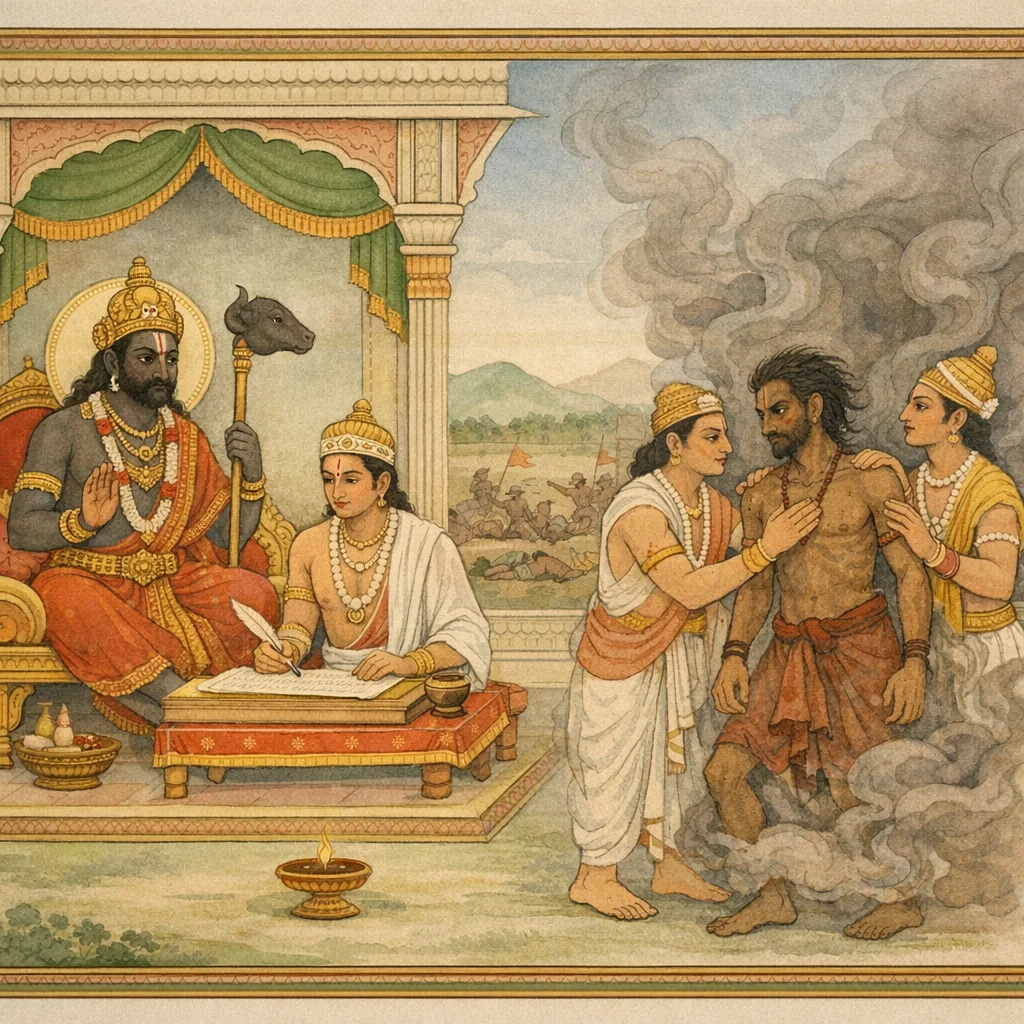
Adhyaya 201: The Battle between the Rākṣasas and Yama’s Attendant-Messengers
Rākṣasa-kiṅkara-yuddham
Mythic-Administration (Yama’s Justice) / Conflict-Narrative
Set within the pedagogical dialogue of Varāha and Pṛthivī, this chapter recounts an episode of cosmic administration and the enforcement of moral order. Messengers arrive in various disguises, report exhaustion, and seek reassignment; their plea sparks anger and a mobilization under Citragupta, portrayed as an impartial overseer mindful of the welfare of all beings. The narrative swells into a large-scale battle against the Mandeha rākṣasas, who deploy diverse mounts, weapons, and dark illusion (tāmasī māyā). As the rākṣasas falter, they take refuge with Jvara, a fearsome personified affliction. Jvara sends agents to “cook” (punish) the offenders; thereafter Yama intervenes, pacifies Jvara, and restores order. The episode reinforces a didactic vision of accountability, restraint, and systemic balance in the governance of embodied life.
Primary Speakers
Key Concepts
Shlokas in Adhyaya 201
Verse 1
अथ राक्षसकीङ्करयुद्धम् ॥ ऋषिपुत्र उवाच ॥ ततस्ते सहिताः सर्वे चान्योऽन्याभिरताः सदा ॥ नानावेषधरा दूताः कृताञ्जलिपुटास्तदा ॥
Now (begins) the battle with the rākṣasas’ attendants. The sage’s son said: Then all those messengers, assembled together, always in mutual accord, wearing various disguises, stood at that time with their hands joined in reverence.
Verse 2
दूता ऊचुः ॥ वयं श्रान्ताश्च क्षीणाश्च ह्यन्यान् योजितुमर्हसि ॥ वयमन्यत्करिष्यामः स्वामिन्कार्यं सुदुष्करम् ॥
The messengers said: We are weary and exhausted; you should appoint others. We will do something else, O master—the task is exceedingly difficult.
Verse 3
अन्ये हि तावत्तत्कुर्युर्यथेष्टं तव सुव्रत ॥ भगवन्स्म परिक्लिष्टाः त्राहि नः परमेश्वर ॥
Others could do that, as you wish, O well-vowed one. We are indeed afflicted, O Blessed Lord; protect us, O Supreme Lord.
Verse 4
ततो विवृत्तरक्ताक्षस्तेन वाक्येन रोषितः ॥ विनिःश्वस्य यथा नागो ह्यपश्यत्सर्वतो दिशम् ॥
Then, with eyes reddened and rolling, enraged by those words, he exhaled forcefully like a serpent and looked in every direction.
Verse 5
अदूरे दृष्टवान्कञ्चित्पुरुषं स ह्यनाकृतिम् ॥ स तु वेगेन सम्प्राप्त इङ्गितज्ञो दुरात्मवान् ॥
Not far away, he saw a certain person, seemingly without a fixed form. That wicked one, skilled at reading signs and intentions, rushed forward with speed.
Verse 6
निःसृतः स च रोषेण चित्रगुप्तेन धीमता ॥ ततः स त्वरितं गत्वा मन्देहा नाम राक्षसाः ॥
He was driven out by the wrath of the wise Citragupta. Then, going quickly, he approached the rākṣasas known as the Mandehas.
Verse 7
नानारूपधरा घोरा नानाभरणभूषिताः ॥ विनाशाय महासत्त्वो यत्र तिष्ठन्महायशाः ॥
Terrifying, assuming many forms and adorned with various ornaments, they moved toward destruction, to the place where the great and renowned mighty being stood.
Verse 8
चित्रगुप्तो महाबाहुः सर्वलोकार्थचिन्तकः ॥ समः सर्वेषु भूतेषु भूतानां च समादिशत् ॥
Citragupta, strong-armed and mindful of the welfare of all worlds, impartial toward all beings, then issued commands concerning those beings.
Verse 9
ततस्ते विविधाकाराः राक्षसाः पिशिताशनाः ॥ उपरुह्य तथा सर्वे मातङ्गांश्च हयं तथा ॥
Then those flesh-eating rākṣasas of diverse forms mounted up—all of them—upon elephants and likewise upon horses.
Verse 10
ब्रुवन्तश्च पुनर्हृष्टाः शीघ्रमाज्ञापय प्रभो ॥ तव सन्देशकर्त्तारः कस्य कृन्तामजीवितम् ॥
And speaking again in delight, they said: “Command quickly, O Lord. As your messengers, whose life shall we cut down?”
Verse 11
तेषां तद्वचनं श्रुत्वा चित्रगुप्तो ह्यभाषत ॥ रोषगद्गदया वाचा निःश्वसन् वै मुहुर्मुहुः ॥
Hearing their words, Citragupta spoke—his voice trembling with anger, repeatedly exhaling again and again.
Verse 12
भो भो मन्देहका वीराः मम चित्तानुपालकाः ॥ एतान्बध्नीत गृह्णीत भूताराक्षसपुङ्गवाः ॥
“Ho! Ho! O Mandeha heroes, guardians of my intent—bind these men, seize them, O foremost among spirits and rākṣasas!”
Verse 13
एवं हत्वा च बद्ध्वा च ह्यागच्छत पुनर्यथा ॥ हन्तारः सर्वभूतानां कृतज्ञा दृढ विक्रमा ॥
“Thus, having slain and having bound (them), return again as before—(you who are) killers of all beings, dutiful and firm in valor.”
Verse 14
हत्वा वै पापकानेतान्मम विप्रियकारिणः ॥ एतच्छ्रुत्वा वचस्तस्य वचनं चेदमब्रुवन् ॥
“Indeed, having slain these sinners, who acted against my wishes”—hearing these words of his, they spoke this reply.
Verse 15
राक्षसाः ऊचुः ॥ श्रान्ता वा क्षुधिता वापि दुःखिता वा तपोधनाः ॥ अमात्याः एव ज्ञातव्याः भृत्याः शतसहस्रशः ॥
The Rākṣasas said: “Whether they are weary, or hungry, or afflicted—those rich in tapas (austerity) should be recognized as ministers; likewise, there are servants by the hundreds of thousands.”
Verse 16
एते वधार्थं निर्दिष्टास्त्वयैव च महात्मना ॥ न युक्तं विविधाकाराः ह्यस्माकं नाशनाय वै ॥
“These have been designated by you yourself, O great-souled one, for the purpose of slaying. It is not fitting that beings of many forms should indeed be set for our destruction.”
Verse 17
यथा ह्येते समुत्पन्नाः सर्वधर्मानुचिन्तकाः ॥ तथा वयं समुत्पन्नास्तदर्थं हि भवानपि ॥
“For just as these have arisen as reflectors upon all dharmas, so too have we arisen; and you also (have arisen) for that very purpose.”
Verse 18
मा च मिथ्या प्रतिज्ञातं धर्मिष्ठस्य भवत्विति ॥ अस्माकं विग्रहे वीर मुच्यन्तां यदि मन्यसे ॥
“And let it not be that a promise proves false—a promise befitting one who is most righteous. O hero, if you think fit, let them be released in our conflict.”
Verse 19
एवमुक्त्वा ततो घोरा व्याधयः कामरूपिणः ॥ सन्नद्धास्त्वरितं शूरा भीमरूपा भयानकाः ॥
Having spoken thus, then the dreadful Vyādhas—shape-shifters at will—swiftly armed themselves: heroes of terrifying form, fearsome to behold.
Verse 20
गजैरन्ये तथा चाश्वै रथैश्चापि महाबलाः ॥ कण्टकैस्तुरगैर्हंसैरन्ये सिंहैस्तथापरे ॥
Some, mighty in strength, came with elephants, likewise with horses and even with chariots; others with spined creatures, with steeds, with swans; and still others with lions.
Verse 21
मृगैः सृगालैर्महिषैर्व्याघ्रैर्मेषैस्तथापरे ॥ गृध्रैः श्येनैर्मयूरैश्च सर्पगर्दभकुक्कुटैः ॥
Others came with deer, jackals, buffaloes, tigers, and rams; with vultures, hawks, and peacocks, and with serpents, donkeys, and cocks.
Verse 22
एवं वाहनसंयुक्ता नानाप्रहरणोद्यताः ॥ समागताः महासत्त्वा अन्योन्यमभिकाङ्क्षिणः ॥
Thus equipped with mounts and ready with various weapons, the great beings assembled, each desiring to confront the other.
Verse 23
तूर्यक्श्वेडितसंघुष्टैर्बलितास्फोटितैरपि ॥ जयार्थिनो द्रुतं वीराश्चालयन्तश्च मेदिनीम् ॥
With the tumult of instruments and battle-cries, and also with roars and clappings, the heroes—seeking victory—swiftly advanced, even causing the earth to tremble.
Verse 24
ततः समभवद्युद्धं तस्मिंस्तमसि सन्तते ॥ मुकुटैरङ्गदैश्चित्रैः केयूरैः पट्टिशासिकैः ॥
Then battle arose there, when darkness had spread—amid crowns, ornate armlets and shoulder-ornaments, and with axes and swords.
Verse 25
सकुण्डलैः शिरोभिश्च भ्राजते वसुधातलम् ॥ बहुभिश्च सकेयूरैश्छत्रैश्च मणिभूषणैः
The surface of the earth shone, strewn with heads still wearing earrings, and with many armlets, parasols, and jeweled ornaments.
Verse 26
शूलशक्तिप्रहारीश्च यष्टितोमरपट्टिशैः ॥ असिखड्गप्रहारीश्च बलप्राणसमीritaiḥ
There were blows from spears and javelins, from clubs, lances, and axes; and strikes with swords and blades—driven by strength and vital force.
Verse 27
अभवद्दारुणं युद्धं तुमुलं लोमहर्षणम् ॥ नखैर्दन्तैश्च पादैश्च तेऽन्योऽन्यमभिजघ्निरे
The battle became dreadful—uproarious and hair-raising; with nails, teeth, and even feet, they struck one another.
Verse 28
ततस्ते राक्षसा भग्ना दूतैर्घोरपराक्रमैः ॥ देहि देहि वदन्त्येव भिन्धि गृह्णीष्व तिष्ठ च
Then those Rākṣasas, routed by messengers of dreadful valor, kept shouting, “Give! Give! Break (him)! Seize (him)! Stand fast!”
Verse 29
वध्यमानाः पिशाचास्ते ये निवृत्ता रणार्दिताः ॥ आहूयन्त प्रतिबयात्क्रोधसंरक्तलोचनाः
Those Piśācas who, harried in battle, had turned back—even as they were being slain—were called out again in fear, their eyes reddened with anger.
Verse 30
तिष्ठ तिष्ठ क्व यासीति न गच्छामि दृढो भव ॥ मया मुक्तमिदं शस्त्रं तव देहविनाशनम्
“Stop, stop—where are you going?” “I will not go; stand firm. This weapon released by me is the destroyer of your body.”
Verse 31
किन्तु मूढ त्वया शस्त्रं न मुक्तं मे रुजाकरम् ॥ मया क्षिप्तास्तु इषवः प्रतीच्छ क्व पलायसे
“But, fool, the weapon you released was not one that brings me pain. Rather, the arrows cast by me—receive them! Where are you fleeing?”
Verse 32
किं त्वं वदसि दुर्बुद्धे एषोऽहं पारगो रणे ॥ मम बाहु विमुक्तस्तु यदि जीवस्यतो वद
“What are you saying, you ill-minded one? Here I am—skilled in battle. My arm has been set free; if you wish to live, speak (your submission).”
Verse 33
तत्र ते सहसा घोरा राक्षसाः पिशिताशनाः ॥ मन्देहा नाम नाम्ना ते वध्यमानाः सहस्रशः
There, suddenly, dreadful Rākṣasas—flesh-eaters—appeared; they were called by name “Mandehas,” and they were being slain by the thousands.
Verse 34
ततो भग्ना यदा ते तु राक्षसाः कामरूपिणः ॥ प्रत्यपद्यन्त ते मायां तामसीं तमसावृताः
Then, when those shape-shifting Rākṣasas were routed, they resorted to a dark illusion, enveloped in darkness.
Verse 35
अदृश्याश्चैव दृश्याश्च तद्बलं तमसावृताः ॥ ततस्ते शरणं जग्मुर्ज्वरं परमभीषणम् ॥
Both the unseen and the seen—those forces, shrouded in darkness—then went to Jvara for refuge, the supremely terrifying one.
Verse 36
शूलपाणिं विरूपाक्षं सर्वप्राणिप्रणाशनम् ॥ मन्देहा नाम नाम्ना वै राक्षसाः पिशिताशनाः ॥
—(They described) the trident-bearer, the one with misshapen eyes, the destroyer of all living beings; and they mentioned the flesh-eating Rākṣasas who are indeed known by the name “Mandehas.”
Verse 37
वयमद्य महाभाग त्रायस्व जगतः पते ॥ ततस्तेषां वचः श्रुत्वा दूतानां कामरूपिणाम् ॥
“Today, O fortunate one—save us; O lord of the world—protect us.” Then, having heard the words of those emissaries who could assume forms at will, …
Verse 38
ज्वरः क्रुद्धो महातेजा योधानां तु सहस्रशः ॥ कालो मुण्डः केकराक्षो लोहयष्टिपरिग्रहः ॥
Jvara, enraged and of great radiance, (assembled) warriors by the thousand—among them Kāla, Muṇḍa, Kekarākṣa, and Lohayaṣṭiparigraha.
Verse 39
विविधान्सन्दिदेशात्र पुरुषानग्निवर्चसः ॥ बद्धाञ्जलिपुटान्सर्वानिदमाह सुरेश्वरः ॥
Here he dispatched various men, radiant like fire. To all of them, standing with hands joined in reverence, the lord of the gods said this:
Verse 40
पच शीघ्रमिमान्पापान्योगेन च बलेन च ॥ ततस्ते त्वरितं गत्वा यत्र ते पिशिताशनाः ॥
“Consume these wicked ones swiftly—by yogic power and by force.” Then they went quickly to where those flesh-eaters were.
Verse 41
ज्वराज्ञया च ते सर्वे जीमूतघननिःस्वनाः ॥ बहूंस्ते राक्षसान्घोरान्दर्पोत्सिक्तान् सहस्रशः ॥
And by Jvara’s command, all of them, roaring like dense storm-clouds, fell upon many terrible Rākṣasas—swollen with pride—by the thousand.
Verse 42
बहुशस्त्रप्रहारैश्च शस्त्रैश्च विविधोज्ज्वलैः ॥ तरसा राक्षसा विग्ना रुधिरेण परिप्लुताः ॥
By many blows of weapons, and by various shining weapons, the Rākṣasas were violently checked and flooded with blood.
Verse 43
मोचयामास संग्रामं स्वयमेव यमस्ततः ॥ राक्षसान्मोचयित्वाऽथ हन्यमानान्समन्ततः ॥
Then Yama himself brought the battle to a halt. Having released the Rākṣasas, who were being slain on all sides, …
Verse 44
गत्वा ज्वरं महाभागं विनयात्सान्त्वयन्मुहुः ॥ पूजयन् वै ज्वरं दिव्यं गृहीय हस्ते महायशाः ॥
Having approached the most fortunate Jvara, O noble one, he repeatedly appeased him with humility; honoring the divine Jvara, the illustrious one took him by the hand.
Verse 45
प्रविवेश गृहं स्वं तु सम्भ्रमेणेदृशेन तु ॥ आननं तु समुत्प्रोष्छ्य सङ्ग्रामे स्वेदबिन्दुवत् ॥
He entered his own house in such agitation; and, lifting up his face, he appeared as though in battle, like one covered with drops of sweat.
Verse 46
रोषायासकरं चैव सर्वलोकनमस्कृतः ॥ अहं त्वं चैव देवेश इमं लोकं चराचरम् ॥
He is one who brings about anger and exertion, yet is revered by all worlds. “I and you, O Lord of the gods, (govern) this world of the moving and the unmoving.”
Verse 47
शासेमहि यथाकामं यथादृष्टं यथाश्रुतम् ॥ त्वया ग्राह्यो ह्यहं देव मृत्युना च सुसंवृतः ॥
“Let us administer and judge as we wish—according to what has been seen and according to what has been heard. Yet I am to be seized by you, O god, and I am also firmly encompassed by Death.”
Verse 48
लोकान्सर्वानहं हन्मि सर्वघाती न संशयः ॥ गच्छ गच्छ यथास्थानं युद्धं च त्यजतु स्वयम् ॥
“I strike down all worlds; I am a slayer of all—there is no doubt. Go, go to your proper place, and let him himself abandon the battle.”
Verse 49
राक्षसानां हतास्तत्र षष्टिकोट्यो रणाजिरे ॥ अमराश्चाक्षयाश्चैव न हि त्वां प्रापयन्ति वै ॥
There, on the battlefield, sixty crores of Rākṣasas were slain; and even the immortals, even the imperishable ones, indeed do not reach you (nor can they overcome you).
Verse 50
ततो ह्युपरतं युद्धं धर्मराजो यमः स्वयम् ॥ दूतानां चित्रगुप्तेन सख्यमेकमकारयत् ॥
Then the battle truly ceased; Dharma-rāja Yama himself caused a single accord to be made with Citragupta concerning the messengers.
Verse 51
सम्भाषन्ते ततो दूताश्चित्रगुप्तं तथैव च ॥ नियुञ्जस्व मया पूर्वं सर्वकर्माणि जन्तुषु ॥
Then the messengers spoke with Citragupta as well: “Assign and record, as I did before, all deeds among living beings.”
Verse 52
स्वकर्मगुणभूतानि ह्यशुभानि शुभानि च ॥ रुद्रं दूताः समागम्य चित्रगुप्तस्य पार्श्वतः ॥
Indeed, deeds that become qualities arising from one’s own karma—inauspicious and auspicious—are to be taken into account. The messengers approached Rudra and stood at Citragupta’s side.
Verse 53
उपस्थानं च कुर्वन्ति कालचिन्तकमब्रुवन् ॥ यथा लोका यथा राजा यथा मृत्युḥ सनातनः ॥
They performed formal attendance and spoke to the one who contemplates Time: “As are the worlds, as is the ruler, so is Death—eternal.”
Verse 54
तदैवोत्तिष्ठ तिष्ठेति क्षम्यतां क्षम्यतां प्रभो
Just then they said, “Rise! Stand!”—“May it be forgiven, may it be forgiven, O Lord.”
Verse 55
बद्धगोधाङ्गुलित्राणा नानायुधधरास्तथा ॥ अग्रतः किंकराः कृत्वा तिष्ठन्पादाभिवन्दनम् ॥
Wearing guards fashioned from bound iguana-toe coverings and bearing various weapons, they set the attendants in front and stood there, offering reverent salutation at his feet.
Verse 56
परित्रायस्व नो वीर किंकराणां महाबलान् ॥ हन्यमानान्हि रक्षोभिरस्मानद्य रणाजिरे ॥
Protect us, O hero—us mighty attendants—for today on the battlefield we are being struck down by the rākṣasas.
Verse 57
बाहुभिः समनुप्राप्तः केशाकेशि ततः परम् ॥ अयुक्तमतुलं युद्धं तेषां वै समजायत ॥
They closed in, grappling with their arms; then followed hair-pulling against hair-pulling. Truly, an unrestrained and unequalled fight arose among them.
Verse 58
खादन्ति चैव घ्नन्ति स्म चित्रगुप्तेन चोदिताः ॥ व्याधीनां च सहस्राणि दूतानां च महाबलाः ॥
Urged on by Citragupta, they devour and strike; and there are thousands of diseases, and mighty messengers as well.
Verse 59
धर्मराजोऽथ विश्रान्तं कालभूतं महाज्वरम् ॥ किंकिं वृत्तमिदं देव व्यापिनस्त्वं महातपाः ॥
Then Dharmarāja addressed Mahājvara, who was at rest, as though an embodiment of Time: “What—what is this that has occurred, O god? You are all-pervading, O great ascetic.”
Frequently Asked Questions
The narrative models cosmic governance as an accountability system: agents (dūtāḥ/kiṅkarāḥ) enforce order, Citragupta functions as an impartial administrator, and Yama ultimately restrains escalation. The text’s internal logic frames violence and punishment as instruments to re-stabilize dharmic order when predatory forces (rākṣasas) disrupt communal well-being.
No tithi, nakṣatra, māsa, or seasonal markers are specified in this adhyāya; it is structured as a continuous mythic episode rather than a ritual calendar instruction.
Although Pṛthivī is not explicitly foregrounded through ecological sites in this passage, the chapter frames “balance” as systemic regulation of harm across beings. By depicting Citragupta’s even-handed stance toward bhūtas and Yama’s de-escalation, the text can be read as extending an ethic of restraint and maintenance of a stable living order—an indirect analogue to preserving terrestrial equilibrium.
The chapter references primarily mythic-administrative figures: Citragupta, Yama (Dharmarāja), and Jvara. A narrator figure, Ṛṣiputra, appears, but no royal dynasties, historical kings, or named sage lineages are developed within this adhyāya’s content.