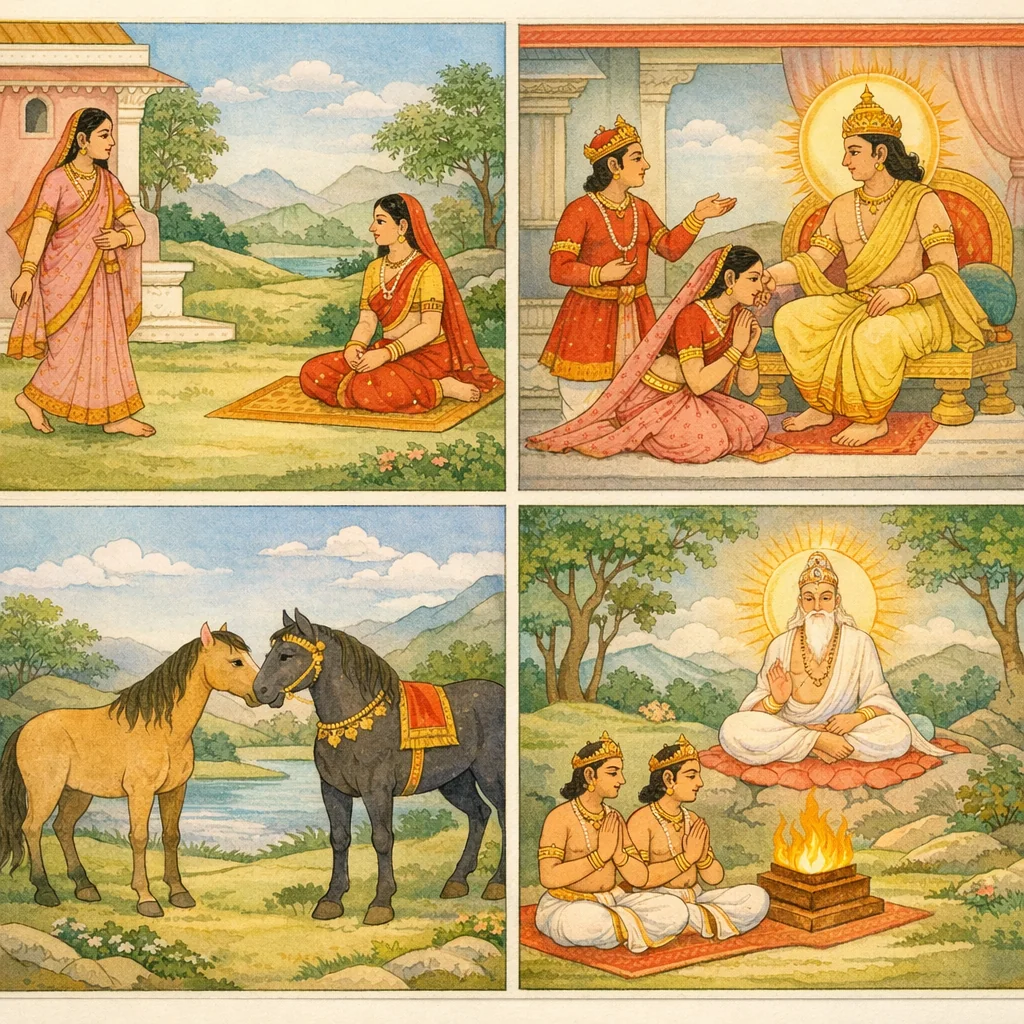
Adhyaya 20: The Birth of the Aśvins: Solar Lineage, Saṃjñā and Chāyā, and the Granting of a Hymn and Boons
Aśvinaujanma–Mārtaṇḍa–Saṃjñā–Chāyā–stotra-pradāna
Genealogical-Theogony and Ritual Merit (Stotra/Phala)
Within the didactic Varāha–Pṛthivī setting, this adhyāya explains how prāṇa and apāna become embodied as the divine Aśvins. It traces the lineage from Marīci to Kaśyapa and the twelve Ādityas, centering on Mārtaṇḍa (Sūrya). Saṃjñā cannot endure Sūrya’s radiance and departs, leaving her shadow-form Chāyā, who bears further offspring and sparks conflict: Yama protests unequal maternal conduct; Chāyā curses him, while Sūrya appoints him to a cosmic juridical office and curses Śani with a harsh gaze. Later Sūrya unites with Saṃjñā in mare-form; his seed divides, and prāṇa and apāna become the Aśvins. The Aśvins perform tapas and recite a brahman-oriented stotra; Prajāpati/Brahmā grants boons—beauty, healing power, and Soma-rights—and teaches tithi-based merit, linking cosmic order to regulated conduct and Earth-sustaining ritual time.
Primary Speakers
Key Concepts
Shlokas in Adhyaya 20
Verse 1
प्रजापाल उवाच । एवमग्नेः समुत्पत्तिर्जाता ब्रह्मन् महात्मनः । प्राणापानौ कथं देवावश्विनौ सम्बभूवतुः ॥ २०.१ ॥
Prajāpāla said: “Thus the origin of Agni has been described, O Brahmin, from that great-souled one. How, then, did the two deities—the Aśvins—come to be as prāṇa and apāna, the vital in-breath and out-breath?”
Verse 2
मरीचिर्ब्रह्मणः पुत्रः स्वयं ब्रह्मा द्विसप्तभिः । रूपैर्व्यवस्थितस्तेषां मरीचिः श्रेष्ठतामगात् ॥ २०.२ ॥
Marīci, a son of Brahmā—indeed as Brahmā himself—was established among them in fourteen forms; among those, Marīci attained preeminence.
Verse 3
तस्य पुत्रो महातेजाः कश्यपो नाम वै मुनिः । स्वयं प्रजापतिः श्रीमान् देवतानां पिता अभवत् ॥ २०.३ ॥
His son was the sage named Kaśyapa, possessed of great splendor; he himself became a distinguished Prajāpati and came to be regarded as the father of the deities.
Verse 4
तस्य पुत्रा बभूवुर्हि आदित्या द्वादश प्रभो । आदित्यपत्यानि ते सर्वे आदित्यास्तेन कीर्तिताः ॥ २०.४ ॥
Indeed, O Lord, he had twelve sons—the Ādityas. Therefore all those offspring are celebrated as Ādityas.
Verse 5
तेषां मध्ये महातेजा मार्त्तण्डो लोकविश्रुतः । नारायणात्मकं तेजो द्वादशं संप्रकीर्तितम् ॥ २०.५ ॥
Among them, the greatly radiant Mārtaṇḍa—renowned in the worlds—is proclaimed as the twelfth splendor, whose essence is Nārāyaṇa.
Verse 6
ये ते मासास्त आदित्याः स्वयं संवत्सरो हरिः । एवं ते द्वादशादित्या मार्त्तण्डश्च प्रधानवान् ॥ २०.६ ॥
Those months of yours are themselves the Ādityas; Hari, in his own form, is the year (saṃvatsara). Thus there are twelve Ādityas, and Mārtaṇḍa (the Sun) is foremost among them.
Verse 7
तस्य त्वष्टा ददौ कन्यां संज्ञां नाम महाप्रभाम् । तस्यापत्यद्वयं जज्ञे यमश्च यमुना तथा ॥ २०.७ ॥
To him, Tvaṣṭṛ gave his daughter, named Saṃjñā, radiant with great splendor. From her, a pair of offspring were born—Yama, and likewise Yamunā.
Verse 8
तस्य तेजोऽप्यसहती बभूवाश्वी मनोजवा । स्वां छायां तत्र संस्थाप्य सा जगमोत्तरान् कुरून् ॥ २०.८ ॥
Unable to endure his radiance, she became a mare, swift as thought; having stationed her own shadow (Chāyā) there, she went to Uttara-Kuru (the Northern Kurus).
Verse 9
तद्रूपां तां सवर्णां तु भेजे मार्त्तण्डभास्करः । तस्याः अपि द्वयं जज्ञे शनिं तपतिमेव च ॥ २०.९ ॥
Mārtaṇḍa, the Sun (Bhāskara), assumed that very form, matching her appearance. From her, moreover, a pair were born: Śani and also Tapati.
Verse 10
यदा त्वसदृशं भेजे पुत्रान् प्रति नरोत्तम । संज्ञां प्रोवाच भगवान् क्रोधसंरक्तलोचनः । असमत्वं न कर्त्तव्यं स्वेष्वपत्येषु भामिनि ॥ २०.१० ॥
But when the best of men adopted an improper attitude toward his sons, the Blessed One—his eyes reddened with anger—addressed Saṁjñā: “O passionate one, inequality must not be practiced toward one’s own children.”
Verse 11
एवमुक्ता यदा सा तु असमत्वं व्यरोचत । तदा यमः स्वपितरं प्रोवाच भृशदुःखितः ॥ २०.११ ॥
When she had thus been addressed, she expressed an unequal disposition. Then Yama, deeply distressed, spoke to his own father.
Verse 12
नेयं माता भवेत् तात अस्माकं शत्रुवत् सदा । सपत्नीव वृत्ताचाराः स्वेष्वपत्येषु वत्सला ॥ २०.१२ ॥
“Father, this woman is not truly a mother to us; to us she is always like an enemy—behaving like a co-wife—while showing affection only toward her own children.”
Verse 13
एवं यमवचः श्रुत्वा सा छाया क्रोधमूर्च्छिता । शशाप प्रेतराजस्त्वं भविष्यस्यचिरादिव ॥ २०.१३ ॥
Having thus heard Yama’s words, Chāyā—overcome by a surge of anger—pronounced a curse: “You shall indeed become the lord of the departed (Pretarāja), before long.”
Verse 14
एवं श्रुत्वाऽथ मार्त्तण्डस्तदा पुत्रहितैषया । उवाच मध्यवर्ती त्वं भविता धर्मपापयोः । लोकपालश्च भविता त्वं पुत्र दिवि शोभसे ॥ २०.१४ ॥
Having heard thus, Mārtaṇḍa (the Sun), desiring his son’s welfare, said: “You shall become the one who stands in the middle, between dharma (merit) and pāpa (demerit). You shall also become a Lokapāla, a guardian of the worlds; and you, my son, shall shine in heaven.”
Verse 15
शनिं शशाप मार्त्तण्डश्छायाकोपप्रधर्षितः । त्वं क्रूरदृष्टिर्भविता मातृदोषेण पुत्रक ॥ २०.१५ ॥
Mārtaṇḍa (the Sun), provoked by Chāyā’s anger, cursed Śani: “Because of your mother’s fault, my son, you shall become one whose gaze is cruel and inauspicious.”
Verse 16
एवमुक्त्वा समुत्थाय योगं भानुर्दिदृक्षया । तामपश्यत्त्वसौ साश्वी उत्तरेषु कुरुष्वथ ॥ २०.१६ ॥
Having spoken thus, Bhānu rose, wishing to behold her through yogic power; and then he saw that eternal lady there in Uttarakuru, among the Northern Kurus.
Verse 17
ततोऽश्वरूपं कृत्वा स गत्वा तत्रोत्तरान् कुरून् । प्राजापत्येन मार्गेण युयोजात्मानमात्मना ॥ २०.१७ ॥
Then, assuming the form of a horse, he went to the Northern Kurus; and by the Prajāpatya path he yoked and disciplined himself by his own agency.
Verse 18
तस्यां त्वाष्ट्र्यामश्वरूप्यां मार्त्तण्डस्तीव्रतेजसः । बीजं निर्वापयामास तज्ज्वलन्तं द्विधा अपतत् ॥ २०.१८ ॥
In her—Tvaṣṭrī in horse-form (Aśvarūpī)—Mārtaṇḍa, of intense radiance, deposited his seed; and that blazing seed fell, divided into two parts.
Verse 19
तत्र प्राणस्त्वपानश्च योनौ चात्मजितौ पुरा । वरदानेन च पुनर्मूर्तिमन्तौ बभूवतुः ॥ २०.१९ ॥
There, Prāṇa and Apāna—formerly self-restrained within the womb—by the granting of a boon, once again became embodied.
Verse 20
तौ त्वाष्ट्र्यामश्वरूपिण्यां जातौ येन नरोत्तमौ । ततस्तावश्विनौ देवौ कीर्त्येते रविनन्दनौ ॥ २०.२० ॥
Those two excellent men were born from Tvaṣṭrī, who had taken the form of a mare; therefore those two gods are celebrated as the Aśvins, the sons of Ravi (the Sun).
Verse 21
प्रजापतिः स्वयं भानुस्त्वाष्ट्रॄ शक्तिः परापरा । तस्याः प्राग्वच्छरीरस्थावमूर्त्तौ मूर्तिमाश्रितौ ॥ २०.२१ ॥
Prajāpati is Bhānu himself; and the Tvāṣṭrī power (śakti) is both transcendent and immanent. As before, from her—abiding in the body—two principles, though unmanifest, assumed manifest form.
Verse 22
ततस्तावश्विनौ देवौ मार्त्तण्डमुपतस्थतुः । उचतुः स्वरुचिं तावत् किं कर्तव्यमथावयोः ॥ २०.२२ ॥
Then the two divine Aśvins approached Mārtaṇḍa (the Sun). They said to Svaruci: “Now then, what is to be done by us?”
Verse 23
मार्त्तण्ड उवाच । पुत्रौ प्रजापतिं देवं भक्त्याराधयतां वरम् । नारायणं स वो दाता वरं नूनं भविष्यति ॥ २०.२३ ॥
Mārtaṇḍa said: “O sons, with devotion worship Prajāpati, the excellent deity. Nārāyaṇa—he indeed—will surely become the giver of a boon to you.”
Verse 24
एवं तावश्विनौ प्रोक्तौ मार्त्तण्डेन महात्मना । तेपतुस् तीव्रतपसौ तपः परमदुष्चरम् । ब्रह्मपारामयं स्तोत्रं जपन्तौ तु समाहितौ ॥ २०.२४ ॥
Thus, having been addressed by the great-souled Mārtaṇḍa (the Sun), the two Aśvins, engaged in severe asceticism, performed an austerity exceedingly difficult to undertake; and with concentrated minds they recited a hymn directed toward the supreme Brahman.
Verse 25
तयोः कालेन महता ब्रह्मा नारायणात्मकः । तुतोष परमप्रीत्या वरं चैतं ददौ तयोः ॥ २०.२५ ॥
In the course of a very long time, Brahmā—whose nature is identified with Nārāyaṇa—became fully pleased with them and, with profound affection, granted them this boon.
Verse 26
प्रजापाल उवाच । अश्विभ्यामीरितं स्तोत्रं ब्रह्मणोऽव्यक्तजन्मनः । श्रोतुमिच्छाम्यहं ब्रह्मंस्त्वत्प्रसादान्महामुने ॥ २०.२६ ॥
Prajāpāla said: “O Brahman, great sage—by your favor I wish to hear that hymn proclaimed by the two Aśvins, concerning Brahmā, whose origin is unmanifest.”
Verse 27
महातपा उवाच । शृणु राजन् यथा स्तोत्रमश्विभ्यां ब्रह्मणः कृतम् । ईदृशं च फलं प्राप्तं तयोः स्तोत्रस्य चानघ ॥ २०.२७ ॥
Mahātapā said: “Listen, O king, to the hymn the two Aśvins composed for Brahmā; and, O blameless one, hear also what kind of result they attained through that hymn.”
Verse 28
ॐ नमस्ते निष्क्रिय निष्प्रपञ्च निराश्रय निरपेक्ष निरालम्ब निर्गुण निरालोक निराधार निर्जय निराकार । ब्रह्मन् महाब्रह्मन् ब्राह्मणप्रिय पुरुष महापुरुषोत्तम । देव महादेवोत्तम स्थाणो स्थितस्थापक । भूत महाभूत भूताधिपति यक्ष महायक्ष यक्षाधिपते । गुह्य महागुह्याधिपते सौम्य महासौम्य सौम्याधिपते । पक्षि महापक्षिपते दैत्य महादैत्याधिपते । रुद्र महारुद्राधिपते विष्णु महाविष्णुपते । परमेश्वर नारायण प्रजापतये नमः । एवं स्तुतस्तदा ताभ्यामश्विभ्यां स प्रजापतिः । तुतोष परमप्रीत्या वाक्यं चेदमुवाच ह ॥ २०.२८ ॥
“Oṃ. Homage to You—actionless, beyond phenomenal expansion, without support, without dependence, without prop, without attributes, without visible sphere, without foundation, unconquered, and formless. O Brahman, Great Brahman; beloved of the Brāhmaṇas; Person, supreme among great persons. O Deva, supreme among great gods; Sthāṇu, the Steadfast One, establisher of what stands. O Being, Great Being; lord of beings; O Yakṣa, Great Yakṣa, lord of Yakṣas; O lord of the Guhyas; O gentle one, supremely gentle, lord of the gentle; O Bird, lord of great birds; O Daitya, lord of great Daityas; O Rudra, lord of great Rudras; O Viṣṇu, lord of great Viṣṇus; O supreme Lord, Nārāyaṇa—homage to Prajāpati.” Thus praised at that time by the two Aśvins, Prajāpati became exceedingly pleased and then spoke these words.
Verse 29
वरं वरयतां शीघ्रं देवैः परमदुर्लभम् । येन मे वरदानेन चरतस्त्रिदिवं सुखम् ॥ २०.२९ ॥
Grant a boon swiftly—one exceedingly difficult to obtain even for the gods—by whose bestowal I may, while moving about, enjoy happiness in the threefold heaven.
Verse 30
अश्विनावूचतुः । आवयोऱ्यज्ञभागं तु देहि देव प्रजापते । सोमपत्वं च देवानां सामान्यत्वं च शाश्वतम् ॥ २०.३० ॥
The Aśvins said: “O divine Prajāpati, grant us our share in the sacrifice; and grant us the right to partake of Soma among the gods, together with enduring equality of status.”
Verse 31
ब्रह्मोवाच । रूपं कान्तिरनौपम्यं भिषक्त्वं सर्ववस्तुषु । सोमपत्वं च लोकेषु सर्वमेतद् भविष्यति ॥ २०.३१ ॥
Brahmā said: “Beauty, radiance, incomparable excellence, skill as a healer in all things, and the state of being a lord of Soma among the worlds—all this shall come to pass.”
Verse 32
एतत् सर्वं द्वितीयायामश्विभ्यां ब्रह्मणा पुरा । दत्तं यस्मादतस्तेषां तिथीनामुत्तमा तिथिः ॥ २०.३२ ॥
Because all this was formerly granted by Brahmā to the Aśvin twins on the second lunar day (dvitīyā), therefore among the lunar days that tithi is regarded as the foremost.
Verse 33
एतस्यां रूपकामास्तु पुष्पाहारो भवेन्नरः । संवत्सरं शुचिर्नित्यं सुस्वरूपी भवेन्नरः । अश्विभ्यां ये गुणाः प्रोक्तास्ते तस्यापि भवन्ति च ॥ २०.३३ ॥
On this day, one who desires beauty should subsist on flowers. Remaining continually pure for a year, that person becomes of excellent form; and the qualities declared to belong to the Aśvins also come to him.
Verse 34
य इदं शृणुयान्नित्यमश्विभ्यां जन्म चोत्तमम् । सर्वपापविनिर्मुक्तः पुत्रवान् जायते नरः ॥ २०.३४ ॥
A man who continually listens to this account—of the excellent birth connected with the Aśvins—is freed from all sins and is blessed with progeny, being endowed with a son.
Frequently Asked Questions
The chapter models dharma as regulated impartiality and role-based responsibility: unequal treatment within kinship produces social suffering, while curses and boons function as narrative tools to assign stable cosmic offices (e.g., Yama’s juridical role). Tapas and disciplined praise (stotra) are presented as legitimate means to obtain recognized rights within the sacrificial order, implying that orderly conduct and authorized ritual participation uphold broader cosmic—and by extension terrestrial—stability.
A specific lunar marker is emphasized: dvitīyā-tithi is called “uttamā tithiḥ” because boons were granted to the Aśvins on that day. The text adds a merit instruction that observances on this tithi (including purity and regulated diet such as puṣpāhāra) yield bodily beauty and the Aśvins’ qualities, indicating a calendrical discipline rather than a seasonal rite.
Environmental balance is implicit rather than explicit: the narrative links cosmic governance (solar lineage, time-keeping via months/Ādityas, and tithi-based observance) to a stable order that supports life on Earth. By presenting prāṇa and apāna as divine agents (Aśvins) and tying their social recognition to disciplined ritual time, the chapter frames terrestrial well-being as dependent on regulated cosmic rhythms and ethically managed roles.
The chapter references Purāṇic lineages and figures: Marīci (son of Brahmā), Kaśyapa (as prajāpati), the twelve Ādityas, Mārtaṇḍa (Sūrya), Tvaṣṭṛ, Saṃjñā, Chāyā, Yama, Yamunā, Śani, and the Aśvinau. It also identifies Prajāpati/Brahmā with a Nārāyaṇa-oriented identity in the stotra context, reflecting theological syncretism within genealogical narration.