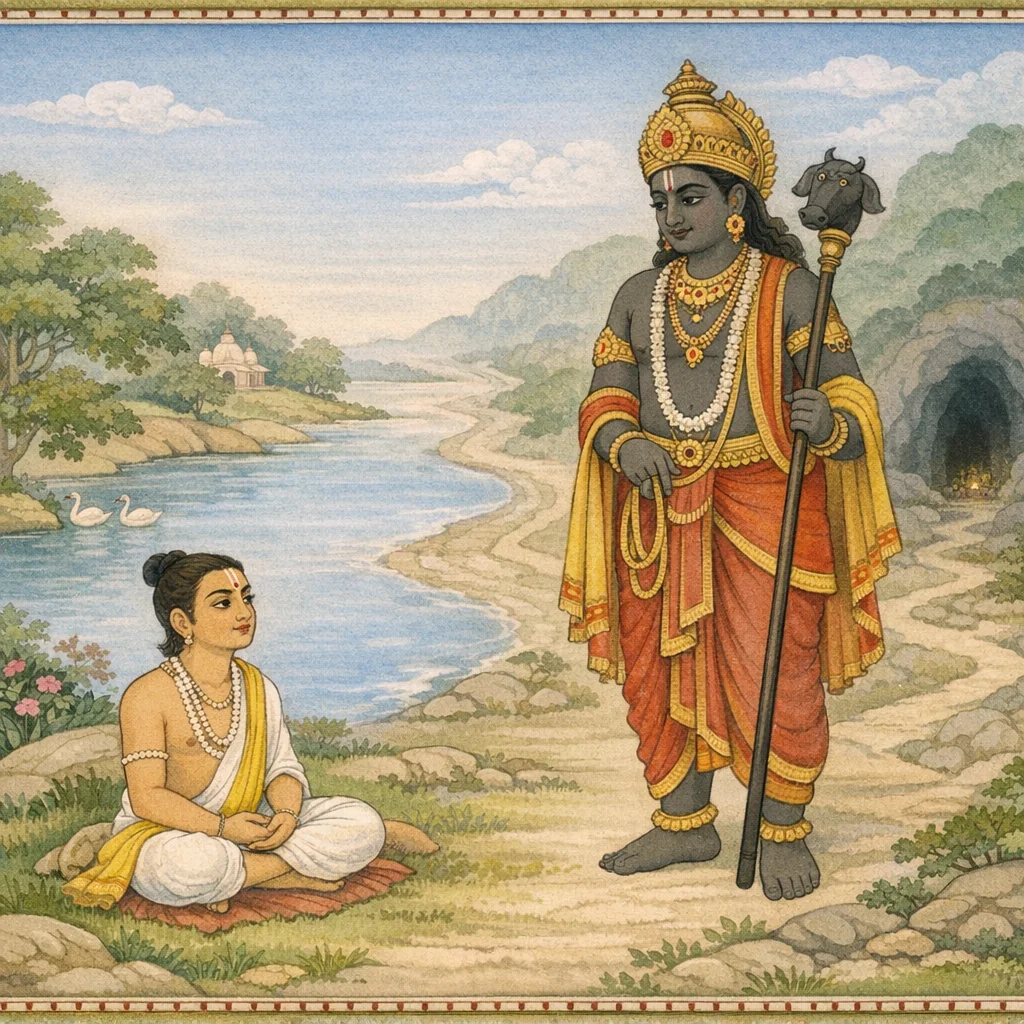
Adhyaya 193: Naciketas’ Journey to Yama’s Abode and the Eulogy of Truthfulness
Nāciketasya Yamālaya-gamanaṃ satya-stutiś ca
Ethical-Discourse (Satya-dharma) with Afterlife Topography (Yamālaya inquiry)
Within the Varāha–Pṛthivī teaching frame, this chapter offers an exemplary account: King Janamejaya, anxious about karmic consequences, asks the sage Vaiśaṃpāyana about Yamālaya—its form, measure, and how it is beheld. Vaiśaṃpāyana replies by recounting an earlier episode of the sage Uddālaka and his son Nāciketa. In anger Uddālaka curses Nāciketa to go to Yama; the son accepts to preserve the truth of a dhārmika’s word and vows to return. The dialogue then becomes an extended satya-stuti, praising truthfulness as the sustaining principle of cosmic order, ritual efficacy, and social ethics, and implying that satya stabilizes the earth and the world’s boundaries.
Primary Speakers
Key Concepts
Shlokas in Adhyaya 193
Verse 1
अथ नचिकेतः प्रयाणवर्णनम् ॥ लोमहर्षण उवाच ॥ व्यासशिष्यं महाप्राज्ञं वेदवेदाङ्गपारगम् ॥ द्वारदेशे समासीनं कृतपूर्वाह्निकक्रियम्
Now begins the description of Naciketas’ departure. Lomaharṣaṇa said: (I saw) the disciple of Vyāsa—greatly learned, having mastered the Vedas and their auxiliaries (Vedāṅgas)—seated at the gateway area, having completed the morning rites.
Verse 2
अश्वमेधे तथा वृत्ते राजा वै जनमेजयः ॥ ब्रह्मवध्याभिभूतस्य दीक्षां द्वादशवार्षिकीम्
When the Aśvamedha had thus been completed, King Janamejaya—afflicted by the guilt of brahmin-slaying—undertook a dīkṣā, a consecratory observance, lasting twelve years.
Verse 3
प्रायश्चित्तं चरित्वैवमागतो गजसाह्वयम् ॥ उपगम्य महात्मानं जाह्नवीतीरसंश्रयम् ॥
Having thus performed the expiatory rite, he came to the place called Gajasāhvaya; and, approaching the great-souled one who dwelt upon the bank of the Jāhnavī (Gaṅgā),
Verse 4
ऋषिं परमसंपन्नं वैशम्पायनमञ्जसा ॥ कर्मणा प्रेरितस्तेन चिन्ताव्याकुललोचनः ॥
—to the supremely accomplished seer Vaiśampāyana, directly; impelled by that deed, his eyes were distressed with anxious thought.
Verse 5
कुरूणां पश्चिमो राजा पश्चात्तापेन पीडितः ॥ व्यासशिष्यमुपागम्य प्रश्नमेनमपृच्छत ॥
The later king among the Kurus, afflicted by remorse, approached Vyāsa’s disciple and asked him a question.
Verse 6
जनमेजय उवाच ॥ भगवञ्जायते तीव्रं चिन्तयानस्य सुव्रत ॥ कर्मपाकफलं यस्मिन्मानुषैरुपभुज्यते ॥
Janamejaya said: “Venerable one, as I reflect, an intense concern arises, O you of good observance: in what manner is the fruit that ripens from actions (karma) experienced by human beings?”
Verse 7
एतदिच्छाम्यहं श्रोतुं कीदृशं तु यमालयम् ॥ किं प्रमाणं च किं रूपं कथं गत्वा स पश्यति ॥
“This I wish to hear: what is Yama’s abode like? What is its measure, what is its form, and how—having gone there—does one perceive it?”
Verse 8
न गच्छेयं कथं विप्र प्रेतराज्ञो निवेशनम् ॥ धर्मराजस्य धीरस्य सर्वलोकानुशासिनः ॥
“O brāhmaṇa, how could one not go to the dwelling of the lord of the departed—the steadfast Dharma-king who governs all worlds?”
Verse 9
सूत उवाच ॥ एवं पृष्टो महातेजास्तेन राज्ञा द्विजोत्तमः ॥ उवाच मधुरं वाक्यं राजानं जनमेजयम् ॥
Sūta said: Thus questioned by that king, the foremost of the twice-born, radiant with great splendor, spoke sweet words to King Janamejaya.
Verse 10
पावनीं सर्वपापानां प्रवृत्तौ शुभकारिणीम् ॥ इतिहासपुराणानां कथां वै विदुषां प्रियाम् ॥
(He spoke) a narrative of Itihāsa and Purāṇa—beloved to the learned—purifying from all sins and fostering auspicious conduct.
Verse 11
कश्चिदासीत्पुरा राजन् ऋषिः परमधार्मिकः ॥ उद्दालक इति ख्यातः सर्ववेदाङ्गतत्त्ववित् ॥
There was once, O king, a seer of exceptional dharmic character, known as Uddālaka, a knower of the principles of all the Vedāṅgas.
Verse 12
तस्य पुत्रो महातेजा योगमास्थाय बुद्धिमान् ॥ नाचिकेत इति ख्यातः सर्ववेदाङ्गतत्त्ववित् ॥
His son, of great radiance and intelligence, having undertaken yogic discipline, was known as Nāciketa—one who knew the principles of all the Vedāṅgas.
Verse 13
तेन रुष्टेन शप्तोऽभूत्पुत्रः परमधार्मिकः ॥ गच्छ शीघ्रं यमं पश्य मम क्रोधेन दुर्मते ॥
Angered by him, the supremely righteous son was cursed: “Go quickly—behold Yama—through my wrath, O foolish-minded one.”
Verse 14
क्षणेनान्तरहितो जातः पितरं प्रत्युवाच ह ॥ विनयात्पृष्टतो वाक्यं भावेन च समन्वितम् ॥
In a moment he became invisible, and then addressed his father; he spoke words that had been asked with humility and were accompanied by sincere feeling.
Verse 15
मा भूद्वाक्यं च ते मिथ्या धार्मिकस्य कदाचन ॥ गमिष्यामि पुरं रम्यं धर्मराजस्य धीमतः ॥
“May your word never be false—at any time—especially in the case of a righteous person. I shall go to the delightful city of the wise Dharmarāja.”
Verse 16
इह चैव पुनस्तावदागमिष्ये न संशयः ॥
“And here itself, again, I shall return before long—there is no doubt.”
Verse 17
तथेत्युक्त्वा महातेजाः पुत्रः परमधार्मिकः ॥ चिन्तयित्वा मुहूर्तं तु योगमास्थाय बुद्धिमान् ॥
Having said “So be it,” the supremely righteous son, possessed of great radiance, reflected for a moment; then, being wise, he adopted yogic concentration.
Verse 18
पितोवाच ॥ एकस्त्वमसि वत्सश्च नान्यो बन्धुर्विधीयते ॥ अधर्मं चानृतं चास्तु त्वकीर्तिर्वापि पुत्रक ॥
The father said: “You alone are my child; no other kinsman has been allotted to me. Let there be even adharma and falsehood—let there even be loss of repute, my son…”
Verse 19
अप्रवृत्तस्त्वसम्भाष्यो योऽहं मिथ्या प्रयुक्तवान् ॥ त्वां वै धर्मसमाचारमभिधानॆन शप्तवान् ॥
“I—one who should not have proceeded thus, one unfit to be spoken with—having employed falsehood, have indeed cursed you, whose conduct is righteous, merely by uttering a designation (a name).”
Verse 20
अहं पुत्र न सद्वादी न क्षमे धर्मदूषितम् ॥ मम त्वं हि महाभाग नित्यं चित्तानुपालकः ॥
“My son, I am not one who speaks well or truthfully; I do not tolerate what corrupts dharma. Yet you, fortunate one, are ever the guardian of my mind—my moral restraint.”
Verse 21
धर्मज्ञश्च यशस्वी च नित्यं क्षान्तो जितेन्द्रियः ॥ शुश्रूषुरनहंवादी शक्तस्तारयितुं मम ॥
“You are a knower of dharma and possessed of good repute; ever patient, with senses restrained—attentive in service, free from self-assertion—capable of rescuing me.”
Verse 22
याचितस्त्वं मया पुत्र गन्तुं वै तत्र नार्हसि ॥
“Though I have begged you, my son, you ought not to go there.”
Verse 23
यदि वैवस्वतो राजा तत्र प्राप्तं यदृच्छया ॥ रोषेण त्वां महातेजा विसृज्येन्न कदाचन ॥
If King Vaivasvata should arrive there by chance, that mighty one, in anger, would never release you.
Verse 24
विनश्येयमहं पश्य कुलसेतु-विनाशनः ॥ धिक्कृतः सर्वलोकेन पापकर्ता नराधमः ॥
Look—I would be ruined, as one who destroys the ‘bridge’ of the family line; condemned by all the world, a doer of sin, the lowest among men.
Verse 25
नरकस्य पूदिताख्या दुःखेन नरकं विदुः ॥ पुतित्राणं भवेत् पुत्रादिहेष्यति परत्र च ॥
They know a hell called Pūditā, a hell characterized by suffering. From a son there is ‘protection/rescue’ (trāṇa) for the father—here in this world and also in the next.
Verse 26
हुतं दत्तं तपस्तप्तं पितरश्चापि पोषिताः ॥ अपुत्रस्य हि तत्सर्वं मोघं भवति निश्चयः ॥
Oblations offered, gifts given, austerities performed, and even ancestors nourished—for one without a son, all of that becomes fruitless; this is the settled view.
Verse 27
शुश्रूषावान्भवेच्छूद्रो वैश्यो वा कृषिजीवनः ॥ सस्यगोप्ता तु राजन्यो ब्राह्मणो वा स्वकर्मकृत् ॥
A Śūdra should be devoted to service; or a Vaiśya may live by agriculture. A Kṣatriya should be a protector of crops; and a Brāhmaṇa should be one who performs his own prescribed duties.
Verse 28
पुत्रेण लभते जन्म पौत्रेण तु पितामहः ॥ पुत्रस्य च प्रपौत्रेण मोदते प्रपितामहः ॥
Through a son one attains (renewed) birth; through a grandson the grandfather (pitāmaha) attains it; and through a great-grandson the great-grandfather (prapitāmaha) rejoices.
Verse 29
न हास्यामिति वत्स त्वां मम वंशविवर्धनम् ॥ याच्यमानः प्रयत्नेन तत्र गन्तुं न चार्हति ॥
“I will not abandon you, my child—you who increase my lineage. Even when earnestly entreated, he is not fit to go there.”
Verse 30
वैशम्पायन उवाच ॥ एवं विलपमानं तं पितरं प्रत्युवाच ह ॥ हृष्टपुष्ट वपुर्भूत्वा पुत्रः परमधार्मिकः ॥
Vaiśaṃpāyana said: Thus, to that father who was lamenting, the son—supremely righteous—replied, having become cheerful and robust in body.
Verse 31
पुत्र उवाच ॥ न विषादस्त्वया कार्यो द्रक्ष्यसे मामिहागतम् ॥ दृष्ट्वा च तमहं देवं सर्वलोकनमस्कृतम् ॥
The son said: “You should not grieve. You will see me return here. And after seeing that deity, revered by all the worlds, I…”
Verse 32
आगच्छामि पुनश्चात्र न भयं मेऽस्ति मृत्युतः ॥ पूजयिष्यति मां तात राजा त्वदनुकम्पया ॥
“I will come back here again; I have no fear of death. The king, out of compassion toward you, will honor me, father.”
Verse 33
सत्ये तिष्ठ महाभाग सत्यं च परिपालय ॥ सत्यं स्वर्गस्य सोपानं पारावारस्य नौरिव
O fortunate one, stand firm in truth and uphold truth. Truth is the staircase to heaven, like a boat for crossing the ocean to the far shore.
Verse 34
सूर्यस्तपति सत्येन वातः सत्येन वाति च ॥ अग्निर्दहति सत्येन सत्येन पृथिवी स्थिता
By truth the sun gives heat; by truth the wind blows. By truth fire burns; by truth the earth stands firm.
Verse 35
उदधिर्ल्लङ्घयेन्नैव मर्यादां सत्यपालितः ॥ मन्त्रः प्रयुक्तः सत्येन सर्वलोकहितायते
The ocean would not transgress its boundary when that boundary is upheld by truth. A mantra, when employed with truth, becomes beneficial to all worlds.
Verse 36
सत्येन यज्ञा वर्त्तन्ते मन्त्रपूताः सुपूजिताः ॥ सत्येन वेदा गायन्ति सत्ये लोकाः प्रतिष्ठिताः
By truth sacrifices proceed—purified by mantras and duly revered. By truth the Vedas ‘sing’; upon truth the worlds are established.
Verse 37
सत्येन सर्वं लभते यथा तात मया श्रुतम् ॥ न हि सत्यमतिक्रम्य विद्यते किञ्चिदुत्तमम्
By truth one obtains everything, as I have heard, dear one. For after transgressing truth, nothing superior is found.
Verse 38
देवदेवेन रुद्रेण वेदगर्भः पुरा किल ॥ सत्यस्थितेन देवानां परित्यक्तो महात्मना
Formerly, it is said, Vedagarbha was abandoned by the gods—through Rudra, the god of gods, the great-souled one—because he stood firm in truth.
Verse 39
दीक्षां धारयते ब्रह्मा स तेनैव सुयन्त्रितः ॥ और्वेणाग्निस्तथा क्षिप्तः सत्येन वडवामुखे
Brahmā maintains the consecratory discipline (dīkṣā); by that alone he is well-restrained. Likewise, by truth the Auruva fire is cast into the mare-faced (submarine) mouth.
Verse 40
संवर्तेन पुरा तात सर्वे लोकाः सदैवताः ॥ देवानामनुकम्पार्थं धृता वीर्यवता तदा
Formerly, dear one, at the time of Saṃvarta (dissolution), all the worlds together with their deities were then sustained by a powerful one, out of compassion for the gods.
Verse 41
पाताले पालयन् सत्यं बद्धो वैरोचनो वसन् ॥ वर्द्धमानो महाशृङ्गैः शतशृङ्गो महागिरिः
In Pātāla, upholding truth while dwelling there, Virocana’s son (Bali) remained bound. The great mountain Śataśṛṅga, growing with lofty peaks, (stands as an example).
Verse 42
स्थितः सत्ये महाविन्ध्यो वर्द्धमानो न वर्द्धते ॥ सर्वं चराचरमिदं सत्येन श्रीयते जगत्
Established in truth, the great Vindhya—though ‘growing’—does not grow beyond measure. This entire world, moving and unmoving, flourishes through truth.
Verse 43
गृहधर्माश्च ये दृष्टा वानप्रस्थाश्च शोभिताः ॥ यतीनां च गतिः शुद्धा ये चान्ये व्रतसंस्थिताः
Recognized are the observed duties of the householder, and the venerable forest-dwellers adorned with discipline; and the pure course of the yatis (ascetics), together with others established in vows—these ways of life are acknowledged.
Verse 44
अश्वमेधसहस्रं च सत्यं च तुलया धृतम् ॥ अश्वमेधसहस्राद्धि सत्यमेव विशिष्यते
A thousand Aśvamedha sacrifices and truthfulness were weighed upon a balance; indeed, truthfulness surpasses even a thousand Aśvamedhas.
Verse 45
सत्येन पालयते धर्मो धर्मो रक्षति रक्षितः ॥ तस्मात् सत्यं कुरुष्वाद्य रक्ष आत्मानमात्मना
By truthfulness dharma is preserved; and dharma, when protected, protects in return. Therefore practice truth today; protect yourself through your own self-discipline.
Verse 46
ऋषिपुत्रो महातेजा सत्यवागनसूयकः ॥ प्राप्तश्च परमं स्थानं यत्र राज्ञो यमस्य तु
A sage’s son, of great radiance—truth-speaking and free from malice—attained the highest abode, where King Yama dwells.
Verse 47
वैशम्पायन उवाच ॥ शृणु राजन् पुरावृत्तां कथां परमशोभनाम् । धर्मवृद्धिकरीं नित्यां यशस्यां कीर्तिवर्ध्धिनीम्
Vaiśampāyana said: O King, listen to an ancient account, exceedingly beautiful—one that ever increases dharma, brings repute, and augments fame.
Verse 48
मिथ्याभिशंसिनं तात यथेष्टं तारयिष्यति ॥ रोषेण हि मृषावादी निर्दयः कुलपांसनः
O dear one, (one might claim that) a slanderer who speaks falsely will be “delivered” as he pleases; yet, in anger, the liar becomes pitiless—a disgrace to his lineage.
Verse 49
तपो वा विपुलं तप्त्वा दत्त्वा दानमनुत्तमम् ॥ अपुत्रो नाप्नुयात्स्वर्गं यथा तात मया श्रुतम्
Even after performing abundant austerity (tapas), or after giving unsurpassed gifts (dāna), one without a son would not attain heaven—so, dear one, I have heard.
Verse 50
सत्यं गाति तथा साम सर्वं सत्ये प्रतिष्ठितम् ॥ सत्यं स्वर्गश्च धर्मश्च सत्यादन्यन्न विद्यते
Truth prevails, and likewise concord; everything is established in truth. Truth—along with heaven and dharma—is paramount; apart from truth nothing else is ultimately found.
Verse 51
एवमुक्त्वा हृष्टपुष्टः स्वेन देहेन सुव्रत ॥ तपसा प्राप्तयोगस्तु जितात्मा कृतसंयमः
Having spoken thus, O well-vowed one, he became joyful and strengthened in his own body; through austerity he attained yogic attainment—self-conquered and possessed of practiced restraint.
Frequently Asked Questions
The text foregrounds satya (truthfulness) as the highest sustaining principle: it presents satya as the basis for dharma, the efficacy of mantras and yajñas, and the stability of the world’s order. Nāciketas’ acceptance of the curse functions as an exemplar of preserving truthful speech and disciplined conduct even under distress.
No explicit tithi, māsa, or seasonal markers are specified in the provided passage. The narrative references a long dīkṣā of twelve years (dvādaśa-vārṣikī dīkṣā) undertaken as expiation, which is a durational (chronological) marker rather than a calendrical one.
Environmental balance is implied through cosmological ethics: satya is described as what upholds the earth’s stability (pṛthivī sthitā) and maintains boundaries (e.g., the ocean not transgressing its maryādā). This frames moral truthfulness as a principle that preserves terrestrial order and prevents destabilization—an early ecological-ethical linkage expressed through cosmic governance.
The chapter references King Janamejaya of the Kuru lineage, the sage Vaiśaṃpāyana (Vyāsa’s disciple), the sage Uddālaka, and his son Nāciketa; it also invokes Yama (Dharmarāja/Vaivasvata) as the ruler of the dead. Additional named figures appear as exempla within the satya-stuti (e.g., Rudra, Brahmā, Auruva, Saṃvarta, Virocana), functioning as cultural-mythic authorities rather than a continuous genealogy.