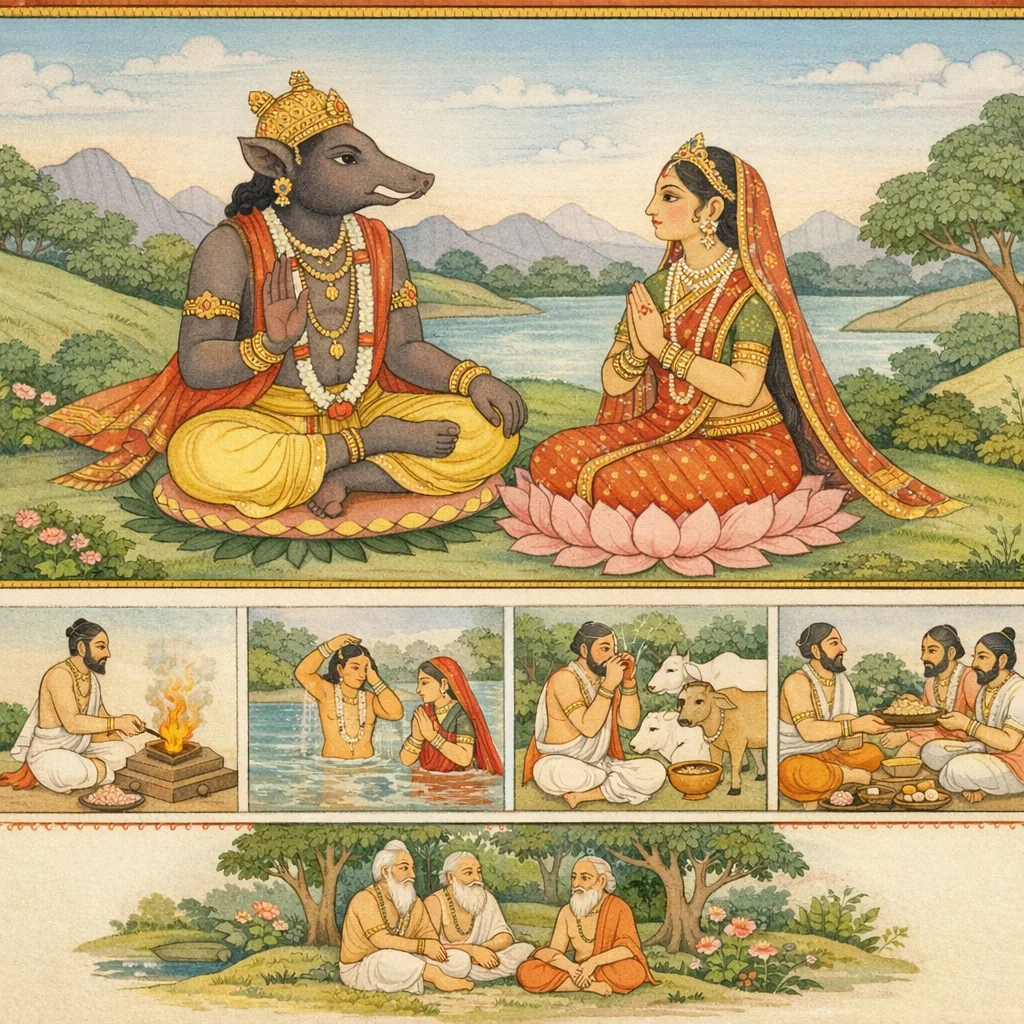
Adhyaya 189: Section on the Origin and Procedure of Piṇḍa-Rites (Funerary Offerings) and Donor–Recipient Purification
Piṇḍakalpotpatti-prakaraṇa
Ritual-Manual and Ethical-Discourse
Pṛthivī asks Varāha about a procedural and ethical dilemma in śrāddha: what occurs when brāhmaṇas accept and eat preta-bhojya (food meant for the departed), how such eating is purified, and how donors are safeguarded if a recipient is ritually or morally unfit. Varāha prescribes a sequence of expiation and bodily purification—fasting, sandhyā observances, agni-tarpaṇa, tila-homa, river bathing, and pañcagavya—followed by sprinkling the home, making offerings to deities and beings, and concluding with the gift of a cow. He then presents recipient-selection as a moral ecology: improper recipients (kuṇḍa/golaka) make offerings fruitless and can harm ancestral welfare. The exemplum of King Medhātithi in Avantī shows how a flawed śrāddha recipient disrupts ancestral well-being until corrected through carefully vetted brāhmaṇa-feeding, restoring balance between human society and the Earth-supported ritual order.
Primary Speakers
Key Concepts
Shlokas in Adhyaya 189
Verse 1
अथ पिण्डकल्पोत्पत्तिप्रकरणम्॥ धरन्युवाच॥ श्रुतं श्राद्धं यथावृत्तं शौचाशौचांश्च सर्वशः॥ चतुर्णामपि वर्णानां प्रेतभोज्यं यथाविधि॥
Now, the section on the arising of the piṇḍa procedure. Earth said: “I have heard of śrāddha as it is performed, and of matters of purity and impurity in every respect, and also of the food prescribed for the departed for all four varṇas, according to rule.”
Verse 2
उत्पन्नं संशयं मेऽद्य भगवन् वक्तुमर्हसि॥ चातुर्वर्ण्येषु सर्वेषु दद्याद्दानं द्विजोत्तमे॥
“A doubt has arisen in me today, O Blessed One; you should explain it. Among all the four varṇas, to whom should a donation be given, O best of the twice-born?”
Verse 3
प्रतिगृह्णन्ति ये तत्र प्रेतभागं विशेषतः ॥ अनिष्टं गर्हितं तत्र प्रेतेन सह भोजनम्
Those who there accept—especially—the portion allotted to the departed (preta) partake of a meal deemed undesirable and censured, as though eating in association with the departed.
Verse 4
भुक्त्वा तेषां द्विजो देव मुच्यते केन कर्मणा ॥ कथं ते तारयिष्यन्ति दातारं पुरुषोत्तम
“Having eaten that, by what act, O Deva, does a brāhmaṇa become released from the fault? And how will they deliver the donor, O Puruṣottama?”
Verse 5
प्रणयात् स्त्रीस्वभावेन पृच्छामि त्वां जनार्दन ॥ एवमुक्तोऽपि भूम्या असौ शङ्खदुन्दुभिनिःस्वनः
“Out of affection, and in keeping with a woman’s disposition, I ask you, O Janārdana.” Though thus addressed by the Earth, he—resounding like conch and kettledrum—prepared to reply.
Verse 6
वराहरूपी भगवान् प्रत्युवाच वसुन्धराम् ॥ श्रीवराह उवाच ॥ साधु भूमे वरारोहे यन्मां त्वं परिपृच्छसि
The Blessed Lord, in the form of Varāha, replied to Vasundharā: “Well spoken, O Earth, fair-hipped one, in that you ask me this.”
Verse 7
कथयिष्यामि ते देवि तारयन्ति यथा द्विजाः ॥ भुक्त्वा तु प्रेतभोज्यानि ब्राह्मणो ज्ञानदुर्बलः
“I shall tell you, O Goddess, how the twice-born bring about deliverance. But if a brāhmaṇa—weak in discernment—has eaten food meant for the departed (preta),”
Verse 8
विशोधनार्थं देहस्य उपवासं तु कारयेत् ॥ अहोरात्रोषितो भूत्वा विप्रो ज्ञानेन संयुतः
For the purification of the body, he should undertake a fast. Having remained abstinent for a full day and night, the brāhmaṇa—endowed with understanding—proceeds further.
Verse 9
पूर्वसन्ध्यां विनिर्वर्त्य कृत्वा चैवाग्नितर्पणम् ॥ तिलोहोमं प्रकुर्वीत शान्तिमङ्गलपाठकः
Having completed the morning sandhyā and also performed offerings of satisfaction to the fire, he should carry out a sesame oblation (tila-homa), reciting pacificatory and auspicious formulas.
Verse 10
औदुम्बरे च पात्रे च कृत्वा शान्त्युदकानि च ॥ प्रोक्षयेच्च गृहं सर्वं यत्रातिष्ठत्स्वयं द्विजः
And having prepared pacificatory waters in a vessel of udumbara (fig-wood), he should sprinkle the entire house—where the brāhmaṇa himself has stayed.
Verse 11
देवाश्चाग्निमुखाः सर्वे तर्पयित्वा विभागशः ॥ भूतानां च बलिं दद्याद् ब्राह्मणेभ्यश्च भोजनम्
Having satisfied all the gods—whose ‘mouth’ is fire—according to due portions, he should also offer bali to beings, and provide a meal to brāhmaṇas.
Verse 12
एका गास्तु प्रदातव्या पापक्शयकरी तदा ॥ एवं तु कुरुते यश्च स याति परमां गतिम्
Then one cow should be given as a gift—an act that brings about the diminution of wrongdoing. Whoever acts in this manner attains the highest state.
Verse 13
प्रेतान्ने चोदरस्थे तु कालधर्ममुपागतः ॥ आकल्पं नरके घोरं वसमानः सुदुःखितः ॥
When the funerary offering meant for the departed is within one’s belly, such a person, in due time, comes under the law of Death; dwelling in a dreadful hell for a span extending to a kalpa, he remains intensely afflicted.
Verse 14
प्राप्नोति राक्षसत्वं वै ततो मुच्येत किल्बिषात् ॥ प्रायश्चित्तं तु कर्त्तव्यं दातृभोक्तृसुखावहम् ॥
He indeed attains the state of a rākṣasa; thereafter he may be released from the sin. Yet an expiatory rite (prāyaścitta) must be performed—one that brings well-being to both the giver and the recipient/consumer.
Verse 15
गोहस्त्यश्वधनादीनि सागरान्तानि माधवि ॥ प्रतिगृह्णन्ति ये विप्रा मन्त्रेण विधिपूर्वकम् ॥
O Mādhavī, those brāhmaṇas who accept gifts—cattle, elephants, horses, wealth, and the like, even gifts extending to the ocean-bounded earth—receive them with mantras and in accordance with prescribed procedure.
Verse 16
प्रायश्चित्तं चरेद्यस्तु स तारयति निश्चितम् । द्विजो ज्ञानॆन सम्पन्नो वेदाभ्यासरतः सदा ॥
But the one who performs expiation (prāyaścitta)—he certainly delivers (others). Such an agent is a twice-born (dvija) endowed with knowledge and ever devoted to Vedic study.
Verse 17
स तारयति चात्मानं दातारं नैव संशयः ॥ ब्राह्मणो नावमन्तव्यस्त्रिभिर्वर्णैर्धराधरे ॥
He delivers both himself and the donor—of this there is no doubt. The brāhmaṇa is not to be treated with contempt by the three varṇas, O bearer of the earth.
Verse 18
दैवे च जन्मनक्षत्रे श्राद्धकाले च पर्वसु ॥ प्रेतकार्येषु सर्वेषु परीक्ष्य निपुणं द्विजम् ॥
In rites for the deities, at the observances connected with one’s birth-constellation, during śrāddha, and on festival occasions—indeed, in all rites concerning the departed—one should first examine and choose a competent twice-born (dvija) officiant.
Verse 19
क्षमायुक्तं च शास्त्रज्ञमहिंसायां रतं तथा ॥ एभिर्गुणैस्तु संयुक्तं ब्राह्मणं प्राप्य सत्वरः ॥
Having promptly found a brāhmaṇa endowed with forbearance, learned in the śāstras, and devoted to ahiṃsā (non-injury)—one possessed of these qualities—one should proceed accordingly.
Verse 20
दद्याद्दानानि विप्राय स वै तारयितुं क्षमः ॥ कुण्डगोलेषु यद्दत्तं निष्फलं तत्तु जायते ॥
One should give gifts to a brāhmaṇa; he is indeed capable of bringing deliverance. But what is given to a kuṇḍa or a gola becomes fruitless.
Verse 21
कुण्डगोलं प्रतिग्राही दातारं चाप्यधो नयेत् ॥ पित्र्ये कर्मणि चैकेन तु कुण्डं वा गोलकं तथा ॥
A recipient who is a ‘kuṇḍa’ or ‘gola’ also leads the donor downward. And in ancestral rites, even a single such unqualified kuṇḍa or golaka, if engaged, likewise undermines the rite.
Verse 22
दृष्ट्वा तं पितरो यान्ति निराशा निरयं द्रुतम् ॥ दैवे कर्मणि चैवं तु तेषां दत्तं सुनिष्फलम् ॥
Seeing such a person, the ancestors depart without hope and swiftly go toward a place of suffering; likewise, in divine rites as well, what is given in that manner becomes entirely fruitless for them.
Verse 23
तस्माद्दानं न दातव्यमपात्राय यशस्विनि ॥ अत्रार्थे यत्पुरा वृत्तं तच्छृणुष्व वसुन्धरे ॥
Therefore, O illustrious one, a gift should not be given to an unfit recipient. In this matter, O Vasundharā, listen to what occurred long ago as an illustrative account.
Verse 24
अवन्तीविषये कश्चिद्राजा ह्यत्यन्तधार्मिकः ॥ नाम्ना मेधातिथिश्चैव मनुवंशविवर्धनः ॥
In the region of Avantī there was a king exceedingly devoted to dharma, named Medhātithi, one who enhanced the lineage of Manu.
Verse 25
राज्ञः पुरोहितश्चासीच्छन्द्रशर्मा द्विजोत्तमः ॥ आत्रेयगोत्रे चोत्पन्नो वेदवादरतः सदा ॥
The king’s household priest was Candrasarmā, an eminent brahmin—born in the Ātreya lineage and always devoted to Vedic discourse and learning.
Verse 26
स राजा ब्राह्मणेभ्यश्च गा ददाति दिने दिने ॥ शतं दत्त्वा विधानॆन पृष्ठाद्भुङ्क्ते नराधिपः ॥
That king gave cows to brahmins day after day; having given a hundred in the prescribed manner, the ruler would then partake of food afterward.
Verse 27
गते बहुतिथे काले राज्ञो मेधातिथेः पितुः ॥ श्राद्धस्य दिवसः प्राप्तो वैशाखे वरवर्णिनि ॥ विप्रानाह्वापयामास पितुर्वै श्राद्धकारणात् ॥
After a long time had passed, the day for the śrāddha of King Medhātithi’s father arrived—during the month of Vaiśākha, O fair-complexioned one. For the sake of performing his father’s śrāddha, he had brahmins invited.
Verse 28
श्राद्धं कृत्वा तु विधिवत्पिण्डान्निर्वाप्य यत्नतः ॥ श्राद्धसंकल्पितं चान्नं विप्रेभ्यः प्रददौ बहु ॥
Having duly performed the śrāddha and carefully offered the piṇḍas, he then gave in abundance to the brahmins the food set apart by the śrāddha intention.
Verse 29
तन्मध्ये ब्राह्मणः कश्चिद्गोलकोऽवस्थितस्तदा ॥ श्राद्धे संकल्पितं चान्नं तस्मै दत्तं विधानतः ॥
Among them at that time there was a certain brahmin described as a golaka; to him, in due form, the food intended for the śrāddha was given.
Verse 30
तेनैव श्राद्धदोषेण राज्ञस्तु पितरस्तदा ॥ स्वर्गाद्भ्रष्टावलम्बन्ते वने कण्टकसंयुते ॥
Because of that very fault in the śrāddha, the king’s ancestors then fell away from heaven and were left clinging in a forest filled with thorns.
Verse 31
क्षुत्पिपासार्दिता नित्यं क्रन्दन्ते च पुनः पुनः ॥ कदाचिद्दैवयोगेन राजा मेधातिथिः स्वयम् ॥
Afflicted continually by hunger and thirst, they cried out again and again. At one time, by a turn of circumstance, King Medhātithi himself came there.
Verse 32
मृगयार्थं गतस्तत्र द्वित्रैः परिजनैर्वृतः ॥ तत्रावलम्बतो दृष्ट्वा तानपृच्छद्द्विजप्रियः ॥
He went there for hunting, accompanied by two or three attendants. Seeing them there, clinging in distress, the king—well disposed toward the dvijas—questioned them.
Verse 33
के भवन्तोऽत्र सम्प्राप्ता दशामेतां सुदुःखिताः ॥ केन कर्मविपाकेन भवन्तः कथयन्तु मे ॥
“Who are you who have come here, fallen into this deeply sorrowful state? By what maturation of karma has this come to pass? Tell me.”
Verse 34
पितर ऊचुः ॥ अस्मद्वंशकरो नित्यं नाम्ना मेधातिथिः प्रभुः ॥ वयं तस्यैव पितरो नरकं गन्तुमुद्यताः ॥
The ancestors said: “A lord named Medhātithi, ever the continuer of our lineage, is our descendant. We are indeed his fathers, and we are about to go to hell.”
Verse 35
तेषां तु वचनं श्रुत्वा राजा दुःखसमन्वितः ॥ उवाच तान्पितॄन्सर्वान्सान्त्वपूर्वमिदं वचः ॥
Hearing their words, the king—overcome with sorrow—addressed all those ancestors with consoling speech, saying this:
Verse 36
मेधातिथिरुवाच ॥ मेधातिथिरहं नाम्ना भवन्तः पितरो मम ॥ केन वै कर्मदोषेण निरयं गन्तुमुद्यताः ॥
Medhātithi said: “I am named Medhātithi, and you are my fathers. By what fault in action are you about to go to Niraya, the place of punishment?”
Verse 37
तत्र दुःखं महद्भुक्त्वा पुनर्गच्छामहे दिवम् ॥ पुत्र त्वं चैव दाता च सर्वलोकहिते रतः ॥
“Having endured great suffering there, we shall return again to the heavenly world. And you, our son, are a giver, devoted to the welfare of all beings.”
Verse 38
असंख्यातास्त्वया दत्ता गावः सुबहुदक्षिणाः ॥ तेन पुण्येन गच्छामः स्वर्गं ह्यतिसुखप्रदम् ॥
Countless cows, together with very abundant priestly gifts (dakṣiṇā), have been given by you. By that merit we go to heaven, which bestows exceedingly great happiness.
Verse 39
तत्र चान्नं न विद्येत येन तृप्तिर्भविष्यति ॥ पुनः श्राद्धं त्वया कार्यं पितॄणां तृप्तिदायकम् ॥
Yet there, no food is found by which satisfaction would arise. Therefore, you must perform Śrāddha again—one that grants satisfaction to the ancestors.
Verse 40
तेषां तु वचनं श्रुत्वा मेधातिथिरगाद्गृहम् ॥ आहूय चन्द्रशर्माणं गुरुं वचनमब्रवीत् ॥
Hearing their words, Medhātithi went home. Summoning his teacher, Candraśarmā, he spoke these words.
Verse 41
इत्युक्तमात्रे वचने चन्द्रशर्मा पुरोहितः ॥ आहूतवान्द्विजान्सर्वान्वेदपाठकृतश्रमान् ॥
As soon as these words were spoken, the priest Candraśarmā summoned all the twice-born (dvija)—those who had exerted themselves in Vedic recitation.
Verse 42
साधून्क्षान्तान्कुलीनांश्च सुशीलान्मानवर्जितान् ॥ राज्ञा तु कारयामास श्राद्धं विधिविदां वरः ॥
He had the king arrange the Śrāddha according to proper rule, employing good people—patient, of reputable lineage, well-conducted, and free from pride—he being the foremost among those who know the correct rites.
Verse 43
कृते श्राद्धे ततः पश्चात्पिण्डान्निर्वाप्य यत्नतः ॥ ब्राह्मणान्भोजयामास दक्षिणाभिः प्रपूज्य च ॥
After the śrāddha had been performed, then—having carefully set out the piṇḍa-offerings—he caused the brāhmaṇas to dine, honoring them as well with gifts (dakṣiṇā).
Verse 44
मेधातिथिरुवाच ॥ चन्द्रशर्मन् पुनः श्राद्धं करिष्ये पितुरद्य वै ॥ आहूयन्तां द्विजाः सर्वे कुण्डगोलकवर्जिताः ॥
Medhātithi said: “Candraśarman, today indeed I shall again perform the śrāddha for my father. Let all the twice-born be invited—excluding those termed kuṇḍa and golaka.”
Verse 45
पश्चाद्विसर्जयामास स्वयं तु बुभुजे नृपः ॥ भुक्त्वा पुनर्वनं गत्वा दृष्टवांश्च स्वकान्पितॄन् ॥
Afterwards he dismissed the guests, and the king himself then ate. Having eaten, he again went to the forest and beheld his own ancestors.
Verse 46
ऊचुर्विनयसंपन्नाः प्रीतिपूर्वमिदं वचः ॥ स्वस्ति तेऽस्तु गमिष्यामः स्वर्गलोकं प्रति प्रभो ॥
Endowed with courtesy, they spoke these words with affection: “May well-being be yours. We shall depart toward the heavenly world, O lord.”
Verse 47
तयोर् दत्तं तु यच्छ्राद्धं निष्फलं तत्स्मृतं बुधैः ॥ दैवे कर्मणि दिव्ये च ब्राह्मणो नैव लभ्यते ॥
But the śrāddha given to those two categories is remembered by the learned as fruitless; for in rites directed to the deities and in sacred acts, a proper brāhmaṇa recipient is not thereby obtained.
Verse 48
सङ्कल्पयित्वा चान्नं तु गोभ्यो देयं यथाविधि ॥ गवामभावे नद्यां वा क्षिपेदन्नं प्रयत्नतः ॥
Having first designated the food with due intention, it should be given to cows according to rule; if cows are unavailable, one should carefully cast the food into a river.
Verse 49
अपात्राय न दातव्यं नास्तिकाय गुरुद्रुहे ॥ गोलकाय न दातव्यं कुण्डाय च विशेषतः ॥
One should not give to an unfit recipient, nor to a denier of the sacred norm, nor to one who harms the teacher. One should not give to a golaka, and especially not to a kuṇḍa.
Verse 50
इत्युक्त्वा पितरः सर्वे गताः स्वर्गाय भामिनि ॥ मेधातिथिरपि प्रायात्स्वपुरं ब्राह्मणैर्वृतः ॥
Having spoken thus, all the ancestors went to heaven, O fair one. Medhātithi too set out for his own city, surrounded by brāhmaṇas.
Verse 51
यदुक्तं पितृभिः सर्वं तच्छकार मुदायुतः ॥ तस्मात्ते कथितं देवि एकोऽपि ब्राह्मणोत्तमः ॥
All that had been spoken by the ancestors, he carried out, filled with joy. Therefore, O goddess, it has been told to you: even a single excellent brāhmaṇa can be decisive.
Verse 52
संतारयति दुर्गेभ्यो विषमेभ्यो न संशयः ॥ एकोऽपि तारितुं शक्तो यथा नावा महज्जलम् ॥
He conveys others across dangers and difficult passages—there is no doubt. Even one alone is capable of ferrying across, just as a boat crosses a great expanse of water.
Verse 53
तस्माद्दानं प्रदातव्यं ब्राह्मणाय वसुन्धरे ॥ देवासुरमनुष्याणां गन्धर्वोरगरक्षसाम्
Therefore, O Vasundharā (Earth), a gift should be given to a brāhmaṇa—an observance upheld among gods, asuras, humans, gandharvas, nāgas, and rākṣasas.
Verse 54
इदानीं च त्वया कार्यमस्मद्धितमनुत्तमम् ॥ गोलकाय न दातव्यं दैवं पित्र्यमथापि वा
And now you should do what is supremely beneficial for us: the offering—whether intended for the gods or for the ancestors—should not be given to a ‘golaka’.
Verse 55
प्राक्स्रोतसं नदीं गत्वा स्नानं कृत्वा विधानतः ॥ पञ्चगव्यं ततः पीत्वा मधुपर्केण संयुतम्
Having gone to a river flowing eastward and performed bathing according to rule, he then drank pañcagavya, combined with madhuparka.
Verse 56
वेदविद्याव्रतस्नातं बहुधर्मनिरन्तरम् ॥ शीलयुक्तं सुसन्तुष्टं धर्मज्ञं सत्यवादिनम्
One who is fully qualified in Veda, learning, and vows; steadfast in many dharmic observances; endowed with good conduct, well-content, knowledgeable of dharma, and a speaker of truth.
Verse 57
आगतान्ब्राह्मणान्दृष्ट्वा मेधातिथिरकल्मषः ॥ विप्रान्नत्वा गुरुं चैव श्राद्धारम्भमथाकरोत्
Seeing the brāhmaṇas who had arrived, Medhātithi—free from blemish—bowed to the vipras and also to his teacher, and then commenced the śrāddha.
Verse 58
पितर ऊचुः ॥ श्राद्धं संकल्पितं चान्नं दत्तं तद्गोलकाय वै ॥ तेनैव कर्मदोषेण नरकं गन्तुमुद्यताः
The Ancestors said: “The śrāddha was duly resolved, and the food was given—but indeed it was given to a golaka. By that very fault in the act, we are poised to go to hell.”
Verse 59
हृष्टान्पुष्टान्बलैर्युक्तान्राजा तु मुमुदे भृशम् ॥ दृष्ट्वा तु पितरश्चैव राजानं पितृवत्सलम्
Seeing them joyful, well-nourished, and endowed with strength, the king rejoiced greatly; and the Ancestors too, seeing the king as affectionate toward the pitṛs, responded accordingly.
Verse 60
सर्वे श्राद्धं करिष्यन्ति निमिप्रभृतयो धरे ॥ मासे मासे च वै पश्चात्पितृपक्षे तपोधनाः
O Dhārā (Earth), all—beginning with Nimi and others—will perform śrāddha; and thereafter, month after month, and also during the Pitṛpakṣa, those rich in ascetic merit (tapodhanas) will do so.
Frequently Asked Questions
The text instructs that śrāddha efficacy depends on both correct ritual procedure and ethical recipient selection: consumption of preta-bhojya requires formal purification, and gifts given to unfit recipients (apātra, especially kuṇḍa/golaka) become fruitless and may destabilize ancestral welfare. The chapter frames ritual giving as a regulated social ecology that must be maintained to preserve intergenerational order sustained by Pṛthivī.
The narrative mentions śrāddha timing in relation to daiva-kāla, janma-nakṣatra, śrāddha-kāla, and parvan days; it also references performance in Vaiśākha for the exemplar story, and notes recurring observance “māse māse” and specifically during pitṛ-pakṣa.
Through Pṛthivī’s inquiry and Varāha’s response, the chapter links human ritual conduct to a broader terrestrial order: river bathing, controlled offerings, and regulated distribution of food and gifts are presented as practices that align society with a stable, Earth-supported moral economy. Improper giving is portrayed as producing disorder (ancestral distress in a forest), while corrected practice restores equilibrium.
The chapter references King Medhātithi, described as a highly dhārmika ruler of Avantī-viṣaya and connected to the Manu-vaṃśa; it also names his purohita Candrāśarman of the Ātreya-gotra. These figures serve as exemplars for governance, priestly authority, and the social regulation of śrāddha.