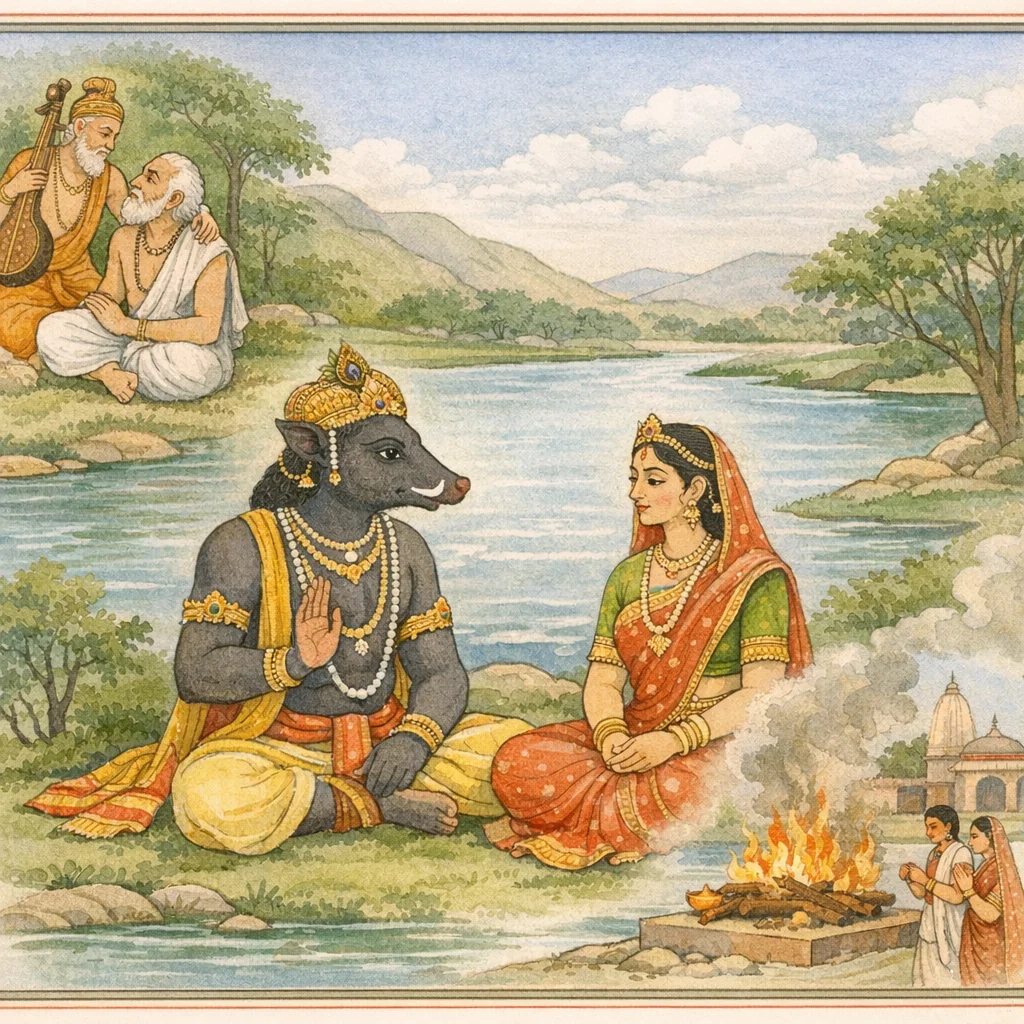
Adhyaya 187: Determination of the Origin and Procedure of the Ancestral Offering (Pitṛyajña/Śrāddha)
Pitṛyajña-śrāddhotpatti-nirṇayaḥ
Ritual-Manual (Śrāddha/Antyeṣṭi) with Cosmological Frame and Ethical-Discourse on Grief
In dialogue, Pṛthivī (Dharaṇī) asks Varāha to disclose the hidden doctrine of pitṛyajña/śrāddha—its merits, method, origin, purpose, and inner meaning. Varāha frames śrāddha within a cosmic preface: primordial darkness, his yogic sleep upon Śeṣa, and the triune manifestation as Brahmā–Viṣṇu–Hara; he then recounts creation through Brahmā and the rise of social orders. The lineage of Nimi and the sage Atreya is introduced: Atreya’s son dies after severe tapas, and grief drives Atreya to improvise a sevenfold feeding and piṇḍa-offering, followed by anxiety over ritual impropriety. Nārada consoles him with teaching on mortality and the guṇas, warning that clinging grief corrodes ethical steadiness and dharma. The chapter culminates in practical guidance for death-rites: proper timing, gifts (notably go-dāna), mantra-based madhuparka at the moment of death, bathing while remembering tīrthas, cremation orientation, and post-death aśauca restrictions—presented as a dharma that stabilizes human society and, as Pṛthivī implies, upholds the order of the earth.
Primary Speakers
Key Concepts
Shlokas in Adhyaya 187
Verse 1
अथ सृष्टिपितृयज्ञौ ॥ सूत उवाच ॥ एवं नारायणाच्छ्रुत्वा सा मही संशितव्रता ॥ कराभ्यामञ्जलिं कृत्वा माधवं पुनरब्रवीत् ॥
Sūta said: Having thus heard from Nārāyaṇa, the Earth—steadfast in her vow—joined her palms in añjali with both hands and again addressed Mādhava.
Verse 2
धरण्युवाच ॥ श्रुतमेतन्मयाख्यानं क्षेत्रस्य च महत्फलम् ॥ एकं मे परमं गुह्यं तद्भवान्वक्तुमर्हति ॥
The Earth said: I have heard this account and the great fruit of the sacred kṣetra. One matter, supremely secret, yet remains for me—your reverence should explain it.
Verse 3
पितृयज्ञस्य माहात्म्यं सोमदत्तो नराधिपः ॥ मृगयां समुपागम्य यत्त्वया पूर्वभाषितम् ॥
Concerning the greatness of the pitṛyajña: I refer to what you previously narrated about King Somadatta, ruler of men, who went forth on a hunt.
Verse 4
को गुणः पितृयज्ञस्य कथमेव प्रयुज्यते ॥ केन चोत्पादितं श्राद्धं कस्मिन्नर्थे किमात्मकम् ॥
What is the benefit of the pitṛyajña, and how exactly is it to be performed? By whom was śrāddha instituted, for what purpose, and of what essential nature is it?
Verse 5
एतदिच्छाम्यहं श्रोतुं विस्तरेण वदस्व मे ॥ श्रीवराह उवाच ॥ साधु भूमे महाभागे यन्मां त्वं परिपृच्छसि ॥
I wish to hear this in detail; explain it to me. Śrī Varāha said: Well done, O Earth, greatly fortunate, that you question me in this way.
Verse 6
मोहितासि वरारोहे भाराक्रान्ता वसुन्धरे ॥ दिव्यां ददामि ते बुद्धिं शृणु सुन्दरि तत्त्वतः ॥
You are bewildered, O fair-hipped one; burdened, O Vasundharā. I grant you a divine understanding—listen, O beautiful one, in accordance with the truth.
Verse 7
कथयिष्यामि ते ह्येवं श्राद्धोत्पत्तिविनिश्चयम् ॥ आदौ स्वर्गस्य चोत्पत्तिं देवानां च वरानने ॥
Thus I shall explain to you the settled account of the origin of śrāddha. First, O fair-faced one, (I shall describe) the arising of heaven and of the gods.
Verse 8
निष्प्रभेऽस्मिन्निरालोके सर्वतस्तमसावृते ॥ स्रष्टुं वै बुद्धिरुत्पन्ना त्रैलोक्यं सचराचरम् ॥
In this world without radiance, devoid of light, covered everywhere by darkness, the resolve arose to create the three worlds together with all that moves and does not move.
Verse 9
सोऽहं च शेषपर्यङ्के एकश्चैव पराङ्मुखः ॥ स्वपामि च वरारोहे अनन्तशयने ह्यहम् ॥
And I—alone, turned away—sleep upon the couch of Śeṣa; I rest indeed on the bed of Ananta, O fair-hipped one.
Verse 10
युगं युगसहस्राणि यास्यन्ति च गतानि च ॥ न त्वं मम विजानासि ज्ञातुं मायां यशस्विनि ॥
Ages—thousands of ages—will pass, and many have passed; yet you do not comprehend my māyā so as to know it, O illustrious one.
Verse 11
धारितं मम सुश्रॊणि दिवा पञ्चशतानि च ॥ वाराहं रूपमादाय न जानासि हि भामिनि ॥
O fair-hipped one, for five hundred days I have borne this burden; yet, having assumed the form of the Boar (Varāha), you do not recognize me, O radiant lady.
Verse 12
यन्मां पृच्छसि वै ज्ञातुमात्मानं च यशस्विनि ॥ एकमूर्त्तिस्त्रिधा जातो ब्रह्मविष्णुहरात्मकः ॥
What you ask—to know me, O illustrious one: I am one in form, yet manifested threefold, bearing the nature of Brahmā, Viṣṇu, and Hara.
Verse 13
क्रोधहेतोर्मया सृष्ट ईश्वरॊऽसुरनाशनः ॥ मम नाभ्यामभूत्पद्मं पद्मगर्भः पितामहः ॥
From the cause of wrath, I brought forth the Lord who destroys the asuras; and from my navel arose the lotus—Pitāmaha, the lotus-wombed progenitor.
Verse 14
एवं त्रयो वयं देवाः कृत्वा ह्येकाणर्वां महीम् ॥ तिष्ठामः परमप्रीत्या मायां कृत्वा तु वैष्णवीम् ॥
Thus we three deities, having made the earth a single ocean, remained in supreme contentment, having fashioned the Vaiṣṇavī māyā.
Verse 15
सर्वं तज्जलपूर्णं तु न चाज्ञायते किञ्चन ॥ वटमेकं वर्जयित्वा विष्णुमूलं यशोद्रुमम् ॥
All of that was filled with water, and nothing at all could be discerned—except for a single banyan, a glorious tree rooted in Viṣṇu.
Verse 16
तिष्ठाम वटवृक्षेऽहं मायया बालरूपधृक् ॥ पश्यामि च जगत्सर्वं त्रैलोक्यं यन्मया कृतम् ॥
I remained upon the banyan tree; by māyā I assumed the form of a child, and I beheld the entire world—the three realms—that were fashioned by me.
Verse 17
वारयामि वरारोहे जानासि त्वं धरे शुभे ॥ कालेन तु तदा देवि कृत्वा वै वडवामुखम् ॥
I restrain this, O fair-thighed one; you understand, O auspicious Earth. Then, in due course, O goddess, the ‘mare’s mouth’ (vaḍavāmukha) was formed.
Verse 18
विनिस्सृतं जलं तत्र मायया तदनन्तरम् ॥ प्रलये च विनिवृत्ते ब्रह्मा लोकपितामहः ॥
Then, immediately thereafter, by māyā, the water flowed out there; and when the dissolution (pralaya) had ceased, Brahmā—the grandsire of the worlds—appeared and assumed his role.
Verse 19
एवमुक्तो मया देवि गृह्य तत्र कमण्डलुम् ॥ उपस्पृश्य शुचिर्भूत्वा ब्रह्मा चोत्पादयन्सुरान् ॥
Thus addressed by me, O goddess, Brahmā took up the kamaṇḍalu there; having ritually touched/sipped water and become purified, he proceeded to generate the gods.
Verse 20
आदित्या वसवो रुद्रा अश्विनौ च मरुद्गणाः ॥ तारणार्थं च सर्वेषां ब्राह्मणान्भुवि दैवतान् ॥
The Ādityas, the Vasus, the Rudras, the two Aśvins, and the hosts of Maruts; and also, for the deliverance and protection of all, he established the Brāhmaṇas on earth as divine beings.
Verse 21
बाहुभ्यां क्षत्रमुत्पन्नं वैश्याः ऊरुविनिःसृताः ॥ पद्भ्यां विनिःसृताः शूद्राः सर्ववर्णोपचारकाः
From the arms arose the kṣatra, the ruling and warrior order; from the thighs issued the vaiśyas. From the feet issued the śūdras, those who render service and practical support to all the varṇas.
Verse 22
देवताश्चासुरा देवि जातास्ते ब्रह्मणस्तथा ॥ देवता ह्यसुराः सर्वे तपोवीर्यबलान्विताः
O Goddess, the gods and the asuras were likewise born from Brahmā. Indeed, both the gods and the asuras—all of them—were endowed with the power of tapas (austerity), vigor, and strength.
Verse 23
दित्यां च जनिताः पुत्रा असुराः सुरशत्रवः ॥ प्रजापतिश्चाजनयदृषींश्चैव तपोधनान्
And from Diti were born sons—the asuras, enemies of the gods. And Prajāpati generated the ṛṣis as well, those whose wealth consisted in tapas (austerity).
Verse 24
तेजसा भास्कराकाराः सर्वे शास्त्रविदो द्विजाः ॥ तेषां पुत्राश्च पौत्राश्च जनिता ब्रह्मसूनुना
Radiant with tejas, sun-like in form, all of them were dvijas, knowers of the śāstras. Their sons and grandsons too were generated by Brahmā’s son.
Verse 25
निमेस्तु वंशसम्भूतो आत्रेय इति विश्रुतः ॥ जातमात्रो महात्मा स श्रीमांश्चापि तपोनिधिः
From the lineage of Nimi arose one renowned as Ātreya. From the moment of his birth he was great-souled—prosperous, and indeed a treasury of tapas (austerity).
Verse 26
आदित्या वसवो रुद्रा अश्विनौ च मरुद्गणाः ॥ देवतास्तु त्रयस्त्रिंशददित्यां जनयन्पुरा
The Ādityas, the Vasus, the Rudras, the two Aśvins, and the hosts of Maruts—these deities, numbering thirty-three, were formerly brought forth from Aditi.
Verse 27
एकचित्तं समाधाय तपश्चरति निश्चलः ॥ पञ्चाग्निर्वायुभक्षश्च एकपादोर्ध्वबाहुकः
Fixing his mind in one-pointed concentration, unmoving, he practices austerity—surrounded by the five fires, subsisting on air, standing on one foot with arms raised upward.
Verse 28
वर्षाणां च सहस्राणि तपस्तप्त्वा वसुन्धरे ॥ मृत्युकालमनुप्राप्तस्ततः पञ्चत्वमागतः
O Earth, having performed austerities for thousands of years, when his time of death arrived, he then passed into the state of the five elements.
Verse 29
नष्टं च तं सुतं दृष्ट्वा निमेः शोक उपाविशत् ॥ पुत्रशोकाभिसंयुक्तो दिवा रात्रौ च चिन्तयन्
Seeing that his son was lost, grief took hold of Nimi. Afflicted by sorrow for his child, he brooded by day and by night.
Verse 30
निमिः कृत्वा ततः शोकं विधानात्तत्र माधवि ॥ तं मनोगतसंकल्पं त्रिरात्रे प्रत्यपद्यत
Then Nimi, O Mādhavī, having performed there the prescribed observance in response to grief, recovered his inward resolve within three nights.
Verse 31
तस्य प्रतिविशुद्धस्य माघमासे तु द्वादशीम् ॥ मानसं सृज्य विषयं बुद्धिर्विस्तारगामिनी
For him who had become wholly purified, on the twelfth day of the month of Māgha—having mentally formed the object of contemplation—his intellect expanded in its range.
Verse 32
स निमिश्चिन्तयामास श्राद्धकल्पं समाहितः ॥ यानि तस्यैव भोज्यानि मूलानि च फलानि च
Composed and attentive, he then set his mind upon the śrāddha procedure—namely, which items were proper for him to offer as food: roots and fruits.
Verse 33
यानि कानि च भक्ष्याणि नवश्च रससंभवः ॥ यानि तस्यैव चेष्टानि सर्वमेतदुदाहरेत्
Whatever edible items there were, and the fresh preparations arising from juices and flavors, and whatever practices were proper to him—he should state all of this explicitly.
Verse 34
आमन्त्र्य ब्राह्मणं पूर्वं शुचिर्भूत्वा समाहितः ॥ दक्षिणावर्ततः सर्वमकरोदृषिसत्तमः
First, having respectfully invited a brāhmaṇa, and having become pure and composed, the excellent sage performed everything in the rightward (clockwise) direction.
Verse 35
सप्तकृत्वस्ततस्तत्र युगपత్సमुपाविशत् ॥ दत्त्वा तु मांसशाकानि मूलानि च फलानि च
Then, there, seven times, he sat down together (in due sequence); and he offered meat and vegetables, as well as roots and fruits.
Verse 36
पूजयित्वा तु विप्रान्स सप्तकृत्वश्च सुन्दरि ॥ कृत्वा तु दक्षिणाग्रांश्च कुशांश्च प्रयतः शुचिः
Having honored the brāhmaṇas seven times, O fair one, and having duly arranged the foremost portions for the dakṣiṇā as well as the kuśa-grass, he remained disciplined and pure.
Verse 37
एवं दिने गते भद्रे ह्यस्तं प्राप्ते दिवाकरे ॥ ब्रह्म कर्मोत्तमं दिव्यं भावसाध्यमुपासत
Thus, when the day had passed, O auspicious one, and the sun had reached its setting, he engaged in the supreme, divine brahman-rite, to be accomplished through inner disposition (bhāva).
Verse 38
एकाकी यतचित्तात्मा निराशी निष्परिग्रहः ॥ शुचौ देशे प्रतिष्ठाप्य स्थिरमासनमात्मनः
Alone, with mind and self restrained, without expectation and without possessions, he established for himself a firm seat in a clean place.
Verse 39
नात्युच्चं नातिनीचं च चेलाजिनकुशोत्तरम् ॥ तत्रैकाग्रं मनः कृत्वा यतचित्तो जितेन्द्रियः
Neither too high nor too low, with cloth, antelope-skin, and kuśa-grass as its upper layer; there, making the mind one-pointed, restrained in thought and having conquered the senses, he proceeded.
Verse 40
उपविश्यासनेऽयुञ्जद्योगमात्मविशुद्धये ॥ समं कायशिरोग्रीवं धारयन्नचलः स्थितः
Seated upon the seat, he applied himself to yoga for the purification of the self; holding body, head, and neck aligned evenly, he remained steady and unmoving.
Verse 41
संप्रेक्ष्य नासिकाग्रं स्वं दिशश्चानवलोकयन् ॥ प्रकाशात्मा विगतभीर् ब्रह्मचारी व्रते स्थितः ॥
Fixing his gaze upon the tip of his own nose and not looking toward the directions, serene in inner clarity and free from fear, the brahmacārin remained established in his vow.
Verse 42
संयम्य मयि चित्तं यो युक्त आसीत मत्परः ॥ प्रयुञ्जीत तदात्मानं मद्भक्तो नान्यमानसः ॥
Whoever, having restrained the mind in me, sits disciplined and devoted to me as the supreme aim—such a devotee, with no other object in mind, should apply himself wholly to that single self-directed practice.
Verse 43
एवं निवृत्तसंध्यायां ततो रात्रिरुपागता ॥ पुनश्चिन्तितुमारब्धः शोकसंविग्नमानसः ॥
Thus, when the twilight observance had ended, night then arrived; and he began again to reflect, his mind agitated by grief.
Verse 44
कृत्वा तु पिण्डसंकल्पं पश्चात्तापं चकार ह ॥ अकृतं मुनिभिः सर्वं किं मया तदनुष्ठितम् ॥
But having formed the resolve regarding the piṇḍa-offering, he then fell into remorse: “If all this was not done by the sages, why did I undertake it?”
Verse 45
निवापकर्म ह्यशुचि पुत्रार्थे विनियोजितम् ॥ अहो स्नेहप्रभावेण मया चाकृतबुद्धिना ॥
“For the rite of offering (nivāpa) is indeed considered impure, yet it is employed for the sake of a son. Alas—under the force of affection, I acted with unformed judgment.”
Verse 46
किं वक्ष्यन्ति च मां सर्वे ये वै पितृपदे स्थिताः ॥ एवं विचिन्त्यमानस्य गता रात्रिर्वसुन्धरे ॥
“And what will all those say to me who indeed abide in the station of the ancestors?” Thus, as he kept pondering, the night passed—O Vasundharā (Earth).
Verse 47
पूर्वसन्ध्यानु सम्प्राप्ता उदिते च दिवाकरे ॥ सन्ध्याविधिं विनिवर्त्य हुत्वाग्नीन् द्विजसत्तमः ॥
When the morning twilight had arrived and the sun had risen, the best of the twice-born, having duly completed the sandhyā rite, offered oblations into the sacred fires.
Verse 48
पुनश्चिन्तां प्रपन्नः स आत्रेयो ह्यतिदुःखितः ॥ एकाकी भाषते तत्र शोकपीडितमानसः ॥
Again he fell into anxious thought; that Ātreya, exceedingly distressed, spoke there alone, his mind oppressed by grief.
Verse 49
धिग्वयो धिक्च मे कर्म धिग्बलं धिक्च जीवितम् ॥ पुत्रं सर्वसुखैर्युक्तं जीवितं हि न दृश्यते ॥
“Shame on fate; shame on my deed; shame on strength; and shame on life. For that life endowed with every happiness—namely, a son—is indeed not to be seen for me.”
Verse 50
नरकं पूतिकाख्यातं हृदि दुःखं विदुर्बुधाः ॥ परित्राणं ततः पुत्रादिच्छन्तीह परत्र च ॥
The wise understand that “Pūtikā” is a hell—an inner anguish within the heart; therefore people seek deliverance through a son, both here and hereafter.
Verse 51
पूजयित्वा तु देवांश्च दत्त्वा दानं त्वनेकशः ॥ हुत्वाग्निं विधिवच्चैव स्वर्गं तु लभते नरः
Having worshipped the deities, given gifts many times, and offered into the sacred fire according to proper rule, a man attains heaven.
Verse 52
पुत्रेण लभते येन पौरत्रेण च पितामहाः ॥ अथ पुत्रस्य पौरत्रेण मोदन्ते प्रपितामहाः
By a son one attains that by which benefit is gained; by a grandson the grandfathers (pitāmahas) are benefited. Further, by a son’s grandson, the great-grandfathers (prapitāmahas) rejoice.
Verse 53
पुत्रेण श्रीमता हीनं नाहं जीवितुमुत्सहे ॥ एतस्मिन्नन्तरे देवि नारदो द्विजसत्तमः
“Deprived of a prosperous son, I do not wish to go on living.” In the meantime, O Goddess, Nārada—the best among the twice-born—arrived.
Verse 54
जगाम तापसारण्यं ऋष्याश्रमविभूषितम् ॥ सर्वकामयुतं रम्यं बहुपुष्पफलोदकम्
He went to a forest of ascetics, adorned with the hermitages of sages—delightful, furnished with every desired resource, and rich in many flowers, fruits, and waters.
Verse 55
तस्मै दत्त्वा पाद्यमर्घ्यं आसने चोपवेश्य च ॥ उपविश्यासने देवि नारदो वाक्यमब्रवीत्
Having offered him water for the feet and an honoring oblation, and having seated him on a seat, Nārada—having himself sat down, O Goddess—spoke.
Verse 56
नारद उवाच ॥ निमे शृणु महाप्राज्ञ शोकमुत्सृज्य दूरतः ॥ अशोच्यानन्वशोचस्त्वं प्रज्ञावान्नावबुध्यसे
Nārada said: “Listen to me, O greatly wise one, casting grief far away. You grieve for those who are not to be grieved for; though you claim discernment, you do not truly understand.”
Verse 57
गतासूनगतासूंश्च नानुशोचन्ति पण्डिताः ॥ मृतं वा यदि वा नष्टं यो यान्तमनुशोचति
The learned do not lament for the dead or for the living. Whether one has died or has been lost, whoever grieves for one who has departed cannot bring him back.
Verse 58
अमित्रास्तस्य हृष्यन्ति स चापि न निवर्त्तते ॥ अमरत्वं न पश्यामि त्रैलोक्ये सचराचरे
His enemies rejoice, and he too does not return. I do not see immortality anywhere in the three worlds, with all that moves and does not move.
Verse 59
देवतासुरगन्धर्वा मानुषा मृगपक्षिणः ॥ सर्वे कालवशं यान्ति सर्वे कालमुदीक्षते
Gods, demons, gandharvas, humans, beasts, and birds—all go under the control of Time; all await Time.
Verse 60
जातस्य सर्वभूतस्य कालो मृत्युरुपस्थितः ॥ अवश्यं चैव गन्तव्यं कृतान्तविहितेन च
For every being that is born, Time—death—stands close at hand. And departure is indeed inevitable, in accordance with what is ordained by Kṛtānta (the terminus, Death).
Verse 61
तव पुत्रो महात्मा वै श्रीमान्नाम श्रियो निधिः ॥ पूर्णं वर्षसहस्रं तु तपः कृत्वा सुदुष्चरम्
Your son is indeed a great-souled one—prosperous by nature, a very treasury of fortune—who, having undertaken severe austerity (tapas), performed it for a full thousand years.
Verse 62
मृत्युकालमनुप्राप्य गतो दिव्यां परां गतिम् ॥ एतत्सर्वं विदित्वा तु नानुशोचितुमर्हति
Having reached the time of death, he has gone to a divine and supreme state. Knowing all this, one ought not to grieve.
Verse 63
नारदेनैवमुक्ते तु श्रुत्वा स द्विजसत्तमः ॥ प्रणम्य शिरसा पादौ निमिरुद्विग्नमानसः
When Nārada had spoken thus, Nimi, the best of twice-born men, having heard it, bowed with his head at Nārada’s feet, his mind still anxious.
Verse 64
अहो मुनिवरश्रेष्ठ अहो धर्मविदां वर ॥ सान्त्वितोऽस्मि त्वया विप्र वचनैर्मधुराक्षरैः
Ah, best among eminent sages! Ah, foremost among the knowers of dharma! O brāhmaṇa, I have been consoled by you through words whose syllables are sweet.
Verse 65
प्रणयात्सौहृदाद्वापि स्नेहाद्वक्ष्यामि तच्छृणु ॥ शोको निरन्तरं चित्ते ममैद्धृदि वर्तते
Out of affection, or out of friendship, or from tenderness, I shall speak—listen to that. Sorrow continually abides in my mind, lodged in my heart.
Verse 66
कृतस्नेहस्य पुत्रार्थे मया संकल्प्य यत्कृतम् ॥ तर्पयित्वा द्विजान्सप्त अन्नाद्येन फलेन च
For my son’s sake—since I had grown attached—what I did, after making a solemn resolve, was to satisfy seven twice-born men with food and other offerings, and with fruits as well.
Verse 67
पश्चाद्विसर्जितं पिण्डं दर्भानास्तीर्य भूतले ॥ उदकानयनं चैव ह्यपसव्येन वासितम्
Afterwards, I disposed of the piṇḍa-offering, having spread darbha-grass upon the ground; and I also performed the bringing of water, seated in the apasavya orientation.
Verse 68
शोकस्य तु प्रभावेण एतत्कर्म मया कृतम् ॥ अनार्यजुष्टमस्वर्ग्यमकीर्तिकरणं द्विज
But under the influence of grief I performed this act—O twice-born one—and (I fear) it is not practiced by the noble, it does not lead to heaven, and it brings about ill-repute.
Verse 69
नष्टबुद्धिस्मृतिसत्त्वो ह्यज्ञानॆन विमोहितः ॥ न च श्रुतं मया पूर्वं न देवैॠषिभिः कृतम्
For my intellect, memory, and steadiness were impaired; I was deluded by ignorance. Nor had I heard of this before, nor is it something done by the gods or the sages.
Verse 70
भयं तीव्रं प्रपश्यामि मुनिशापात्सुदारुणात् ॥ नारद उवाच ॥ न बेतव्यं द्विजश्रेष्ठ पितरं शरणं व्रज
I perceive an intense fear arising from a most dreadful curse of a sage. Nārada said: “You should not fear, O best of the twice-born; go to the Pitṛs as your refuge.”
Verse 71
अधर्मं न च पश्यामि धर्मो नैवात्र संशयः ॥ नारदेनैवमुक्तस्तु निमिर्ध्यानमुपाविशत् ॥
“I see no unrighteousness here; indeed, there is no doubt that this is dharma.” Thus spoken to by Nārada, Nimi sat down to meditate.
Verse 72
कर्मणा मनसा वाचा पितरं शरणं गतः ॥ ततोऽतिचिन्तयामास वंशकर्त्तारमात्मनः ॥
With deed, mind, and speech he took refuge in his father; then he reflected deeply upon the begetter of his own lineage.
Verse 73
पुत्रमाश्वासयामास वाग्भिरिष्टाभिरव्ययैः ॥ निमे संकल्पितस्तेऽयं पितृयज्ञस्तपोधन ॥
He consoled his son with cherished and unfailing words: “O Nimi, this pitṛyajña has been resolved for you, O treasure of austerity.”
Verse 74
पितृयज्ञेति निर्दिष्टा धर्मोऽयं ब्रह्मणा स्वयम् ॥ ततो ह्यतितरो धर्मः क्रतुरेकः प्रतिष्ठितः ॥
This dharma—designated as ‘pitṛyajña’—was indicated by Brahmā himself; and from that, a surpassing dharma was established as a single sacrificial rite.
Verse 75
कृतः स्वयम्भुवा पूर्वं श्राद्धं यो वित्तवित्तमः ॥ शृण्वतो नारदस्यापि विधिं विधिविदां वरः ॥
Formerly, Svayambhū (Brahmā) instituted the Śrāddha—he, the foremost among the wealthy; and the best among those who know ritual procedure explained the rite’s method, even as Nārada listened.
Verse 76
श्राद्धकर्मविधिं चैव प्रेतकर्म च या क्रिया ॥ शृणुषु सुन्दरि तत्त्वेन यथा दाता सपुत्रकः ॥
Listen, O fair one, in truth, to the procedure for the śrāddha rite and to the actions that constitute the preta-rites, so that the giver, together with his son, may act accordingly.
Verse 77
मम चैव प्रसादेन तस्य बुद्धिं ददाम्यहम् ॥ जातस्य सर्वभूतस्य कालमृत्युरुपस्थितः ॥
And by my favor I grant him understanding. For every being that is born, Time-and-Death stands near.
Verse 78
अवश्यमेव गन्तव्यं धर्मराजस्य शासनात् ॥ अमरत्वं न पश्यामि पिपीलादीनि जन्तवः ॥
One must certainly depart, by the ordinance of Dharmarāja (Yama). I do not see immortality in creatures—even in those beginning with ants.
Verse 79
जातस्य हि ध्रुवो मृत्युः ध्रुवं जन्म मृतस्य च ॥ मोक्षः कर्मविशेषेण प्रायश्चित्तेन च ध्रुवम् ॥
For one who is born, death is certain; and for one who has died, birth is likewise certain. Liberation (mokṣa) is certain through specific forms of action, and also through expiation (prāyaścitta).
Verse 80
सत्त्वं रजस्तमश्चैव त्रयः शारीरजाः स्मृताः ॥ अल्पायुशो नराः पश्चाद्भविष्यन्ति युगक्षये ॥
Sattva, rajas, and tamas are remembered as the three constituents arising with embodied existence; later, at the end of a yuga, humans will become short-lived.
Verse 81
सात्त्विकं नावबुद्ध्यन्ति कर्मदोषेण तामसः ॥ तामसं नरकं विन्द्यात्तिर्यग्योनिं च राक्षसीम् ॥
Those of tāmasika disposition, through the fault of their actions, do not comprehend what is sāttvika. One who follows tamas attains hell, and also an animal birth and a rākṣasa-like womb.
Verse 82
क्रूरो भीरुर्विषादी च हिंसको निरपत्रपः ॥ अज्ञानान्धश्च पैशाचमेतॆषां तामसा गुणाः ॥
Cruel, fearful, despondent, violent, shameless, blinded by ignorance, and tending toward the paiśāca disposition—these are the qualities of those dominated by tamas.
Verse 83
तामसं तद्विजानीयादुच्यमानो न बुद्ध्यति ॥ दुर्मदोऽश्रद्धधानश्च विज्ञेयास्तामसा नराः ॥
One should recognize as tāmasika the person who, even when instructed, does not understand. Those who are arrogantly intoxicated and lacking in trust (or receptivity) are to be known as tāmasika people.
Verse 84
प्रबलो वाचि युक्तश्चाचलबुद्धिः सदायतः ॥ शूरः सर्वेषु व्यक्तात्मा विज्ञेया राजसा नराः ॥
Powerful, disciplined in speech, unsteady in mind, ever straining outward; heroic, and manifesting the self among all—such people are to be known as rājasa.
Verse 85
क्षान्तो दान्तो विशुद्धात्मा विज्ञेयः श्रद्धयान्वितः ॥ तपःस्वाध्यायशीलश्च एतेषां सात्त्विका गुणाः ॥
Patient, self-controlled, of purified inner nature, endowed with trustful receptivity; devoted to austerity (tapas) and self-study (svādhyāya)—these are the qualities of those characterized by sattva.
Verse 86
एवं सञ्चिन्तयानस्तु न शोकं कर्तुमर्हसि ॥ त्यज शोकं महाभाग शोकः सर्वविनाशनः ॥
Thus reflecting, you ought not to give way to grief. Cast off grief, O fortunate one; grief is the destroyer of all.
Verse 87
शोको दहति गात्राणि बुद्धिः शोकेन नश्यति ॥ लज्जा धृतिश्च धर्मश्च श्रीः कीर्तिश्च स्मृतिर्नयः ॥
Grief burns the limbs; the intellect is ruined by grief. Modesty, steadfastness, dharma, prosperity, fame, memory, and sound judgment are also lost.
Verse 88
त्यजन्ति सर्वधर्मं च शोकेनोपहृतं नरम् ॥ एवं शोकं त्यजित्वा तु निःशोको भव पुत्रक ॥
People abandon even all obligations toward a man overwhelmed by grief. Therefore, having cast off grief, become free from grief, dear child.
Verse 89
मूढः स्नेहप्रभावेण कृत्वा हिंसानृते तथा ॥ पच्यते नरके घोरे ह्यात्मदोषैर्वसुन्धरे ॥
A deluded person, under the influence of attachment, having committed violence and falsehood, is ‘cooked’ in dreadful hell—indeed, by one’s own faults, O Vasundharā (Earth).
Verse 90
स्नेहं सर्वेषु संयम्य बुद्धिं धर्मे नियोजयेत् ॥ धर्मलोक हितार्थाय शृणु सत्यं ब्रवीम्यहम् ॥
Having restrained attachment toward all, one should apply the intellect to dharma. For the welfare of the world grounded in dharma, listen: I speak what is true.
Verse 91
कण्ठस्थानं गते जीवे भीतिविभ्रान्तमानसः ॥ ज्ञात्वा च विह्वलं तत्र शीघ्रं निःसारयेद्गृहात् ॥ १०१ ॥ कुशास्तरणशायी च दिशः सर्वा न पश्यति ॥ लब्धस्मृतिर्मुहूर्तं तु यावज्जीवो न पश्यति ॥
When the life-breath (jīva) reaches the region of the throat, the person’s mind becomes fearful and disoriented. Knowing that he has become distressed at that moment, one should quickly remove him from the house. Lying upon a spread of kuśa-grass, he no longer sees the directions; and for a brief interval, even if memory returns, the living being still does not perceive clearly.
Verse 92
वाचयेत्स्नेहभावेन भूमिदेवा द्विजातयः ॥ सुवर्णं च हिरण्यं च यथोत्पन्नेन माधवि ॥
With an attitude of affection and care, one should have the “gods on earth”—the dvija, the learned twice-born brāhmaṇas—recite the appropriate texts. And one should offer gold and wealth according to what has been obtained, O Mādhavī.
Verse 93
परलोकहितार्थाय गोप्रदानं विशिष्यते ॥ सर्वदेवमया गाव ईश्वरेणावतारिताः ॥
For the sake of welfare in the world beyond, the gift of a cow is especially esteemed. Cows are described as embodying all the deities, brought forth into the world by the Lord.
Verse 94
अमृतं क्षरयन्त्यश्च प्रचरन्ति महीतले ॥ एतासां चैव दानेन शीघ्रं मुच्येत किल्बिषात् ॥
They are said to “pour forth nectar (amṛta)” as they move upon the surface of the earth. By the gifting of such cows, one is said to be quickly released from wrongdoing (kilbiṣa).
Verse 95
पश्चाच्छ्रुतिपथं दिव्यमुत्कर्णेन च श्रावयेत् ॥ यावत्प्राणान्प्रमुञ्चेत कृत्वा कर्म सुदुष्करम् ॥
After that, one should have the divine “path of śruti” recited into his uplifted ear, until he releases his vital breaths—having undertaken this very difficult duty.
Verse 96
दृष्ट्वा सुविह्वलं ह्येनं मम मार्गानुसारिणम् ॥ प्रयाणकाले तु नरो मन्त्रेण विधिपूर्वकम् ॥
Seeing him indeed greatly overwhelmed—one who follows my path—at the time of departure a man should act with a mantra, in accordance with proper procedure.
Verse 97
मन्त्रेणानेन कर्तव्यं सर्वसंसारमोक्षणम् ॥ मधुपर्कं त्वरन् गृह्य चेमं मन्त्रमुदाहरेत् ॥
By means of this mantra, release from the entirety of worldly bondage is to be effected. Taking the madhuparka promptly, one should utter this mantra.
Verse 98
मन्त्रः— ॐ गृह्णीष्व मे सुविमलं मधुपर्कमाद्यं संसारनाशनकरं त्वमृतेन तुल्यम् ॥ नारायणेन रचितं भगवत्प्रियाणां दाहे च शान्तिकरणं सुरलोकपूज्यम् ॥
Mantra: ‘Oṃ—accept from me this very pure, foremost madhuparka, which brings about the destruction of worldly bondage, equal to nectar (amṛta). Composed by Nārāyaṇa for those dear to the Lord, it brings pacification even amid burning affliction, and is revered in the world of the gods.’
Verse 99
एवं विनिस्सृते प्राणे संसारं च न गच्छति ॥ नष्टसंज्ञं समुद्धिश्य ज्ञात्वा मृत्युवशङ्गतम् ॥
Thus, when the vital breath has departed, he does not go again to saṃsāra. Recognizing that he has lost consciousness and has come under the power of death, one should address him and perform the rites accordingly.
Verse 100
महावनस्पतिं गत्वा गन्धान्श्च विविधानपि ॥ घृततैलसमायुक्तं कृत्वा वै देहशोधनम् ॥
Having gone to a great tree and taking various fragrances as well, one should perform the purification of the body, using ghee and oil together as the anointing medium.
Verse 101
तेजोऽव्ययकरं चास्य तत्सर्वं परिकल्प्य च ॥ दक्षिणायां शिरः कृत्वा सलिले सन्निधाप्य च
Having duly arranged all that is required for him, and having set the body with the head oriented to the south, one should place it near water.
Verse 102
तीर्थाद्यावाहनं कृत्वा स्नापनं तस्य कारयेत् ॥ गयादीनि च तीर्थानि ये च पुण्याः शिलोच्चयाः
Having performed the invocation of sacred waters and related rites, one should have him bathed. One should also remember and invoke the tīrthas beginning with Gayā, and the meritorious rocky elevations.
Verse 103
कुरुक्षेत्रं च गङ्गा च यमुना च सरिद्वरा ॥ कौशिकी च पयोष्णी च सर्वपापप्रणाशिनी
Kurukṣetra, the Gaṅgā, and the Yamunā—the most excellent of rivers—and also the Kauśikī and the Payoṣṇī, each praised as destroying all wrongdoing.
Verse 104
गण्डकी भद्रनामाच सरयूरबलदा तथा ॥ वनानि नव वाराहे तीर्थे पिण्डारके तथा
The Gaṇḍakī, the river called Bhadranāmā, the Sarayū, and the Baladā; likewise the nine forests at the Vārāha-tīrtha, and also the place called Piṇḍāraka.
Verse 105
पृथिव्यां यानि तीर्थानि चत्वारः सागरास्तथा ॥ सर्वाणि मनसा ध्यात्वा स्नानमेवं तु कारयेत्
All the sacred places on the earth, and likewise the four oceans—having contemplated them all in the mind, one should perform the bathing in this manner.
Verse 106
प्राणैर्हृतं तु तं ज्ञात्वा चितां कृत्वा विधानतः ॥ तस्या उपरि संस्थाप्य दक्षिणाग्रं शिरस्तथा
Knowing him to be bereft of the life-breath, and having constructed the funeral pyre according to rule, one should place the body upon it, with the head likewise oriented toward the south.
Verse 107
दिव्यानग्निमुखान्ध्यात्वा गृहीय हस्ते हुताशनम् ॥ प्रज्वाल्य विधिवत्तत्र मन्त्रमेतमुदाहरेत्
Having contemplated the divine ones whose mouths are fire, and taking fire in the hand, having kindled it there according to rule, one should recite this mantra.
Verse 108
धर्माधर्मसमायुक्तो लोभमोहमसमावृतः ॥ दह चैत्तस्य गात्राणि देवलोकं स गच्छतु
Endowed with both right and wrong conduct, and covered by greed and delusion—burn, O Fire, his limbs; may he go to the world of the gods.
Verse 109
एवमुक्त्वा ततः शीघ्रं कृत्वा चैव प्रदक्षिणाम् ॥ ज्वलमानं तदा वह्निं शिरःस्थाने प्रदापयेत्
Having spoken thus, then promptly—having also performed circumambulation—one should apply the blazing fire at the place of the head.
Verse 110
चातुर्वर्ण्येषु संस्कारमेवं भवति पुत्रक ॥ गात्राणि वाससी चैव प्रक्षाल्य विनिवर्तयेत्
Thus is this funerary saṃskāra among the four social classes, dear child. Having washed one’s limbs and garments as well, one should return.
Verse 111
मृतं नाम तथोद्दिश्य दद्यात्पिण्डं महीतले॥ तदाप्रभृति चाशौचं देवकर्म न कारयेत्॥
Having thus named the deceased and directing the offering toward that person, one should place a piṇḍa upon the ground. From that point onward āśauca, the period of ritual impurity, applies, and one should not have deity-rites (devakarma) performed.
Verse 112
निद्रां मायामयीं कृत्वा जागर्मि च स्वपामि वा॥ विष्णुमायामयं कृत्वा जानासि त्वं न धारिणि॥
Fashioning sleep as something constituted of māyā, I either remain awake or I sleep. Yet when things are made of Viṣṇu’s māyā, you do not recognize it, O dhāriṇī, bearer.
Verse 113
चातुर्वर्णस्य वक्ष्यामि यश्च स्वायंभुवोऽब्रवीत्॥ नेमिप्रभृतिनामेवं येन श्राद्धं प्रवर्त्तते॥
I shall explain the rule for the four varṇa, as Svāyaṃbhuva (Manu) also declared: thus, beginning with Nemi and the named lineage, the practice of śrāddha is set in motion.
Verse 114
तत एतेन मन्त्रेण दद्याद्वै मधुपर्ककम्॥ मृत्युकाले तु पुरुषो परलोकसुखावहम्॥
Then, with this mantra, one should indeed offer the madhuparka. At the time of death, it becomes for a person a means that conduces to well-being in the next world.
Verse 115
कृत्वा सुदुष्करं कर्म जानता वाप्यजानता॥ मृत्युकालवशं प्राप्य नरः पञ्चत्वमागतः॥
Having done a very difficult or grievous deed—whether knowingly or unknowingly—when one comes under the power of the time of death, a person reaches pañcatva, the state of ‘five-ness’, namely dissolution into the five elements.
Verse 116
मुहूर्त्तं ध्यानमास्थाय भाषितो वचनं मया॥ शीघ्रमुत्पादय ब्रह्मन् देवतासुरमानुषान्॥
Having entered contemplation for a muhūrta, I spoke this utterance: “Quickly bring forth, O Brahman, the devas, the asuras, and humankind.”
Verse 117
शीर्णपर्णाम्बुभक्षश्च शिशिरे च जलेशयः॥ स कृच्छ्रे फलभक्षश्च पुनश्चान्द्रायणं चरन्॥
He subsisted on withered leaves and water, and in the cold season he lay in water. During the kṛcchra observance he ate only fruits, and again he practiced the cāndrāyaṇa vow.
Verse 118
प्रददौ श्रीमते पिण्डं नामगोत्रमुदाहरन्॥ तत्कृत्वा स मुनिश्रेष्ठो धर्मसंकल्पमात्मनः॥
He offered a piṇḍa to the venerable one, pronouncing the name and the gotra (lineage). Having done so, the best of sages formed within himself a resolve aligned with dharma.
Verse 119
कथं ते मुनयः शापात्प्रदहेयुर्न मामिति॥ सदेवासुरगन्धर्वपिशाचोरगराक्षसाः॥
“How could those sages, by a curse, burn me?”—thus he thought. Then there assembled beings: devas and asuras, gandharvas, piśācas, uragas (serpentine beings), and rākṣasas.
Verse 120
तत्प्रविश्याश्रमपदं भ्राजमानं स्वतेजसा॥ तं दृष्ट्वा पूजयामास स्वागतेनाथ धर्मवित्॥
Entering that hermitage-abode, radiant with its own splendor, and seeing him, the knower of dharma then honored him with words of welcome.
Verse 121
भीतो गद्गदया वाचा निःश्वसंश्च मुहुर्मुहुः ॥ सव्रीडो भाषते विप्रः कारुण्येन समन्वितः ॥
Frightened, speaking with a voice choked by emotion and sighing again and again, the brāhmaṇa spoke—ashamed, yet filled with compassion.
Verse 122
ध्यायमानस्ततोऽप्याशु आजगाम तपोधनम् ॥ पुत्रशोकेन संतप्तं पुत्रं दृष्ट्वा तपोधनम् ॥
Still absorbed in thought, he quickly approached the ascetic rich in austerity; and on seeing his son—consumed by grief for his son—the ascetic was distressed.
Verse 123
सात्त्विकं मुक्तियानाय यान्ति वेदविदो जनाः ॥ धर्मज्ञानं तथैश्वर्यं वैराग्यमिति सात्त्विकम् ॥
Those who know the Veda proceed on the path to liberation through what is sāttvika. Dharma, knowledge, sovereignty/inner mastery, and dispassion—these are called sāttvika.
Frequently Asked Questions
The text frames śoka (grief) as a destabilizing force that erodes dharma, memory, and discernment, and it pairs this critique with an ethical-ritual response: channeling loss into regulated pitṛyajña/śrāddha and disciplined conduct. Nārada’s counsel emphasizes universal mortality under kāla and interprets human dispositions through the guṇas, encouraging restraint and dharma-oriented action rather than improvised or fear-driven rites.
A specific calendrical marker appears when Atreya’s ritual reflection is linked to Māgha-māsa and a dvādaśī (12th lunar day). The procedural sections also mark transitions by sandhyā (twilight rites), the moment of prāṇa-viyoga (death), and immediate post-death periods (aśauca) during which deva-karmas are restricted.
By staging the instruction as Pṛthivī’s inquiry and embedding ritual order within cosmogony, the chapter presents social-ritual regulation as part of maintaining terrestrial stability. The repeated appeal to rivers, tīrthas, and water-based purification (including mental recollection of sacred waters) functions as an ecological-ritual map: human death practices are tied to landscapes and hydrological systems, implying that ethical life and end-of-life rites are integrated with the stewardship and sacralization of Earth’s waters and regions.
The narrative references Nimi (as progenitor context), the sage Atreya (identified as a descendant within Nimi’s lineage), and Nārada as the instructing sage. It also includes cosmogonic figures—Brahmā (Padmagarbha/Pitāmaha) and the triadic deity model (Brahmā–Viṣṇu–Hara)—and a varṇa-origin account (kṣatra from arms, vaiśya from thighs, śūdra from feet) used to situate ritual authority and social function.