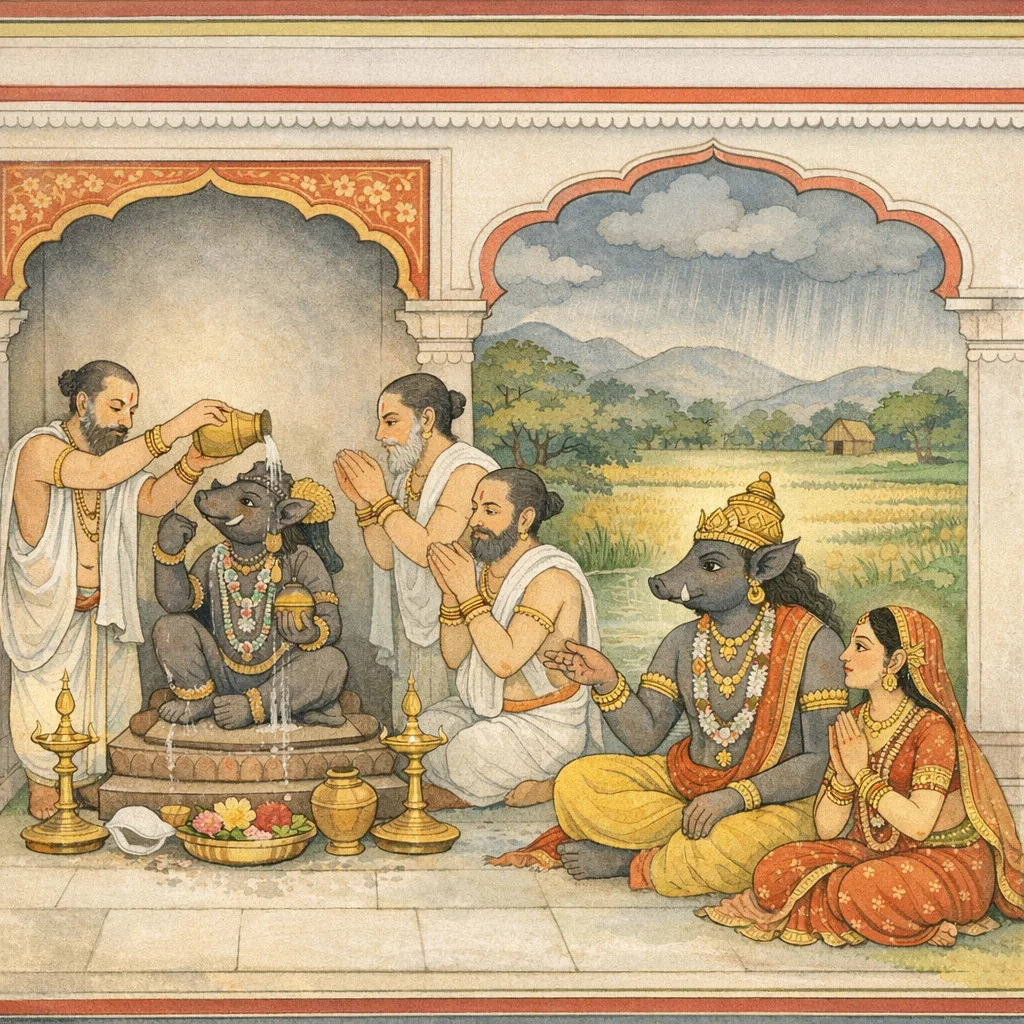
Adhyaya 183: Installation of a Clay Icon (Mṛnmayārcā) and the Ritual Protocol of Worship
Mṛnmayārcā-sthāpana
Ritual-Manual (Pūjāvidhi) with Ethical-Discourse on Intention, Humility, and Earth-centered Devotion
In dialogue with Pṛthivī (Vasundharā), Varāha sets out a procedural guide for establishing and worshipping a clay icon (mṛnmayārcā). He states the acceptable features of an icon—unbroken, undistorted, and well-proportioned—and allows substitutes when wood is unavailable, such as stone and metals. Worship may be undertaken for duty, reputation, or desire, yet inner intention and steady devotion are decisive; even a simple water-offering (jalāñjali) can suffice. The chapter then gives a stepwise consecration: choosing the auspicious nakṣatra Śravaṇa, performing adhivāsana, bathing the icon with pañcagavya and scented water, reciting installation and abhiṣeka mantras, and completing worship with incense, cloth-offering, peace-chanting, and respectful honoring of devotees, brāhmaṇas, and especially the guru. The Earth-centered setting highlights ritual discipline aligned with terrestrial stability and social harmony.
Primary Speakers
Key Concepts
Shlokas in Adhyaya 183
Verse 1
अथ मृन्मयार्चास्थापनम् ॥ श्रीवराह उवाच ॥ पुनरन्यत्प्रवक्ष्यामि तच्छृणुष्व वसुन्धरे ॥ तिष्ठामि मृन्मयीं चापि प्रतिमां पूजनेच्छया
Now, the installation of a clay image. Śrī Varāha said: I shall again explain something further—listen, O Vasundharā. I also abide in a clay image, out of the wish to be worshipped.
Verse 2
अर्च्चां च मृण्मयीं कृत्वा अस्पुटां चाप्यखण्डिताम् ॥ नाधिकां वामनां चापि न वक्रां कारयेद्बुधः ॥
Having fashioned a clay icon for worship—clear in form and unbroken—a discerning person should not have it made overly large, nor dwarfish, nor crooked.
Verse 3
ईदृशीं प्रतिमां कृत्वा मम कर्मपरायणः ॥ भूमे सर्वाणि कर्माणि यथा वा रोचते तथा ॥
Having made such an image and being devoted to my rites, O Earth, one may perform all actions in whatever manner is fitting and agreeable, as the occasion requires.
Verse 4
काष्ठानामप्यलाभे तु मृण्मयीं तत्र कारयेत् ॥ शैलजां वा ततो भूमे मम कर्मपरायणः ॥
If even wood is unavailable, one should have a clay (icon) made there; or thereafter a stone-made one, O Earth, for the person devoted to my ritual obligations.
Verse 5
ताम्रेण कांस्यरौप्येण सौवर्णत्रपु-रीतिभिः ॥ कुर्वन्ति शुभकर्माणः कोविदः प्रतिमां शुभाम् ॥
Using copper, bronze, silver, gold, tin, and lead, skilled artisans—engaged in auspicious work—fashion an auspicious sacred image.
Verse 6
अर्चनं त्वपरं वेद्यां मम कर्मपरिग्रहात् ॥ केचिल्लोकापवादेन ख्यात्यै कुर्वन्ति केचन ॥
But another mode of worship should be understood in relation to undertaking my prescribed acts: some perform it for renown, and some out of fear of public reproach.
Verse 7
गृहं चालोच्य कश्चिन्मां पूजयेत्कामनापरः ॥ पूजयेद्यदि वा चक्रं मम तेजोंऽशसम्भवम् ॥
Considering the circumstances of one’s household, a person intent on a desired result may worship me; or, alternatively, one may worship the cakra (discus), born from a portion of my radiance.
Verse 8
भूमे एवं विजानीहि स्थापितोऽहं न संशयः ॥ सम्पदस्तु प्रयच्छामि पूजितोऽहं धराधरे ॥
O Earth, understand it thus: when I am duly installed, there is no doubt of my presence. When I am worshipped, I grant prosperity, O bearer of the earth-masses.
Verse 9
मन्त्रैर्वा विधिपूर्वेण यो मे कर्माणि कारयेत् ॥ यं यं फलं समुद्दिश्य मां पूजयति मानवः ॥
Whether by mantras or by the proper procedure, the one who carries out my rites—whatever result a human being intends and with that intention worships me—
Verse 10
मद्भक्तः सततं नित्यं कर्मणा परिवेष्टितः ॥ स वै मत्परितोषार्थं मनस्येव प्रपूजयेत् ॥
My devotee, constantly and always encompassed by duties, should indeed worship me within the mind alone, for the sake of pleasing me.
Verse 11
दद्याज्जलाञ्जलिं मह्यं तेन मे प्रीतिरुत्तमा ॥ तस्य किं सुमनोभिश्च जाप्येन नियमेन किम् ॥
Let one offer me a handful of water; by that my satisfaction is supreme. For such a person, what need is there of flowers? What need of japa (repeated muttering)? What need of restrictive observances?
Verse 12
मह्यं चिन्तयतो नित्यं निभृतेनान्तरात्मना ॥ तस्य कामान्प्रयच्छामि दिव्यान्भोगान्मनोरमान् ॥
To one who continually meditates on me with a restrained and inwardly composed self, I grant the desired aims—divine and delightful enjoyments.
Verse 13
एतत्ते सर्वमाख्यातं सुगोप्यं च प्रयत्नतः ॥ मृन्मयीं प्रतिमां कृत्वा मम कर्मसु निष्ठितः ॥
All this has been explained to you—something to be carefully safeguarded. Having made a clay image, remain steadfast in the rites connected with me.
Verse 14
श्रवणे चैव नक्षत्रे कुर्यात्तस्याधिवासनम् ॥ पूर्वोक्तेन विधानेन स्थापयेन्मन्त्रपूर्वकम् ॥
And on the Śravaṇa asterism one should perform its preliminary consecration (adhivāsana); following the procedure stated earlier, one should install it, preceded by mantras.
Verse 15
पञ्चगव्यं च गन्धं च वारिणा सह मिश्रयेत् ॥ ततो मे स्नपनं कार्यमिमं मन्त्रमुदाहरेत् ॥
One should mix pañcagavya and fragrance together with water. Then my bathing-rite (snapana) should be performed, reciting this mantra.
Verse 16
मन्त्रः— योऽसौ भवान्सर्वजगत्प्रकर्त्ता यस्य प्रसादेन भवन्ति लोकाः ॥ स त्वं कुरुष्वाच्युत मत्प्रसादं त्वं तिष्ठ चार्चासु च मृन्मयीषु ॥
Mantra: “You indeed are the maker of the entire world; by whose favor the worlds endure. Therefore, O Acyuta, bestow your favor upon me; abide within the images of worship, including those made of clay.”
Verse 17
कारणकारणं ह्युग्रतेजसं द्युतिमन्तं महापुरुषं नमो नमः ॥ अनेन मन्त्रेण वेश्मनि प्रविश्य स्थापनां कुर्यात् ॥ अनेनैव तु मन्त्रेण स्थापयेन्मां समाहितः ॥ पूर्ववत्स्थापयेत्तत्र चतुरः कलशान्पुरा ॥ चतुरस्तान्गृहीत्वा च इमं मन्त्रमुदाहरेत् ॥
“Homage, homage to the Mahāpuruṣa—radiant, of formidable splendor, the cause of causes.” With this mantra, entering the house, one should perform the installation; with this very mantra, with the mind composed, one should establish me. As before, one should first set up four ritual pitchers there; taking up those four, one should then recite the following mantra.
Verse 18
मन्त्रः— ॐ वरुणं समुद्रो लब्ध्वा सम्पूजितो ह्यात्ममतिप्रसन्नः ॥ एतेन मन्त्रेण ममाभिषेकं प्राप्तं वरिष्ठं हि स ऊर्ध्वबाहुः ॥ अग्निश्च भूमिश्च रसाश्च सर्वे भवन्ति यस्मात्सततं नमस्ये ॥
Mantra: “Oṃ. Having obtained Varuṇa, the Ocean—fully honored—he becomes serene in mind and understanding. By this mantra, my abhiṣeka (consecratory ablution) has attained excellence; he stands with uplifted arms. Since from him arise fire, earth, and all essences, I bow continually.”
Verse 19
अगुरुं चैव धूपं च सकर्पूरं सकुङ्कुमम् ॥ नमो नारायणायेति उक्त्वा धूपं प्रकल्पयेत् ॥
One should prepare incense with aguru, together with camphor and saffron; saying “Homage to Nārāyaṇa,” one should offer the incense.
Verse 20
धूपं दत्त्वा यथान्यायं पीतं वस्त्रं तु दापयेत् ॥ नमो नारायणायेति उक्त्वा मन्त्रमुदाहरेत् ॥
Having offered incense according to rule, one should then present a yellow garment. Saying “Homage to Nārāyaṇa,” one should recite the mantra.
Verse 21
मन्त्रः— वस्त्रेण पीतेन सदा प्रसन्नो यस्मिन्प्रसन्ने तु जगत्प्रसन्नम् ॥ गृह्णातु वस्त्रं सुमुखः प्रसन्नो देवः सदा पातु भवस्य बन्धात् ॥
Mantra: “Ever pleased by the yellow garment—when he is pleased, the world is pleased. Let the gracious, pleased deity accept the garment; may he always protect from the bondage of worldly becoming.”
Verse 22
तत एतेन मन्त्रेण वस्त्रं दद्याद्यथोचितम् ॥ धूपदीपादिभिः पूज्य प्रापणं परिकल्पयेत् ॥
Then, with this mantra, one should give a garment as is fitting; having worshipped with incense, lamps, and the like, one should arrange the offering or distribution (prāpaṇa).
Verse 23
पूर्वोक्तेन विधानेन दद्यात्प्रापणकं नरः ॥ पश्चादाचमनं दद्यान्मन्त्रपूर्वं प्रयत्नतः ॥
By the procedure stated earlier, a person should give the prāpaṇaka; afterward, with effort, one should provide ācamana—the ritual sipping of water—preceded by mantra-recitation.
Verse 24
मन्त्रः— शान्तिर्भवतु देवानां ब्रह्मक्षत्रविशां तथा ॥ शान्तिर्भवतु वृद्धानां बालानां शान्तिरुत्तमा ॥
Mantra: May there be peace for the gods, and likewise for brāhmaṇas, kṣatriyas, and vaiśyas. May there be peace for the elders; for the children—supreme peace.
Verse 25
देवो वर्षतु पर्जन्यः पृथिवी सस्यपूरिता ॥ अनेनैव तु मन्त्रेण शान्तिं कृत्वा विधानतः ॥
May the divine rain-cloud Parjanya send rain; may the earth be filled with crops. And indeed, with this very mantra, having performed the peace-rite according to prescription...
Verse 26
पश्चाद्भागवतान्पूज्य ततो ब्राह्मणपूजनम् ॥ शिरसा वचनं कार्यं दक्षिणाभिः प्रपूज्य च ॥
Afterward, having honored the bhāgavatas (devotees), one should then honor the brāhmaṇas. One should heed their words with bowed head, and also venerate them with gifts (dakṣiṇā).
Verse 27
अच्छिद्रं वाच्य पश्चाच्च कुर्यादेवं विसर्जनम् ॥ एवं विसर्जनं कृत्वा ये च तत्र समागताः ॥
Afterward, having uttered the word “acchidram” (“without omission or fault”), one should perform the dismissal in this manner. Having thus performed the dismissal, those who had assembled there…
Verse 28
यो गुरुं पूजयेद्भक्त्या विधिदृष्टेन कर्मणा ॥ तेनाहं पूजितो नित्यं देवि सत्यं ब्रवीमि ते ॥
Whoever honors the guru with devotion, by an act sanctioned by rule—by that person I am honored always. O Devī, I speak the truth to you.
Verse 29
तुष्टो ददाति कृच्छ्रेण ग्राममात्रं नराधिपः ॥ आब्रह्मपदपर्यन्तं हेलया यच्छते गुरुः ॥
Even when pleased, a king grants—with difficulty—only so much as a village. But a guru bestows, with ease, up to the rank of Brahmā, the highest station.
Verse 30
तथैव मम शास्त्रेषु ममैव वचनाच्छुभे ॥ सर्वशास्त्रेषु कल्याणि गुरुपूजा व्यवस्थिताः ॥
So too, in my teachings—indeed by my own word, O auspicious one—throughout all śāstras, O beneficent one, the honoring of the guru is established.
Verse 31
य एतेन विधानेन कुर्यात्संस्थापनं मम ॥ तारितानि कुलान्येव त्रीणि त्रिंशच्च सप्ततिः ॥
Whoever, by this procedure, performs my saṃsthāpana (ritual installation), truly delivers families: three, thirty, and seventy—according to the stated scale of ancestral benefit.
Verse 32
पूजायां मम मार्गेषु पतन्ति जलबिन्दवः ॥ तावद्वर्षसहस्राणि मम लोकेषु मोदते
When, during worship, drops of water fall upon my pathways, one rejoices in my worlds for that many thousands of years.
Verse 33
एवं ते कथितं भूमे स्थापने मृण्मयस्य तु ॥ कथयिष्यामि ते ह्यन्यत्सर्वभागवतप्रियं
Thus, O Earth, the installation of the earthen image has been explained to you. I shall also tell you something else—dear to all devotees of the Blessed One.
Verse 34
तत्तत्फलं प्रयच्छामि प्रसन्नेनान्तरात्मना ॥ मम चैव प्रसादेन प्राप्नोति गतिमुत्तमाम्
I grant the corresponding fruit, with my inner being made serene; and by my favor indeed, one attains the highest course of destiny.
Verse 35
एवमास्नाप्य विधिवन्मम कर्मपरायणः ॥ पूर्वोक्तविधिना चैव गन्धमाल्यैश्च पूजयेत्
Having thus bathed the image according to rule, devoted to my prescribed rite, one should worship—following the method previously stated—also with fragrances and garlands.
Verse 36
पूजयेत् तांश्च विधिवद्वस्त्रालङ्कारभूषणैः ॥ पूजयीता गुरुं तत्र यदीच्छेन्मम सात्म्यताम्
One should worship them also, duly, with garments, adornments, and ornaments. One should honor the teacher there, if one desires accord with me.
Frequently Asked Questions
The text prioritizes disciplined ritual action guided by mantra while repeatedly stressing intention and inner devotion (antarātman) over external display. It frames even minimal offerings (such as jalāñjali) as meaningful when performed with sustained bhakti, and it elevates guru-pūjā as a normative ethical requirement that stabilizes religious practice and social order.
A specific nakṣatra marker is given: the rite of adhivāsana is to be performed under the Śravaṇa nakṣatra. No tithi, māsa, or seasonal division is explicitly stated, but the śānti-mantra section invokes rain (parjanya) and agricultural fullness (sasyapūritā), implying an agrarian calendrical concern.
By situating instruction within a Varāha–Pṛthivī dialogue, the chapter frames ritual order as supportive of terrestrial well-being. The concluding śānti formulas explicitly connect communal peace with ecological regularity—calling for rainfall and a crop-filled earth—thereby presenting a model where correct conduct and ritual restraint contribute to environmental stability.
No named dynasties, sages, or regional lineages appear. The chapter references social categories (brāhmaṇas; devotees/bhāgavatas) and the institutional figure of the guru, and it uses a generic royal type (narādhipa) to contrast worldly gifting with the guru’s expansive spiritual efficacy.