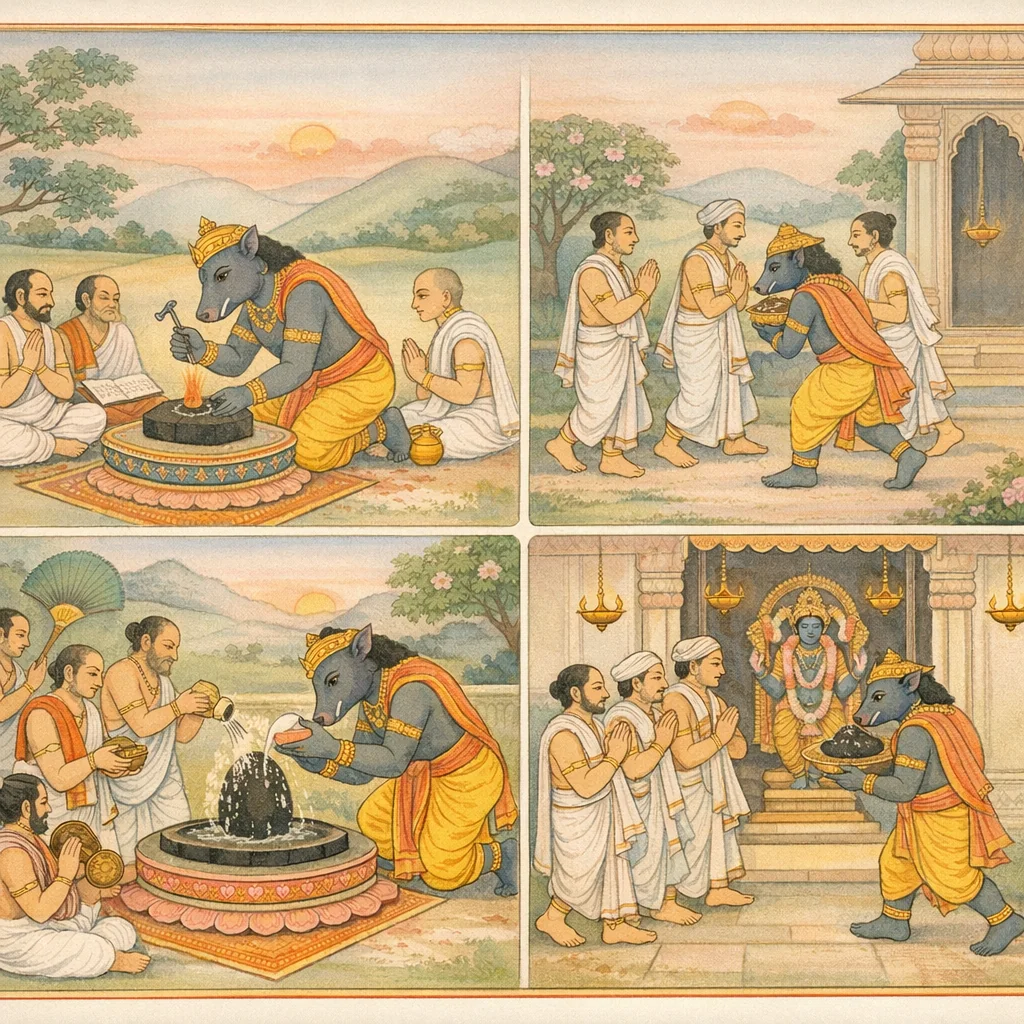
Adhyaya 182: Installation of a Stone Image (Ritual Procedure for Consecration)
Śailārcāsthāpana (Śilā-pratimā-pratiṣṭhā)
Ritual-Manual (Pratiṣṭhā and Temple-Entry Rites)
In dialogue, Varāha instructs Pṛthivī with a step-by-step ritual manual for the installation and consecration (sthāpana/pratiṣṭhā) of a stone image of Nārāyaṇa. The rite begins by choosing a well-examined, flawless stone and appointing a skilled artisan, then proceeds through marking/drawing, circumambulation, and preliminary worship with offerings such as lamps and bali. Varāha supplies multiple mantras for consecration, invocation (āvāhana), ritual bathing (snāpana), and temple entry (prāsāda-praveśa), stressing east-facing placement and overnight observances in white garments with the sacred thread. The chapter prescribes homa with specified oblations, proper calendrical timing (including Pūrvaproṣṭhapadā), festive soundscapes of song and instruments (gīta-vādya) with Vedic recitation, post-installation offerings, and a śānti-japa for social welfare—kingdom, rains, and agriculture. Merit statements conclude, linking ritual correctness to communal stability and an Earth-centered order.
Primary Speakers
Key Concepts
Shlokas in Adhyaya 182
Verse 1
अथ शैलार्चास्थापनम् ॥ श्रीवराह उवाच ॥ पुनरन्यत्प्रवक्ष्यामि तच्छृणुष्व वसुन्धरे ॥ यथा तिष्ठामि शैलेषु प्रतिमायामितस्ततः ॥
Śrī Varāha said: “Again I shall expound another procedure; listen, O Vasundharā, how I am established upon mountains—here and there—in the form of a sacred icon (mūrti).”
Verse 2
सुरूपां च शिलां दृष्ट्वा निःशल्यां सुपरिक्षिताम् ॥ तत्र दक्षं रूपकारं शीघ्रं च विनियोजयेत् ॥
Having found a well-shaped stone, free from flaws and carefully examined, one should promptly engage there a skilled sculptor.
Verse 3
शीघ्रमालिख्य तं तत्र श्वेतवर्तिकया नरः ॥ प्रदक्षिणां ततः कृत्वा पूजयेदक्षतादिभिः ॥
There, one should quickly sketch or mark it with a white chalk-stick; then, having performed pradakṣiṇā (circumambulation), one should worship with akṣata (unbroken rice) and related offerings.
Verse 4
दीपकं च ततो दद्याद्बलिं दध्योदनेन च ॥ नमो नारायणायेति उक्त्वा मन्त्रमुदीरयेत् ॥
Then one should offer a lamp and a bali-offering of curd-rice; having said “Namo Nārāyaṇāya” (“Homage to Nārāyaṇa”), one should recite the mantra.
Verse 5
मन्त्रः— योऽसौ भवान्सर्वजनप्रवीरः सोमाग्नितेजाः सुमतिप्रधानः ॥ एतेन मन्त्रेण तु वासुदेव प्रतिष्ठितो वर्धय कीर्तिराशिम् ॥
Mantra: “You who are the champion among all beings, possessing the radiance of Soma and Agni, foremost in wise counsel—by this mantra, O Vāsudeva, once established, increase the gathered measure of renown.”
Verse 6
प्रवर अयुतवराह जय जय वर्धस्व ॥ अनेनैव तु मन्त्रेण कर्तव्यं यस्य यादृशम् ॥ एवंरूपं ततः कृत्वा देवं नारायणं प्रभुम् ॥
“O excellent one, O Ayuta-Varāha—victory, victory; flourish.” By this very mantra one should perform what is fitting according to the intended form; then, having fashioned it in such a form, one proceeds with the Lord Nārāyaṇa, the divine master.
Verse 7
ततो वै स्थापयेत् तत्र पूर्वाभिमुखमेव तु ॥ अहोरात्रमुषित्वैवं शुक्लवस्त्रेण भूषितः ॥
Then one should install it there, facing east. Having observed thus for a day and a night, adorned in white garments, the rite continues.
Verse 8
शुक्लयज्ञोपवीती च कृत्वा वै दन्तधावनम् ॥ सर्वगन्धोदकं गृह्य इमं मन्त्रमुदाहरेत् ॥
Wearing a white yajñopavīta (sacrificial thread) and having performed the cleansing of the teeth, taking water scented with various fragrances, one should recite this mantra.
Verse 9
मन्त्रः— योऽसौ भवांस्तिष्ठति सर्वरूपं मायाबलं सर्वजगत्स्वरूपम् ॥ एतेन मन्त्रेण जगत्स्वरूप सम्पूजितस्तिष्ठसि लोकनाथ ॥
Mantra: “You who abide as all forms, whose power is māyā, whose nature is the form of the entire world—by this mantra, O embodiment of the world, being fully worshipped, you abide, O Lord of the world.”
Verse 10
यो मां संस्थापयेद्भूमे मम कर्मपरायणः ॥ स याति वैष्णवं लोकं नात्र कार्या विचारणा ॥
Whoever installs me upon the earth, devoted to my ritual act, goes to the Vaiṣṇava world; regarding this, no further deliberation is enjoined.
Verse 11
यावकं पायसं भुक्त्वा अहोरात्रं समापयेत् ॥ ततः पश्चिमसन्ध्यायां दद्याच्चत्वारि दीपकान् ॥
Having eaten barley-gruel and milk-rice, one should complete the observance for a full day and night. Then, at the evening sandhyā (twilight), one should offer four lamps.
Verse 12
पञ्चगव्यं च गन्धं च वारिणा सह मिश्रयेत् ॥ चतुरः कलशांश्चैव स्थापयेत्पादमूलतः ॥
One should mix pañcagavya and fragrant substances together with water. And one should place four kalaśa water-pots at the base of the feet (of the deity or icon).
Verse 13
गीतवादित्रघोषेण उत्सवं तत्र कारयेत् ॥ ब्राह्मणैः सामगैस्तत्र वेदघोषं तु कारयेत् ॥
There one should have a festival conducted with the sound of song and instruments. And there one should have Vedic recitation performed by Brāhmaṇas who chant the Sāman hymns.
Verse 14
ब्रह्माक्षरसहस्राणि पठतां ब्रह्मवादिनाम् ॥ येषां पठितशब्देन शुभगीतस्वरेण च ॥
For those expounders of sacred knowledge who recite thousands of syllables of the Brahman-text, by the very sound of their recitation and by the auspicious tone of their chanting...
Verse 15
पुनरावाहनं कुर्यान्मन्त्रेणानेन सुव्रतः ॥ आगच्छ हे देव सुमन्त्रयुक्तः पञ्चेन्द्रियैः षट्सु तथा प्रधानः ॥
A disciplined observer should perform a re-invocation (āvāhana) with this mantra: “Come, O God—endowed with the good mantra; present with the five senses, with the six (categories), and likewise as the Pradhāna, the primordial principle.”
Verse 16
एतेषु भूतेषु च संविधाता आवासितस्तिष्ठति लोकनाथ ॥
And within these beings and elements, the Ordainer—installed here—abides as the Lord of the world.
Verse 17
अनेनैव तु मन्त्रेण समित्तिलघृतेन च ॥ मधुना चैव होतव्यमष्टोत्तरशताहुतिः ॥
And with this very mantra, one should offer oblations with kindling-sticks, sesame, and ghee, and also with honey—making one hundred and eight offerings.
Verse 18
पञ्चगव्यं ततः प्राश्य मन्त्रेण विधिपूर्वकम् ॥ सर्वगन्धैश्च लाजैश्च पञ्चगव्यजलं तथा ॥
Then, having consumed pañcagavya in due form with the mantra, (one should proceed) with all fragrances and with parched grains (lāja), and likewise with pañcagavya-water.
Verse 19
ततः प्रासादे स्थाप्योऽहं गीतवादित्रमङ्गलैः ॥ सर्वगन्धान्स्ततो गृहीत्वा इमं मन्त्रं उदाहरेत् ॥
Then I am to be installed in the temple (prāsāda) amid auspicious songs and instruments. Then, taking all fragrances, one should pronounce this mantra.
Verse 20
मन्त्रश्च — योऽसौ भवान्लक्षणलक्षितश्च लक्ष्म्या च युक्तः सततं पुराणः ॥ अत्र प्रासादे सुसमिद्धतेजाः प्रवेशमायाहि नमो नमस्ते ॥
And the mantra is: “You, indeed, who are marked by auspicious characteristics, ever united with Lakṣmī, the eternal Ancient One—here, in this temple, O one of well-kindled radiance, come and enter. Homage, homage to you.”
Verse 21
तत एतेन मन्त्रेण प्रासादं संप्रवेशयेत् ॥ प्रतिमा स्थापितव्या मे मध्ये न तु विपार्श्वतः ॥
Then, with this mantra, one should enter the temple. The image (pratimā) is to be installed for Me in the center, not to either side.
Verse 22
एवं संस्थापनं कृत्वा दद्यादुद्वर्तनं विभोः ॥ चन्दनं कुङ्कुमं चैव मिश्रं कालेयकेन च ॥
Having thus completed the installation, one should offer udvartana (ceremonial anointing/rubbing) to the Lord—sandalwood and saffron, mixed also with kāleyaka.
Verse 23
एवं चोद्वर्तनं कृत्वा इमं मन्त्रमुदाहरेत् ॥ योऽसौ भवान्सर्वजगत्प्रधानः सम्पूजितो ब्रह्मबृहस्पतिभ्याम् ॥ प्रवन्दितः कारणं मन्त्रयुक्तः सुस्वागतं तिष्ठ सुलोकनाथ ॥
And having thus performed the udvartana, one should recite this mantra: “You indeed—preeminent over the entire world—are worshipped by Brahmā and by Bṛhaspati; you are praised as the causal principle, endowed with mantra. Welcome; remain here, O lord of the virtuous worlds.”
Verse 24
एवं संस्थापनं कृत्वा गन्धमाल्यैश्च पूजयेत् ॥ शुक्लवस्त्राणि मे दद्यादिमं मन्त्रमुदाहरेत् ॥
Having thus completed the installation, one should worship with fragrances and garlands. One should offer Me white garments and recite this mantra.
Verse 25
मन्त्रः— वस्त्राणि देवेश गृहाण तानि मया सुभक्त्या रचितानि यानि ॥ इमानि सन्धारय विश्वमूर्त्ते प्रसीद मह्यं च नमो नमस्ते ॥
Mantra: “O Lord of gods, accept these garments which I have prepared with sincere devotion. Wear these, O You whose form is the universe; be gracious to me—obeisance, obeisance to You.”
Verse 26
एवं वस्त्राणि मे दद्याद्विधिदृष्टेन कर्मणा ॥ धूपनं मे ततो दद्यात्कुङ्कुमागुरुमिश्रितम् ॥ एवं च धूपनं दद्यादिमं मन्त्रमुदीरयेत् ॥
Thus one should offer Me the garments through an act in accordance with the prescribed rule. Then one should offer Me incense mixed with kunkuma (saffron) and agaru. And while offering the incense, one should utter this mantra.
Verse 27
एवं पूजां ततः कृत्वा प्रापणं च निवेदयेत् ॥ पूर्वोक्तेन विधानेन प्रापणं चोपकल्प्य च ॥
Having thus performed the worship, one should present the offering called prāpaṇa. And having prepared the prāpaṇa according to the procedure stated earlier, one should present it.
Verse 28
पूर्वोक्तेनैव मन्त्रेण दद्यत्प्रापणकं बुधः ॥ प्रापणान्ते चाचमनं दद्याद्देहविशुद्धये ॥
Using that same mantra stated earlier, the wise person should offer the prāpaṇa. And at the conclusion of the prāpaṇa, one should perform ācamana—ritual sipping of water—for purification of the body.
Verse 29
शान्तिजापस्ततः कार्यः सर्वकार्यर्थसिद्धिदः ॥ मन्त्रः— त्वं वै सुशान्तिं कुरु लोकनाथ राज्ञः सराष्ट्रस्य च ब्राह्मणानाम् ॥ बालेषु वृद्धेषु गवाङ्गणेषु कन्यासु शान्तिं च पतिव्रतासु ॥
Then śānti-japa, a peace-recitation, should be performed, for it is said to grant accomplishment of the aims of all undertakings. Mantra: “You indeed establish profound peace, O Lord of the world: for the king and his realm, and for the brāhmaṇas; peace among children and the elderly, among cows and households, among maidens, and also among devoted, faithful wives.”
Verse 30
रोगा विनश्यन्तु च सर्वतश्च कृषीवलानां च कृषिः सदा स्यात् ॥ सुभिक्षयुक्ताश्च सदा हि लोकाः काले सुवृष्टिर्भविता च शान्तिः ॥
May diseases be destroyed on every side; and may the agriculture of cultivators always prosper. May people ever be endowed with good provisions; may timely, beneficial rains occur—and may there be peace.
Verse 31
आगमिष्याम्यहं देवि मन्त्रपाठो मम प्रियः ॥ निःशब्दं च ततः कृत्वा स्थाप्यो भागवतैः सह
“I shall come, O Goddess; the recitation of mantras is dear to me. Then, having established silence, (the image) should be installed together with the devotees of Bhagavān.”
Verse 32
एवं विधिं ततः कृत्वा विधिदृष्टेन कर्मणा ॥ सम्पूज्य तत्र देवेशं ब्राह्मणान्भोजयेद्व्रती
“Thus, having performed the rite according to the procedure, by an act sanctioned by rule, the vowed practitioner should worship the Lord there and feed the brāhmaṇas.”
Verse 33
दीनानाथान्प्रतर्प्याथ यथाविभवशक्तितः ॥ य एतेन विधानेन कुर्यात्संस्थापनं मम
“Then, having satisfied the poor and the unprotected according to one’s means and capacity—whoever performs my installation by this method…”
Verse 34
यावन्तो मम गात्रेषु जायन्ते जलबिन्दवः ॥ तावद्वर्षसहस्राणि मम लोकेषु तिष्ठति
“For as many water-drops as arise upon my limbs, for that many thousands of years he remains in my worlds.”
Verse 35
यो मां संस्थापयेद्भूमे सर्वाहङ्कारवर्जितः ॥ तारितं च कुलं तेन सप्त सप्त च सप्ततिः
“Whoever installs me upon the earth, free from all egoism—by him his lineage is carried across (to safety), seven and seven and seventy (generations).”
Verse 36
एतत्ते कथितं भद्रे शैलिकास्थापनं मम ॥ धर्मसन्धारणार्थाय मम भक्तसुखाय च
This has been told to you, O auspicious one: my installation upon stone, for the sustaining of dharma and for the welfare of my devotees.
Verse 37
करणधारणप्रवध्यं उदाहरणम् अपराजितम् अजारामर । सम्पूज्य स्नापयात्मानम् अनेन मन्त्रेण ॐ नमो वासुदेवाय ॥ एवं तु स्थापनं कृत्वा शिलायां मम सुन्दरि ॥ ततोऽधिवासनं कार्यं पूर्वप्रोष्ठपदासु च
Having duly worshipped, one should bathe oneself with this mantra: “Oṃ, homage to Vāsudeva.” Thus, having performed my installation upon a stone, O fair one, then the rite of adhivāsana should be performed, on the days of Pūrvaproṣṭhapadā as well.
Verse 38
एवं कृते विधाने भवामि सन्निहितः स्वयम् ॥ व्यतीतायां तु शर्वर्यां प्रभाते विमले ततः
When the procedure is performed in this manner, I myself become present. And when the night has passed, then, in the clear morning…
Verse 39
मन्त्रः — असावनादिः पुरुषः पुराणो नारायणः सर्वजगत्प्रधानः ॥ गन्धं च माल्यानि च धूपदीपौ गृहाण देवेश नमो नमस्ते
Mantra: “That primordial Person, without beginning, the Ancient—Nārāyaṇa, the foremost principle of the entire world. Accept the fragrance, the garlands, and the incense and lamp, O Lord of gods; homage, homage to you.”
Frequently Asked Questions
The text frames correct ritual installation as a mechanism for sustaining dharma and collective stability: the śānti-japa explicitly targets the welfare of the polity (rājñah and rāṣṭra), the protection of vulnerable groups, agricultural success, and timely rains. In this internal logic, temple consecration is not only personal devotion but a public-order practice linking sacred procedure to terrestrial balance addressed through Pṛthivī.
The excerpt specifies timing elements including an overnight observance (ahorātra), evening action at the western twilight (paścima-sandhyā), and a calendrical reference to Pūrvaproṣṭhapadā (noted as a timing for adhivāsana). It also indicates a next-morning sequence after the night has passed (vyatītāyāṃ tu śarvaryāṃ prabhāte vimale).
Environmental and terrestrial balance is expressed through the Pṛthivī-addressed pedagogy and, most concretely, the śānti-japa’s desired outcomes: elimination of disease, agricultural flourishing (kṛṣi), abundance (subhikṣa), and timely rainfall (kāle su-vṛṣṭi). The narrative thus encodes an early ecological ethic where ritual order is mapped onto Earth’s productivity and social resilience.
No royal dynasties or named historical lineages appear in the provided excerpt. The chapter references social and ritual categories—brāhmaṇas (including sāmagas and brahmavādins), the king (rājā), and community groups (children, elders, women, cattle/households)—as recipients of the śānti benefits, but without specific proper names.