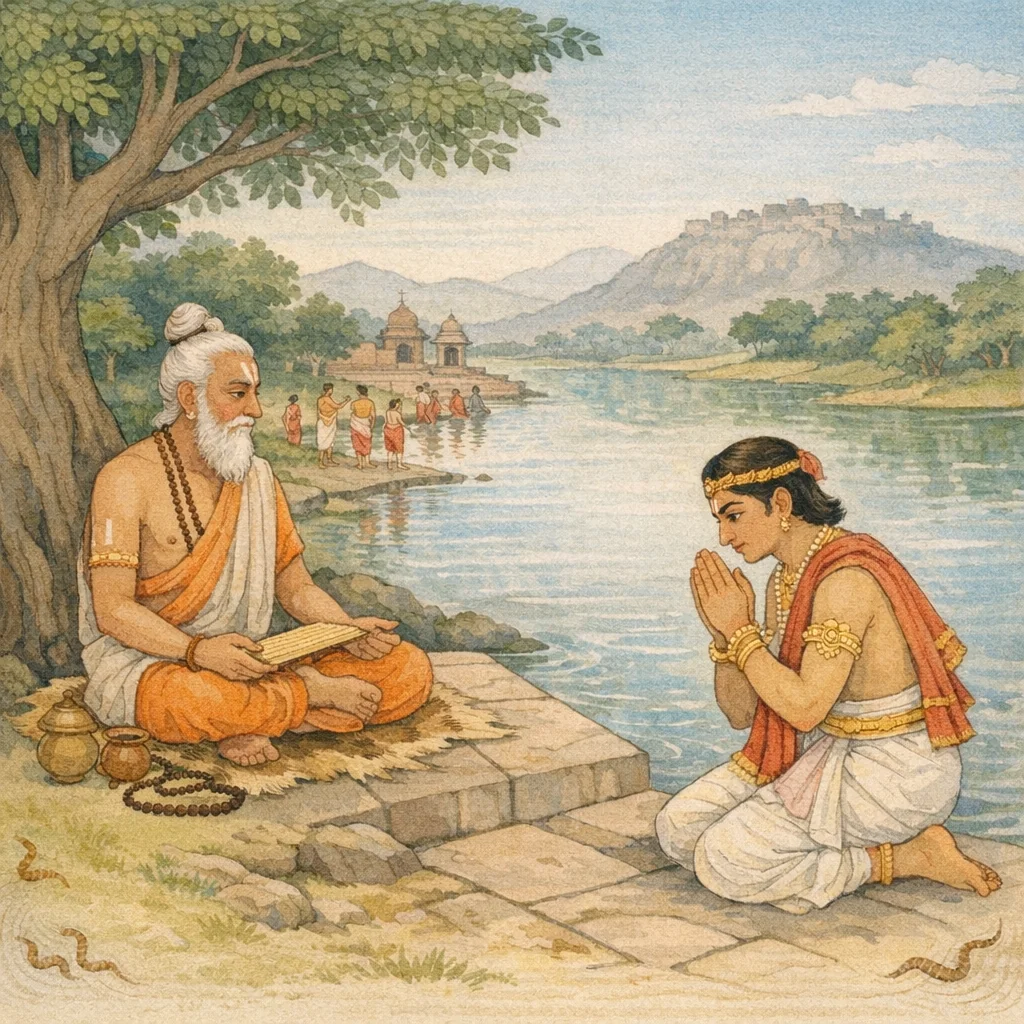
Adhyaya 176: The Māhātmya of Kṛṣṇagaṅgodbhava, Kāliñjara, and the Five Sacred Baths: The Tale of Pāñcāla and Tilottamā
Kṛṣṇagaṅgodbhava–Kāliñjara–Pañcatīrtha-māhātmya (Pāñcāla–Tilottamā-upākhyāna)
Tīrtha-māhātmya (Pilgrimage Theology) and Ethical-Discourse (Transgression, Atonement, and Social Harm)
Within the Varāha–Pṛthivī teaching frame, this chapter illustrates how earthly tīrthas serve as instruments of ethical repair. A young merchant-brāhmaṇa, Pāñcāla, comes to Mathurā and repeatedly bathes at Kṛṣṇagaṅgodbhava, gaining outward purity, yet when he does not bathe his hidden wrongdoing appears as worms. The sage Sumantu notices this recurring impurity and questions him, drawing out the confession of an incestuous liaison with his sister Tilottamā, portrayed as lineage-destroying and socially harmful. As the two consider self-immolation for expiation, an aerial voice redirects them to non-violent purification through tīrtha-sevā and bathing at the prescribed pañcatīrtha times on specific tithis. Varāha concludes by affirming the Earth-centered power of Mathurā’s waters and the sanctity of Kāliñjara to cleanse moral pollution and restore socio-ecological order.
Primary Speakers
Key Concepts
Shlokas in Adhyaya 176
Verse 1
श्रीवराह उवाच ॥ पञ्चानां तु कनिष्ठो यः पञ्चालो ब्राह्मणात्मजः ॥ वाणिज्यभाण्डमादाय समूहस्य प्रसङ्गतः
Śrī Varāha said: Among five brothers, the youngest—Pañcāla, a Brahmin’s son—took up merchandise and, by circumstance, became associated with a trading group.
Verse 2
सार्थेन निष्ठितः सोऽथ धनवान् रूपवांस्ततः ॥ क्रमेण ते सर्वदेशान् विषयान् पर्वतान् नदीः
Then, established with the caravan, he became wealthy and handsome; in due course they traversed all regions—territories, mountains, and rivers.
Verse 3
आक्रम्य तत्र सम्प्राप्ता यत्र सा मथुरा पुरी ॥ आवासं कारयामासुः प्रभूतयवसेन्धने
Proceeding onward, they arrived there—at the city of Mathurā—and had lodgings prepared, with abundant fodder and fuel.
Verse 4
तस्मिन्स्थाने स पाञ्चालः प्रातस्तु पुरुषैः सह ॥ तस्मिंस्तीर्थवरे स्नाप्य वस्त्रालङ्कारभूषितः ॥ ऐश्वर्यमदभावेन यानेन महता तदा
At that place, Pañcāla, early in the morning with his men, bathed at that excellent tīrtha; adorned with garments and ornaments, and—free from the arrogance born of prosperity—he then went in a grand vehicle.
Verse 5
कौतुकार्थं ततो गत्वा देवं गर्त्तेश्वरं तदा ॥ तिलोत्तमायास्तद्रूपं दृष्ट्वा मोहवशं गतः
Then, out of curiosity, he went and approached the deity Gartteśvara; upon seeing that form of Tilottamā, he fell under the power of delusion.
Verse 6
धात्रेयिकायास्तस्याश्च बहुमानपुरःसरम् ॥ वस्त्राणि बद्धरूपाणि कटकानां शतानि च
With honor foremost, he offered to that Dhātreyikā garments of well-arranged make, and hundreds of bracelets as well.
Verse 7
हारा रत्नमयास्तद्वद्ददौ लोभविमोहितः ॥ ददावगुरुसारं च सकर्पूरं सचन्दनम्
Likewise, he gave necklaces made of jewels; deluded by greed, he also gave fine agarwood essence, together with camphor and sandalwood.
Verse 8
देवतादर्शनं कृत्वा दत्त्वा दानान्यनेकशः
Having beheld the deity, and having given many gifts in various ways,
Verse 9
तस्या गृहवरे तत्र वसति स्म दिनेदिने ॥ प्रहरार्धे दिने जाते ततः स्वशिबिरं ययौ
There, in her excellent house, he stayed day after day; when half a watch of the day had passed, he then went to his own camp.
Verse 10
एवं तु कुर्वतस्तस्य मासषट्कं ततो गतम् ॥ अथैकदा समायातः स्नातुं तत्र सुमन्तुना ॥
As he continued to act in this manner, six months passed. Then, on one occasion, Sumantu came there to bathe.
Verse 11
स्वाश्रमस्थेन दृष्टः स कृमियुक्तः समागतः ॥ कृमयो रोमकूपेभ्यः पतमानाऽनेकशः ॥
Seen by the one residing in his own hermitage, that man arrived infested with worms; worms were falling in great numbers from the pores of his skin.
Verse 12
यावत्स्नानं स कुरुते पतते राशिमात्रकः ॥ स्नाने कृते नश्यति च सुरूपश्चाभिजायते ॥
So long as he performs the bath, they fall in heap-like quantities. When the bathing is completed, they disappear, and he becomes of pleasing appearance.
Verse 13
एवं सुमन्तुना दृष्टमाश्चर्यं बहुवासरम् ॥ सुमन्तुस्तर्कयामास कोऽयं कस्यात्मजो युवा ॥
Thus, for many days Sumantu observed this marvel. Sumantu then reasoned: 'Who is this youth, and whose son is he?'
Verse 14
इति चिन्तासमायुक्तस्तमपृच्छद्विशङ्कितः ॥ कस्त्वं कस्यासि सुभग का जातिः कश्च ते पिता ॥
Thus filled with concern and uncertainty, he asked him: 'Who are you, fortunate one? To whom do you belong? What is your social origin, and who is your father?'
Verse 15
किं करोṣi दिवरात्रौ ब्रूहि त्वं पृच्छतो मम ॥ पाञ्चाल उवाच ॥ पाञ्चालो ब्राह्मणसुतो वाणिज्यं च समाश्रितः ॥
“What do you do by day and by night? Tell me, as I ask.” Pāñcāla said: “I am Pāñcāla, the son of a brāhmaṇa, and I have taken up trade.”
Verse 16
दक्षिणापथदेशाच्च मथुरायां समागतः ॥ निशामुषित्वा शिबिरे प्रातस्तीर्थं समाश्रितः ॥
From the region known as Dakṣiṇāpatha I arrived at Mathurā. Having spent the night in a camp, in the morning I approached the sacred ford (tīrtha).
Verse 17
स्नात्वा महेश्वरं दृष्ट्वा त्रिगर्तेश्वरसंज्ञितम् ॥ कालिञ्जरं भवत्पादौ गच्छामि शिबिरं ततः ॥
After bathing and beholding Maheśvara known as Trigarteśvara, I go to Kāliñjara, to your sacred feet; thereafter I return to the camp.
Verse 18
सुमन्तुरुवाच ॥ आश्चर्यं तव देहेऽस्मिन्नित्यं पश्यामि निःसृतम् ॥ अस्नाते कृमिसंपूर्णं स्नाते निर्मलवर्चसम् ॥
Sumantu said: “I constantly see a marvel issuing forth from your body: when you have not bathed it is full of worms; when you have bathed it possesses a clean radiance.”
Verse 19
कालिञ्जरस्य संस्पर्शाच्छुद्धं देहं च दृश्यते ॥
By contact with Kāliñjara, the body is seen to become purified as well.
Verse 20
निरूप्य कथयास्माकं यत्ते प्रच्छन्नकिल्बिषम्
Having examined it, explain to us what sin or fault of yours is being concealed.
Verse 21
तीर्थमाहात्म्याभवं च दृष्ट्वा पृच्छामि ते हितम् ॥ इति तस्य मुनेः श्रुत्वा त्रिकालज्ञस्य भाषितम्
And seeing the sacred place’s greatness diminished, I ask what is beneficial for you. Thus, having heard the words of that sage, who knew the three times (past, present, and future)…
Verse 22
किञ्चिन्नोवाच पृष्टोऽपि एवमेव गतः पुनः ॥ तस्यामासीत्तस एकान्ते तां तु पप्रच्छ सादरम्
Though questioned, she said nothing; again he went away in the same manner. Then, in privacy, he remained with her and asked her respectfully.
Verse 23
का त्वं कस्यासि सुभगे कश्च देशः प्रियंवदे ॥ किं तत्कारणमुद्दिश्य वसस्यत्र सुखं सदा
Who are you, fortunate lady—whose are you (to what family do you belong), and what is your country, sweet-spoken one? For what reason do you dwell here, always at ease?
Verse 24
इति निर्बन्धतः पृष्टा किञ्चिन्नोवाच तं प्रति ॥ पुनःपुनश्च पप्रच्छ सा प्रोवाच न किञ्चन
Thus, when pressed insistently and questioned, she said nothing in reply to him. Again and again he asked; she spoke nothing at all.
Verse 25
किञ्चित्कालं समास्थाय तेनोक्तं हि प्रियां प्रति ॥ त्यक्ष्यामि हि प्रियान्प्राणान्यदि सत्यं न वक्ष्यति
After waiting for some time, he said to his beloved: “Truly, I shall give up my dear life-breaths if you do not speak the truth.”
Verse 26
निर्बन्धं तस्य तज्ज्ञात्वा दुःखेनोवाच तं प्रति ॥ पितरौ भ्रातरश्चेति देशं ज्ञातिं ततः कुलम्
Understanding his insistence, she spoke to him in sorrow: she described her parents and brothers, and then her country, her kin-group, and her lineage.
Verse 27
पाञ्चालनगरी रम्या गङ्गायाश्चोत्तरे तटे ॥ तस्यां तौ पितरौ मह्यं वसतश्च यदृच्छया
There is the lovely city of Pāñcāla on the northern bank of the Gaṅgā. There my two parents live, as it happened by circumstance.
Verse 28
तस्मिन् स्थाने पितुर्मह्यं पञ्च पुत्रा मया सह ॥ जातास्तेषामहं षष्ठी कनिष्ठा विधवाऽभवम्
In that place, to my father, five sons were born together with me. Of them I was the sixth—the youngest—and I became a widow.
Verse 29
योऽसौ कनिष्ठको भ्राता मम ज्येष्ठश्च पञ्चमः ॥ बाल एव गतो देशं धनतृष्णाप्रलोभितः
That youngest brother of mine—who was the fifth among the elders—went away to another country while still a boy, enticed by thirst for wealth.
Verse 30
तस्मिङ्गतेऽथ पितरौ कालधर्ममुपेयतुः ॥ तीर्थेऽस्मिन्नस्थिपातार्थमहं सार्थैः सहागता ॥
After he had departed, my parents then met the law of Time (that is, they died). I came to this sacred ford with caravans, for the purpose of consigning their bones (funerary remains).
Verse 31
अत्र स्नानपरा नित्यं देवब्राह्मणवन्दनम् ॥ कुर्वन्ती वशमापन्ना आसां यस्या ममेदृशम् ॥
Here, ever devoted to ritual bathing and regularly offering reverence to the gods and to Brahmins, I nevertheless fell under another’s control—one among those women whose condition became like mine.
Verse 32
नीता नरकमत्युग्रं मया पापिष्ठया भृशम् ॥ एवं सा तस्य तत्सर्वं कथयित्वा तिलोत्तमा ॥
By me—most sinful—she was driven severely into a most dreadful hell. Thus Tilottamā, having related all of that to him, continued her account.
Verse 33
रुरोद सुस्वरं दीना स्मृत्वा पूर्वं कुलं वरम् ॥ विलप्य बहुधा रात्रौ संस्मृत्य स्वं विचेष्टितम् ॥
Wretched, she wept in a clear voice, remembering her former noble family. Lamenting again and again through the night, she recalled her own misdeeds and conduct.
Verse 34
तस्याः विलपितं श्रुत्वा स्त्रीजनः स तदागतः ॥ सान्त्वयामास तां बालां कि भद्रे रुदितं तव ॥
Hearing her lament, the group of women came there. They consoled the young girl: “O good one, why are you weeping?”
Verse 35
आश्रिता कुलटाधर्मं कुलनाशो मया कृतः ॥ कुलद्वये च पुरुषा एकविंशतिसंख्यया ॥
Having taken refuge in the conduct of a courtesan, I have brought about the ruin of the family. And in two lineages, the men—twenty-one in number—were implicated.
Verse 36
एतच्छ्रुत्वा स पाञ्चाल्यो मूर्च्छितो धरणीं गतः ॥ ताः स्त्रियस्तां समाश्वास्य पाञ्चाल्यं परिवार्य च ॥
Hearing this, the man of Pāñcāla fainted and fell to the ground. Those women, after comforting her, also gathered around the Pāñcāla man.
Verse 37
ततस्तेन सवृत्तान्तं कथितं च कुलं महत् ॥ तिलोत्तमासहायानां स्त्रीणामग्रे सविस्तरम् ॥
Then, in the presence of the women who were companions of Tilottamā, he narrated in detail the entire account and the great lineage involved.
Verse 38
ततः स विमना जातो अगम्यागमनेन च ॥ प्रायश्चित्ते मतिरभून्निर्विण्णस्य दुरात्मनः ॥
Then he became downcast because he had approached what must not be approached. The mind of that despondent, ill-guided man turned toward expiation (prāyaścitta).
Verse 39
ब्रह्महा च सुरापश्च ब्राह्मणो यदि जायते ॥ प्रायश्चित्तं विनिर्दिष्टं मुनिभिर्देहनाशनम् ॥
If a Brahmin becomes a slayer of a Brahmin and a drinker of liquor, the expiation prescribed by sages is the destruction of the body—that is, a penance culminating in death.
Verse 40
मातरं गुरुपत्नीं च स्वसारं पुत्रिकां वधूम् ॥ गत्वा तु प्रविशेदग्निं नान्या शुद्धिर्विधीयते ॥
Having violated one’s mother, the preceptor’s wife, one’s sister, one’s daughter, or one’s daughter-in-law, one should go and enter fire; no other means of purification is prescribed.
Verse 41
ब्रह्मघ्नश्च सुरापश्च स्त्रीघ्नश्च गुरुतल्पगः ॥ अगम्यागमनं कृत्वा एषां स समतामियात् ॥
One who has intercourse with a forbidden woman becomes equal in status (of culpability) to a slayer of a brāhmaṇa, a drinker of intoxicants, a slayer of a woman, and one who violates the teacher’s bed.
Verse 42
इति श्रुत्वा तु पाञ्चाली ज्येष्ठभ्रातरमेव तम् ॥ द्विजेभ्यः प्रददौ सर्वमङ्गलग्नं विभूषणम् ॥
Having heard this, Pāñcālī (Draupadī) gave to the twice-born (brāhmaṇas) all the auspicious ornaments that were then upon her (worn at that auspicious time).
Verse 43
रत्नं वस्त्रं धनं धान्यं यत्किञ्चित्तत्र संस्थितम् ॥ तत्सर्वं ब्राह्मणेभ्यश्च दत्त्वाशेषं ददौ धनम् ॥
Whatever was present there—jewels, garments, wealth, grain, anything at all—having given all of that to the brāhmaṇas, she gave away the remaining wealth as well.
Verse 44
कालिञ्जरस्य भूषार्थमारामार्थं विशेषतः ॥ कृष्णगङ्गोद्भवे तीर्थे चितां कृत्वा विधानतः ॥
For the adornment of Kāliñjara, and especially for the establishment of a pleasure-grove (ārāma), at the sacred ford that arises from the Kṛṣṇagaṅgā, a funeral pyre was constructed according to prescribed procedure.
Verse 45
आत्मनश्च विशुद्ध्यर्थं प्रजज्वाल हुताशनम् ॥ इति निश्चित्य तत्रैव स्नात्वा देवं प्रणम्य च ॥
And for the sake of her own purification, she kindled the sacred fire; having thus resolved, she bathed right there and bowed in reverence to the deity.
Verse 46
मरणायोपयोग्यानि कृत्वा कर्माणि तत्र च ॥ माथुरान्स समाहूय दत्त्वा दानानि सर्वशः ॥
And having performed there the rites appropriate for death, he summoned the Māthuras and distributed gifts in every manner.
Verse 47
क्रीत्वा ग्रामांश्च तत्रैव ब्राह्मणेभ्यो ददौ तदा ॥ ईशावास्यं जपं दिव्यं जापकेभ्यः शृणोति च ॥
Having purchased villages, there itself he then gave them to the brāhmaṇas; and he also listens to the divine japa of the Īśāvāsya as recited by professional reciters.
Verse 48
तेभ्योऽपि प्रददौ द्रव्यं सत्रार्थं च विभागशः ॥ और्ध्वदैहिकभागार्थं कल्पयित्वा यथाविधि ॥
To them also he gave resources, apportioned for the purpose of a satra (communal rite and feeding), and—according to rule—made arrangements for the share meant for post-funerary rites.
Verse 49
स्नात्वा तीर्थे च कृष्णस्य देवं दृष्ट्वा प्रणम्य च ॥ कालिञ्जरस्य पूजार्थं सत्रार्थं परिकल्प्य च ॥
Having bathed at the tīrtha of Kṛṣṇa, and having seen and bowed to the deity, he also arranged provisions for the worship of Kāliñjara and for the purpose of a satra.
Verse 50
देवालयं च तत्रैव कृत्वा सन्दिश्य सार्थकान् ॥ सुमन्तोः प्रवरस्याथ पादौ जग्राह धर्मवित् ॥
Having built a temple there itself and, after instructing the leaders of the caravan, the righteous man then clasped the feet of the eminent Sumantu.
Verse 51
देव ज्ञानं च ते दिव्यमद्भुतं लोमहर्षणम् ॥ अगम्यागमनादेव पापं जातं मम प्रभो ॥
O Lord, your divine knowledge is wondrous and awe-inspiring. Yet merely by going to a place that should not be approached, sin has arisen in me, O master.
Verse 52
आगतोऽहं यदारभ्य मथुरायां ततो गुरो ॥ भगिन्या सह संयोगे जातोऽयं कुलनाशकः ॥
From the time I arrived in Mathurā, O teacher, through union with my sister there has arisen this destroyer of the family line.
Verse 53
त्वया निर्मलदृष्ट्या च वीक्षितोऽहं पुरा मुने ॥ कृमयो मम गात्रात्तु निर्गच्छन्तो हि नित्यदा ॥
Formerly, O sage, when you looked upon me with a purified gaze, worms were continually emerging from my body.
Verse 54
कृष्णगङ्गाप्रभावेण पुनर्निर्मलतां गतम् ॥ तत्सर्वं हि त्वया दृष्टं पृष्टश्चाहं पुनः पुनः ॥
By the power of the Kṛṣṇa-Gaṅgā I again attained purity. All of that was indeed seen by you, and I was questioned again and again.
Verse 55
अनुज्ञां देहि भो स्वामिंस्तव पादौ नमाम्यहम् ॥ विश्राव्य तस्य तत्पापं चितां दीप्य घृतोक्षिताम् ॥
Grant permission, O master; I bow at your feet. Having proclaimed his sin, he kindled the funeral pyre, sprinkled with ghee.
Verse 56
प्रवेष्टुकामं तत्राग्नौ खे प्रोवाचाशरीरिणी ॥ मैवं कार्षीः साहसं च विपाप्मानौ यतश्च वाम् ॥
As he wished to enter the fire there, a bodiless voice spoke in the sky: “Do not act thus rashly—for you two are free from sin.”
Verse 57
कस्माद्वा कस्य सन्त्रासान्मरणे कृतनिश्चयौ ॥ यत्र कृष्णस्य सञ्चारः क्रीडितं च यथासुखम् ॥
Why—and out of fear of whom—have you resolved upon death, in a place where Kṛṣṇa moves about and plays at ease?
Verse 58
चक्राङ्कितपदा तेन स्थानं ब्रह्मसमं शुभम् ॥ अन्यत्र हि कृतं पापं तीर्थमासाद्य गच्छति ॥
Marked by his discus-imprinted footprints, that place is auspicious—equal to Brahman’s realm. Sin committed elsewhere departs upon reaching a tīrtha, a sacred ford of pilgrimage.
Verse 59
तीर्थे च यत्कृतं पापं वज्रलेपो भविष्यति ॥ द्वावेतौ च यथावश्यं गङ्गासागरसम्गमे ॥
But sin committed at a tīrtha becomes like a “diamond-coating,” hard to remove. And these two matters apply with certainty at the confluence of the Gaṅgā and the ocean.
Verse 60
सकृदेव नरः स्नात्वा मुच्यते ब्रह्महत्यया ॥ पृथिव्यां यानि तीर्थानि सर्वाण्येवाभिषेचनात् ॥
A man, having bathed even once, is freed from the sin of brahma-slaying; and by that sacred bathing-ablution, it is as though all the tīrthas upon the earth are encompassed.
Verse 61
तत्पञ्चतीर्थस्नानेन समं नास्त्यत्र संशयः ॥ एकादश्यां च विश्रान्तौ द्वादश्यां सौकरे तथा ॥
Nothing here is equal to bathing at the Pañcatīrtha—of this there is no doubt. It is commended on the eleventh lunar day at Viśrānta, and likewise on the twelfth at Saukara.
Verse 62
त्रयोदश्यां नैमिषे च प्रयागे च चतुर्दशीम् ॥ कार्त्तिक्यां पुष्करे चैव कार्त्तिकस्य सितासिते ॥
On the thirteenth lunar day at Naimiṣa, and on the fourteenth at Prayāga; and also in the month of Kārttika at Puṣkara—during both the bright and dark fortnights of Kārttika.
Verse 63
कालेष्वेषु नरः स्नात्वा सर्वपापं व्यपोहति ॥ मथुरायां च तीर्थेभ्यो विश्रान्तः पञ्चतीर्थके ॥
Bathing at these times, a person casts off all sin. And in Mathurā, among the tīrthas, one should bathe at Viśrānta, within the Pañcatīrtha.
Verse 64
कृष्णगङ्गा दशगुणं लभते च दिनेदिने ॥ ज्ञातोऽज्ञातो वा अपि यत्पापं समुपार्जितम् ॥
At Kṛṣṇagaṅgā, the fruit of merit is gained tenfold, day by day. Whether knowingly or unknowingly, whatever sin has been accumulated—
Verse 65
सुकृतं दुष्कृतं चापि मथुरायां प्रणश्यति ॥ वराहेण पुरा चेदं पृथिव्यै कथितं शुभम् ॥
In Mathurā, both merit and demerit are said to be dissolved. Formerly, Varāha related this auspicious account to Pṛthivī.
Verse 66
तीर्थानां गुणमाहात्म्यं महापातकनाशनम् ॥ सर्वदेवमयो योऽसौ सर्ववेदमयस्तथा ॥
This is the excellence and renowned greatness of the tīrthas, which destroys great transgressions. That reality is constituted of all the deities, and likewise constituted of all the Vedas.
Verse 67
अनन्तश्चाप्रमेयश्च यस्य चान्तो न विद्यते ॥ यस्य श्रोत्रैकदेशे तु आकाशो लेशमात्रकः ॥
Infinite and immeasurable is that One, whose end is not known. In a single portion of whose ear, space itself is only a minute fragment.
Verse 68
विलीनो ज्ञायते नैव तस्य देवस्य का कथा ॥ तथा नयनयोः प्रान्ते तेजो लीनं न दृश्यते ॥
When it has merged, it is not known at all—what then can be said of that deity? Likewise, at the edge of the eyes, light, once merged, is not seen.
Verse 69
निःश्वासे च विलीनोऽसौ वायुर्नष्टो न दृश्यते ॥ खुराग्रेषु तथा लीनाः समुद्राः सप्त च प्रभोः ॥
And in the out-breath, that wind, once merged, is not seen, having vanished. Likewise, at the tips of the Lord’s hooves, the seven oceans are merged.
Verse 70
दृश्यन्ते स्वेदसङ्काशा नाममात्रा यथा पुरा ॥ रोमकूपान्तरे लग्ना सशैलवनकानना
They are seen only as sweat-like traces—existing merely as names, as before—clinging within the pores (of the divine body), together with their mountains, forests, and groves.
Verse 71
नष्टा पृथ्वी न लभ्येत तस्माद्देवात्तु कोऽधिकः ॥ सोऽत्र तीर्थपरित्राणं कुर्वन्देवः स्वयं प्रभुः
If the Earth were lost, it would not be recovered; therefore who could be greater than that deity? Here, that Lord—himself the god—acts to protect the sacred fords (tīrthas).
Verse 72
वराहः संस्थितः साक्षात्पुराणं येन सूचितम् ॥ पृथिव्याः सर्वसन्देहान् स्फोटयामास योऽव्ययः
Varāha stood present in person—by whom this Purāṇa was indicated—he, the imperishable one, shattered all the doubts of the Earth.
Verse 73
नवम्यां ज्येष्ठ शुक्लस्य स्नात्वा गङ्गोदके नरः ॥ सूकरे तु त्रिरात्रं च मानवो दीपदः सकृत्
On the ninth day of the bright fortnight of Jyeṣṭha, having bathed in the waters of the Gaṅgā, a person—at Sūkara—should observe a three-night rite; and should offer a lamp once.
Verse 74
दत्त्वा दानं यथाशक्ति सर्वपापैः प्रमुच्यते ॥ कालिञ्जरे च द्वादश्यां स्नात्वा सम्पूज्य देवताम्
Having given charity according to one’s capacity, one is released from all faults. And at Kāliñjara, on the twelfth day, having bathed and duly worshipped the deity…
Verse 75
द्वादशादित्यसङ्काशो विमाने च समास्थितः ॥ विष्णुना समनुज्ञातो विष्णुलोके महीयते
Brilliant like twelve suns, seated in a celestial vimāna, and, permitted by Viṣṇu, he is honored in the world of Viṣṇu.
Verse 76
वराह उवाच ॥ एवं सुखदशब्देन देववाण्या प्रचोदितः ॥ पाञ्चालसंज्ञकस्तत्र सुमन्तुं पर्यपृच्छत
Varāha said: Thus, prompted by the divine voice with its pleasing words, the one known there as Pāñcāla questioned Sumantu.
Verse 77
अस्मद्गुरुः पिता त्वं च ब्रूहि किं करवाणि वै ॥ पावकालम्भनं मे स्यादुताहो तीर्थसेवनम्
You are my teacher and also my father; tell me what I should do. Should I undertake the fire-observance, or rather the service of sacred tīrthas?
Verse 78
त्रिरात्रं कृच्छ्रपाराक चान्द्रायणमथापि वा ॥ तव पादाङ्किते वापि स्थित्वा मोक्षमवाप्नुयाम्
Should it be a three-night observance, or the severe kṛcchra-pārāka, or even the cāndrāyaṇa? Or, by remaining at a place marked by your footprints, might I attain liberation?
Verse 79
आकाशभारती यत्तु तत्सत्यं नानृतं क्वचित् ॥ मया प्रत्यक्षतः पूर्वं तव गात्रेषु पातकम्
But whatever is spoken by the voice from the sky is true—never false at any time. Previously, I myself directly perceived wrongdoing upon your limbs.
Verse 80
दिनेदिने च स्नानात्प्राक् प्रतिगच्छति नित्यशः ॥ आश्रमे त्वं स्थितश्चात्र निर्मलश्च शशी यथा ॥
Day after day, he regularly departs before the time of bathing. Yet here, dwelling in the hermitage, you remain pure—like the moon.
Verse 81
तिष्ठोपरमितः पापाद्यावৎकालं च जीवसि ॥ इयं तु भगिनी पापादुपावृत्ता सती परम् ॥
Stand firm, having ceased from sin, for as long as you live. But this sister—though virtuous—has turned back from sin only with great difficulty.
Verse 82
कृष्णगङ्गोद्भवस्यापि तथा कालिञ्जरस्य च ॥ सूकरस्य च माहात्म्यं यथा ते वर्णितं पुरा ॥
The greatness of Kṛṣṇagaṅgā-udbhava, and likewise of Kāliñjara, and also of Śūkara—just as it was described to you earlier.
Verse 83
यः शृणोति वरारोहे श्रद्धया परया युतः ॥ पठति प्रातरेवापि न स पापेन लिप्यते ॥
O fair-hipped one, whoever listens with the highest faith—or even recites it in the morning—he is not tainted by sin.
Verse 84
सप्तजन्मकृतं पापं तस्य सर्वं व्यपोहति ॥ फलं च गोशतस्यापि दत्तस्य समवाप्नुयात् ॥ अमृतत्वं च लभते स्वर्गलोकं च गच्छति ॥
It removes all sin accumulated across seven births. He attains the fruit even of having given a hundred cows; and he gains immortality and goes to the heavenly world.
Verse 85
स्नात्वा तीर्थे समीपे च कृष्णगङ्गोद्भवे सदा ॥ एवं नित्यं प्रसक्तो हि करोति द्रव्यगर्वितः ॥
Having bathed at the sacred ford and always near the place called Kṛṣṇagaṅgā-udbhava—thus, ever attached to such observances—he acts, puffed up with pride in wealth.
Verse 86
अस्ति किञ्चिन्महत्पापं तव प्रच्छन्नसम्भवम् ॥ अस्यां तीर्थप्रभावेण स्नानाद्गच्छति दूरतः ॥
There is in you some great sin, born of a concealed cause. By the power of this tīrtha, through bathing it departs far away.
Verse 87
दुर्भिक्षपीडिते राष्ट्रे गतौ तौ दक्षिणापथम् ॥ नर्मदादक्षिणे कूले ब्राह्मणानां पुरोत्तमे ॥
When the kingdom was afflicted by famine, the two of them went along the Dakṣiṇāpatha, to the southern bank of the Narmadā, to a foremost settlement of Brāhmaṇas.
Verse 88
तैस्तै रुपायैर्विविधैर्जीवयित्वा च तं नरम् ॥ लब्धप्राणं तु तं दृष्ट्वा पप्रच्छुर्मोहकारणम् ॥
By various means they revived that man. Seeing him restored to life, they asked him about the cause of his bewilderment.
Verse 89
पाञ्चालोऽपि विधानॆन नमस्कृत्य मुनिं गुरुम् ॥ सुमन्तुं च महाभागमुपविश्याग्रतश्च सः ॥
Pāñcāla too, in due form, bowed to the muni—his teacher—and to the fortunate Sumantu, and then sat down before him.
Verse 90
तत्सत्यं मम सञ्जातमगम्यागमपातकम् ॥ तत्पापस्य विशुद्ध्यर्थं देहत्यागं करोमि वै ॥
Truly it has come to pass in my case: the sin born of an illicit approach. For the sake of purification from that wrongdoing, I shall indeed abandon my body.
Verse 91
असिकुण्डे सरस्वत्यां तथा कालिञ्जरस्य च ॥ पञ्चतीर्थाभिषेकाच्च यत्फलं लभते नरः ॥
Whatever fruit a man obtains by bathing at Asikuṇḍa, at the Sarasvatī, and also at Kāliñjara—and by the consecratory bathing at the ‘Five Tīrthas’—
Verse 92
तस्य सन्दर्शनादेव सर्वपापविवर्जितः ॥ तत्क्षणादेव जायेत नात्र कार्याविचारणा ॥
By merely beholding it, one becomes free from all sins at that very moment; on this there is no need for deliberation.
Verse 93
सगतिश्च विपापा च भविष्यति न संशयः ॥ श्रीवराह उवाच ॥ एवं प्रभावस्तीर्थस्य मथुरायां वसुन्धरे ॥
There will be a good destiny, and freedom from sin as well—there is no doubt. Śrī Varāha said: Thus is the potency of the tīrtha in Mathurā, O Vasundharā (Earth).
Frequently Asked Questions
The chapter contrasts violent expiation (deha-tyāga through entering fire) with non-violent remediation through tīrtha-sevā and regulated ritual practice. It frames moral injury (pāpa) as socially and bodily consequential (kula-nāśa, visible impurity) while presenting sacred waters and disciplined observance as mechanisms for restoration, guided by sagely inquiry (Sumantu) and corrective instruction (the aerial voice, then Varāha’s concluding framing).
The text specifies calendrical observances tied to lunar days and months: ekādaśī and dvādaśī are highlighted in relation to resting/bathing sequences; navamī in the bright half of Jyeṣṭha (jyeṣṭha-śukla-navamī) is named for Gaṅgā bathing; dvādaśī is also specified for bathing and worship at Kāliñjara; Kārttika month observances are mentioned (kārttikasya sitāsite), alongside comparative references to Naimiṣa, Prayāga, and Puṣkara timings.
Within Varāha’s Earth-oriented discourse, tīrthas are treated as terrestrial infrastructures that absorb, transform, and neutralize human moral pollution, thereby stabilizing dharmic order on Pṛthivī. The narrative links water-based sites (Kṛṣṇagaṅgodbhava, pañcatīrtha, Gaṅgā contexts) and landscape shrines (Kāliñjara, Trigarteśvara) to purification processes that prevent further social harm, implying an early model where maintaining sacred waterscapes supports communal and ethical equilibrium.
The narrative references Pāñcāla (a brāhmaṇa’s son engaged in trade), his sister Tilottamā (presented here as a woman whose past conduct caused social damage), and the sage Sumantu as the key diagnostic authority. It also names deities and cult-sites (Mahādeva as Trigarteśvara; Viṣṇu/Varāha) and invokes broader pilgrimage geographies (Naimiṣa, Prayāga, Puṣkara, Gaṅgā–Sāgara) as culturally recognized nodes rather than dynastic royal genealogies.