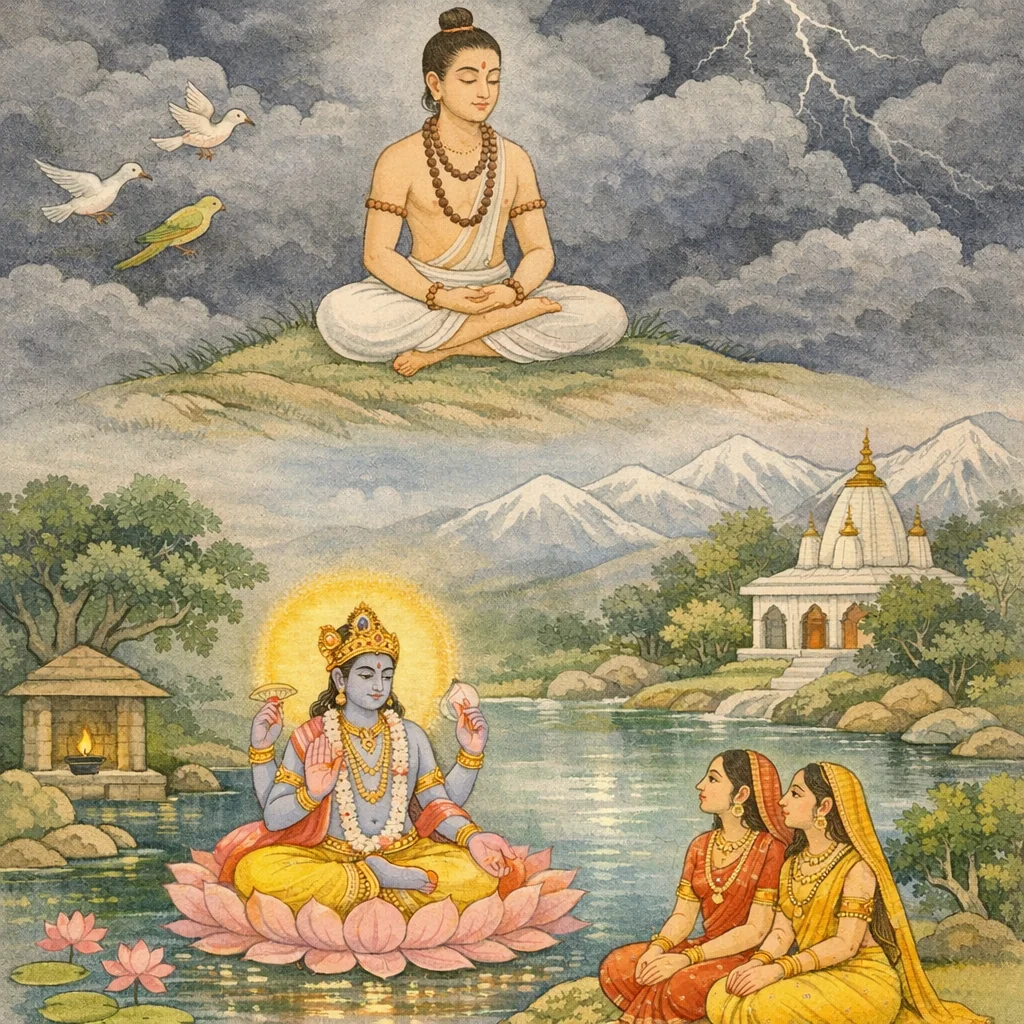
Adhyaya 171: Śuka’s Ocean Voyage: Adverse Winds, Arrival at a Viṣṇu Shrine, and Aid from the Jaṭāyu Birds
Śukasya samudrayātrā—durvātaḥ, Viṣṇvāyatana-prāptiḥ, jaṭāyu-sahāyatā ca
Ethical-Discourse (merchant conduct, crisis navigation, divine sanctuary ecology)
Varāha narrates to Pṛthivī the episode of Śuka and his father Gokarṇa, who leave Mathurā on a merchant sea-voyage in search of precious gems. After setting their household affairs in order, their ship is battered by contrary winds, stirring panic, mutual blame, and moral anxiety among the traders. Śuka steadies his father and flies north to a mountain sanctuary with a radiant Viṣṇu temple, where celestial devīs worship and then grant him food and protection. Śuka petitions bird-flocks associated with Jaṭāyu; they guide him back to the ship and help Gokarṇa cross safely to the island/mountain refuge. The merchants later return with jewels, presume Gokarṇa lost, and propose an equitable redistribution. Śuka returns to Mathurā to inform the family; grief is soothed through learned discourse, and in time the caravan reunites and honors Gokarṇa.
Primary Speakers
Key Concepts
Shlokas in Adhyaya 171
Verse 1
श्रीवराह उवाच ॥ शुकं गृह्य ततः स्थानात्प्रस्थितो मथुरां पुरीम् ॥ प्रविश्य गृह्य तत्पुण्यं मातापित्रोस्तदर्पितम्
Śrī Varāha said: “Taking Śuka, he departed from that place toward the city of Mathurā; entering it, he accepted that meritorious offering presented by his mother and father.”
Verse 2
शुकस्य चरितं सर्वं निवेद्य च महामतिः ॥ एवं निवसतस्तस्य बहुवर्षाणि तत्र वै
And the wise one, having reported the entire account of Śuka’s conduct, continued: thus he dwelt there indeed for many years.
Verse 3
सुखं प्राप्तं मतं चापि व्यवहारॆ च पूजने ॥ एवं निवसतस्तस्य द्रव्यं शेषमजायत ॥
He attained comfort, and his good repute increased as well, both in worldly dealings and in acts of honor and worship. Thus, as he continued to dwell there, a surplus of wealth accrued to him.
Verse 4
पुनस्तत्रैव गमने वणिग्भावे मतिर्गता ॥ समुद्रयाने रत्नानि महामौल्यानि साधुभिः ॥
Again his mind turned to going there in the role of a merchant. On ocean voyages, precious gems of great value are obtained by capable traders.
Verse 5
आनयिष्ये बहून्यत्र सार्धं रत्नपरीक्षकैः ॥ एवं निश्चित्य मनसा महासार्थपुरःसरः ॥ समुद्रयायिभिर्लोकैः संविदं प्रोच्य निर्गतः ॥
“I shall bring many (gems) here, together with experts who test jewels.” Having thus resolved in his mind, leading a great trading company, he set out after stating the agreement with those bound for the sea-voyage.
Verse 6
पेयाहारसमाहारं कृत्वा कृत्यविदार्थकम् ॥ शुकं गृहीत्वा प्रस्थानमकरोत्पुण्यवासरे ॥
Having prepared a stock of drink and food—provisions suitable for the intended tasks—and taking a parrot with him, he set out on an auspicious day.
Verse 7
मातापित्रोः शुभा वाचो गृहीत्वा देवतागृहे ॥ भार्याणां देवकार्यं च वाटिकायाश्च पोषणम् ॥
In the deity’s shrine, receiving auspicious words from his mother and father, he arranged that his wives should attend to the deity’s duties and also maintain the garden-plot.
Verse 8
पितुः शुश्रूषणं चोक्त्वा सर्वं यूयं करिष्यथ ॥ यथायोगं यथाकालं यथाकृत्यं यथा च यत् ॥
Having instructed them in service to his father, he said: “All of you shall do everything appropriately—according to your capacity, at the proper time, in accordance with what is to be done, and as each matter requires.”
Verse 9
भवतीभिश्च कृत्यं मे करणीयं यथा तथा ॥ सन्दिश्य भार्याः सुश्रोणीर् देवं दृष्ट्वा प्रसाद्य च ॥
“And you ladies, likewise, should do on my behalf what is to be done, as is fitting.” Having thus instructed his fair-hipped wives, he went to behold the deity and, with reverence, sought divine favor and leave.
Verse 10
पोतारूढास्ततः सर्वे पोतवाहैरुपोहिताः ॥ अपारे दुस्तरेऽगाधे यान्ति वेगेन नित्यशः ॥
Then all of them boarded the ship, conveyed by the shipmen. They journey onward with constant speed across the boundless, difficult-to-cross, unfathomable ocean.
Verse 11
अथ दैववशाद्वायुर् विलोमः समजायत ॥ दुर्वातेन तदा नित्यं बलात्पोत उपोहितः ॥ पोतवाहास्ततः सर्वे विसंज्ञा मोहिताः कृशाः ॥
Then, by the turn of fate, the wind became contrary. At that time the ship was continually driven by force by the harsh wind, and all the shipmen became senseless, bewildered, and exhausted.
Verse 12
हा कष्टं हि कथं किञ्च कुत्र गच्छामहे वयम् ॥ तेषां तु वचनं श्रुत्वा ज्ञात्वा दुर्वातपीडनम् ॥ आक्षिपद्वाग्भिरुग्राभिरन्योन्यं शङ्क्य मूर्च्छिताः ॥
“Alas, what calamity! How shall we manage at all, and where are we to go?” Hearing their words and realizing the oppression of the harsh wind, they turned on one another with fierce speech, suspecting each other, and swooned.
Verse 13
जल्पन्ति कोऽत्र पापिष्ठः समारूढो निराकृतः ॥ तस्य पातकसंस्पर्शान्मृताः सर्वे न संशयः ॥
They lament: “Who here is the most sinful—one who mounted up and was cast off? Through contact with his sin, all have died; of this there is no doubt.”
Verse 14
एवं विलपतां तेषां चत्वारोऽपि समभ्ययुः ॥ मासास्तत्रैव वाणिज्यं षण्मासात्सिध्यते फलम् ॥
While they were thus lamenting, all four of them arrived. Trade conducted right there takes months; the result is accomplished after six months.
Verse 15
निर्भर्त्सनं ततस्तेषामन्योन्यमभिजल्पनम् ॥ श्रुत्वा शुकस्य गोकर्णः शशंसात्मविनिन्दनम् ॥
Then, hearing their mutual reproaches and exchanges, Gokarṇa, in Śuka’s presence, voiced self-reproach.
Verse 16
अपुत्रस्य गतिर् नास्ति इति सर्वस्य निश्चितम् ॥ एषां मध्ये ह्यहं पापस्तेन तप्यामि पुत्रक ॥
“It is settled for everyone that one without a son has no secure course. Among these, I am the sinner; therefore I suffer, dear child.”
Verse 17
यदत्र युक्तं कालेऽस्मिन् विषमे समुपस्थिते ॥ वद स्वाध्यायषाड्गुण्यं कृच्छ्रे त्वं कार्यवित्तमः ॥
“Tell what is appropriate here, now that this difficult time has arrived. Speak of the sixfold excellence grounded in study; in hardship, you are the best knower of what must be done.”
Verse 18
शुक उवाच ॥ मा जोषमास्व भैस्तात अस्मिन्काले यथोचितम् ॥ अहं करिष्ये तत्सर्वं मा विषादे मनः कृथाः ॥
Śuka said: “Do not be silent; do not fear, dear father. At this time, as is fitting, I will do all of that. Do not let your mind sink into dejection.”
Verse 19
नीचगत्या रक्षयन् वै सुतरं दुस्तरं जलम् ॥ सानौ पर्वतसामीप्ये योजनेंन वरं गिरिम् ॥
Protecting (him/them) by moving along a low course, he safely crossed the difficult-to-cross water; near the mountain-slope, at a distance of one yojana, there stood an excellent mountain.
Verse 20
रोमाञ्चिततनुर्जातः शुको वीक्ष्य महागिरिम् ॥ क्रमित्वोर्ध्वं च यात्युग्रं तावद्देवालयं शुभम् ॥
Seeing the great mountain, Śuka’s body thrilled with sacred gooseflesh; he climbed upward and moved swiftly on, until he reached that auspicious temple.
Verse 21
दृष्टं च विष्ण्वायतनं तेजसा चोपशोभितम् ॥ दिक्षु सर्वास्वटित्वैवं निलिल्ये देवमन्दिरे ॥
He beheld a sanctuary of Viṣṇu, adorned with radiance; and having thus wandered in all directions, he rested within the divine temple.
Verse 22
वत्सायं कोऽत्र सञ्चारी कदा किं तु पिता मम ॥ वितरिष्यति नो कालं दुरन्तं सुकृतिर्यथा ॥
“Dear child—who is the traveler here? And when, indeed, will my father grant us relief from this unending time, as merit brings forth its fruit?”
Verse 23
क्षणमेकं तथा चैनं तस्य चिन्तान्वितस्य हि ॥ सौवर्णपात्रहस्ता च देवी देवं समर्च्चयत्
And for a single moment, while he was absorbed in thought, the Goddess—holding a golden vessel in her hand—performed worship of the God.
Verse 24
नमो नारायणायोक्त्वा निषसाद वरासने ॥ निमेषान्तरमात्रेण वयोरूपसमन्विताः ॥ असंख्याताः समायाता यथा देवी तथैव ताः
Having uttered, “Homage to Nārāyaṇa,” she sat upon an excellent seat. Within the span of a single blink, countless beings—endowed with age and form—arrived, just like the Goddess herself.
Verse 25
गीतं वाद्यं च नृत्यं च यथासौख्यं विहृत्य च ॥ गतास्ता देवताः सर्वा यथास्थानमनुत्तमम्
After engaging—according to their pleasure—in song, instrumental music, and dance, all those deities departed to their own unsurpassed proper abodes.
Verse 26
देवतादक्षिणे भागे पक्षिणां च जटायुषाम् ॥ लक्ष्यान्यनेकयूथानि बृहन्ति बहु सङ्घशः
On the southern side of the deities, there were to be seen many groups of birds—of Jatāyu’s kind—forming numerous large flocks in many clusters.
Verse 27
शुको लेख्यसमस्तेषां मध्ये कृत्वा तु संविदम् ॥ स्वभाषां पुरतः कृत्वा शरणं तमयाचत
Then the parrot, having established communication among them all, and placing his own speech to the fore, requested refuge from him.
Verse 28
शुकस्तान्प्रत्युवाचाथ पिता मे पोतसंस्थितः ॥ दुर्गवाताद्दुर्गमस्थो विषमे समुपस्थिते
Then Śuka replied to them: “My father is in a boat; because of a perilous wind he is in a difficult plight, for danger has arisen.”
Verse 29
तस्य त्राणमभीप्सन्वै ह्यागतोऽत्र वरं गिरिम् ॥ कुरुध्वं तस्य मे त्राणं यथा सुखमवाप्यते
Desiring his deliverance, I have indeed come here to this excellent mountain. Please grant protection to my father, so that he may attain safety and ease.
Verse 30
पक्षिण ऊचुः ॥ एहि पुत्र सुकाय्र्यं ते मार्गं द्रक्ष्यामहे वयम् ॥ पोताभ्याशगतिं यासि पितुस्तव गतिं प्रति
The birds said: “Come, child; your task is a worthy one. We shall show the route. Go toward the course that draws near the boat—toward your father’s path.”
Verse 31
ममैव पादविन्यासे क्रमयिष्ये यथा जलम् ॥ तेन ते पृष्ठतो मह्यं स पिता सन्तरिष्यति
“By placing my own steps, I shall proceed across the water; and thus, behind me, your father will cross over.”
Verse 32
मम चञ्च्वावगाहेन नङ्क्ष्यन्ति जलजन्तवः ॥ एतत्पितुः समक्षं हि शंसन् क्षिप्रं नदीपतिम्
“By the dipping of my beak, the creatures of the water will not be harmed. Quickly proclaim this in your father’s presence, and proceed toward the lord of the river.”
Verse 33
तारयामास वेगेन गत्वा पृष्ठं जटायुषः ॥ स ययौ पर्वतं तीर्त्वा क्वचिन्नाभिसमं जलम्
Swiftly he went and brought deliverance, reaching the back of Jaṭāyu. Then he continued on—crossing a mountain—and came to a stretch of water that was not deep, not even navel-high.
Verse 34
हृत्कण्ठं चैव गम्भीरं सुखेन सुकृती यथा ॥ स्तोकान्तरे ततः सोऽथ देवागारमनुत्तमम्
There was a deep and formidable stretch, yet he passed it with ease—like one endowed with merit. Then, after a short interval, he reached an unsurpassed temple.
Verse 35
सरोवरं च पद्माढ्यं मणिरत्नविभूषितम् ॥ स्नात्वा देवान्पितॄंश्चैव तर्पयित्वा यथासुखम्
He came to a lotus-filled lake adorned with gems and jewels. Bathing there, he satisfied the gods and the ancestors with offerings, as was fitting and in peace.
Verse 36
पुष्पाण्यादाय देवं च पूजयित्वा स केशवम् ॥ पञ्चायतनकं चैव खचितं रत्नसञ्चयैः ॥ दृष्ट्वा निलिल्ये चैकेऽन्ते शुकस्यानुमते स्थितः
Taking flowers, he worshipped the deity Keśava. Seeing a pañcāyatana complex inlaid with accumulations of jewels, he withdrew to a secluded place and remained there with Śuka’s permission.
Verse 37
स्वागतस्य क्षुधार्त्तस्य ब्रह्मिष्ठस्य महात्मनः ॥ भोजनार्थं फलं दिव्यं पानार्थं तोयमुत्तमम्
For the welcomed great-souled one—afflicted by hunger and foremost among the knowers of brahman—there was divine fruit for food and excellent water for drinking.
Verse 38
गोकर्णस्य प्रयच्छध्वं येन तृप्तिस्त्रिमासिकी ॥ यथा शोको यथा पापं यथा मोहः प्रणश्यति
“Provide these provisions for Gokarṇa, by which satisfaction will last for three months—so that grief, sin, and delusion may thereby come to an end.”
Verse 39
तथा कृत्वा तमूचुस्ता अभयं तेऽस्तु मा शुचः ॥ वस स्वर्गोपमे स्थाने यावत्सिद्धिर्भवेत् तव
Having done so, they said to him: “May you be safe; do not grieve. Dwell in this place, like heaven, until your attainment is fulfilled.”
Verse 40
गतास्ताः पुनरेवं च नित्यमेव दिने दिने ॥ वसते स सुखं तत्र मथुरायां यथा तथा
After they had gone, it continued thus day after day. He lived there in comfort—just as one lives in Mathurā, so too in that place.
Verse 41
पोतात्तस्मादुत्ततार सुवातेनोपवाहितः ॥ रत्नाकरः शुभो यत्र भावित्वाद्दैवयोगतः
From that boat he disembarked, borne along by a favorable wind. There was an auspicious ocean—“a mine of jewels”—there, by the force of destiny and providential conjunction.
Verse 42
रत्नानि बहु मौल्यानि आहृतानि बहून्यथ ॥ यावत्परीक्षणार्थं च गोकर्णं रत्नकोविदम्
Then many jewels of great value were brought. And for the purpose of examination, they went to Gokarṇa, who was skilled in jewels.
Verse 43
निरीक्ष्यतेऽस्य संवासो न दृष्टश्चुक्रुशुस्ततः ॥ कुतोऽसौ गतवान्भद्रो मृतो नष्टो जले प्लुतः ॥
They inspected his dwelling, but he was not seen; then they cried out: “Where has that good man gone—has he died, perished, or been swept away in the water?”
Verse 44
व्रीडायुतो निमग्नोऽयं निश्चितं मकरालये ॥ पितुरस्य वयं सर्वे पुत्रवद्विचरामहे ॥
“Ashamed, he has surely sunk into the ocean—the abode of makaras. As for his father, all of us shall conduct ourselves toward him as sons.”
Verse 45
यथाभागं च रत्नानां भागं दास्यामहे परम् ॥ एष धर्मः सदास्माकमेकसार्थागमेन हि ॥
“And we shall give the share of the jewels according to each one’s portion—fully. This is our standing rule, for we have set out as a single caravan/company.”
Verse 46
शुकेन मन्त्र मूढत्वात्पितुरेवं निवेदितम् ॥ अहं पक्षी लघुतनुर्भवन्तं नेतुमक्षमः ॥
Because of being bewildered by the mantra, Śuka reported thus to his father: “I am a bird with a light body; I am unable to carry you.”
Verse 47
याताऽस्मि मथुरां मार्गे समुद्रे जलमालिनि ॥ पित्रोर्वाक्यं तवाख्यासे त्वदीयं च तयोरहम् ॥
“I have gone on the route to Mathurā, crossing the sea with its waters. I will convey to the parents your message—and also what is yours, as I am devoted to them.”
Verse 48
अवश्यं च गमिष्येऽहमनुज्ञा तु प्रदीयताम् ॥ सत्यमुक्तं ततस्तेन गोकर्णेन शुकं प्रति ॥
“I shall certainly go; only grant permission.” Then Gokarṇa spoke truthfully to Śuka.
Verse 49
गच्छ त्वं पुत्र मथुरामवस्थां मामकीमिमाम् ॥ त्वया विना न शक्नोमि शीघ्रमागमनं कुरु ॥
“Go, my son, to Mathurā. In this condition of mine, without you I cannot manage; return quickly.”
Verse 50
इत्युक्तः स तथेत्युक्त्वा पोतारूढः खगोत्तमः ॥ कालेन मथुरां प्राप्तः सर्वं पित्रे न्यवेदयत् ॥
Thus addressed, he replied, “So be it,” and the excellent bird, having boarded a boat, in due time reached Mathurā and reported everything to his father.
Verse 51
श्रुत्वा तौ विषमावस्थां मृतं हृदि निवेश्य च ॥ रुदित्वा सुचिरं कालं शुके स्नेहो निवेशितः ॥
Hearing of their dire condition, and taking death into his heart, he wept for a long time; in Śuka, affection became firmly settled.
Verse 52
अस्माकं जीवनार्थाय त्वया कार्यं विहङ्गम ॥ कथाभिरनुकूलाभिर्धर्मदर्शिभिरेव च ॥
“For the sake of our living, you must act, O bird—by means of supportive discourses, and indeed by those who discern dharma.”
Verse 53
शुकेन पञ्जरस्थेन कथालापेन विद्यया ॥ पुत्रशोकाभितन्तप्तौ तथैवानेन सान्त्वितौ
By Śuka—who was staying in a cage—through learned conversation and instruction, the two who were scorched by grief for their son were likewise consoled by him.
Verse 54
प्रसाद्य सर्वे सम्पूज्य प्रेषितास्ते गृहं ययुः ॥ एवं ते न्यवसंस्तत्र यावत्त्कालं सुखेन तु
Having been reconciled and duly honored, they were sent off and went home. In this manner, they dwelt there for as long a time, indeed in comfort.
Verse 55
शुश्रूषमाणास्तं वैश्यं यथा स्वपितरं तथा
They attended upon that vaiśya in the same way as they would their own father.
Verse 56
अथ सार्थः समायातो रत्नपूर्णो यथोदधिः ॥ वसुकर्णस्य पुत्रार्थमकरोत्स जनो महान्
Then the caravan arrived, filled with jewels like the ocean; and a great man undertook efforts for Vasukarṇa’s son.
Verse 57
भार्याभिः समनुज्ञातो यानपात्रं गतस्तदा ॥ शुकेन सह सम्प्राप्तो महान्तं लवणार्णवम्
Then, permitted by his wives, he boarded a vessel; together with Śuka he reached the great Salt Ocean.
Verse 58
एवमाश्वास्य पितरं समुड्डीय ततो द्रुतम् ॥ ध्रुवाख्यां दिशमुद्वीक्ष्य उत्तराभिमुखो ययौ
Thus, having reassured his father, he swiftly took flight; looking toward the direction called “Dhruva,” he went forth facing north.
Verse 59
ते समाश्वास्य तं प्राहुः कथमस्मिन्भवाङ्गतः ॥ वारिराशिर्दुराधर्षः समुद्रो झषसङ्कुलः
After reassuring him, they said: “How have you come to be in this plight? The ocean—this vast mass of waters—is hard to cross, thronged with fish.”
Verse 60
क्षणेन ता यथापूर्वं देवताश्चागताः पुनः ॥ नर्त्तयित्वा यथायोग्यं तासां ज्येष्ठा अब्रवीदिदम्
In a moment they returned again, as before, together with the deities. After causing them to dance as was fitting, the eldest among them spoke these words.
Verse 61
एवं वसन्स गोकर्णो द्वीपस्थः शोकविह्वलः ॥ शुकं प्रोवाच दीनात्मा मातापित्रोः कृते तदा
Thus dwelt Gokarṇa upon an island, overwhelmed by grief. Then he addressed Śuka; downcast in spirit, he spoke for the sake of his mother and father.
Verse 62
सर्वैस्तैर्विंशतिः सङ्ख्या एकैकेन समुद्रगैः ॥ रत्नैः समर्च्चितोऽत्यर्थं पर्वतः कुसुमोत्करैः
By all of them—twenty in number—each bringing sea-gems, the mountain was exceedingly honored, adorned with jewels and heaps of flowers.
Frequently Asked Questions
The narrative foregrounds sārtha-dharma and āpaddharma: in collective danger (a storm at sea), panic and scapegoating are shown as destabilizing, while responsibility, reassurance, and practical rescue efforts are presented as the appropriate response. It also models putra-dharma through Śuka’s commitment to saving his father and maintaining obligations to family and community.
No explicit tithi, pakṣa, or named season is provided. The departure is described generally as occurring on a puṇya-vāsara (“auspicious day”), and the provisioning implies a multi-month duration (references to “months” and “three months” of sustenance), but without calendrical specification.
Environmental balance is approached indirectly through hazard ecology and refuge ecology: the sea is depicted as a complex, dangerous biome (deep waters, aquatic creatures, adverse winds) requiring disciplined conduct and risk management, while the mountain-temple-lake complex functions as a protected refuge landscape where bathing, offerings, and non-violent coexistence with bird communities enable survival. This framing supports an ecological reading of safe habitats and responsible movement through risky environments.
The chapter centers on the figures Gokarṇa and Śuka within a merchant (vaṇij/sārtha) setting. It references Jaṭāyu through associated bird-flocks (jaṭāyuṣām pakṣiṇām), and invokes Nārāyaṇa/Keśava as the deity of the Viṣṇvāyatana. No royal genealogy or administrative lineage is explicitly supplied in the provided passage.