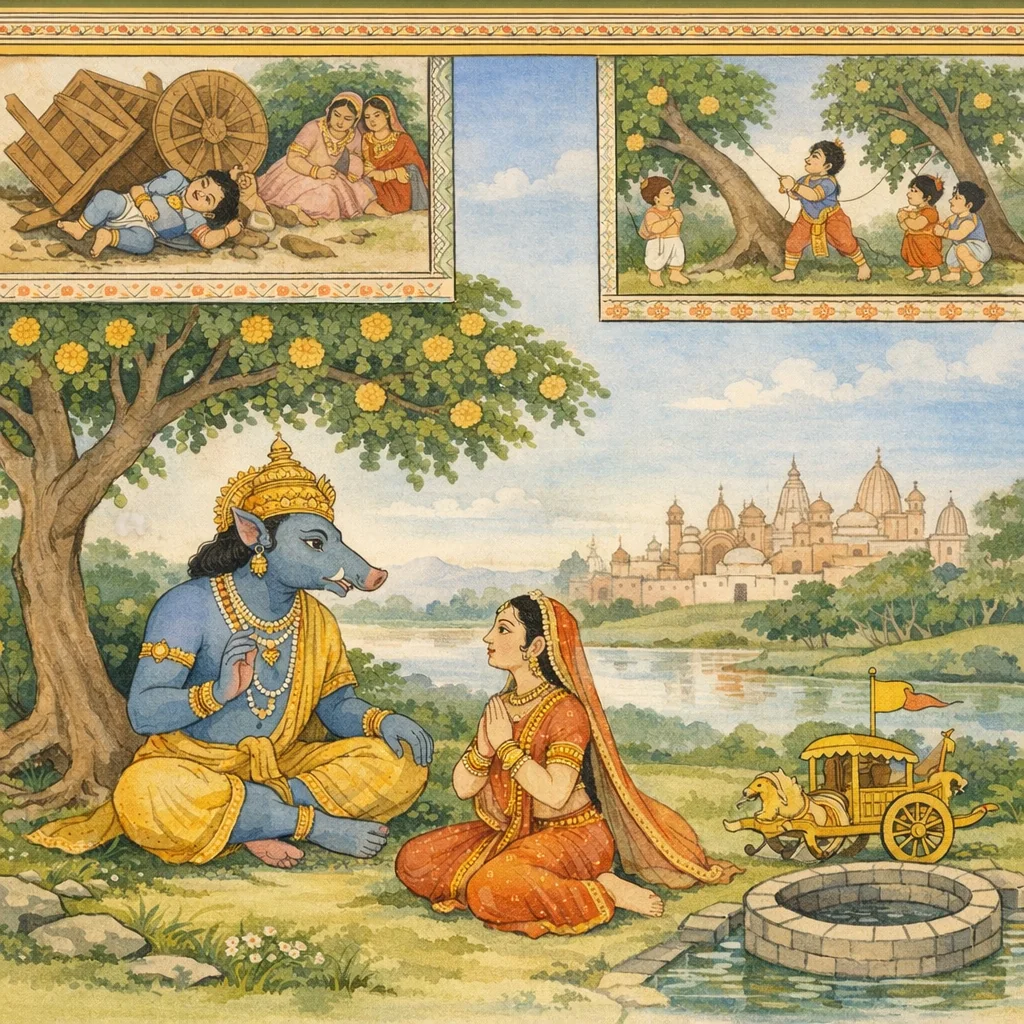
Adhyaya 157: Praise of the Malayārjuna Sacred Ford and the Mathurā–Yamunā Pilgrimage Cycle
Malayārjuna-tīrtha-prāśaṃsā tathā Mathurā-Yamunā-māhātmya
Ritual-Manual; Sacred Geography (Tīrtha-māhātmya)
In dialogue, Varāha instructs Pṛthivī on a network of sacred waters and groves around the Yamunā and Mathurā. Bathing (snāna), fasting (upavāsa), worship (arcana), gifting (dāna), and ancestral rites (piṇḍa-dāna/śrāddha) are taught as disciplines that erase grave sins and grant definite post-mortem destinations—Sūryaloka, Rudraloka, Brahmaloka, and “mama loka.” The chapter marks calendrical observances, especially Jyeṣṭha śukla-dvādaśī and Caitra śukla-dvādaśī, and anchors the sacred geography in Kṛṣṇa’s childhood līlā motifs (the broken śakaṭa cart and the paired arjuna trees) and in Mātali’s स्थापना of Gopīśvara. Framed through Pṛthivī’s stewardship, the teaching emphasizes disciplined conduct and careful use of water landscapes as an ethically ordered pilgrimage ecology.
Primary Speakers
Key Concepts
Shlokas in Adhyaya 157
Verse 1
अथ मलयार्जुनतीर्थादिस्नानादिप्रशंसा ॥ श्रीवराह उवाच ॥ यमुनापारमुल्लङ्घ्य तत्रैव च महामुने ॥ मलयार्जुनकं तीर्थं कुण्डं तत्र च विद्यते ॥
Now follows the praise of bathing and related observances at Malayārjuna-tīrtha and other sites. Śrī Varāha said: Having crossed to the far bank of the Yamunā, right there, O great sage, is the Malayārjuna tīrtha, and a pond (kuṇḍa) is also found there.
Verse 2
पर्यस्तं तत्र शकटं भिन्नभाण्डकुटीघटम् ॥ तत्र स्नानोपवासाभ्यामनन्तं फलमश्रुते ॥
There one sees an overturned cart and broken vessels—hut and pot. There, by bathing and fasting, one is said to obtain an endless fruit, immeasurable merit.
Verse 3
द्वादश्यां शुक्लपक्षस्य ज्येष्ठमासे वसुन्धरे ॥ तत्र स्नानेन दानेन महापातकनाशनम् ॥
O Earth, on the twelfth lunar day of the bright fortnight in the month of Jyeṣṭha—there, by bathing and by giving (donations), great transgressions are removed.
Verse 4
ज्येष्ठस्य शुक्लद्वादश्यां स्नात्वा सुनियतेंद्रियः ॥ मथुरायां हरिं दृष्ट्वा प्राप्नोति परमां गतिम् ॥
Having bathed on the bright twelfth day (Dvādaśī) of Jyeṣṭha, with the senses well restrained, one who beholds Hari in Mathurā attains the supreme state.
Verse 5
यमुनासलिले स्नातः शुचिर्भूत्वा जितेंद्रियः ॥ समभ्यर्च्याच्युतं सम्यक् प्राप्नोति परमां गतिम् ॥
Having bathed in the waters of the Yamunā, becoming purified and self-controlled, one who duly worships Acyuta properly attains the supreme state.
Verse 6
अपि चास्मत्कुले जातः कालिन्दीसलिले प्लुतः ॥ अर्चयिष्यति गोविन्दं मथुरायामुपोषितः ॥
Moreover, even one born in our lineage—immersed in the waters of the Kālindī (Yamunā) and fasting in Mathurā—will worship Govinda.
Verse 7
इति गायन्ति पितरः परलोकगताः सदा ॥ द्वादश्यां ज्येष्ठमासे तु समभ्यर्च्य जनार्दनम् ॥
Thus the ancestors, gone to the other world, continually sing: “Indeed, on the twelfth day in the month of Jyeṣṭha, having duly worshiped Janārdana …”
Verse 8
धन्योऽसौ पिण्डनिर्वापं यमुनायां करिष्यति ॥ तत्रैव तु महातीर्थे वने बहुलसंज्ञके ॥
Blessed is that person who will perform the offering of piṇḍas in the Yamunā—there itself, at the great pilgrimage-site, in the forest known as Bahulā.
Verse 9
तत्र स्नातो नरो देवि रुद्रलोके महीयते ॥ द्वादश्यां चैत्रमासे तु शुक्लपक्षे वसुन्धरे ॥
O Goddess, the man who bathes there is honored in Rudra’s world. And on the twelfth day of the month of Caitra, in the bright fortnight, O Earth, …
Verse 10
दृश्यन्तेऽहरहस्तत्र आदित्याः शुभकारिणः ॥ तत्र चार्कस्थले कुण्डे स्नानं यः कुरुते नरः ॥
There, day after day, the Ādityas are seen, bestowing auspiciousness. And there, at Arkasthala, the man who bathes in the pond …
Verse 11
सर्वपापविनिर्मुक्तः सूर्यलोकं व्रजेनरः ॥ तत्राथ मुञ्चते प्राणान्मम लोकं स गच्छति ॥
Freed from all wrongdoing, the person goes to the world of the Sun. Then, upon relinquishing the life-breath there, he goes to my world.
Verse 12
अर्कस्थलसमीपे तु कूपं तु विमलोदकम् ॥ सप्तसामुद्रिकं नाम देवानामपि दुर्लभम् ॥
Near Arkasthala there is a well of spotless water, called Saptasāmudrika—difficult to obtain even for the gods.
Verse 13
तत्र स्नानेन वसुधे स्वच्छन्दगमनालयः ॥ अथात्र मुञ्चते प्राणान्मम लोकं स गच्छति ॥
By bathing there, O Earth, one becomes an abode of unobstructed movement, gaining free passage. Then, upon relinquishing the life-breath there, he goes to my world.
Verse 14
यस्तत्र कुरुते स्नानमेक रात्रोषितो नरः ॥ स मत्प्रसादात्सुश्रोणि वीरलोके महीयते ॥
Whoever, having stayed there for a single night, performs bathing at that place—by my favor, O fair-hipped one, he is honored in the world of heroes.
Verse 15
अथात्र मुञ्चते प्राणान्ममलोकं स गच्छति ॥ कुशस्थलं च तत्रैव पुण्यं पापहरं शुभम् ॥
Then, if he gives up his life-breaths there, he goes to my world. And there itself is Kuśasthala—meritorious, auspicious, and a remover of wrongdoing.
Verse 16
तत्र स्नातो नरो देवि ब्रह्मलोके महीयते ॥ अथात्र मुञ्चते प्राणान्मम लोकं स गच्छति ॥
Having bathed there, O goddess, a person is honored in Brahma’s world. And if he relinquishes his life-breaths there, he goes to my world.
Verse 17
तत्र वीरस्थलं नाम क्षेत्रं गुह्यं परं मम ॥ आसन्नसलिलं चैव पद्मोत्पलविभूषितम् ॥
There is a sacred tract called Vīrasthala, a hidden and supreme domain of mine—having water close at hand, and adorned with lotuses and water-lilies.
Verse 18
तत्र पुष्पस्थलं नाम शिवक्षेत्रमनुत्तमम् ॥ तत्र स्नानेन मनुजः शिवलोके महीयते ॥
There is a place called Puṣpasthala, an unsurpassed Śiva-sanctuary. By bathing there, a person is honored in Śiva’s world.
Verse 19
तत्र गोपीश्वरो नाम महापातकनाशनः ॥ कृष्णस्य रमणार्थं हि सहस्राणि च षोडश ॥
There is a shrine named Gopīśvara, said to destroy great sins. For Kṛṣṇa’s delight, indeed, there were sixteen thousand forms.
Verse 20
गोप्यो रूपाणि चक्रे च तत्र क्रीडनके हरिः ॥ यदा बालेन कृष्णेन भग्नार्जुनयुगं तथा ॥
And there, in the course of play, Hari assumed the forms of the gopīs, the cowherd maidens. And when the boy Kṛṣṇa likewise broke the pair of arjuna trees… (the narrative continues).
Verse 21
शकटं च तदा भिन्नं घटभाण्डकुटीरकम् ॥ ताभिस्तत्रैव गोविन्दं क्रीडन्तं च यदृच्छया ॥
And then the cart was broken, and the hut with its pots and vessels was damaged. There itself, by chance, they found Govinda playing.
Verse 22
परिष्वज्य हि धर्मेण व्याजेन च सुगोपितम् ॥ मातलिस्तत्र चागत्य देवैरुक्तं यथोदितम् ॥
Indeed, having embraced (him) according to propriety, and also concealing the matter by a pretext, Mātali came there; it was as the gods had spoken, just as had been declared.
Verse 23
गोपीमण्डलपातेन स्नापितो हेमकुण्डलः ॥ गोप्यो गायन्ति नृत्यन्ति कृष्ण कृष्ण इति ब्रुवन् ॥
By the falling stream of the circle of gopīs around him, the golden-earringed one was bathed. The gopīs sing and dance, uttering, “Kṛṣṇa, Kṛṣṇa.”
Verse 24
तत्र गोपीश्वरं देवं मातलिः स्थाप्य पूजितम् ॥ कूपं च स्थापयामास माङ्गल्यैः कलशैः शुभैः ॥
There Mātali, having installed and worshipped the deity Gopīśvara, also caused a well to be established with auspicious, benedictory water-pots.
Verse 25
सप्तसामुद्रिकं नाम कूपं तु विमलोदकम् ॥ देवस्याग्रे तु वसुधे गोपा यस्य महात्मनः ॥
A well named ‘Saptasāmudrika’, with clear water, stood in front of the deity—O Vasudhā—of that great-souled one whose association is that of a cowherd.
Verse 26
गोपीवेषधरं देवं अभिषेकं चकार ह ॥ आनीय सप्त कलशान् रत्नौषधिपरिप्लुतान् ॥
He performed the consecratory bathing (abhiṣeka) of the deity who bore the attire of a cowherd, bringing seven water-pots suffused with gems and medicinal herbs.
Verse 27
पितरश्चापि नन्दन्ति पानीयं पिण्डमेव च ॥ सप्तसामुद्रिके कूपे यः श्राद्धं सम्प्रदास्यति ॥
The ancestors also rejoice—through water-offerings and indeed through the piṇḍa—when one performs śrāddha at the well called Saptasāmudrika.
Verse 28
पितरस्तस्य तृप्यन्ति कोटिवर्षशतान्यलम् ॥ गोविन्दस्य च देवस्य तथा गोपीश्वरस्य च ॥
His ancestors are satisfied in full for hundreds of millions of years; and this is said in relation to the deity Govinda, and likewise to Gopīśvara.
Verse 29
मध्ये तु मरणं यस्य शक्रस्यैति सलोकताम् ॥ तथा बहुलरुद्रस्य गोविन्दस्यैव मध्यतः ॥
Whoever dies in the middle (of this sacred region) attains the same world as Śakra; likewise, dying in the very center of Govinda, one attains the world of Bahula-rudra.
Verse 30
तद्वद्ब्रह्माणमाशास्य गोपीशस्यैव मध्यतः ॥ एतेषु स्नानदानेन पिण्डपातेन भामिनि ॥
In the same manner, with regard to Brahmā, this is declared from the very center of Gopīśa; by bathing and giving (offerings) at these places, and by offering piṇḍas, O fair one—
Verse 31
नरस्तारयते पुंसां दश पूर्वान्दशापरान् ॥ एषु स्नातो नरो देवि देवैश्च सह मोदते ॥
A man delivers ten generations before him and ten after him. Having bathed at these places, O Goddess, a man rejoices together with the gods.
Verse 32
तत्राथ मुञ्चते प्राणान्मम लोकं स गच्छति ॥ वसुपत्रं महातीर्थं पुण्यं परममुत्तमम् ॥
Then, if one relinquishes the life-breaths there, he goes to my world. (That place called) Vasupatra is a great tīrtha—meritorious, supremely excellent.
Verse 33
मथुरादक्षिणे पार्श्वे क्षेत्रं फाल्गुनकं तथा ॥ तत्र स्नात्वा च पीत्वा च परलोके महीयते ॥
On the southern side of Mathurā there is also the sacred region called Phālgunaka. Having bathed there and drunk (its water), one is honored in the world beyond.
Verse 34
तत्र फाल्गुनके चैव तीर्थे परमदुर्लभे ॥ वृषभाञ्जनकं नाम क्षेत्रं मे दुर्लभं महत्
There, at the exceedingly rare sacred ford called Phālgunaka, there is a great holy region of Mine known as Vṛṣabhāñjanaka—difficult to attain.
Verse 35
तत्राभिषेकं यः कुर्यात्स देवैः सह मोदते ॥ तत्र यो मुञ्चते प्राणान्मम लोकं स गच्छति
Whoever performs ritual consecration (abhiṣeka) there rejoices in the company of the gods; and whoever relinquishes life-breath there, he goes to My world.
Verse 36
अस्ति तालवनं नाम धेनुकासुररक्षितम् ॥ मथुरापश्चिमे भागे अदूरादर्धयोजनम्
There is a forest called Tālavana, guarded by the asura Dhenuka; it lies on the western side of Mathurā, not far—about half a yojana away.
Verse 37
अस्ति संपिठकं नाम अस्मिन् क्षेत्रे परं मम ॥ तत्र कुण्डं विशालाक्षि प्रसन्नसलिलं शुभम्
In this sacred region of Mine there is a supreme place called Saṃpīṭhaka. There is also a pond (kuṇḍa), O wide-eyed one, auspicious, with clear and tranquil waters.
Verse 38
तत्र स्नानं च ये कुर्युरेकरात्रोषिता नराः ॥ अग्निष्टोमफलं चैव लभन्ते नात्र संशयः
Those men who bathe there and remain for a single night obtain the fruit of the Agniṣṭoma rite—of this there is no doubt.
Verse 39
अथात्र मुञ्चते प्राणान्मम लोकं स गच्छति ॥ देवकीगर्भसंभूतो वसुदेवगृहे शुभे
Moreover, whoever relinquishes the life-breath here goes to My world. (Here begins the account:) born from Devakī’s womb, in the auspicious house of Vasudeva…
Verse 40
तत्र पुण्येन हि मया रविराराधितः शुभः ॥ लब्धः प्राज्ञो मया पुत्रो रूपवांश्च गुणान्वितः
There, indeed, by merit (puṇya) I worshipped the auspicious Sun, Ravi. Through that I obtained a son—wise, handsome, and endowed with virtues.
Verse 41
तत्रैवं तु ततो दृष्टः पद्महस्तो दिवाकरः ॥ मासि भाद्रपदे देवी तिग्मतेजा विभावसुः
Then, in that manner, the Sun, Divākara, was seen there—lotus in hand. In the month of Bhādrapada, O Goddess, Vibhāvasu, the blazing one of sharp radiance, appeared.
Verse 42
सप्तम्यां कृष्णपक्षस्य रविस्तिष्ठति सर्वदा ॥ तस्मिन्नहनि यः स्नानं कुर्यात्कुण्डे समाहितः
On the seventh tithi of the dark fortnight (kṛṣṇa-pakṣa), the Sun’s observance is established always. On that day, whoever bathes in the pond with a collected mind…
Verse 43
न तस्य दुर्लभं लोके सर्वदाता दिवाकरः ॥ आदित्येऽहनि संप्राप्ते सप्तम्यां तु वसुन्धरे
For him nothing is difficult to obtain in the world, for the Sun, Divākara, is the giver of all. When the Sun’s day arrives—on the seventh tithi, O Earth…
Verse 44
नरो वाप्यथवा नारी प्राप्नोत्यविकलं फलम् ॥ तत्रैव तु तपस्तप्तं राज्ञा शन्तनुना पुरा ॥
Whether man or woman, one attains an undiminished fruit; and in that very place, in former times, King Śantanu performed austerities (tapas).
Verse 45
आदित्यं तु पुरः स्थाप्य प्राप्तो भीष्मो महाबलः ॥ शन्तनुः प्राप्य तं पुत्रं गतोऽसौ हस्तिनापुरम् ॥
Having set Āditya (the Sun) before him as the focus of worship, the mighty Bhīṣma was obtained; and Śantanu, having gained that son, went to Hastināpura.
Verse 46
तत्र स्नातो नरो याति मम लोकं न संशयः ॥ अस्ति भाण्डह्रदं नाम परपारेषु दुर्लभम् ॥
Having bathed there, a person goes to my realm—there is no doubt. There is a lake called Bhāṇḍahrada, difficult to find on the farther bank.
Verse 47
ख्याता एते पञ्च देशा महापापविनाशनाः ॥ तेषु स्नानेषु वसुधे ब्रह्मणा सह मोदते ॥
These five regions are renowned as destroyers of great sins. O Vasudhā (Earth), by bathing in them one rejoices together with Brahmā.
Verse 48
पितरस्तारितास्तेन कुलानां सप्तसप्ततिः ॥ सोमवारे त्वमायां वै पिण्डदानं करोति यः ॥
Through that, the ancestors are carried across (saved), and seventy-seven lineages are benefited. Whoever performs the piṇḍa-offering on a Monday, on the new-moon day, indeed gains this merit.
Verse 49
तत्र कुण्डं स्वच्छजलṃ नीलोत्पलविभूषितम् ॥ तत्र स्नानेन दानेन वाञ्छितं फलमाप्नुयात् ॥
There is a pond there with clear water, adorned with blue lotuses. By bathing there and by giving dāna (charity), one may obtain the desired fruit.
Verse 50
तत्र स्नानेन दानेन वाञ्छितं फलमाप्नुयात् ॥
By bathing there and by giving dāna (charity), one may obtain the desired fruit.
Frequently Asked Questions
The chapter frames pilgrimage as disciplined, socially ordered conduct: bodily restraint (niyama, jitendriya), responsible ritual use of water sites (kuṇḍa/kūpa/hrada), and reciprocal obligations to ancestors through piṇḍa-dāna/śrāddha. The narrative logic links ethical self-regulation and careful engagement with terrestrial places to purification and communal continuity.
Key timings include Jyeṣṭha-māsa śukla-dvādaśī (noted for bathing, gifting, and seeing Hari in Mathurā), Caitra-māsa śukla-pakṣa dvādaśī (bathing linked to attaining Varāha’s loka), and Bhādrapada-māsa kṛṣṇa-pakṣa saptamī (a Sūrya-focused bathing observance). The text also mentions a Monday (somavāra) context for piṇḍa-dāna in connection with ancestral satisfaction.
By presenting multiple named water bodies and groves as morally charged landscapes, the chapter encourages regulated access—bathing, drinking, and offerings performed with restraint and timing—implicitly promoting preservation of shared freshwater resources. Pṛthivī’s presence as interlocutor positions these tīrthas as Earth’s managed ecologies, where correct practice functions as a cultural mechanism for protecting and sustaining sacred hydroscapes.
The narrative references Kṛṣṇa’s childhood setting in Mathurā/Vraja motifs (including the broken śakaṭa and arjuna pair), the charioteer Mātali (who installs and consecrates Gopīśvara and establishes the Saptasāmudrika well), and royal genealogy motifs involving King Śantanu and Bhīṣma in connection with Sūrya worship and tapas.