Adhyaya 156: The Manifest Sacred Landscape of Mathurā: Merits of Vatsakrīḍanaka, Bhāṇḍīraka, Vṛndāvana, Keśītīrtha, and the Sūrya-Tīrthas
Mathurāprādurbhāvaḥ (Vatsakrīḍanaka–Bhāṇḍīraka–Vṛndāvana–Keśītīrtha–Sūryatīrtha Māhātmya)
Ancient-Geography (Tīrtha-māhātmya) and Ritual-Manual (snāna/dāna/homa phalaśruti)
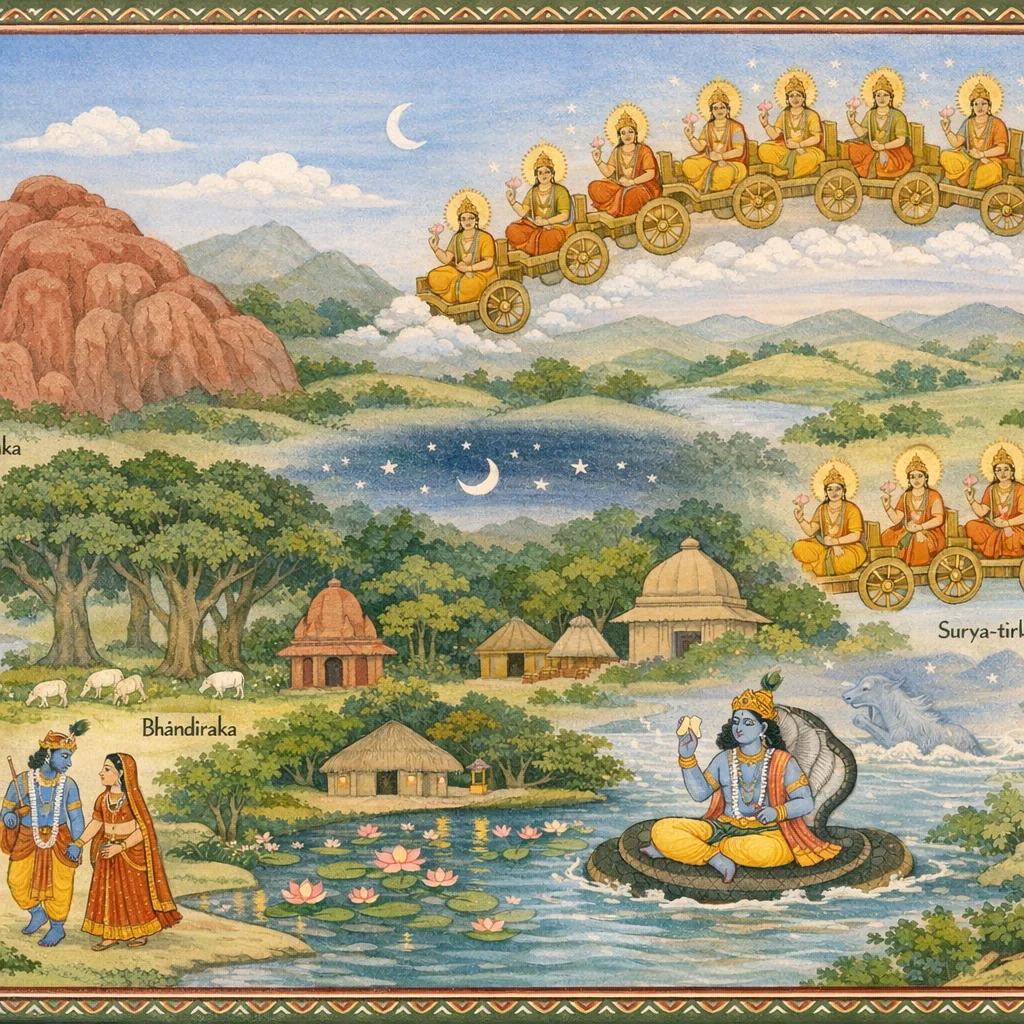
Framed as Varāha’s instruction to Pṛthivī, the chapter charts the sacred geography around Mathurā through a sequence of tīrthas and their ritual fruits. Vatsakrīḍanaka, adorned with raktaśilā and raktacandana, grants Vāyuloka by mere bathing, and death there leads to Varāha’s loka. Bhāṇḍīraka is praised with its grove ecology (śāla, tāla, tamāla, arjuna, iṅguda, pīluka, karīra, raktapuṣpaka); regulated bathing and disciplined diet erase sin, bestow Indraloka, and ultimately Varāha’s loka. Vṛndāvana, a rare forest play-ground of cows and cowherds, promises gandharva–apsaras enjoyment through a one-night stay and bathing in a kuṇḍa, followed by ascent after death. The merit peaks at Keśītīrtha—where Keśin fell and Hari rests—where piṇḍadāna equals Gayā and snāna/dāna/homa are likened to the Agniṣṭoma. Finally, Sūryatīrthas tied to the twelve Ādityas and the Kāliya episode are introduced: the Ādityas seek entitlement to the bath’s merit, Varāha affirms release from demerit by bathing, and declares that death between Harideva and Kāliya yields apunarbhava, non-return.
Primary Speakers
Key Concepts
Shlokas in Adhyaya 156
Verse 1
अथ मथुराप्रादुर्भावः ॥ श्रीवराह उवाच ॥ वत्सक्रीडनकं नाम तीर्थं वक्ष्ये परं मम ॥ तत्र रक्तशिलाबद्धं रक्तचन्दनभूषितम्
Now, the account of Mathurā’s manifestation. Śrī Varāha said: “I shall describe a supreme tīrtha of mine, named Vatsakrīḍanaka. There it is set with red stone, adorned with red sandalwood.”
Verse 2
स्नानमात्रेण तत्रैव वायुलोकं व्रजेन्नरः ॥ तत्राथ मुञ्चते प्राणान्मम लोके महीयते
By bathing there alone, a person would go to the world of Vāyu. And if one gives up the life-breath there, one is honored in my world.
Verse 3
पुनरन्यत्प्रवक्ष्यामि तच्छृणुष्व वसुन्धरे ॥ अस्ति भाण्डीरकं नाम यत्तीर्थं परमुत्तमम् ॥
Again I shall expound something further; listen, O Vasundharā. There is a sacred ford named Bhāṇḍīraka, esteemed as a tīrtha of supreme excellence.
Verse 4
सालैस्तालैश्च तरुभिस्तमालैरर्जुनैस्तथा ॥ इङ्गुदैः पीलुकैश्चैव करीैरक्तपुष्पकैः ॥
It is filled with śāla and tāla trees, with tamāla and arjuna as well; with iṅguda and pīluka, and with karīra shrubs bearing red blossoms.
Verse 5
तस्मिन्भाण्डीरके स्नातो नियतो नियताशनः ॥ सर्वपापविनिर्मुक्तश्चेन्द्रलोकं स गच्छति ॥
Having bathed at that Bhāṇḍīraka, disciplined and restrained in diet, one—freed from all wrongdoing—goes to Indra’s world.
Verse 6
तत्राथ मुञ्चते प्राणान्मम लोकं च गच्छति ॥ पुनरन्यत्प्रवक्ष्यामि क्षेत्रं वृन्दावनं मम ॥
There, then, one relinquishes the life-breath and goes to my world. Again I shall explain another sacred region—my kṣetra, Vṛndāvana.
Verse 7
तत्राहं क्रीडयिष्यामि गोभिर्गोपालकैः सह ॥ रम्यं च सुप्रतीतं च देवदानवदुर्लभम् ॥
There I shall engage in play together with the cows and the cowherds. It is delightful and well-renowned—rare even for gods and dānavas to attain.
Verse 8
तत्र कुण्डे महाभागे बहुगुल्मलतावृते ॥ तत्र स्नानं प्रकुर्वीत चैकरात्रोषितो नरः ॥
There, at the auspicious pond, overgrown with many shrubs and creepers, a man should bathe there after having stayed for a single night.
Verse 9
गन्धर्वैरप्सरोभिश्च क्रीडमानः स मोदते ॥ तत्राथ मुञ्चते प्राणान्मम लोकं च गच्छति ॥
Sporting with gandharvas and apsarases, he rejoices; then, there itself, he relinquishes the life-breath and goes to my world.
Verse 10
तीर्थं शतगुणं पुण्यं यत्र केशी निपातितः ॥ केश्यः शतगुणं पुण्यं यत्र विश्रमते हरिः ॥
A tīrtha is a hundredfold meritorious where Keśī was brought down. A hundredfold meritorious is the Keśī-tīrtha where Hari rests.
Verse 11
तस्माच्छतगुणं पुण्यं नात्र कार्या विचारणा ॥ तत्रापि च विशेषोऽस्ति केशितीर्थे वसुन्धरे ॥
Therefore it is a hundredfold meritorious—there is no need for deliberation here. And even among those, there is a particular distinction at Keśī-tīrtha, O Vasundharā.
Verse 12
तस्मिन्पिण्डप्रदानेन गयातुल्य फलं भवेत् ॥ स्नाने दाने तथा होमे अग्निष्टोमफलं भवेत् ॥
There, by offering a piṇḍa, the result is said to be equal to that of Gayā. And by bathing, giving, and likewise by performing a fire-offering (homa), the result is said to be that of the Agniṣṭoma sacrifice.
Verse 13
सूर्यतीर्थेषु वसुधे द्वादशादित्यसंज्ञके ॥ कालियो रमते तत्र कालिन्द्याः सलिले शुभे ॥
O Earth, at the Sun-sacred fords known as the “Twelve Ādityas,” Kāliya sports there in the auspicious waters of the Kāliṇdī (Yamunā).
Verse 14
आदित्या ऊचुः ॥ वरं ददासि नो देव वरार्हा यदि वा वयम् ॥ अस्मिंस्तीर्थवरे स्नानमस्माकं सम्प्रदीयताम् ॥
The Ādityas said: O god, grant us a boon, if we are worthy of a boon. In this excellent tīrtha, let the rite of bathing be duly assigned to us (as our observance/privilege).
Verse 15
आदित्यानां वचः श्रुत्वा क्रीडां कृत्वा वसुन्धरे ॥ स्नानमात्रेण तत्रैव मुच्यते सर्वकिल्बिषैः ॥
O Earth, having heard the words of the Ādityas and having sported there, by bathing there alone one is released from all stains of wrongdoing.
Verse 16
अथात्र मुञ्चते प्राणान्मम लोकं स गच्छति ॥ उत्तरे हरिदेवस्य दक्षिणे कालियस्य तु ॥
Then, if one relinquishes life here, one goes to my world; this place lies to the north of Harideva and to the south of Kāliya.
Verse 17
कालियो दमितस्तत्र आदित्याḥ स्थापिताः मया ॥ वरं वृणुध्वं भद्रं वो यद्वो मनसि वर्त्तते ॥
There Kāliya was subdued, and the Ādityas were installed by me. Choose a boon—may it be well with you—whatever is in your mind.
Verse 18
अनयोर्देवयोर्मध्ये ये मृतास्तेऽपुनर्भवाः ॥
Those who die in the space between these two deities become ‘non-returning’—not subject to rebirth.
Verse 19
पुनरन्यत्प्रवक्ष्यामि महापातकनाशनम् ॥ तत्र वृन्दावने तीर्थे यत्र केशी निपातितः ॥
Again I shall proclaim another account—a destroyer of great transgressions: there, at the tīrtha in Vṛndāvana where Keśī was struck down.
Frequently Asked Questions
The chapter frames sacred geography as a pedagogy of conduct: the text instructs that disciplined practice (snāna paired with niyama/niyatāśana, and optionally dāna/homa) aligns human behavior with a ritually ordered landscape. Its internal logic links moral purification (release from pāpa/kilbiṣa) to respectful engagement with specific terrestrial zones (tīrthas), implying that caring for and properly using designated natural spaces (groves, river waters, boundary sites) sustains a stable human–earth relationship.
No explicit tithi, nakṣatra, lunar phase, or seasonal timing is stated in the provided verses. The only time-bound practice specified is a vrata-like duration: “ekarātroṣitaḥ” (staying for one night) in Vṛndāvana in connection with bathing at the kuṇḍa.
Environmental balance is implied through sacralized place-management: Bhāṇḍīraka is characterized via a detailed grove-species list, treating vegetation as an identifying and valued feature of the tīrtha. The repeated emphasis on regulated behavior (niyama, controlled diet) and non-destructive ritual acts (snāna, dāna, homa) positions the landscape—rivers, groves, ponds, and boundary markers—as a protected infrastructure of meaning. The text thereby models an early ecological ethic where Earth (Pṛthivī) is taught through mapped sites that require disciplined, low-impact engagement.
The chapter references primarily mythic/cultic figures rather than human dynasties: Varāha and Pṛthivī as interlocutors; Hari (Viṣṇu) associated with Keśītīrtha; Keśin (the slain adversary marking the tīrtha); the twelve Ādityas (solar deities) requesting bathing rights; Gandharvas and Apsarases as post-ritual enjoyment figures; Kāliya (serpent figure) linked to the Kālimdī waters; and local divine markers Harideva and Kāliya used to define a liminal zone whose death-result is described as apunarbhava.