Adhyaya 150: The Sacred Greatness of Sānandūra
Sānandūra-māhātmya
Ancient-Geography (Tīrtha-Māhātmya) and Ritual-Manual
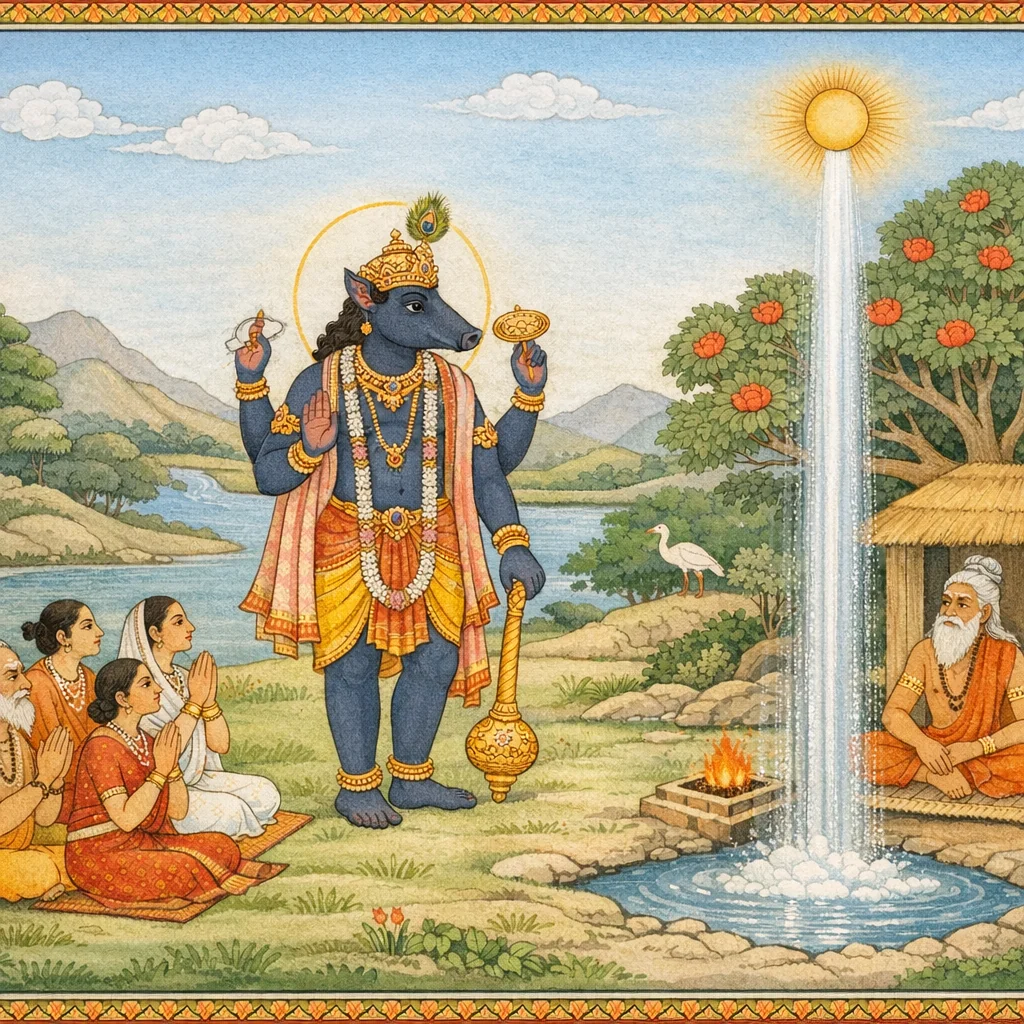
After hearing the greatness of Dvārakā, Pṛthivī (Vasundharā) offers thanks and asks Varāha (Viṣṇu) to disclose an even more secret sacred teaching. Varāha describes Sānandūra, a hidden and supreme kṣetra north of the ocean and south of the Malaya region, where His image stands facing north. He then lists a succession of tīrthas and waters—Rāmasaras, Brahmasaras, Saṅgamana, Śakrasaras, Sūrpāraka, and Jaṭākuṇḍa—each with prescribed bathing durations and promised post-mortem destinations: Budha-loka, Brahma-loka, the realms of the lokapālas, and Viṣṇu’s own loka. The account stresses that these sacred realities are chiefly visible to disciplined devotees, linking ritual observance to moral conduct and presenting Pṛthivī’s sacral landscape as a framework for earthly order and stewardship.
Primary Speakers
Key Concepts
Shlokas in Adhyaya 150
Verse 1
अथ सानन्दूरमाहात्म्यम् ॥ सूत उवाच ॥ द्वारकायास्तु माहात्म्यं श्रुत्वा ह्येतत्सुभाषितम् ॥ हृष्टावोचत्तदा देवं धर्मकामा वसुन्धरा ॥
Now, the Māhātmya of Sānandūra. Sūta said: Having heard this well-spoken account of the greatness of Dvārakā, Vasundharā—desiring dharma—then spoke with joy to the Lord.
Verse 2
धरण्युवाच ॥ अहो देव प्रसादश्च यत्त्वया परिकीर्तितम् ॥ श्रुत्वैतत्परमं पुण्यं प्राप्तास्मि परमां श्रियम् ॥
Dharaṇī said: O Lord, what you have proclaimed is truly a gracious favor. Having heard this supremely meritorious account, I have attained the highest prosperity.
Verse 3
एतस्मादपि चेद्गुह्यं लोकनाथ जनार्दन ॥ यद्यस्ति प्रोच्यतां मह्यं कृपा चेत्परमा मयि ॥
If there is something even more secret than this, O Lord of the world, Janārdana—if it exists—let it be told to me, if your highest compassion rests upon me.
Verse 4
ततो महीवचः श्रुत्वा विष्णुः कमललोचनः ॥ वराहरूपी भगवान्प्रत्युवाच वसुन्धराम् ॥
Then, having heard the words of Mahī, Viṣṇu—the lotus-eyed—, the Blessed One in the form of Varāha, replied to Vasundharā.
Verse 5
श्रीवराह उवाच ॥ सानन्दूरेति विख्यातं भूमे गुह्यं परं मम ॥ उत्तरे तु समुद्रस्य मलयस्य तु दक्षिणे ॥
Śrī Varāha said: “O Earth, a supremely secret place of mine is renowned as Sānandūra—situated to the north of the ocean and to the south of the Malaya mountain range.”
Verse 6
तत्र तिष्ठामि वसुधे उदीचीं दिशमाश्रितः ॥ प्रतिमा वै मदीयास्ति नात्युच्छा नातिनीचका ॥
“There, O Earth, I abide, facing the northern direction. Indeed, there is an image of me—neither overly tall nor overly low.”
Verse 7
आयसीं तां वदन्त्येके अन्ये ताम्रमयीं तया ॥ कांस्यां रीतिमयीमन्ये केचित्सीसकनिर्मिताम् ॥
“Some say that (image) is made of iron; others (say) it is made of copper. Others describe it as bronze or as fashioned from bell-metal; some say it is made of lead.”
Verse 8
शिलामयीमित्यपरे महदाश्चर्यरूपिणीम् ॥ तत्र स्थानानि वै भूमे कथ्यमानानि वै शृणु ॥
“Others say it is made of stone—of a form that is a great marvel. Now, O Earth, listen to the places there as they are being described.”
Verse 9
मनुजा यत्र मुच्यन्ते गताः संसारसागरम् ॥ तत्राश्चर्यं प्रवक्ष्यामि सानन्दूरे यशस्विनि ॥
“Where people, having reached the ocean of transmigration (saṃsāra), are released from it—there, in Sānandūra, O illustrious one, I shall describe a marvel.”
Verse 10
तत्रापि शृणु चाश्चर्यं यश्चापि परिवर्तते ॥ एका तत्र लता वृक्षे उच्छैः स्थूलो महाद्रुमः ॥
There too, listen to a marvel—one that also undergoes change. There, a single creeper grows upon a tree; and there is a great tree, lofty and massive.
Verse 11
समुद्रमध्ये तिष्ठन्तं कोऽपि तत्र न पश्यति ॥ अन्यच्च ते प्रवक्ष्यामि महाश्चर्यं वसुन्धरे ॥
Standing in the midst of the ocean, no one there sees it. And I shall tell you yet another great marvel, O Earth.
Verse 12
मम भक्ताः हि पश्यन्ति विद्यमाना स्वकर्मणा ॥ बहुमत्स्यसहस्राणि कोट्यो ह्यर्बुदमेव च ॥
For my devotees do see it, being so enabled by their own actions. There are many thousands of fish—indeed crores, and even tens of millions as well.
Verse 13
क्षिप्तः पिण्डश्च तन्मध्ये येन केन विकर्मिणा ॥ एकस्तत्र स्थूलमत्स्यो भूमे चक्रेण चाङ्कितः ॥
And a lump of offering is thrown into its midst by some wrongdoer or other. There, O Earth, one huge fish is marked with a discus-sign.
Verse 14
तावत्कश्चिन्न गृह्णाति यावत्तेन न भक्षितः ॥ तत्र रामसरो नाम गुह्यं क्षेत्रं परं मम ॥
No one takes it so long as it has not been eaten by that fish. There, in that place, is a secret sacred precinct of mine called Rāmasara.
Verse 15
अगाधं चाप्यपारं च रक्तपद्मविभूषितम् ॥ तत्र स्नानं तु कुर्वीत एकरात्रोषितो नरः ॥
It is described as unfathomable and boundless, adorned with red lotuses. A man who has stayed there for a single night should then perform bathing there.
Verse 16
बुधस्य भवनं गत्वा मोदते नात्र संशयः ॥ अथ प्राणान्प्रमुच्येत तस्मिन्सरसि सुन्दरी ॥
Having gone to the abode of Budha, one rejoices—of this there is no doubt. And if one should relinquish life-breaths in that lake, O fair one,
Verse 17
बुधस्य भवनं त्यक्त्वा मम लोकं प्रपद्यते ॥ तस्मिन्रामसरस्युच्चैराश्चर्यं शृणु सुन्दरी ॥
Leaving the abode of Budha, one attains my world. Concerning that lofty marvel in the lake called Rāma-saras, listen, O fair one.
Verse 18
मनुजास्तन्न पश्यन्ति मम कर्मरता न ये ॥ तत्सरः क्रोशविस्तारं बहुगुल्मलतावृतम् ॥
Human beings do not see that—those who are not devoted to my prescribed practice. That lake extends for a krośa and is covered with many shrubs and creepers.
Verse 19
एकं तु दृश्यते श्वेतमब्जं रुक्ममयं तथा ॥ तत्र ब्रह्मसरस्युच्चैरुत्तरं पार्श्वमाश्रिता ॥
There, one white lotus is seen, and likewise one made of gold. There, at the lofty Brahma-saras, it rests on the northern side.
Verse 20
धारा चैका प्रपतति स्थूला मुसलसन्निभा ॥ तत्र स्नानं प्रकुर्वीत षष्ठकालोषितो नरः ॥
There a single stream descends, thick, like a pestle. A man who has remained for six periods of time should perform the ritual bath there.
Verse 21
ब्रह्मलोकं समासाद्य मोदते नात्र संशयः ॥ अथात्र मुंचते प्राणैर्भूमे ब्रह्मसरस्यपि ॥
Having reached Brahma-loka, one rejoices—of this there is no doubt. And if here on earth, at Brahma-saras as well, one relinquishes the life-breaths,
Verse 22
ब्रह्मणा समनुज्ञातो मम लोकं च गच्छति ॥ तत्राश्चर्यं महाभागे रम्ये ब्रह्मसरे शृणु ॥
Duly permitted by Brahmā, one also goes to my world. Now listen to the marvel there, O greatly fortunate one, in the delightful Brahma-saras.
Verse 23
मद्भक्ता यच्च पश्यन्ति घोरसंसारमोक्षणम् ॥ चतुर्विंशतिद्वादश्यां सा धारा पृथुलेक्षणे ॥
And what my devotees behold as release from dreadful saṃsāra—on the twenty-fourth Dvādaśī, O wide-eyed one—that stream appears.
Verse 24
भूमे पतति मध्याह्ने यावत्सूर्यस्तु तिष्ठति ॥ परिवृत्ते तु मध्याह्ने सा धारा न पतेद्भुवि ॥
It falls upon the earth at midday for as long as the sun remains (in that position). But when midday has passed, that stream no longer falls upon the earth.
Verse 25
एवं तत्र महाश्चर्यं पुण्यब्रह्मसरोवरे ॥ अस्ति सङ्गमनं नाम गुह्यं क्षेत्रं परं मम ॥
Thus, in that holy Brahmā-lake there is a great marvel. There exists a secret sacred field called “Saṅgamana,” described as my highest sacred place.
Verse 26
समुद्रश्चैव रामश्च समेष्येते वराङ्गने ॥ तत्र कुण्डं महाभागे प्रसन्नविमलोदकम् ॥
O fair-limbed lady, the Ocean and Rāma are said to meet there. O greatly fortunate one, there is a pond there whose waters are clear, calm, and pure.
Verse 27
बहुगुल्मलताकीर्णं शोभितं च विहङ्गमैः ॥ समुद्रस्य तु पार्श्वेन ह्यदूरात्तत्र योजनात् ॥
It is filled with many shrubs and creepers, and is beautified by birds. It lies beside the Ocean, not far away—about a yojana from there.
Verse 28
समुद्रभवनं गत्वा मम लोकं प्रपद्यते ॥ तत्राश्चर्यं प्रवक्ष्यामि कुण्डं रामस्य सङ्गमे ॥
Having gone to the abode of the Ocean, one attains my world. There I shall describe a marvel: the pond at the confluence associated with Rāma.
Verse 29
यद्दृष्ट्वा मनुजास्तत्र भ्रमन्ति विगतज्वराः ॥ यानि कानि च पर्णानि पतन्ति जलसंसदि ॥
Upon seeing it, people there move about free from fever and distress. And whatever leaves fall into the assembly of waters (the water’s surface/reservoir)…
Verse 30
एकमप्यत्र पश्यन्ति न केपि वसुधे नराः ॥ अच्छिद्राणि च पत्राणि तस्मिन् रामस्य सङ्गमे ॥
O Earth, no one here sees even a single leaf with any defect; in that confluence sacred to Rāma, the leaves are without holes.
Verse 31
प्रपन्नेनापि मार्गं तच्छिद्रं तत्र न पश्यति ॥ अस्ति शक्रसरो नाम गुह्यं क्षेत्रं परं मम ॥
Even one who approaches with care sees no hole there along that path. There is also a secret sacred place called “Śakra-saras,” spoken of as my highest kṣetra.
Verse 32
तत्र पूर्वेण पार्श्वेण ह्यदूरादर्धयोजनात् ॥ तस्य कुण्डस्य सुश्रोणि चतस्रो विषमाश्रिताः ॥
There, on the eastern side, not far away—at a distance of half a yojana—O fair-hipped one, four streams are situated on uneven ground in connection with that kuṇḍa.
Verse 33
धाराः पतन्ति कल्याणि प्रसन्नसलिलास्तथा ॥ तत्र स्नानं प्रकुर्वीत चतुष्कालोषितो नरः ॥
O auspicious lady, streams fall there, and the waters are likewise clear. One who has dwelt there through the four time-periods should perform ritual bathing there.
Verse 34
चतुर्णां लोकपालानां लोकानाप्नोति चोत्तमान् ॥ अस्मिंश्च शक्रसरसि यदि प्राणान्प्रमुञ्चति ॥
He attains the excellent worlds of the four Lokapālas, guardians of the directions. And if, in this Śakra-saras, he relinquishes his life-breaths (dies)…
Verse 35
लोकपालान्समुत्सृज्य मम लोकेषु मोदते ॥ तत्राश्चर्यं महाभागे दृश्यते तच्छृणुष्व मे ॥
Setting aside the guardians of the worlds, he rejoices in my realms. There, O fortunate one, a wonder is seen—listen to it from me.
Verse 36
शुद्धैर्भागवतैर्भूमे सर्वसंसारमोक्षणम् ॥ चतुर्धारास्ततो भद्रे पतन्ति चतुरो दिशः ॥
O Earth, through purified bhāgavatas there is liberation from the whole of transmigratory existence. Then, O auspicious one, four streams pour forth toward the four directions.
Verse 37
श्रूयते गीतनिर्घोषः श्रुतिकर्ममनोहरः ॥ अस्ति सूर्पारकं नाम गुह्यं क्षेत्रं परं मम ॥
A resonant sound of song is heard, delightful with rites grounded in sacred recitation. There is a secret sacred site of mine, supreme, named Sūrpāraka.
Verse 38
जामदग्न्यस्य रामस्य स्वाश्रमोऽथ भविष्यति ॥ तत्र तिष्ठाम्यहं देवि समुद्रतटमाश्रितः ॥
There will be the hermitage (āśrama) of Rāma Jāmadagnya (Paraśurāma). There, O goddess, I remain, dwelling upon the seashore.
Verse 39
शाल्मलीं चाग्रतः कृत्वाधिष्ठितश्चोत्तरामुखः ॥ तत्र स्नानं प्रकुर्वीत पञ्चकालोषितो नरः ॥
Placing the Śālmalī tree before him and taking his seat facing north, a man who has observed the five time-periods should perform ritual bathing there.
Verse 40
ऋषिलोकं ततो गत्वा पश्येत् तत्राप्यरुन्धतीम् ॥ अथ प्राणान्विमुञ्चेत कृत्वा कर्म सुदुष्करम् ॥
Then, having gone to the world of the seers (ṛṣis), one should behold Arundhatī there as well. Thereafter, having performed the exceedingly difficult rite, one should relinquish one’s life-breaths.
Verse 41
ऋषिलोकं परित्यज्य मम लोकं प्रपद्यते ॥ तत्राश्चर्यं महाभागे नमस्कारं च कुर्वते ॥
Having left the world of the seers (ṛṣis), he attains my realm. There, O fortunate one, a wonder is seen: he performs an act of reverential salutation.
Verse 42
वर्षाणि द्वादशैतेन नमस्कारः कृतो भवेत् ॥ तस्मिन्क्षेत्रे महाभागे पश्यन्ति परिनिष्ठिताः ॥
By this, a single salutation is regarded as having been performed for twelve years. In that sacred place, O fortunate one, those firmly established in discipline behold the vision.
Verse 43
पापात्मानो न पश्यन्ति मम मायाविमोहिताः ॥ चतुर्विंशतिद्वादश्यां समुपायान्ति शाल्मलीम् ॥
Those of sinful disposition do not see, deluded by my māyā. On the Dvādaśī of the twenty-fourth day-count, they approach the Śālmalī.
Verse 44
तत्र पश्यन्ति सुश्रोणि शुद्धा भागवता नराः ॥ तस्मिन्क्षेत्रे महाभागे अस्ति गुह्यं परं मम ॥
There, O fair-hipped one, purified Bhāgavata devotees behold it. In that sacred place, O fortunate one, there is a secret of mine, supreme.
Verse 45
जटाकुण्डमिति ख्यातं वायव्यां दिशि संस्थितम् ॥ तत्कुण्डस्य महाभागे समन्ताद्दशयोजनम्
It is renowned as “Jaṭā-kuṇḍa,” situated in the north‑western direction. O noble lady, the region extending all around that pond measures ten yojanas.
Verse 46
अगस्तिभक्नं गत्वा मोदते नात्र संशयः ॥ अथ प्राणान्प्रमुञ्चेत मम चिन्तापरायणः
Having gone to Agastibhakna, one rejoices—of this there is no doubt. And if, devoted to contemplation of me, one should then relinquish life‑breath,
Verse 47
अगस्तिभवनं त्यक्त्वा मम लोकं तु गच्छति ॥ तस्य कुण्डस्य सुश्रोणि नव धारा न किञ्चन
Having departed from Agastya’s abode, one indeed goes to my world. O fair‑hipped lady, of that pond there are nine streams—nothing is lacking in them.
Verse 48
विस्तारश्च महाभागे अगाधश्च महार्णवः ॥ आश्चर्यं सुमहत्तत्र कथ्यमानं मया शृणु
O noble lady, it is expansive and unfathomable like a great ocean. Hear from me the very great marvel there, as I relate it.
Verse 49
यच्च पश्यति सुश्रोणि समन्तादितरो जनः ॥ चतुर्विंशतिद्वादश्यां रवावभ्युदिते सति
And what another person sees all around, O fair‑hipped lady—on the twenty‑fourth day, on the Dvādaśī tithi, when the sun has risen—
Verse 50
न वर्द्धते ततश्चाम्भो यावत्तिष्ठति तत्पुनः ॥ एतत्ते कथितं भद्रे सानन्दूरेति तन्मया
Then the water does not increase, and it remains just so for as long as it stands. This has been told to you, O good lady, by me—concerning “Sānandūra,” thus.
Verse 51
आश्चर्यं च प्रमाणं च भक्तिकीर्तिविवर्धनम् ॥ गुह्यानां परमं गुह्यं स्थानानां परमं महत्
It is both a marvel and an authoritative testimony, increasing devotion and renown. It is the most secret among secrets, and the greatest among sacred places.
Verse 52
यस्तु गच्छति सुश्रोणि अष्टभक्तपथे स्थितः ॥ प्राप्नोति परमां सिद्धिं ममैव वचनं यथा
But whoever goes—O fair-hipped lady—established on the path of eightfold devotion, attains the highest accomplishment, just as my statement declares.
Verse 53
य एतत्पठते नित्यं यश्चैवं शृणुयान्मुदा ॥ कुलानि तेन तीर्णानि षट् च षट् च पुनश्च षट्
Whoever recites this daily, and whoever likewise listens with gladness—by that person, lineages are carried across: six, and six, and again six.
Verse 54
एतन्मरणकाले न विस्मर्तव्यं कदाचन ॥ यदीच्छेद्विष्णुलोके हि निष्कलं गमनं नरः
This should never be forgotten at the time of death, if a man indeed desires unimpeded passage to Viṣṇu’s realm.
Verse 55
सौवर्णं दृश्यते पद्मं मध्याह्ने तु दिवाकरे ॥ यत्र रामगृहं नाम मम गुह्यं यशस्विनि ॥
At midday, when the sun stands overhead, a golden lotus is seen. There is a place called Rāmagṛha—my secret sacred spot, O illustrious one.
Verse 56
मनोज्ञं रमणीयं च जलजैश्चापि संवृतम् ॥ तत्र रूढानि पद्मानि द्योतयन्ति दिशो दश ॥
Delightful and beautiful, and also surrounded by water-born plants. There, the lotuses that have grown up illuminate the ten directions.
Verse 57
मण्डितं कुमुदैः पद्मैः सुगन्धैश्चोत्तमैस्तया ॥ तत्र स्नानं तु कुर्वीत षष्ठकालोषितो नरः ॥
Adorned with kumuda (white lotuses) and lotuses, and with excellent fragrances. There one should perform the ritual bath, even a man who has remained for six periods of time.
Verse 58
न च तद्वर्धते चाम्भो न चैव परिहीयते ॥ मासे भाद्रपदे चैव शुक्लपक्षे तु द्वादशी ॥
And that water neither increases nor indeed diminishes. In the month of Bhādrapada, on the twelfth day of the bright fortnight—
Verse 59
मलयस्य दक्षिणेन समुद्रस्योत्तरे तथा ॥ तत्र स्नानं तु कुर्वीत पञ्चकालोषितो नरः ॥
To the south of Malaya and likewise to the north of the ocean—there one should bathe, even a man who has remained for five periods of time.
Verse 60
एतत्ते कथितं भद्रे त्वया पृष्टं च मां प्रति ॥ उक्तं भागवतार्थाय किमन्यत्परिपृच्छसि ॥
This has been told to you, O noble lady, just as you asked of me. It has been stated for the sake of the Purāṇic, the ‘Bhāgavata’ meaning—what else do you ask further?
Frequently Asked Questions
The chapter frames sacred geography as an ethical-ritual ecology: Pṛthivī asks for a deeper ‘guhya’ teaching, and Varāha answers by linking disciplined devotion (bhakti, karmic fitness, observance of vows and stays) with access to sacred places and liberation. The internal logic emphasizes that moral-spiritual discipline governs perception and benefit—non-disciplined persons ‘do not see’ certain wonders—thereby presenting the landscape as a pedagogical field where conduct, restraint, and reverence maintain terrestrial order.
The text repeatedly specifies dvādaśī (the 12th lunar day), including ‘caturviṃśati-dvādaśyām’ as a key timing for visible phenomena (e.g., water-flow behavior and extraordinary sightings). It also names Bhādrapada māsa and śukla-pakṣa dvādaśī, and describes midday (madhyāhna) as a temporal marker for appearances/disappearances (e.g., a golden lotus seen at midday; a water-stream that falls only while the sun remains at midday).
Environmental balance is expressed through Pṛthivī-centered sacred topography: Varāha’s instructions map a network of ponds, streams, and confluences whose waters are described as ‘prasanna’ and ‘vimala,’ and whose flows exhibit regulated constancy (not increasing or decreasing). This portrays hydrology as ordered and meaningful, reinforcing an ethic of careful engagement with water-bodies (snāna with specified durations, restraint, and ritual discipline). The Earth (Pṛthivī) is treated as a living moral landscape where right practice sustains harmony between humans and place.
The chapter references Varāha (Viṣṇu) as instructor; Budha (as a post-mortem destination via Rāmasaras); Brahmā (authorization after Brahmasaras); Śakra/Indra (Śakrasaras); the lokapālas (guardians of directions) as destination-realms; Jāmadagnya Rāma (Paraśurāma) and his āśrama at Sūrpāraka; and Agasti (via Agasti-bhavana/association). These figures function as cosmological administrators and sage-anchors that situate the tīrthas within broader Purāṇic cultural memory.