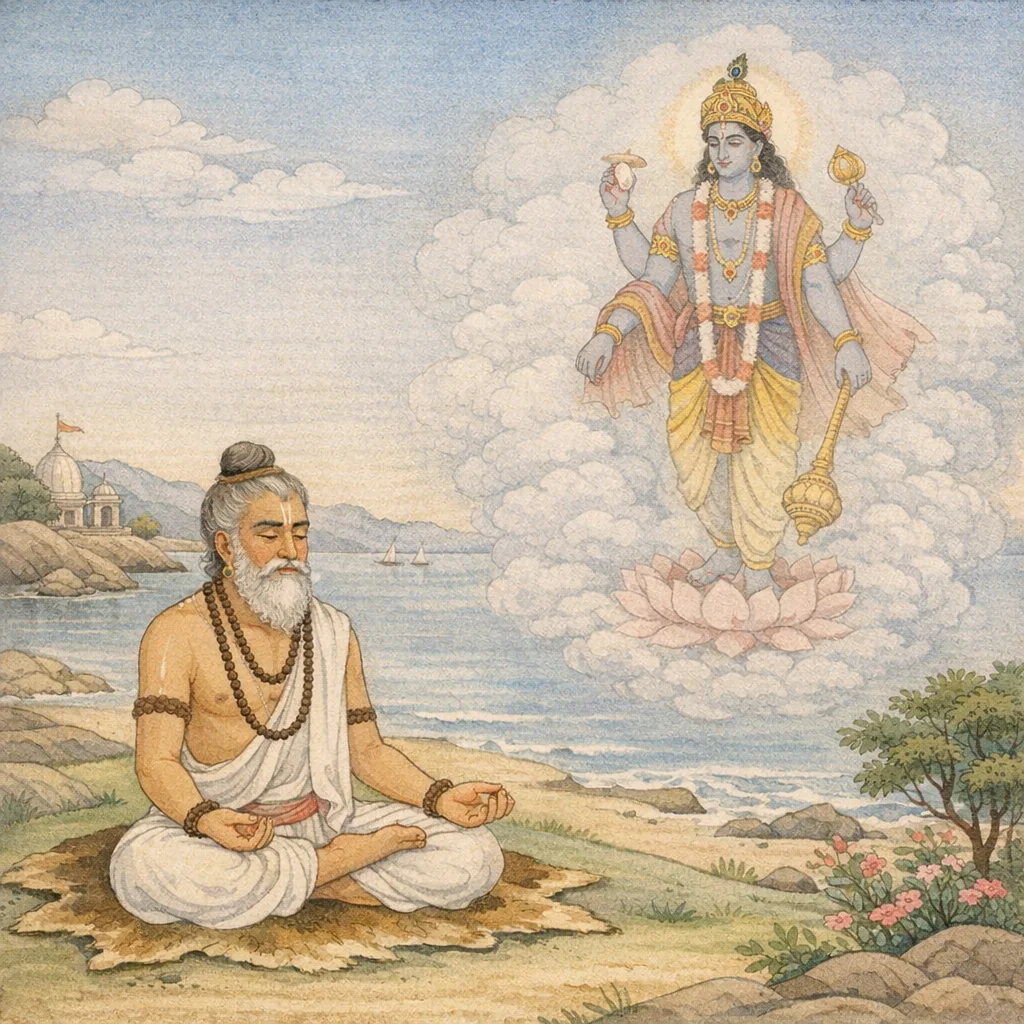
Adhyaya 15: Gauramukha’s Recollection and the Hymn to Hari at Prabhāsa
Gauramukhasya Smṛtiḥ Prabhāsa-tīrthe Hari-stavaś ca
Ritual-Manual and Devotional-Theology (Śrāddha continuation; avatāra-stotra; liberation motif)
In dialogue with Pṛthivī, Varāha continues the Śrāddha-focused account, describing what happened after Mārkaṇḍeya taught the rite. Pṛthivī asks who Gauramukha was in a former birth, how he regained memory, and what he did thereafter. Varāha replies that Gauramukha was Bhṛgu in another Brahmā-cycle and, prompted by Mārkaṇḍeya, recollected many lives. After offering to the Pitṛs for twelve years, he goes to the famed Prabhāsa tīrtha and recites a structured hymn to Hari, enumerating the avatāras—Matsya, Kūrma, Varāha, Narasiṃha, Vāmana, Paraśurāma, the Rāma-forms, Vāsudeva, and Kalkin. The narrative culminates in Hari’s direct manifestation and the sage’s dissolution into the eternal brahman as release from rebirth, implicitly linking ritual duty with cosmic-terrestrial stability and ethical continuity.
Primary Speakers
Key Concepts
Shlokas in Adhyaya 15
Verse 1
श्रीवराह उवाच । एवं श्राद्धविधिं श्रुत्वा मार्कण्डेयान्महामुनिः । तदा गौरमुखो देव किमूर्ध्वं कृतवान्विभो ॥ १५.१ ॥
Śrī Varāha said: “Thus, having heard the procedure of the Śrāddha, the great sage asked Mārkaṇḍeya: ‘Then, O deity of fair countenance—what did you do thereafter, O mighty one?’”
Verse 2
एतच्छ्रुत्वा तदा धात्री पितृऋतन्त्रं महामुनिः । संस्मारितो जन्मशतं मार्कण्डेयेन धीमता ॥ १५.२ ॥
Having heard this at that time, within the context of the doctrine concerning the ancestors (pitṛ-tantra), the great sage was caused by the wise Mārkaṇḍeya to remember a hundred births.
Verse 3
धरण्युवाच । भगवन् गौरमुखः कोऽसौ अन्यजन्मनि कः स्मृतः । कथं च स्मृतवान् स्मृत्वा किं चकार च सत्तमः ॥ १५.३ ॥
Dharaṇī (Earth) said: “O Blessed One, who is that fair-faced person? Who was he remembered as in another birth? And how did he come to remember—having remembered, what did that most excellent man then do?”
Verse 4
श्रीवराह उवाच । भृगुरासीत् स्वयं साक्षाद् अन्यस्मिन् ब्रह्मजन्मनि । तदन्वयात्मजस्त्वेष मार्कण्डेयो महामुनिः ॥ १५.४ ॥
Śrī Varāha said: “In another birth of Brahmā, Bhṛgu himself was present in person. From that lineage, this one—Mārkaṇḍeya—was born as a great sage.”
Verse 5
पुत्रैस्तु बोधिताः यूयं सुगतिं प्राप्स्यथेति यत् । प्रागुक्तं ब्रह्मणा तेन मार्कण्डेयेन बोधितः ॥ १५.५ ॥
That earlier statement made by Brahmā—“You will attain a good destiny when instructed by your sons”—is what he conveys here, having been instructed by Mārkaṇḍeya.
Verse 6
सस्मार सर्वजन्मानि स्मृत्वा चैव तु यत्कृतम् । तच्छृणुष्व वरारोहे कथयामि समासतः ॥ १५.६ ॥
He recalled all his births, and, having remembered what had been done in the past, he said: “Listen to that, O fair-hipped one; I shall relate it briefly.”
Verse 7
एवं श्राद्धविधानॆन द्वादशाब्दं ततः पितॄन् । इष्ट्वा पश्चाद्धरेः स्तोत्रं स मुनिस्तूपचक्रमे ॥ १५.७ ॥
Thus, by the prescribed śrāddha procedure, after performing the rites for the Pitṛs for twelve years, the sage then began a hymn of praise to Hari.
Verse 8
प्रभासं नाम यत्तीर्थं त्रिषु लोकेषु विश्रुतम् । तत्र दैत्यान्तकं देवं स्तोतुं गौरमुखः स्थितः ॥ १५.८ ॥
That sacred ford named Prabhāsa is renowned across the three worlds. There, Gauramukha stood ready to praise the god Daityāntaka, the slayer of the Daityas.
Verse 9
गौरमुख उवाच । स्तोष्ये महेन्द्रं रिपुदर्पहं शिवं नारायणं ब्रह्मविदां प्रतिष्ठितम् । आदित्यचन्द्राश्वियुगस्थमाद्यं पुरातनं दैत्यहरं सदा हरिम् ॥ १५.९ ॥
Gauramukha said: “I shall praise Mahendra, the breaker of the enemies’ pride—auspicious Nārāyaṇa, established among the knowers of Brahman; Hari, primordial and ancient, abiding in the cycles of the Sun, the Moon, and the Aśvins, ever the slayer of the Daityas.”
Verse 10
चकार मात्स्यं वपुरात्मनो यः पुराकृतं वेदविनाशकाले । महामहीधृग्वपुरग्रपुच्छ-छटाहवार्च्छिः सुरशत्रुहाद्यः ॥ १५.१० ॥
He who once, in ancient time when the Vedas were threatened with destruction, assumed his own form as the Fish (Matsya)—that slayer of the gods’ foes now bears the form of the great Lifter of the Earth, radiant with the blazing splendor of his projecting tail and mane-like bristles.
Verse 11
तथाब्धिमन्थानकृते गिरिन्द्रं दधार यः कूर्म्मवपुः पुराणम् । हितेच्छया यः पुरुषः पुराणः प्रपातु मां दैत्यहरः सुरेशः ॥ १५.११ ॥
May that ancient Lord protect me—he who, taking the primordial form of the Tortoise (Kūrma), bore the king of mountains for the churning of the ocean; who, out of benevolent intent, is the primeval Person; who destroys the Daityas and is the Lord of the gods.
Verse 12
महावराहः सततं पृथिव्यास्तलातलं प्राविशद्यो महात्मा । यज्ञाङ्गसंज्ञः सुरसिद्धवन्द्यः स पातु मां दैत्यहरः पुराणः ॥ १५.१२ ॥
May the ancient, great-souled Mahāvarāha protect me—he who continually entered Talātala beneath the Earth, who is known as the very limb of sacrifice (yajña), and who is revered by the gods and the Siddhas; the destroyer of the Daityas.
Verse 13
नृसिंहरूपी च भवत्यजस्त्रं युगे युगे योगिवरोग्रभीमः । करालवक्त्रः कनकाग्रवर्चा रत्नाशयोऽस्मानसुरान्तकोऽव्यात् ॥ १५.१३ ॥
May the slayer of the Asuras—who assumes the form of Nṛsiṃha—unceasingly protect us in every age: foremost among yogins, fierce and formidable, with a terrifying mouth, radiant with the splendor of refined gold, and a treasury of jewels.
Verse 14
बलिर्मखध्वंसकृते महात्मा स्वां गूढतां योगवपुःस्वरूपः । स दण्डकाश्ठाजिनलक्षणः पुनः क्षितिं च पदाक्रान्तवान् यः स पातु ॥ १५.१४ ॥
May that Great Being protect us—he who, to bring Bali’s sacrifice to an end, assumed his own concealed form as a yogic body; and who, bearing the ascetic marks of staff, wooden implement, and antelope-skin, once again strode over the earth with his foot.
Verse 15
त्रिःसप्तकृत्वो जगतीं जिगाय जित्वा ददौ कश्यपाय प्रचण्डः । स जामदग्न्योऽभिजनस्य गोप्ता हिरण्यगर्भोऽसुरहा प्रपातु ॥ १५.१५ ॥
Having conquered the earth twenty-one times, the fierce one, after victory, granted it to Kaśyapa. May that descendant of Jamadagni—protector of noble lineage, Hiraṇyagarbha, slayer of asuras—safeguard us.
Verse 16
चतुःप्रकारं च वपुर्य आद्यं हैरण्यगर्भप्रतिमानलक्ष्यम् । रामादिरूपैर्बहुरूपभेदश्चकार सोऽस्मानसुरान्तकोऽव्यात् ॥ १५.१६ ॥
And that primordial body—fourfold in character and marked by a measure comparable to Hiraṇyagarbha—assumed many differentiated forms, beginning with Rāma. May that destroyer of the Asuras protect us.
Verse 17
चाणूरकंसासुरदर्पभीतेर्भीतामराणामभयाय देवः । युगे युगे वासुदेवो बभूव कल्पे भवत्यद्भुतरूपकारी ॥ युगे युगे कल्किनाम्ना महात्मा वर्णस्थितिं कर्त्तुमनेकमूर्त्तिः ॥ १५.१७ ॥
To remove the fear born of the arrogance of foes such as Cāṇūra, Kaṁsa, and the asuras, and to grant fearlessness to the frightened devas, the Divine becomes Vāsudeva in each age; in each cosmic cycle he assumes wondrous forms. Again and again, as the great-souled one named Kalki, taking on many manifestations, he acts to restore the established order of the varṇas.
Verse 18
सनातनो ब्रह्ममयः पुराणो न यस्य रूपं सुरसिद्धदैत्याः । पश्यन्ति विज्ञानगतिं विहाय अथोप्यनेकानि समर्च्वयन्ति । मत्स्यादिरूपाणि चरणि सोऽव्यात् ॥ १५.१८ ॥
He is eternal, constituted of brahman, the Ancient One—whose true form the gods, siddhas, and daityas do not perceive, having set aside the path of discriminative knowledge; and yet they worship many manifestations. May he protect us—he whose forms begin with Matsya, the Fish, and whose feet are revered.
Verse 19
नमो नमस्ते पुरुषोत्तमाय पुनश्च भूयोऽपि नमो नमस्ते । नमः पुरस्तादथ पृष्ठतस्ते नयस्व मां मुक्तिपदं नमस्ते ॥ १५.१९ ॥
Homage, homage to You, O Puruṣottama; again and yet again, homage to You. Homage to You from the front and also from behind; lead me to the state of liberation—homage to You.
Verse 20
एवं नमस्यतस्तस्य महर्षेर्भावितात्मनः । प्रत्यक्षतां गतो देवः स्वयं चक्रगदाधरः ॥ १५.२० ॥
As that great seer, whose mind was disciplined, thus offered reverent salutations, the Deity—himself the bearer of discus and mace—became directly manifest before him.
Verse 21
तं दृष्ट्वा तस्य विज्ञानं निस्तरङ्गं स्वदेहतः । उत्तस्थौ सोऽपि तं लब्ध्वा तस्मिन् ब्रह्मणि शाश्वते । लयं जगाम देवात्मा त्वपुनर्भवसंज्ञिते ॥ १५.२१ ॥
Seeing his own knowledge—calm and wave-less—arising from within his embodied condition, he too rose up; and having attained it, that divine-souled one entered dissolution in the eternal Brahman, in the state called “non-return” (freedom from rebirth).
Frequently Asked Questions
The chapter links disciplined ancestral ritual (śrāddha and pitṛ observance) with moral continuity across generations and lifetimes, culminating in a theological claim that sustained duty and focused praise (stotra) can orient the practitioner toward liberation (apunarbhava) and integration with brahman.
A clear duration marker appears: Gauramukha performs rites for the Pitṛs for twelve years (dvādaśābda). No specific tithi, pakṣa, or māsa is stated in these verses.
Environmental stewardship is implicit through the tīrtha framework: Prabhāsa is presented as a renowned landscape where correct ritual action and remembrance occur. The avatāra sequence—especially Varāha’s descent to lift and stabilize the earth—functions as a narrative ecology, portraying terrestrial preservation as a cosmic responsibility mirrored by human ritual order.
The text identifies Gauramukha with Bhṛgu in another Brahmā-era and situates Mārkaṇḍeya as his descendant (anvayātmaja). It also references Kaśyapa (recipient of the earth in the Paraśurāma episode) and figures embedded in avatāra narratives such as Bali, Cāṇūra, and Kaṃsa.