Adhyaya 149: The Sacred Geography and Merit of Dvārakā
Dvārakā-māhātmya
Ancient-Geography (Tīrtha-Māhātmya) and Ritual-Manual
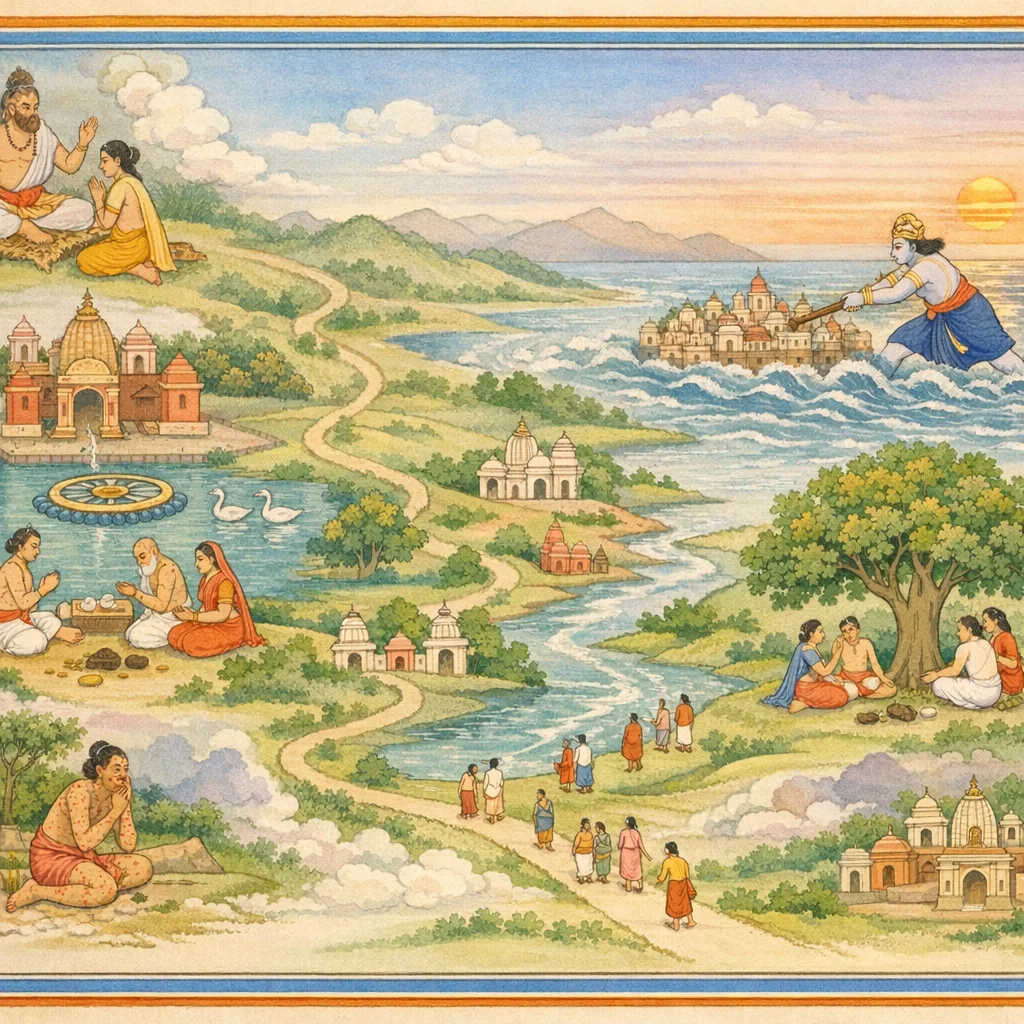
The chapter begins with Pṛthivī (Dharaṇī), calmed after hearing the earlier praise of Stutasvāmin, asking for higher instruction. Varāha replies with a Dvāpara-yuga frame: the rise of the Yādava line, the divinely built founding of Dvārakā, and a coming calamity set in motion by Durvāsas’ curse. He explains the immediate cause—Sāmba’s deception through a feigned pregnancy—leading to the musala (club) prophecy and the eventual destruction of the Vṛṣṇi–Andhaka–Bhoja groups, as Balarāma draws the city toward the sea. Varāha then turns to a didactic itinerary of Dvārakā’s sacred places (tīrthas, kuṇḍas, and holy trees), prescribing timely bathing, piṇḍa offerings, and ethical prerequisites of purity over sin that grant heaven or Varāha’s own loka, presenting earthly sanctity as a disciplined, place-based ecology of conduct.
Primary Speakers
Key Concepts
Shlokas in Adhyaya 149
Verse 1
अथ द्वारकामाहात्म्यम्॥ सूत उवाच॥ श्रीस्तुतस्वामिमाहात्म्यं श्रुत्वा धर्मपरायणा॥ परितुष्टमना देवी वाक्यमेतदुवाच ह॥
Now, the account of Dvārakā’s greatness. Sūta said: Having heard the greatness of Śrī-Stutasvāmin, the goddess devoted to dharma, her mind satisfied, spoke these words.
Verse 2
धरण्युवाच॥ एतच्छ्रुत्वा तु माहात्म्यं देव देववर प्रभो॥ मम चित्तस्य परमा जाता शान्तिरनुत्तमा॥
Dharaṇī (Earth) said: “Having heard this account of greatness, O God—best of gods, Lord—within my mind there has arisen a supreme, unsurpassed peace.”
Verse 3
नाराचधारावरणासिधारी सुररिपुवधकारी धरणीधरः ॥ धृतशङ्खगदाब्जचक्रपाणिः स्वयमिह शास्त्रमुदावहत्प्रधानम् ॥
Bearing a sword like a protective screen against showers of arrows—the slayer of the gods’ foes, the Upholder of the Earth—holding conch, mace, lotus, and discus in his hands, he himself here proclaimed the foremost teaching (śāstra).
Verse 4
एवं हि गुणमाहात्म्यं स्तुतस्वामिनि मच्छ्रुतम् ॥ अस्माच्छेदं परं श्रेष्ठं तन्मे वद कृपानिधे ॥
Thus, O praised Lord, I have heard of the greatness of your qualities. Now tell me what is higher and most excellent—O treasury of compassion—beyond this account.
Verse 5
श्रीवराह उवाच ॥ एवं भूमे वरं श्रेष्ठे फुल्लपङ्कजमालिनि ॥ कथयिष्यामि चान्यत्ते गुह्यं पापभयापहम् ॥
Śrī Varāha said: “So be it, O Earth—O excellent one, adorned with garlands of blossoming lotuses. I shall also tell you another matter: a secret teaching that removes the fear arising from wrongdoing.”
Verse 6
द्वापरं युगमासाद्य यादवाणां कुलोद्वहः ॥ शौरीति तत्र विख्यातो भविष्यति पिता मम ॥
When the Dvāpara age is reached, the upholder of the Yādava lineage—there renowned as ‘Śauri’—will be my father.
Verse 7
द्वारकेति च विख्याता पुरी तत्र स्थिता अभवत् ॥ या च देवपुरी रम्या विश्वकर्मविनिर्मिता ॥
There stood a city renowned as Dvārakā—lovely like a city of the gods—constructed by Viśvakarman.
Verse 8
पञ्चयोजनविस्तारा दशयोजनमायता ॥ वसाम्यत्र वरारोहे शतपञ्चसमास्तथा ॥
It was five yojanas in breadth and ten yojanas in length. I dwell there, O fair-hipped one, for one hundred and five years.
Verse 9
भारावतरणं कृत्वा देवानां सुमहत्प्रियम् ॥ पुनरप्यागमिष्यामि स्वर्लोकं प्रति सुन्दरि ॥
Having carried out the ‘descent and removal of the burden’—a deed greatly dear to the gods—I shall return again toward Svarga, O beautiful one.
Verse 10
तस्य शापाभिसन्तापाद्द्वारकावासिनो धरे ॥ वृष्ण्यन्धकाश्च भोजाश्च गमिष्यन्ति यमक्षयम् ॥
From the affliction caused by that curse, O Earth, the inhabitants of Dvārakā—the Vṛṣṇis, the Andhakas, and the Bhojas—will go to Yama’s abode.
Verse 11
चन्द्रपाण्डुरसङ्काशो वनमाली हलायुधः ॥ हलेनाकृष्य नगरं समुद्रं गमयिष्यति ॥
Resembling the pale brightness of the moon, wearing a forest-garland, the wielder of the plough will, dragging the city with his plough, send it into the sea.
Verse 12
नारायणवचः श्रुत्वा धर्मकामा वसुन्धरा ॥ उभौ तौ चरणौ गृह्य पुनः पप्रच्छ माधवी ॥
Having heard Nārāyaṇa’s words, Vasundharā—desiring dharma—took hold of both his feet; then Mādhavī again asked (him).
Verse 13
धरण्युवाच ॥ लोकनाथोऽसि सर्वेषां देव मायाकरण्डक ॥ शपिष्यति कथं तत्र दुर्वासास्तद्वदस्व मे ॥
Pṛthivī said: “You are the Lord of all worlds, O God, a casket of wondrous power. How, in such a situation, will Durvāsas utter a curse? Tell me that.”
Verse 14
श्रीवराह उवाच ॥ तत्र जाम्बवती नाम मम पत्नी भविष्यति ॥ रूपयौवनसम्पन्ना मम भोगसमन्विता ॥
Śrī Varāha said: “There, a woman named Jāmbavatī will become my wife—endowed with beauty and youth, and connected with my enjoyment and worldly prosperity.”
Verse 15
तस्याः पुत्रो महाभागो रूपयौवनदर्पितः ॥ साम्ब इत्यभिविख्यातो ममैव सततं प्रियः ॥
“Her son will be greatly fortunate, proud of his beauty and youth—renowned by the name Sāmba, and ever dear to me.”
Verse 16
तेनैव क्रीडमानेन कृत्वा गर्भमतथ्यतः ॥ स पृष्टः परमश्रेष्ठ ऋषिरेषा प्रसोष्यति ॥
“While he was sporting in that manner, he contrived a false pregnancy. Then the supreme ṛṣi was questioned: ‘Will this woman give birth?’”
Verse 17
पुत्रकामा त्वियं बाला मुने तत्प्रब्रवीहि मे ॥ साम्बोऽयमिति च ज्ञात्वा स मुनिः कोपमूर्च्छितः ॥
“‘This young woman desires a son, O muni—tell me about it,’ they said. And recognizing, ‘This is Sāmba,’ the sage was overcome with anger.”
Verse 18
उवाच तर्हि ते गर्भान्मुसलं कुलनाशनम् ॥ येन वृष्ण्यन्धकाः सर्वे गमिष्यन्ति यमक्षयम् ॥
Then he said: “From your womb will come forth a club (musala), the destroyer of the lineage—by which all the Vṛṣṇis and Andhakas will go to Yama’s abode, that is, to death.”
Verse 19
ततस्तानागतान्दृष्ट्वा कुमारान्पृष्टवानहम् ॥ ते च मामब्रुवन्सर्वे यथावृत्तं समुत्सुकाः ॥
Then, seeing those youths arrive, I questioned them; and they all eagerly told me what had happened.
Verse 20
तच्च तेषां वचः श्रुत्वा प्रोक्तवानस्मि तच्छृणु ॥ भविष्यति न सन्देहो दुर्वासा यदुवाच ह ॥
Having heard their statement, I said: “Listen to this. It will indeed happen—there is no doubt—what Durvāsas declared.”
Verse 21
एवं ते कथितं भूमे वृष्ण्यादेः शापकाणम् ॥ तत्र स्थानानि मे भूमे कथ्यमानानि मे शृणु ॥
Thus, O Earth, I have told you the cause of the curse upon the Vṛṣṇis and others. Now, O Earth, listen as I describe my sacred places there.
Verse 22
द्वारकायां महाभागे वैष्णवानां सुखावहे ॥ अस्ति पञ्चसरो नाम गुह्यं क्षेत्रं परं मम ॥
In Dvārakā, O greatly fortunate one—bringing well-being to the Vaiṣṇavas—there is a supremely sacred, secret pilgrimage-site of mine called Pañcasaras.
Verse 23
समुद्रतीरमुत्सृज्य मम कर्मसुखावहम् ॥ तत्र स्नानं तु कुर्वीत षष्ठकालोषितो नरः ॥
Having gone to the seashore—productive, in my sacred domain, of the pleasurable fruit of actions—a man should bathe there after residing for six ritual time-periods.
Verse 24
मोदते नाकपृष्ठे तु अप्सरोगणसंकुले ॥ अथात्र मुञ्चते प्राणान्क्षेत्रे पञ्चसरे मम ॥
He rejoices on the heavenly plane, thronged with hosts of apsarases; and if he relinquishes his life-breath here, in my sacred field called Pañcasara, that very result is obtained.
Verse 25
देवलोकं समुत्सृज्य मम लोके महीयते ॥ प्लक्षो वै तत्र सुश्रोणि शतशाखो महाद्रुमः ॥
Leaving the world of the gods behind, he is honored in my world. And there, O fair-hipped one, is indeed a plakṣa tree—a great tree with a hundred branches.
Verse 26
सुफलैः शोभनैः कुम्भाकृतिभिर्बहुभिः फलैः ॥ बहवस्तत्र गच्छन्ति लाभलौल्येन मानवाः ॥
With many excellent, beautiful fruits shaped like jars, many people go there, driven by eagerness for gain.
Verse 27
फलं न लभते कश्चिन्मुक्त्वा भागवतं नरम् ॥ लभन्ते ये फलं तत्र मुक्ताः पापेन कर्मणा ॥
No one obtains the (true) fruit there, except a devoted bhāgavata person. Those who do obtain fruit there are released from sinful action.
Verse 28
मनुजा यं न पश्यन्ति रागलोभसमन्विताः ॥ तत्र स्नानं प्रकुर्वीत पञ्चभक्तोषितो नरः ॥
That which people do not perceive, being bound by passion and greed—there a man should perform the sacred bathing, after residing there while observing the fivefold devotional discipline.
Verse 29
मोदते सप्तद्वीपेषु गुह्यानि च स गच्छति ॥ अथ चेन्मुञ्चते प्राणान्प्रभाते गतकिल्बिषः ॥
He rejoices across the seven continents and goes also to the hidden realms. And if, at dawn, purified of demerit, he relinquishes his life-breaths…
Verse 30
सर्वसङ्गं परित्यज्य मम लोकं स गच्छति ॥ तत्राश्चर्यं महाभागे कथ्यमानं मया शृणु ॥
Abandoning all attachment, he goes to my realm. Now, O greatly fortunate one, listen to a marvel there as I describe it.
Verse 31
प्रभासे यत्र शृण्वन्ति सागरे न म (ग) रं प्रति ॥ मकरास्तत्र दृश्यन्ते भ्रममाणा इतस्ततः ॥
At Prabhāsa, by the sea, they hear a sound not directed toward the makara; there makaras are seen, wandering to and fro.
Verse 32
॥ न किञ्चिदपराध्यन्ति स्नायमाना जले ततः ॥ अथात्र प्रक्षिपेत्पिण्डान्प्रसन्ने सलिले नरः ॥
Those bathing there in the water commit no fault at all. Then, here, a person should cast piṇḍas into the clear and tranquil water.
Verse 33
असम्प्राप्ते च गृह्णन्ति एवमेतन्न संशयः ॥ पापकर्मरतस्यापि न गृह्णन्ति जलं प्रति ॥
They accept the offering when it is duly obtained—of this there is no doubt. But for one devoted to sinful deeds, they do not accept even water as an offering.
Verse 34
धर्मात्मनां च गृह्णन्ति पिण्डमेव न संशयः ॥ पञ्चपिण्डमिति ख्यातं तस्मिन्गुह्यं परं मम ॥
And of the righteous-minded they indeed accept the piṇḍa-offering—of this there is no doubt. It is renowned as the ‘five piṇḍas’; in that lies my highest secret teaching.
Verse 35
अगाधस्याप्यपारस्य क्रोशविस्तार एव च ॥ तत्राभिषेकं कुर्वीत पञ्चकालोषितो नरः ॥
Though (the water) is unfathomable and boundless, it extends for a krośa. There, a person who has observed the five time-periods should perform the ritual bathing (abhiṣeka).
Verse 36
मोदते शक्रलोके स एवमेतन्न संशयः ॥ अथात्र मुञ्चते प्राणान्पञ्चकुण्डे यशस्विनि ॥
He rejoices in the world of Śakra (Indra)—of this there is no doubt. And then, O illustrious one, at this ‘five-kuṇḍa’ place he relinquishes his life-breath.
Verse 37
न पश्येत्पापकर्मा वै शुभकर्मैव पश्यति ॥ चतुर्विंशतिद्वादश्यां मध्याह्ने च दिवाकरे ॥
The doer of sinful deeds does not behold it; rather, only the doer of auspicious deeds beholds it. On the twenty-fourth (lunar day) and on the twelfth, and at midday when the sun is overhead…
Verse 38
रौप्यं सुवर्णकं पद्मं दृश्यते नात्र संशयः ॥ क्षेत्रं संगमनं नाम तस्मिंस्तीर्थे परं मम ॥
A lotus of silver and of gold is seen there—of this there is no doubt. The sacred field is named ‘Saṅgamana’; at that tīrtha abides my supreme teaching.
Verse 39
चतुर्धाराः पतन्त्यत्र मणिपूरगिरिं श्रिताः ॥ तत्राभिषेकं कुर्वीत चतुर्भक्तोषितो नरः ॥
Four streams fall here, resorting to Maṇipūra mountain. There, one who has observed the four periods of devotional discipline should perform the abhiṣeka, the ritual bathing.
Verse 40
वैखानसेषु लोकेषु मोदते नात्र संशयः ॥ अथात्र मुञ्चते प्राणान्मम भक्तिपरायणः ॥
He delights in the Vaikhānasa worlds—of this there is no doubt. Then, here he relinquishes his life-breath, being wholly devoted in devotion toward me.
Verse 41
त्यक्त्वा वैखानसान् लोकान्मम लोकं स गच्छति ॥ तत्रापि परमाश्चर्यं कथ्यमानं शृणुष्व मे ॥
Having left the Vaikhānasa worlds, he goes to my world. And there too, listen to me as I relate a supreme marvel.
Verse 42
दृश्यन्ते यानि कुण्डेषु मणिपूरगिरौ तथा ॥ प्रक्षीयमाणे पापे तु नयते तज्जलं भुवि ॥
Whatever is seen in the basins (kuṇḍas) there on Maṇipūra mountain—when sin is being worn away, that water carries its effect upon the earth.
Verse 43
स्नायमानेषु पापेषु न पतॆत्तद्यथा पुरा ॥ हंसकुण्डेति विख्यातं तस्मिन्क्षेत्रे परे मम ॥
When sins are washed away by bathing, one does not fall back into them as before. That supreme sacred region of Mine is renowned as “Haṃsakuṇḍa.”
Verse 44
धारा चैका पतत्यत्र मणिपूरगिरौ श्रिता ॥ तत्राभिषेकं कुर्वीत षष्ठकालोषितो नरः ॥
A single stream falls here, resting upon Maṇipūragiri. A person who has stayed there for six ritual periods should perform an abhiṣeka—an ablution of consecration—there.
Verse 45
मुक्तसङ्गो महाभागे मोदते वरुणालये ॥ अथात्र मुंचते प्राणान् हंसकुण्डे वरानने ॥
Freed from attachment, O fortunate one, he rejoices in Varuṇa’s abode. And if here at Haṃsakuṇḍa he relinquishes his life-breaths, O fair-faced one, it is said to lead to such a state.
Verse 46
शुद्धाः पश्यन्ति मनुजाः पापकर्मा न पश्यति ॥ चतुर्विंशतिद्वादश्यां मध्याह्ने च दिवाकरे ॥
Pure people perceive it, but one whose actions are sinful does not perceive it—on the twenty-fourth tithi and on the twelfth tithi, and at midday when the sun is present.
Verse 47
हंसाश्चैवात्र दृश्यन्ते चन्द्रकुण्डसमप्रभाः ॥ हंसान्पश्यति यस्तत्र भ्रममाणानितस्ततः ॥
And swans (haṃsas) are indeed seen here, possessing a radiance equal to that of the Candra-kuṇḍa, the Moon-pond. Whoever there sees the swans wandering here and there—
Verse 48
लभन्ते ते परां सिद्धिं धरे नास्त्यत्र संशयः ॥ कदम्बमिति विख्यातं तस्मिन्क्षेत्रे परं मम ॥
They attain the highest accomplishment; O Bearer of the earth, there is no doubt of this. That supreme sacred region of Mine is renowned as “Kadamba.”
Verse 49
मोदते ऋषिलोकॆषु पुण्यात्मा वै न संशयः ॥ अथात्र मुञ्चते प्राणान्कृत्वा कर्म सुदुष्करम् ॥
The meritorious person rejoices in the worlds of the seers (ṛṣis)—indeed, there is no doubt. And if here he relinquishes his life-breaths after performing a very difficult act,
Verse 50
वृष्णयो यत्र वै शुद्धाः संप्राप्ताश्च ममालयम् ॥ तत्राभिषेकं कुर्वीत चतुःकालोषितो नरः ॥
Where the Vṛṣṇis, indeed purified, reached My abode—there a person who has stayed for four ritual periods should perform the abhiṣeka, the consecratory ablution.
Verse 51
ऋषिलोकं परित्यज्य मम लोकं प्रपद्यते ॥ तत्राश्चर्यं महाभागे कथ्यमानं शृणुष्व मे ॥
Abandoning the world of the seers (ṛṣis), he attains My world. Now, O fortunate one, listen to the marvel that I am relating in this regard.
Verse 52
कदम्बात्पतते धारा तत्र पूर्वविनिःसृता ॥ स कदम्बो महाभागे माघमासस्य द्वादशी ॥
From the Kadamba a stream falls, having issued forth there since ancient times. That Kadamba, O fortunate one, is especially associated with the twelfth lunar day of the month of Māgha.
Verse 53
पुष्पाणि वै प्रकटयत्युदयस्थे दिवाकरे ॥ ये वा लभन्ते तत्पुष्पं मम मार्गानुसारिणः ॥
When the sun has risen, it truly causes the blossoms to manifest. Those who obtain that flower—followers of my path—are thereby distinguished.
Verse 54
ते लभन्ते परां सिद्धिमेवमेतन्न संशयः ॥ चक्रतीर्थमिति ख्यातं तस्मिन्क्षेत्रे परं मम ॥
They attain the highest accomplishment (siddhi); thus it is—there is no doubt. That place is renowned as Cakratīrtha; in that sacred region is my supreme presence.
Verse 55
दशवर्षसहस्राणि स्वर्गलोके स मोदते ॥ अथात्र मुञ्चते प्राणाँल्लोभमोहविवर्जितः ॥
For ten thousand years he rejoices in the heavenly world. Then, here at the end, free from greed and delusion, he releases his vital breaths (dies).
Verse 56
सर्वान्स्वर्गान्समुत्सृज्य मम लोकं स गच्छति ॥ तत्राश्चर्यं प्रवक्ष्यामि कथ्यमानं शृणुष्व मे ॥
Abandoning all the heavens, he goes to my world. There I shall explain a marvel—listen to what is being related by me.
Verse 57
अन्यथैतन्न पश्यन्ति मम कर्मपरायणाः ॥ चतुर्विंशतिद्वादश्यामर्द्धरात्रे यशस्विनि ॥
My devoted practitioners, intent upon my works, do not perceive this otherwise. On the twenty-fourth tithi and on the twelfth, at midnight, O illustrious one, this is observed to occur.
Verse 58
श्रूयते तत्र निर्घोषो मनःकर्णसुखावहः ॥ सुगन्धो वहते वायुर्बहुमाल्यसमन्वितः ॥
There a resonant sound is heard, bringing delight to mind and ear. A fragrant breeze blows, accompanied by abundant garlands, laden with floral scent and offerings.
Verse 59
दुर्ल्लभः पापिनां चैव सुलभः पुण्यकर्मिणाम् ॥ तस्य चोत्तरपार्श्वेन अशोकश्च महाद्रुमः ॥
It is difficult to obtain for those of sinful conduct, and easy for those who perform meritorious deeds. And on its northern side stands an Aśoka tree, a great tree.
Verse 60
पुष्प्यते सोऽथ तत्रापि सूर्ये चाभ्युदिते सति ॥ ये तत्र लभते पुष्पं मम मार्गानुसारिणः ॥
That tree blossoms there as well when the sun has risen. Those who obtain the flower there—followers of my path—receive the stated result.
Verse 61
ते लभन्ते परां सिद्धिं एवं भूमे न संशयः ॥ अस्ति रैवतकम् नाम तस्मिन्क्षेत्रे परं मम ॥
They attain the highest accomplishment (siddhi)—thus, O Earth; there is no doubt. There is a place named Raivataka; in that sacred region is my supreme presence.
Verse 62
सर्वलोकेषु विख्यातं यत्र विक्रीडितं मया ॥ बहुगुल्मलताकीर्णं बहुपुष्पैश्च शोभितम् ॥
It is renowned in all worlds, where I have sported. It is filled with many shrubs and creepers, and adorned with many flowers.
Verse 63
बहुवर्णशिलापङ्क्तिर्गुहाश्चापि दिशो दश ॥ वाप्यश्च कन्दराश्चैव देवानामपि दुर्लभाः
There are rows of stones of many hues, and caves as well, extending through all ten directions; there are also ponds and mountain-gullies—features said to be difficult to obtain even for the gods.
Verse 64
अथात्र मुञ्चते प्राणान्मम कर्मसु निष्ठितः ॥ सोमलोकं समुत्सृज्य मम लोकं प्रपद्यते
Then, here, one who is steadfast in the observances enjoined by me relinquishes the vital breaths; having passed beyond the Soma-world, he attains my world.
Verse 65
तत्राश्चर्यं महाभागे कथ्यमानं मया शृणु ॥ पश्यन्ति मनुजाः सर्वे धर्मकामाः न संशयः
There, O fortunate one, listen to the marvel as I relate it: all people who desire dharma behold it—of this there is no doubt.
Verse 66
पतन्ति सर्ववृक्षाणां पत्राणि सुबहून्यपि ॥ एकं चापि न दृश्येत प्रसन्नं याति तज्जलम्
Leaves from all the trees fall—indeed in great numbers—yet not even a single one is seen (upon it); that water remains clear.
Verse 67
स च पूर्वेण पार्श्वेन शोभते वै महाद्रुमः ॥ अपरो मम पार्श्वेन देवानामपि दुर्लभः
And on the eastern side, indeed, a great tree stands resplendent; another, on my side, is rare even among the gods.
Verse 68
पञ्चक्रोशसुविस्तारः शोभते वै महाद्रुमः ॥ पद्मैश्चैवोत्पलैश्छन्नं सुगन्धिकुसुमैः सह
The great tree, spreading over five krośas, indeed appears splendid—covered with lotuses and water-lilies, together with fragrant blossoms.
Verse 69
बहुमत्स्यजलाकीर्णं सर्वतस्तु फलान्वितम् ॥ शिलातलगुहाच्छन्नं सुगन्धिकुसुमैः सह
It is filled with abundant fish and water; on all sides it is endowed with fruit—covered with rocky ground and caves, together with fragrant blossoms.
Verse 70
तत्राभिषेकं कुर्वीत अष्टभक्तोषितो नरः ॥ मोदते नन्दने दिव्ये अप्सरोभिः समन्विते
There, a man who is satisfied through the eightfold regimen should perform an ablution rite (abhiṣeka); he rejoices in the divine Nandana (garden), accompanied by apsarases.
Verse 71
अत्राश्चर्यं महाभागे कथ्यमानं मया शृणु ॥ पश्यन्ति मनुजाः सर्वे धर्मकामाः न संशयः
Here, O fortunate one, listen to the marvel as I relate it: all people who desire dharma behold it—of this there is no doubt.
Verse 72
मध्याह्ने च पुनः पूर्णश्चार्धरात्रे समो वहेत् ॥ वर्धते क्षीयते चैव यथैव च महोदधिः
At midday it becomes full again, and at midnight it flows evenly; it increases and decreases, just as the great ocean does.
Verse 73
पश्येत् तु शुभकर्मा च पापकर्मा न पश्यति ॥ दृश्यते च महाभागे अस्तमेते दिवाकरे ॥
One who performs auspicious deeds is able to behold it, whereas one engaged in sinful acts does not behold it. And, O fortunate one, it is seen when the sun is setting.
Verse 74
यस्तत्र लभते पुष्पं मम मार्गानुसारकः ॥ स लभेत परां सिद्धिमेवं भूमे न संशयः ॥
Whoever there obtains a flower—being a follower of my path—attains the highest accomplishment; thus, O Earth, there is no doubt.
Verse 75
विष्णुसंक्रमणं नाम तस्मिन्क्षेत्रे परे मम ॥ विद्धोऽस्मि यत्र व्याधेन स्वमूर्त्तिं चास्थितः पुनः ॥
In that supreme sacred field of mine is a place called ‘Viṣṇu-saṃkramaṇa’. It is where I was pierced by a hunter, and then again assumed my own form.
Verse 76
तत्र कुण्डं महाभागे मणिपूरगिरा श्रुतम् ॥ धारा चैका पतत्यत्र लाभालाभविवर्जितः ॥
There, O fortunate one, is a pond known by the name ‘Maṇipūragirā’. And there a single stream falls—(the devotee) being free from concern for gain and loss.
Verse 77
सूर्यलोकं समुत्सृज्य मम लोके महीयते ॥ तत्राश्चर्यं प्रवक्ष्यामि विष्णुं शत्रुगणेश्वरम् ॥
Abandoning the world of the sun, one is honored in my world. There I shall describe a marvel: Viṣṇu, the lord over hosts of adversaries.
Verse 78
पापिनां यस्तु दुर्दर्शः सुदृश्यः पुण्यचारिणाम् ॥ तस्य दक्षिणपार्श्वेन अश्वत्थो वै महाद्रुमः ॥
That marvel, hard for sinners to behold, is clearly seen by those who practice merit. On its southern side stands an aśvattha (aśvattha), truly a great tree.
Verse 79
चतुर्विंशतिद्वादश्यां मध्याह्ने तु दिवाकरे ॥ फलते स यथान्यायं सर्वभागवतप्रियम् ॥
On the twenty-fourth tithi, the Dvādaśī, at midday when the sun is overhead, it bears fruit in proper order—dear to all devotees of the Lord.
Verse 80
उच्चश्चैव विशालश्च मनोज्ञश्चैव शीतलः ॥ ये लभन्ते फलं तत्र मम मार्गानुसारिणः ॥
High and broad, pleasing and cool; those who obtain the fruit there are followers of my path.
Verse 81
ते लभन्ते परां सिद्धिमेवमेतन्न संशयः ॥ तस्मिन् क्षेत्रे महाभागे तिष्ठामि चोत्तरामुखः ॥
They attain the highest siddhi—so it is, without doubt. In that sacred kṣetra, O fortunate one, I remain facing north.
Verse 82
त्रयस्तत्रैव तिष्ठामो द्वारकायां यशस्विनि ॥ तस्मिन् क्षेत्रे महाभागे त्रयो मोदामहे वयम् ॥
The three of us indeed remain there—in Dvārakā, O illustrious one. In that sacred kṣetra, O fortunate one, the three of us rejoice.
Verse 83
त्रिंशद्योजनविस्तारः सर्वतस्तु दिशो दश ॥ तत्र गत्वा वरारोहे ये मां द्रक्ष्यन्ति भक्तितः ॥
(It extends) thirty yojanas in breadth, in all ten directions. Having gone there, O fair-hipped one, those who behold Me with devotion…
Verse 84
अदीर्घेणैव कालेन प्राप्नुवन्ति परां गतिम् ॥ आख्यानानां महाख्यानं शान्तीनां शान्तिरुत्तमा ॥
In no long time indeed, they attain the supreme destination. This is the great narrative among narratives, the highest peace among states of peace.
Verse 85
धर्माणां परमो धर्मो द्युतिनां परमा द्युतिः ॥ लाभानां परमो लाभः क्रियाणां परमा क्रिया ॥
Among duties, this is the highest duty; among splendors, the highest splendor; among gains, the highest gain; among rites and actions, the highest act.
Verse 86
यदीच्छेत्परमां सिद्धिं मम लोकं स गच्छति ॥ य एतत्पठते भद्रे कल्यमुत्थाय मानवः ॥
If one desires the supreme accomplishment (siddhi), he goes to My world. O auspicious one, the human who recites this, rising at dawn, attains that result.
Verse 87
सकुल्यास्तारितास्तेन सप्त सप्त च सप्त च ॥ एतत्ते कथितं भद्रे द्वारकायाः सुनिश्चितम् ॥
Along with his kinsmen, they are carried across by him—seven, and seven, and seven generations. This has been told to you, O auspicious one, as the settled conclusion concerning Dvārakā.
Verse 88
उचितेनोपचारेण किमन्यत्परिपृच्छति ॥
With due honor and proper attentiveness, what else is there to ask?
Verse 89
श्रुतीनां परमं श्रेष्ठं तपसा च परं तपः ॥ एतन्मरणकालेऽपि मा कदाचित्तु विस्मरेत् ॥
Among the revealed teachings, this is the supreme excellence; and among austerities, the highest austerity. Even at the time of death, one should never forget this.
Verse 90
भविष्यति वरारोहे ईश्वरः सदृशो मम ॥ दुर्वासा इति विख्यातः शपिष्यति कुलं मम ॥
There will be, O fair-hipped one, a lordly figure comparable to me, renowned as Durvāsā; he will curse my lineage.
Verse 91
श्रुत्वा दुर्वाससः शापं ते च सर्वे कुमारकाः ॥ शापेन संतप्तधियो मामूचुर्भयसंयुताः ॥
Having heard Durvāsā’s curse, all those youths—minds scorched by the curse—spoke to me, overcome with fear.
Verse 92
ते लभन्ते परां सिद्धिं मम कर्मणि संस्थिताः ॥ प्रभासमिति विख्यातं तस्मिंस्तीर्थे परे मम ॥
Established in my rite and practice, they attain the supreme accomplishment. There is that foremost tīrtha of mine, renowned as Prabhāsa.
Verse 93
शक्रलोकं परित्यज्य मम लोकं स गच्छति ॥ तत्राश्चर्यं महाभागे कथ्यमानं मया शृणु ॥
Abandoning Śakra’s world, he goes to my realm. Now, O fortunate one, listen to the marvel there, as I relate it.
Verse 94
वारुणं लोकमुत्सृज्य मम लोके महीयते ॥ तत्राश्चर्यं प्रवक्ष्यामि हंसकुण्डे यशस्विनि ॥
Leaving the realm of Varuṇa behind, he is honored in my world. I shall describe the marvel there, O illustrious one, at Haṃsakuṇḍa.
Verse 95
पञ्च धाराः पतन्त्यत्र मणिपूरसमाश्रिताः ॥ तत्राभिषेकं कुर्वीत पञ्चकालोषितो नरः ॥
Here five streams fall, associated with Maṇipūra. A man who has stayed for five ritual periods should perform the bathing-rite (abhiṣeka) there.
Verse 96
तत्राभिषेकं कुर्वीत षष्ठकालोषितो नरः ॥ गच्छेत्तु सोमलोकं तु कृतकृत्यो न संशयः ॥
A man who has stayed for six ritual periods should perform the bathing-rite there; he would go to Soma’s realm, having fulfilled his aims—of this there is no doubt.
Verse 97
तस्य पश्चिमपार्श्वे तु बिल्वश्चैव महाद्रुमः ॥ चतुर्विंशतिद्वादश्यां स पुष्यति च निष्कलम् ॥
On its western side stands a bilva tree, a great tree indeed. On the twenty-fourth Dvādaśī, it blossoms fully and without defect.
Verse 98
सर्वभागवतप्रीतिं समुद्रतटमाश्रितः ॥ अहं रामेण सहितः सा चाप्येकादशी शुभा ॥
Residing on the seashore, this place delights all devotees of the Blessed Lord. I am there together with Rāma; and that Ekādaśī, too, is auspicious.
Frequently Asked Questions
The text links moral disposition to ritual efficacy and perceptibility: those characterized as puṇyakarman (ethically disciplined) can access the chapter’s promised ‘visions’ and fruits of tīrtha practice, while pāpakarman are described as unable to perceive or obtain certain results. The instruction is framed as disciplined conduct expressed through regulated pilgrimage, restraint from raga/lobha, and correct performance of snāna/abhiṣeka and offerings within designated sacred ecologies (trees, kuṇḍas, sea-shores).
Multiple rites are keyed to caturviṁśati-dvādaśī (the 24th dvādaśī) and specific times such as madhyāhna (midday), ardharātra (midnight), and astamita divākara (sunset). A māsika marker appears with Māgha-māsa dvādaśī in connection with the Kadamba site. Ekādaśī is also mentioned in association with Varāha’s presence with Rāma (Balarāma) at the sea-shore.
Pṛthivī’s role as interlocutor frames sacred space as an ethical landscape: the narrative maps merit onto specific ecological features—springs (dhārā), ponds/kuṇḍas, groves and keystone trees (plakṣa, aśoka, bilva, aśvattha), and the sea margin—treating them as regulated zones where human action (bathing, offering, restraint) yields social and cosmic outcomes. The city’s movement toward the sea and the emphasis on clean, calm waters also encode a discourse of terrestrial vulnerability and place stewardship through disciplined use.
The chapter references the Yādava lineage and the groups Vṛṣṇi, Andhaka, and Bhoja; the sage Durvāsas as the agent of the curse; Jāmbavatī as Varāha’s future wife in the narrative frame; Sāmba as their son and the catalyst for the curse episode; and Balarāma (Halāyudha) as the figure who draws the city toward the sea. Viśvakarman is named as the divine architect associated with Dvārakā’s construction.