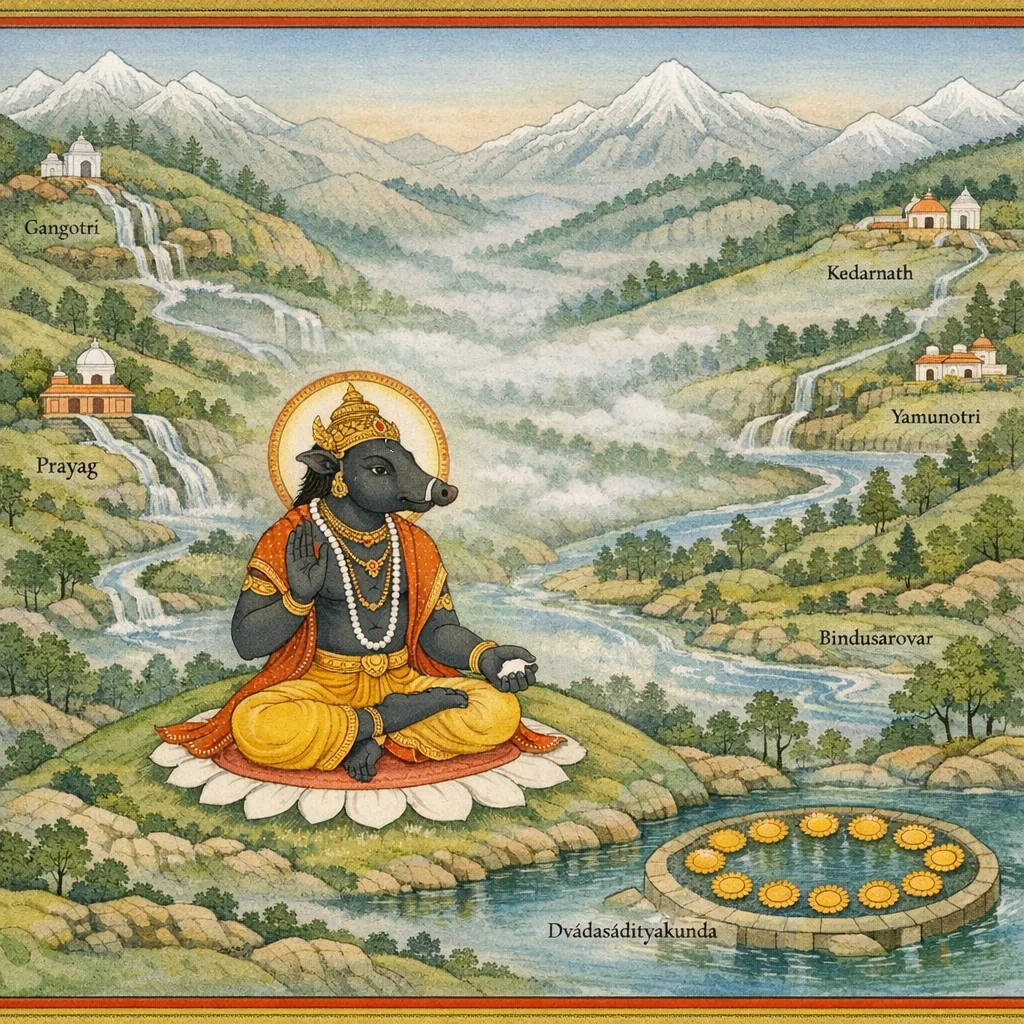
Adhyaya 141: The Sacred Greatness of Badarikāśrama (Badrinath Region)
Badarikāśrama-māhātmya
Tīrtha-māhātmya (Sacred Geography & Ritual Merit)
In dialogue with Pṛthivī (Earth), Varāha proclaims the extraordinary sanctity of Badarikāśrama on the Himalayan slopes, a rare and difficult-to-attain sacred terrain. The chapter catalogs many named tīrthas and kuṇḍas, each linked with specific waterfalls (dhārās), vows, and fasting observances (eka-, tri-, catur-, and pañcarātra upavāsa). Varāha explains the graded fruits of ritual bathing (snāna) and disciplined conduct: from merits equivalent to great sacrifices such as Aśvamedha and Agniṣṭoma, to attainment of various lokas, culminating in Varāha’s own realm. It also recounts Varāha’s hidden tapas in the region—hard to perceive due to yogamāyā—the gods’ appeal to Brahmā, and the restoration of cosmic stability through recognizing Viṣṇu/Varāha’s role, presenting the Himalayan tīrtha network as a teaching in restraint, truthfulness, and Earth-centered sacred topography.
Primary Speakers
Key Concepts
Shlokas in Adhyaya 141
Verse 1
अथ बदरिकाश्रममाहात्म्यम् ॥ श्रीवराह उवाच ॥ तस्मिन् हिमवतः पृष्ठे परं गुह्यमतः शृणु ॥ बदरीति च विख्याता देवानामपि दुर्लभा ॥
Now, the eulogy of Badarikāśrama. Śrī Varāha said: On the northern ranges of the Himavat, listen to this supreme matter, regarded as secret. It is renowned as “Badarī,” and is difficult to obtain even for the gods.
Verse 2
न तत्प्राप्नोति मनुजः कृत्वा कर्म सुदुष्करम् ॥ प्राप्नुवन्ति च भक्ताः ये बदरीं विश्वतारिणीम् ॥
A human does not attain that even by performing extremely difficult acts; but those devotees who reach Badarī—the “savior who carries one across the world”—do attain it.
Verse 3
दुर्लभं तन्मम क्षेत्रं हिमकूटशिलातले ॥ यस्तत्प्राप्नोति हि क्षेत्रं कृतकृत्यो भवेन नरः ॥
That sacred field of mine is difficult to obtain, upon the rocky slopes of Himakūṭa. Indeed, the man who reaches that holy place becomes one who has fulfilled what is to be done.
Verse 4
ब्रह्मकुण्डमिति ख्यातमास्ते तत्र शिलोच्चये ॥ हिमसंस्थं तथात्मानं कृत्वा तिष्ठामि माधवि ॥
There, upon a rocky elevation, lies the pool renowned as Brahmakuṇḍa. Establishing myself likewise amid the snow, O Mādhavī, I abide there.
Verse 5
मुञ्चेत्प्राणांस्तत्र यदि व्रतनिष्ठो जितेन्द्रियः ॥ सत्यलोकमतिक्रंम्य मम लोकं च गच्छति ॥
If there, steadfast in the vow and self-controlled, one relinquishes one’s life-breath, one transcends Satyaloka and goes to my realm as well.
Verse 6
अग्निसत्यपदं नाम तस्मिन्क्षेत्रे परं मम ॥ शृङ्गत्रयात्पतन्त्यत्र धारा मुसलसन्निभाः ॥
In that sacred place of mine there is a supreme spot named Agnisatyapada. From three peaks streams fall there, resembling pestles in force and form.
Verse 7
यस्तत्र कुरुते स्नानं त्रिरात्रोपोषितो नरः ॥ सत्यवादी भवेद्दक्षो मम कर्मपरायणः ॥
The man who bathes there after fasting for three nights becomes truthful in speech, competent, and devoted to my prescribed rites and duties.
Verse 8
स्नानं करोति यस्तत्र त्रिरात्रोपोषितो नरः ॥ अग्निष्टोमस्य यज्ञस्य फलं प्राप्नोति मानवः ॥
The man who bathes there after fasting for three nights obtains the fruit of the Agniṣṭoma sacrifice.
Verse 9
यस्तत्र मुञ्चते प्राणान्यदि कृत्वा जलाशयम् ॥ सत्यलोकमतिक्रंम्य मम लोके स मोदते ॥
If a person relinquishes life there, having resorted to the water-reservoir (the sacred pool), he transcends Satyaloka and rejoices in my realm.
Verse 10
तत्र चैव तु शृङ्गेभ्यः स्थूलधारा पतॆत्पुनः ॥ स्थूले शिलातले तत्र मम धर्मो व्यवस्थितः ॥
There itself, again, a broad torrent falls from the mountain-peaks. Upon the broad rocky slab there, my dharma is said to be firmly established.
Verse 11
स्नानं करोति यस्तत्र एकरात्रोषितो नरः ॥ सत्यवादी शुचिर्भूत्वा सत्यलोके महीयते ॥
A man who bathes there after staying for one night—becoming truthful in speech and purified—is honored in the world of Satya.
Verse 12
अथात्र मुञ्चते प्राणान्कृत्वा चानाशकं व्रतम् ॥ सत्यलोकमतिग्रम्य मम लोकेषु तिष्ठति ॥ अस्ति पञ्चशिखं नाम बदर्याश्रमतीर्थकम् ॥ यत्र धाराः पतन्त्यत्र पञ्चशृङ्गसमाश्रिताः ॥
Now, if one relinquishes life-breath here after undertaking the vow of fasting, then—passing beyond Satya-loka—one abides in my worlds. There is a sacred ford named Pañcaśikhā at Badaryāśrama, where streams fall, supported by (or issuing from) five peaks.
Verse 13
यस्तत्र कुरुते स्नानं पञ्चस्रोतसि मानवः ॥ अश्वमेधफलं प्राप्य देवैश्च सह मोदते ॥
A person who bathes there, at the five-stream confluence, attains the fruit of the Aśvamedha and rejoices together with the gods.
Verse 14
यद्यत्र मुञ्चते प्राणान् कृत्वा कर्म सुदुष्करम् ॥ स्वर्गलोकमतिग्रम्य मम लोके महीयते ॥
If one relinquishes life-breath here after performing an exceedingly difficult act, then—surpassing Svarga-loka—one is honored in my realm.
Verse 15
चतुःस्रोत इति ख्यातं तस्मिन्क्षेत्रे परे मम ॥ चतुर्धाराः पतन्त्यत्र चतस्रो दिश आश्रिताः ॥
In that supreme sacred field of mine it is known as “Catuḥsrota.” There, four torrents fall, aligned with the four directions.
Verse 16
यस्तत्र कुरुते स्नानमेकऱात्रोषितो नरः ॥ मोदते नाकपृष्ठे तु मम भक्तश्च जायते ॥
A person who bathes there after staying for one night rejoices upon the surface of Nāka’s heaven and becomes devoted to me.
Verse 17
अथ प्राणान्परित्यज्य कृत्वा कर्म सुदुष्करम् ॥ नाकपृष्ठमतिग्रम्य मम लोकं प्रपद्यते ॥
Then, having relinquished the life-breath after performing an exceedingly difficult act, one surpasses Nāka’s heaven-surface and attains my realm.
Verse 18
तत्रैव हिमवत्पृष्ठे चतुःशृङ्गाद्बृहत्तराः ॥ चतुर्धाराः पतन्त्यत्र विषमाश्च शिलोच्चये ॥
There itself, on the slopes of Himavat, from the four-peaked mountain fall four torrents, greater still, unevenly, upon a rocky height.
Verse 19
यस्तत्र कुरुते स्नानं चतूरात्रोषितो नरः ॥ चतुर्णामपि वेदानां ग्रहणे कारणं भवेत् ॥
A person who bathes there after staying for four nights becomes a cause for the ‘grasping’—the acquisition and understanding—of even the four Vedas.
Verse 20
अथात्र मुञ्चते प्राणान्मम कर्मपथे स्थितः । देवलोकमत्क्रम्य मम लोकं प्रतिष्ठते ॥
Now, one who, established on my path of rites, relinquishes the life-breath here—having passed beyond the world of the gods—becomes established in my realm.
Verse 21
द्वादशादित्यकुण्डेति तस्मिन्क्षेत्रे परे मम । यत्र ते द्वादशादित्या देवि संस्थापिता मया ॥
In that supreme sacred area of mine there is a place called ‘Dvādaśāditya-kuṇḍa’, O Goddess—where the twelve Ādityas were established by me for you.
Verse 22
तत्र पर्वतशृङ्गे तु स्थूलमूले शिलातले । द्वादश पतन्ति धारा मम कर्मसुखावहाः ॥
There, on a mountain peak—upon a rock-surface at the broad base—twelve streams fall, bringing the happiness that comes from meritorious ritual action connected with me.
Verse 23
यस्तत्र कुरुते स्नानं यां काञ्चिद्द्वादशीं यदि । यत्र ते द्वादशादित्या स्तत्र गच्छेन्न संशयः ॥
Whoever performs bathing there on any Dvādaśī (twelfth lunar day) goes—without doubt—to the realm where those twelve Ādityas are present.
Verse 24
अथात्र मुञ्चते प्राणान्मम कर्मणि संस्थितः । समतिक्रम्य चादित्यान्मम लोके महीयते ॥
Now, one who relinquishes the life-breath here while established in my rite—having also passed beyond the Ādityas—becomes exalted in my realm.
Verse 25
लोकपालमिति ख्यातं तस्मिन्क्षेत्रे परे मम । तत्र ते लोकपाला स्तु मया संस्थापिताः पुरा ॥
In that supreme sacred region of mine there is a place known as “Lokapāla”; there, long ago, I established the Lokapālas for you.
Verse 26
तत्र पर्वतमध्ये तु स्थल कुण्डं बृहन्मम । भित्वा पर्वतमुद्गीर्णं यत्र सोमसमुद्भवः ॥
There, in the midst of the mountain, is my broad “Sthala-kuṇḍa”; having burst through the mountain, it emerges—where the Soma-born (moon-origin) source arises.
Verse 27
अथात्र मुञ्चते प्राणान्मम कर्मसु तत्परः । लोकपालानतिक्रम्य मम लोकं प्रपद्यते ॥
Now, one who relinquishes the life-breath here, devoted to my rites—having passed beyond the Lokapālas—attains my realm.
Verse 28
अस्ति मेरोरवरं नाम तस्मिन्गुह्यं परं मम । तत्र स्थितेन वै भूमे मेरुः संस्थापितः स्वयम् ॥
There is a place called “Meror-vara”; in it lies my supreme secret, O Earth. By one stationed there, Meru itself is established, as if of its own accord.
Verse 29
धारास्तिस्रः पतन्त्यत्र सुवर्णसदृशप्रभाः । पतत्तु तज्जलं भूमौ व्यक्तिं नैवोपलभ्यते ॥
Here three streams fall, shining like gold; yet when that water falls upon the ground, it is not perceived in any manifest form.
Verse 30
यस्तत्र कुरुते स्नानं त्रिरात्रोपोषितो नरः ॥ मोदते मेरुशृङ्गेषु मम भक्तश्च जायते ॥
Whoever bathes there, having fasted for three nights, rejoices upon the peaks of Meru and becomes devoted to me.
Verse 31
अथ तत्र मृतो देवि तस्मिन्गुह्ये परे मम ॥ मेरुपृष्ठमत्क्रम्य मम लोकं तु गच्छति ॥
And, O Goddess, one who dies there—at that supreme, secret place of mine—having passed beyond the ridge of Meru, goes indeed to my world.
Verse 32
मानसोद्भेदमिति च तत्रान्यत्तीर्थमुत्तमम् ॥ पृथ्वीमुद्भिद्य मध्ये तु जलं गच्छति सत्वरम् ॥
And there is another excellent sacred ford there, called ‘Mānasodbheda’: piercing up through the earth, the water swiftly moves into the interior.
Verse 33
देवा अपि न जानन्ति तं देशं तत्र संस्थितम् ॥ मानुषा हि विजानन्ति भूम्यां पतति तज्जलम् ॥
Even the gods do not know that place situated there; humans, however, know it—its water falls upon the earth.
Verse 34
यस्तत्र कुरुते स्नानमहोऱात्रोषितो नरः ॥ मोदते मानसे दिव्ये मम भक्तश्च जायते ॥
Whoever bathes there, having fasted for a full day and night, rejoices in the divine Mānasa and becomes devoted to me.
Verse 35
अस्ति पञ्चशिरं नाम तस्मिन्गुह्यं परं मम ॥ ब्रह्मणा छिद्यते यत्र शिरश्चैव महाद्युति ॥
There is there a secret, supreme place of Mine, called Pañcaśira, where Brahmā cuts off a head of great radiance.
Verse 36
यत्र तन्मध्यमं कुण्डं छिन्नमेव स्वयम्भुवा ॥ तत्र रक्तजला भूमिर्दृश्यते धारसंकुला ॥
Where that central pool is indeed cleft by Svayambhū (Brahmā), there the ground is seen with reddish water, filled with many streams.
Verse 37
यस्तत्र कुरुते स्नानं पञ्चरात्रोषितो नरः ॥ मोदते ब्रह्मलोकस्थो मम भक्तश्च जायते ॥
Whoever bathes there, having fasted for five nights, rejoices while dwelling in Brahmaloka and becomes devoted to Me.
Verse 38
तथात्र मुञ्चते प्राणान् गुह्ये पञ्चशिरे मम ॥ जलचन्द्रायणं कृत्वा मम कर्मसु निष्ठितः ॥
Likewise, one relinquishes the life-breaths there, at My secret Pañcaśira—having performed the water-based Cāndrāyaṇa observance, steadfast in My prescribed rites.
Verse 39
बुद्धिमान्मतिमांश्चैव रागमोहविवर्जितः ॥ ब्रह्मलोकमत्क्रम्य मम लोकं स गच्छति ॥
Wise and discerning, free from attachment and delusion, he passes beyond Brahmaloka and goes to My world.
Verse 40
अस्ति सोमाभिषेकेति तीर्थमन्यत्परं मम। राजत्वे ब्राह्मणानां तु मया सोमोऽभिषेचितः॥
There is another supreme sacred ford of mine called “Somābhiṣeka.” When the Brāhmaṇas held sovereignty, Soma was consecrated by me.
Verse 41
तत्राहं तोषितस्तेन अत्रिपुत्रेण माधवि। नवपञ्चककोट्यस्तु कृत्वा कर्म सुदुष्करम्॥
There I was pleased by that son of Atri, O Mādhavī, after he had performed a most difficult act—(valued at) nine and five koṭis (in merit/measure).
Verse 42
प्राप्तश्च परमां सिद्धिं मत्प्रसादाद्वसुन्धरे। तदायत्तं जगत्सर्वं व्रीहयः परमौषधीः॥
And he attained the highest accomplishment through my favor, O Vasundharā. Dependent upon that is the entire world—(its) rice-crops and supreme medicinal plants.
Verse 43
जायतेऽस्मिन्प्रलीयन्ते स्कन्देन्द्राः समरुद्गणाः। भूमे सोममयं सर्वं मम संस्थं भविष्यति॥
In this (sphere), Skanda and Indra—together with the hosts of the Maruts—are born and dissolve. O Earth, all of this will be pervaded by Soma and established in me.
Verse 44
तत्र सोमगिरिर्नाम यत्र धारा पतेद्भुवि। कुण्डेऽरण्ये विशालें तु एतत्ते कथितं मया॥
There is a place called Somagiri, where a stream (dhārā) falls upon the earth. In the wide forest at the kuṇḍa—this has been told to you by me.
Verse 45
अथात्र म्रियते देवि कृत्वा कर्म सुदुष्करम्। सोमलोकमतिगम्य मम लोकं प्रपद्यते॥
Now, O Goddess, if one dies here after performing a most arduous act, one passes beyond the Soma-world and attains my world.
Verse 46
अस्ति चोर्वशिकुण्डेति गुह्यं क्षेत्रे परं मम। यत्र चैवोर्वशी भित्त्वा दक्षिणोरुमजायत॥
There is a place called Corvaśikuṇḍa, a secret and supreme sacred field of mine—where indeed Urvaśī, having split it, was born from the right thigh.
Verse 47
तत्र तप्याम्यहं देवि देवानामपि कारणात्। न मां कश्चिद्विजानाति स्वात्मानो हि विजानते॥
There, O Goddess, I practice tapas (austerity), even for the sake of the gods’ cause. No one recognizes me; only those who truly know their own Ātman know (me).
Verse 48
ततो मे तप्यमानस्य बहुवर्षव्यतिक्रमात्। देवा अपि न जानन्ति वज्रिब्रह्ममहेश्वराः॥
Then, as I continued in austerity and many years passed, even the gods—Indra the vajra-bearer, Brahmā, and Maheśvara—did not know (me).
Verse 49
एकैकॆन फलेनात्र बदर्यां तु सुनिश्चितम्। बहुवर्षसहस्रं तु तपश्चीर्णं मया भुवि॥
Here, in the Badarī (jujube) grove, by taking but a single fruit at a time—this is certain—I have undertaken tapas upon the earth for many thousands of years.
Verse 50
तत्राहं दश कोट्यस्तु दशवर्षं दशार्बुदम् ॥ दश भूमे तथान्यानि पद्मानि तपसि स्थितः
There I remained—for spans reckoned as ten koṭis, ten years, ten arbuda-s; and for ten such measures, O Earth, and for other measures called padma as well—abiding in austerity (tapas).
Verse 51
ततस्ते मां न पश्यन्ति देवा गुह्यपथे स्थितम् ॥ विस्मयं परमं जग्मुर्देवा दुःखपरायणाः
Then the gods did not see me, though I was stationed on the hidden path; and the gods—given over to distress—fell into the utmost astonishment.
Verse 52
अहं पश्यामि सर्वं वै तपःसंस्थो वसुन्धरे ॥ न मां सर्वे प्रपश्यन्ति योगमायासमावृताः
I indeed see everything, O Vasundharā, being established in austerity (tapas); yet not all behold me, for they are enveloped by yogic māyā.
Verse 53
ततस्ता देवताः सर्वाः प्रत्य ऊचुश्च पितामहम् ॥ विष्णुना च विना लोके शान्तिं नैव लभामहे
Then all those deities replied to Pitāmaha (Brahmā): “Without Viṣṇu in the world, we do not obtain peace at all.”
Verse 54
ततो देवाः सगन्धर्वाः सिद्धाश्च परमर्षयः ॥ तत्र जग्मुर्महाभागे तुष्यन्तः परमं मुदा
Then the gods—together with the Gandharvas, the Siddhas, and the supreme seers (ṛṣis)—went there, O greatly fortunate one, rejoicing with the highest delight.
Verse 55
विभावयन्ति मां तत्र देवा इन्द्रपुरोगमाः ॥ त्वया नाथ परित्यक्ता दुःखिताः श्रमवर्जिताः
There the gods, led by Indra, contemplated me and said: “Abandoned by you, O Lord, we are afflicted—bereft of vigor and effort.”
Verse 56
त्रायस्व नो हृषीकेश परमाणुग्रहेण वै ॥ एतत्कृत्वा विशालाक्षि देवान् प्रणतिपूर्वकम्
“Save us, O Hṛṣīkeśa, indeed with supreme compassion.” Having done this, O wide-eyed one, they approached the gods with prior obeisance.
Verse 57
मया विलोकिताः सर्वे परां निर्वृतिमागताः ॥ एतस्मिन्नुर्वशी कुण्डे एकरात्रोषितो नरः
When they were seen by me, all attained the highest relief. In this Urvāśī-kuṇḍa, a man who stays for a single night…
Verse 58
यः स्नाति सर्वपापेभ्यो मुच्यते नात्र संशयः ॥ उर्वशीलोकमासाद्य क्रीडते कालमक्षयम्
Whoever bathes here is freed from all faults—of this there is no doubt. Reaching the world of Urvāśī, he enjoys for imperishable time.
Verse 59
यस्तत्रोत्सृजते प्राणान्मम कर्मपरायणः ॥ पुण्यपापविनिर्मुक्तो याति मल्लीनतां प्रिये
And whoever there gives up his life-breaths, devoted to my service and rites—freed from both merit and demerit—goes to Mallīnatā, O beloved.
Verse 60
श्रीबदर्याश्रमं पुण्यं यत्र यत्र स्थितः स्मरेत् ॥ स याति वैष्णवं स्थानं पुनरावृत्तिवर्जितः ॥
Whoever, wherever he may be, remembers the auspicious and meritorious Śrī-Badarīāśrama, attains a Vaiṣṇava abode, free from return (beyond repeated rebirth).
Verse 61
य इदं शृणुयान्नित्यं मद्भक्तः सततं पठेत् ॥ ब्रह्मचारी जितक्रोधः सत्यवादी जितेन्द्रियः ॥
He who continually listens to this and—being devoted to me—recites it regularly is described as a brahmacārin, one who has conquered anger, a speaker of truth, and one who has mastered the senses.
Verse 62
ध्यानयोगरतो नित्यं स मुक्तिफलभाग्भवेत् ॥ यस्यैतद्विदितं सर्वं ध्यानयोगं वसुन्धरे ॥
One who is constantly devoted to the yoga of meditation becomes a recipient of the fruit of liberation. O Vasundharā, for whom this entire discipline of meditative yoga is understood in full.
Verse 63
इन्द्रलोकमिति ख्यातो बदर्यां च ममाश्रमः ॥ तत्राहं देवि शक्रेण निष्कलं परितोषितः ॥
In Badarī, my hermitage is renowned by the name ‘Indraloka’. There, O Goddess, I was completely gratified by Śakra (Indra).
Verse 64
वेदधारमिति ख्यातं तस्मिन्क्षेत्रे परे मम ॥ यत्र ब्रह्ममुखाद्भ्रष्टा वेदाश्चत्वार एव च ॥
In that supreme sacred field of mine, there is a place renowned as ‘Vedadhāra’, where it is said that the four Vedas issued forth—as if fallen—from the mouth of Brahmā.
Verse 65
तत्र स्नानं तु कुर्वीत ज्येष्ठमासस्य द्वादशीम् ॥ मोदते लोकपालेषु मम भक्तश्च जायते ॥
There one should perform the ritual bath on the Dvādaśī (twelfth lunar day) of the month of Jyeṣṭha; he rejoices among the Lokapālas (world-guardians) and becomes devoted to me.
Verse 66
तत्र वै पञ्च कुण्डानि स्थूलशीर्षशिलोच्चये ॥ पञ्चात्र शिरसः स्थाने बहुधारासमन्विताः ॥
There indeed are five kuṇḍas (bathing-pools) on the rocky elevation called Sthūlaśīrṣa; here, at the “place of the head,” they are endowed with many streams.
Verse 67
यस्तत्र कुरुते स्नानं त्रिरात्रोपोषितो नरः ॥ मोदते सोमलोकेषु एवमेतन्न संशयः ॥
A person who bathes there after fasting for three nights rejoices in the Soma-worlds; so it is—there is no doubt of this.
Verse 68
देवानां तु वचः श्रुत्वा ब्रह्मा लोकापितामहः ॥ योगमायापटच्छन्नं कथयामास मां तदा ॥
Having heard the words of the gods, Brahmā—the grandsire of the worlds—then spoke of me as one concealed by the veil of Yogamāyā.
Verse 69
योऽवगच्छति चात्मानं स गच्छेत्परमां गतिम् ॥
Whoever comes to understand the Self (Ātman) attains the supreme destination.
Frequently Asked Questions
The chapter frames tīrtha practice as inseparable from ethical discipline: truthfulness (satya-vāda), purity (śauca), sense-control (jitendriyatā), and vow-observance (vrata-niṣṭhā). Merit is presented as graded and conditional—ritual acts like snāna and fasting are repeatedly linked to moral qualifications and to a hierarchy of post-mortem destinations (lokas), culminating in Varāha’s realm.
The text specifies fasting durations (eka-, tri-, catur-, and pañcarātra) and includes tithi-based timing: bathing on a Dvādaśī in the Dvādaśādityakuṇḍa section, and explicitly mentions Jyeṣṭha-māsa Dvādaśī for the Lokapāla tīrtha bathing observance.
Through Pṛthivī as interlocutor and the detailed mapping of mountain-water features (dhārā, srotas, kuṇḍa), the narrative sacralizes Himalayan hydrology as a regulated moral-ritual landscape. The implied stewardship logic is that disciplined human conduct (restraint, truthful speech, controlled consumption via fasting) harmonizes with and preserves the sanctity of Earth’s waters and slopes, making geography itself a medium of ethical education.
The chapter references Brahmā (pitāmaha), Indra (Śakra/Vajrin), Maheśvara, various devas with gandharvas and siddhas, and Atri’s son (Atriputra) in the Somābhiṣeka narrative. Urvaśī is named in connection with Urvaśīkuṇḍa. No human royal lineage is foregrounded; the emphasis remains on divine figures and tīrtha topography.