Adhyaya 14: Ritual Procedure for Śrāddha: Sequence, Eligibility, and Offerings to Ancestors
Śrāddha-vidhiḥ (Paitṛkakriyā-kramāḥ)
Ritual-Manual
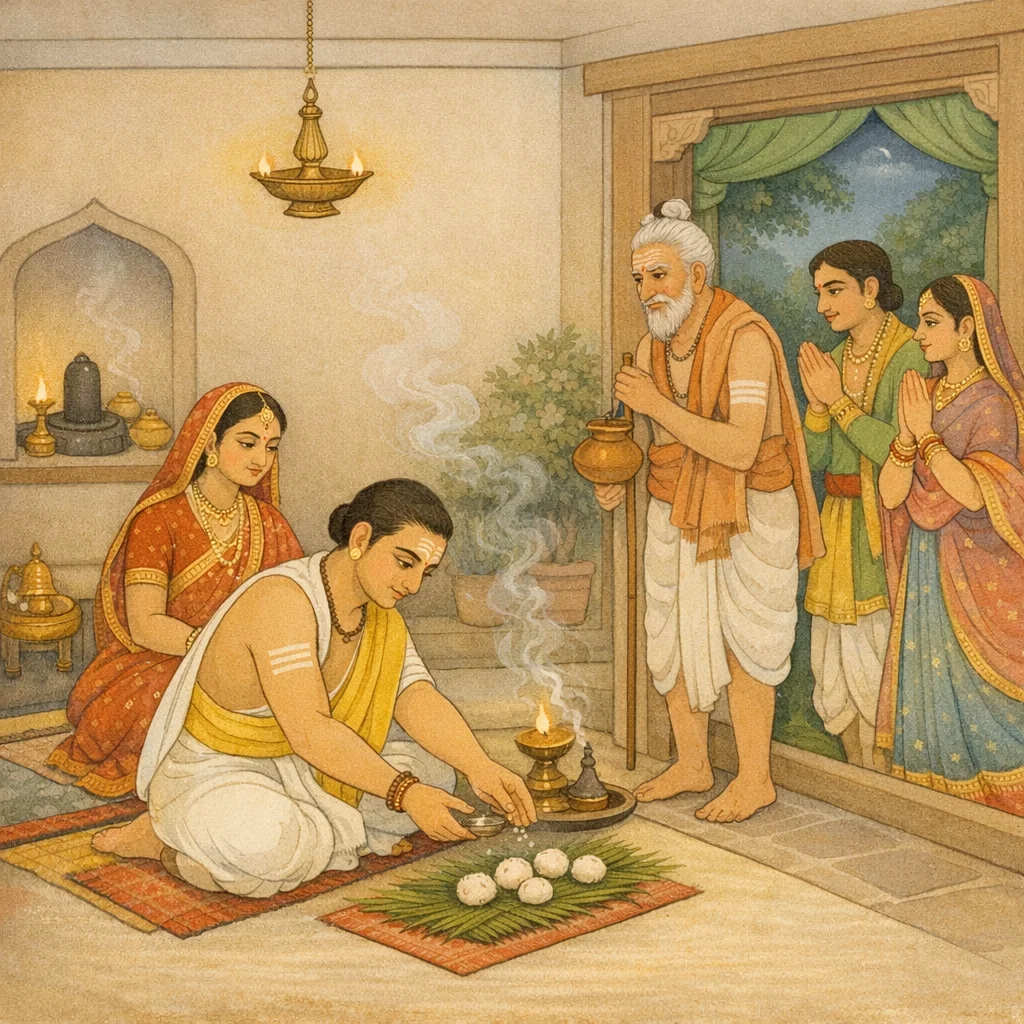
Within the Varāha–Pṛthivī teaching frame, this chapter serves as a procedural manual for śrāddha (ancestral rites) handed down through a lineage of sages. It identifies ideal invitees—Vedic specialists, disciplined ascetics, and ethically grounded Brāhmaṇas—and specifies those to be excluded due to moral or ritual disqualification. The rite is then set out step by step: inviting guests, purification and seating, arranging offerings for devas and pitṛs, and performing āvāhana with arghya, dhūpa, dīpa, and prescribed water–sesame combinations. Hospitality to unexpected atithis is stressed as essential to preserve the rite’s efficacy. The chapter further details homa offerings (to Agni, Soma, and Vaivasvata), feeding protocols, protective recitations, piṇḍa placement and water-libations, dakṣiṇā, blessings, and an orderly visarjana, presenting these acts as sustaining family continuity and terrestrial social order.
Primary Speakers
Key Concepts
Shlokas in Adhyaya 14
Verse 1
मार्कण्डेय उवाच । एतन्मे कथितं पूर्वं ब्रह्मपुत्रेण धीमता । सनकानुजेन विप्रर्षे ब्राह्मणान् शृणु साम्प्रतम् ॥ १४.१ ॥
Mārkaṇḍeya said: “This was formerly told to me by the wise son of Brahmā, the younger brother of Sanaka. Now, O best of Brāhmaṇas, listen to what concerns the Brāhmaṇas.”
Verse 2
त्रिणाचिकेतस्त्रिमधुस्त्रिसुपर्णः षडङ्गवित् । वेदवित् श्रोत्रियो योगी तथा वै ज्योष्ठसामगः ॥ १४.२ ॥
He is one who has mastered the threefold Nāciketa rite, the teachings of the ‘three Madhu,’ and the recitations of the ‘three Suparṇa’; he knows the six ancillary disciplines of the Veda, is a knower of the Veda, a properly trained śrotriya, a yogin, and indeed a foremost chanter of the Sāman hymns.
Verse 3
ऋत्विजं भागिनेयं च दौहित्रं श्वशुरं तथा । जामातरं मातुलं च तपोनिष्ठं च ब्राह्मणम् ॥ १४.३ ॥
“(One should honor and receive) the officiating priest, a sister’s son, a daughter’s son, the father-in-law, the son-in-law, the maternal uncle, and also a Brāhmaṇa devoted to ascetic discipline.”
Verse 4
पञ्चाग्न्यभिरतं चैव शिष्यं संबन्धिनं तथा । मातापितॄरतं चैव एताञ्छ्राद्धे नियोजयेत् ॥ १४.४ ॥
For the śrāddha one should also appoint: a person devoted to the five sacred fires, a disciple, a relative, and likewise one devoted to service of mother and father.
Verse 5
मित्रध्रुक् कुनखी चैव श्यावदन्तस्तथा द्विजः । कन्यादूषयिता वह्निवेदोज्झः सोमविक्रयी ॥ १४.५ ॥
One who betrays a friend, one with deformed nails, a twice-born with discolored teeth, one who violates a maiden, one who neglects the sacred fires and the Veda, and one who sells soma—these are listed here as condemnable persons.
Verse 6
अभिशप्तस्तथा स्तेनः पिशुनो ग्रामयाजकः । भृतकाध्यापकश्चैव भृतकाध्यापितश्च यः ॥ १४.६ ॥
Likewise are enumerated here: one under a curse, a thief, a slanderer, a village-priest who performs rites for hire, a teacher employed for wages, and one who is taught for wages.
Verse 7
परपूर्वापतिश्चैव मातापित्रोस्तथोज्झकः । वृषलीसूतिपोष्यश्च वृषलीपतिर एव च । तथा देवलकश्चापि श्राद्धे नार्हन्ति केतनम् ॥ १४.७ ॥
And likewise: the husband of a woman previously married to another; one who abandons or neglects mother and father; one maintained by the offspring of a vṛṣalī; the husband of a vṛṣalī; and also a devalaka—these are not fit recipients in the śrāddha rite.
Verse 8
प्रथमेऽह्नि बुधः कुर्याद् विप्राग्र्याणां निमन्त्रणम् । आनिमन्त्र्य द्विजान् गेहमागतान् भोजयेद् यतीन् ॥ १४.८ ॥
On the first day, a prudent person should invite eminent Brahmins; and, having invited the twice-born who have come to the house, one should also provide food to ascetics (yatis).
Verse 9
पादशौचादिना गृहमागतान् भोजयेद् द्विजान् । पवित्रपाणिराचान्तानासनेषूपवेशयेत् ॥ १४.९ ॥
After performing the customary observances beginning with washing the feet, one should feed the twice-born guests who have come to the house; with purified hands, after they have performed ācamana (ritual sipping of water), one should seat them upon proper seats.
Verse 10
पितॄणामयुजो युग्मान् देवानामपि योजयेत् । देवानामेकमेकं वा पितॄणां च नियोजयेत् ॥ १४.१० ॥
One should assign the offering-portions for the Pitṛs (ancestors) in odd and even pairings, and likewise for the Devas; or else one may allot them one by one—both for the Devas and for the Pitṛs.
Verse 11
तथा मातामहश्राद्धं वैश्वदेवसमन्वितम् । कुर्वीत भक्तिसम्पन्नः सक्तन्त्रं वा वैश्वदेविकम् ॥ १४.११ ॥
Likewise, one should perform the śrāddha rite for the maternal grandfather, accompanied by the Vaiśvadeva offering; or, endowed with devotion, one may perform the Vaiśvadevika rite together with the prescribed ritual procedure.
Verse 12
प्राङ्मुखं भोजयेद्विप्रं देवानामुभयात्मकम् । पितृपैतामहानां च भोजयेच्चाप्युदङ्मुखान् ॥ १४.१२ ॥
One should feed a brāhmaṇa facing east, as one who embodies the gods in a dual manner; and one should also offer food on behalf of the Pitṛs and the Pitāmahas with them facing north.
Verse 13
पृथक् तयोः केचिदाहुः श्राद्धस्य करणं द्विज । एकत्रैकेन पाकेन वदन्त्यन्ये महर्षयः ॥ १४.१३ ॥
Some say, O twice-born, that the śrāddha rite should be performed separately for the two; others, the great seers, state that it may be done together with a single cooking or preparation.
Verse 14
विष्टारार्थं कुशान् दत्त्वा सम्पूज्यार्घविधानतः । कुर्यादावाहनं प्राज्ञो देवानां तदनुज्ञया ॥ १४.१४ ॥
Having placed kuśa grass to arrange the ritual space, and having duly honored them according to the prescribed offering of arghya, the wise practitioner should perform the invocation (āvāhana) of the deities, with their assent.
Verse 15
यवाम्बुना च देवानां दद्यादर्घ्यं विधानवित् । सुगन्धधूपदीपांश्च दत्त्वा तेभ्यो यथाविधि । पितॄणामपसकव्येन सर्वमेवोपकल्पयेत् ॥ १४.१५ ॥
One skilled in proper procedure should offer arghya to the devas with barley-water (yava-ambu); and, having presented fragrant incense and lamps to them according to rule, one should likewise prepare everything for the pitṛs with the apasakavyā offering.
Verse 16
अनुज्ञां च ततः प्राप्य दत्त्वा दर्भान् द्विधाकृतान् । मन्त्रपूर्वं पितॄणां तु कुर्यादावाहनं बुधः । तिलाम्बुना चापसव्यं दद्यादर्घ्यादिकं बुधः ॥ १४.१६ ॥
Having obtained permission, and having placed kuśa-grass (darbha) blades divided into two, the wise officiant should, with the prescribed mantras, perform the āvāhana—invocation of the Pitṛs (ancestral spirits). With water mixed with sesame, and with the sacred thread worn in the apasavya manner, he should offer arghya and the other customary offerings.
Verse 17
काले तत्रातिथिं प्राप्तमन्नकामं द्विजाध्वगम् । ब्राह्मणैरभ्यनुज्ञातः कामं तमपि पूजयेत् ॥ १४.१७ ॥
If, at the proper time, a guest arrives there—a travelling dvija (twice-born) desiring food—then, when permitted by the brāhmaṇas, one should willingly honour him as well.
Verse 18
योगिनो विविधैरूपैर्नराणामुपकारिणः । भ्रमन्ति पृथिवीमेतामविज्ञातस्वरूपिणः ॥ १४.१८ ॥
Yogins—benefactors of humankind—wander over this earth in many forms, their true nature remaining unrecognized.
Verse 19
तस्मादभ्यर्चयेत् प्राप्तं श्राद्धकालेऽतिथिं बुधः । श्राद्धक्रियाफलं हन्ति द्विजेन्द्रापूजितोऽतिथिः ॥ १४.१९ ॥
Therefore, a wise person should duly honour a guest who arrives at the time of the śrāddha. An unhonoured guest—especially one regarded as foremost among the dvijas—destroys the merit of the śrāddha rite.
Verse 20
जुहुयाद् व्यञ्जनं क्षारैर्वर्ज्यमन्नं ततोऽनले । अनुज्ञातो द्विजैस्तैस्तु त्रिः कृत्वा पुरुषर्षभ ॥ १४.२० ॥
He should offer into the fire (homa) the prepared foods, excluding those made with alkaline substances. Then, having obtained the permission of those brāhmaṇas, he should perform it three times, O best among men.
Verse 21
अग्नये काव्यवाहनाय स्वाहेति प्रथमा हुतिः । सोमाय वै पितृमते दातव्या तदनन्तरम् ॥ १४.२१ ॥
The first oblation is to be offered with the utterance “svāhā” to Agni, the bearer of sacrificial offerings. Thereafter an offering should be given to Soma, who is associated with the Pitṛs (ancestors).
Verse 22
वैवस्वताय चैवान्या तृतीया दीयताहुतिः । हुतावशिष्टमल्पाल्पं विप्रपात्रेषु निर्वपेत् ॥ १४.२२ ॥
A third offering should likewise be given to Vaivasvata. Then, little by little, one should place the remainder left from the oblation into the vessels of the Brāhmaṇas.
Verse 23
ततोऽन्नं मृष्टमत्यर्थमभीष्टमभिसंस्कृतम् । दत्त्वा जुषध्वमिच्छातो वाच्यमेतदनिष्ठुरम् ॥ १४.२३ ॥
Then, having given food that is well prepared, exceedingly choice, and carefully refined, one should say as one wishes, “Please partake,” speaking these words without harshness.
Verse 24
भोक्तव्यं तैश्च तच्चित्तैर्मौनिभिः सुमुखैः सुखम् । अक्रुध्यता अत्वरता देयं तेनापि भक्तितः ॥ १४.२४ ॥
It should be enjoyed pleasantly by those sages of tranquil mind and gracious demeanor. The giver too should offer it with devotion—without anger and without haste.
Verse 25
रक्षोघ्नमन्त्रपठनं भूमेरास्तरणं तिलैः । कृत्वाऽध्येयाश्च पितरस्त एव द्विजसत्तमाः ॥ १४.२५ ॥
Having recited the mantra that wards off harmful beings and having spread sesame seeds upon the ground, those very Pitṛs (ancestors) are then to be reverently invoked/recited by the excellent twice-born (brāhmaṇas).
Verse 26
पिता पितामहश्चैव तथैव प्रपितामहः । मम तृप्तिं प्रयान्त्वद्य होमाप्यायितमूर्त्तयः ॥ १४.२६ ॥
May my father, my grandfather, and likewise my great-grandfather attain satisfaction today, their forms nourished and strengthened through the oblation of the homa.
Verse 27
पितापितामहश्चैव तथैव प्रपितामहः । मम तृप्तिं प्रयान्त्वद्य विप्रदेहेषु संस्थिताः ॥ १४.२७ ॥
May my father, my grandfather, and likewise my great-grandfather—who abide today within the bodies of brāhmaṇas—attain satisfaction through me.
Verse 28
पिता पितामहश्चैव तथैव प्रपितामहः । तृप्तिं प्रयान्तु पिण्डेषु मया दत्तेषु भूतले ॥ १४.२८ ॥
May my father, my grandfather, and likewise my great-grandfather attain satisfaction through the piṇḍa-offerings that I have given upon the earth.
Verse 29
पिता पितामहश्चैव तथैव प्रपितामहः । तृप्तिं प्रयान्तु मे भक्त्या यन्मयैतदुदाहृतम् ॥ १४.२९ ॥
May my father, my grandfather, and likewise my great-grandfather attain satisfaction through my devotion, since these words have been uttered by me.
Verse 30
मातामहस्तृप्तिमुपैतु तस्य तथा पिता तस्य पिता ततोऽन्यः । विश्वेऽथ देवाः परमां प्रयान्तु तृप्तिं प्रणश्यन्तु च यातुधानाः ॥ १४.३० ॥
May his maternal grandfather attain satisfaction; likewise his father, his father’s father, and then the other ancestors. And may the Viśve-devas proceed to the highest fulfillment; and may the yātudhānas (harmful, hostile spirits) lose their satisfaction and be dispelled.
Verse 31
यज्ञेश्वरो हव्यसमस्तकाव्यभोक्ता । अव्ययात्मा हरिरीश्वरॊऽत्र । तत्सन्निधानादपयान्तु सद्यो रक्षांस्यशेषाण्यसुराश्च सर्वे ॥ १४.३१ ॥
Hari, the Lord of sacrifice, the consumer of the havya and of all ritual offerings, abides here as the imperishable Self. By His very presence, may all rākṣasas without remainder, and all asuras as well, depart at once.
Verse 32
तृप्तेष्वेतेषु विप्रेषु किरेदन्नं महीतले । दद्यादाचमनार्थाय तेभ्यो वारि सकृत्सकृत् ॥ १४.३२ ॥
When those brāhmin guests have been satisfied, one should scatter food upon the ground; and, for the purpose of ācamana (ritual rinsing), one should give them water again and again.
Verse 33
सुतृप्तैस्तैरणुज्ञातः सर्वेणान्नेन भूतले । सलिलेन ततः पिण्डान् समागृह्य समाहितः ॥ १४.३३ ॥
Having satisfied them, and being granted leave by them through the offering of all the food upon the earth, he then—composed in mind—gathered up the piṇḍa-offerings with water.
Verse 34
पितृतीर्थेन सलिलं तथैव सलिलाञ्जलिम् । मातामहेभ्यस्तेनैव पिण्डांस्तीर्थेन निर्वपेत् । दक्षिणाग्रेषु दर्भेषु पुष्पधूपादिपूजिताम् ॥ १४.३४ ॥
Using the ‘pitṛ-tīrtha’ (ancestral hand-position), one should offer water, and likewise a water-libation with joined palms. By that same method, one should also set down the piṇḍa-offerings for the maternal grandfathers, placing them upon kuśa-grass whose tips are oriented southward, and honoring them with flowers, incense, and related offerings.
Verse 35
स्वपित्रे प्रथमं पिण्डं दद्यादुच्छिष्टसन्निधौ । पितामहाय चैवान्यं तत्पित्रे च तथापरम् ॥ १४.३५ ॥
One should offer the first piṇḍa to one’s own father, in the presence of the remnants (of the meal/ritual). Another piṇḍa should be offered to the grandfather, and likewise a further one to his father (the great-grandfather).
Verse 36
दर्भमूले लेपभुजः प्रीणयेल्लेपघर्षणात् । पिण्डे मातामहे तद्वद्गन्धमाल्यादिसंयुतैः ॥ १४.३६ ॥
At the base of the darbha grass, one should satisfy the beings who partake of the unguent by gently rubbing the applied paste; likewise, for the maternal grandfather, the piṇḍa-offering should be presented furnished with fragrances, garlands, and the like.
Verse 37
पूजयित्वा द्विजाग्र्याणां दद्यादाचमनं बुधः । पैत्रेभ्यः प्रथमं भक्त्या तन्मनस्को द्विजेश्वर ॥ १४.३७ ॥
Having honored the foremost of the twice-born, the wise person should offer water for sipping (ācamana). First, with devotion and with focused attention, he should make the offering to the ancestral beings—O lord of the twice-born.
Verse 38
सुस्वधेत्याशिषा युक्तां दद्याच्छक्त्या च दक्षिणाम् । दत्त्वा च दक्षिणां तेभ्यो वाचयेद्वैश्वदेविकान् । प्रीयन्तामिति ये विश्वे देवास्तेन इतीरयेत् ॥ १४.३८ ॥
Having accompanied it with the benediction “su-svadhā,” one should, according to one’s capacity, give the honorarium (dakṣiṇā). And after giving the dakṣiṇā to them, one should cause the Vaiśvadeva formulas to be recited, uttering: “May those Viśve Devas be pleased by this.”
Verse 39
तथेति चोक्ते तैर्विप्रैः प्रार्थनीयास्तथाशिषः । पश्चाद्विसर्जयेद्देवान् पूर्वं पैत्रान्महामते ॥ १४.३९ ॥
When those brāhmaṇas have said, “So be it,” blessings should likewise be requested (from them). Thereafter, O wise one, the deities should be formally dismissed—first (dismissing) the ancestral ones.
Verse 40
मातामहानामप्येवं सह देवैः क्रमः स्मृतः । भोजने च स्वशक्त्या च दाने तद्वद्विसर्जने । आपादशौचनात् पूर्वं कुर्यादेव द्विजन्मसु ॥ १४.४० ॥
In the same manner, the prescribed sequence is also remembered for the maternal grandfathers, together with the deities. In feeding and in giving—according to one’s capacity—and likewise in the concluding dismissal, one should perform it for those of the twice-born classes, prior to the washing of the feet.
Verse 41
जानन्तं प्रथमं पित्र्यं तथा मातामहेषु च । विसर्जयेत् प्रीतिवचः सम्मान्याभ्यर्थितांस्ततः । निवर्त्तेताभ्यनुज्ञात आद्वारान्तमनुव्रजेत् ॥ १४.४१ ॥
First, one should respectfully dismiss the learned elders on the father’s side, and likewise those of the maternal grandfather’s line, addressing them with pleasing words and due honor. Then, having sought and received their permission, one should return after escorting them as far as the threshold of the door.
Verse 42
ततस्तु वैश्वदेवाख्यां कुर्यान्नित्यक्रियां ततः । भुञ्जीयाच्च समं पूज्य भृत्यबान्धुभिरात्मना ॥ १४.४२ ॥
Then one should perform the daily rite called Vaiśvadeva. Thereafter, having shown proper reverence, one should partake of the meal together, oneself in the company of one’s dependents and kinsmen.
Verse 43
एवं श्राद्धं बुधः कुर्यात् पितृयं मातामहं तथा । श्राद्धैराप्यायिता दद्युः सर्वान् कामान् पितामहाः ॥ १४.४३ ॥
Thus a wise person should perform the śrāddha rite—both the ancestral offering (pitṛya) and likewise that for the maternal grandfathers (mātāmaha). Pleased and nourished by the śrāddha offerings, the forefathers will bestow all desired aims.
Verse 44
त्रीणि श्राद्धे पवित्राणि दौहित्रः कुतपस्तिलाः । रजतस्य तथा दानं तथा संदर्शनादिकम् ॥ १४.४४ ॥
In the śrāddha rite, three things are described as purifying: the daughter’s son (dauhitra), the woollen cloth called kutapa, and sesame seeds (tilāḥ). Likewise, the gifting of silver, and acts beginning with respectful attendance and viewing (saṃdarśana-ādikam), are also stated to be meritorious in this context.
Verse 45
वर्ज्यस्तु कुर्वता श्राद्धं क्रोधोऽध्वगमनं त्वरा । भोक्तुरप्यत्र विप्रेन्द्र त्रयमेतन्न संशयः ॥ १४.४५ ॥
One who is performing a śrāddha should avoid anger, setting out on a journey, and haste. And the one who partakes of the meal here as well, O best of Brahmins, should avoid these three—without doubt.
Verse 46
विश्वेदेवाः सपितरस्तथा मातामहाः द्विज । कुलं चाप्यायते पुंसां सर्वं श्राद्धं प्रकुर्वताम् ॥ १४.४६ ॥
O twice-born one, the Viśvedevas, together with the Pitṛs and likewise the maternal grandfathers, are satisfied; and the entire lineage of those men who duly perform all śrāddha rites is nourished and thrives.
Verse 47
सोमाधारः पितृगणो योगाधारश्च चन्द्रमाः । श्राद्धं योगिनियुक्तं तु तस्मद्विप्रेन्द्र शस्यते ॥ १४.४७ ॥
Soma is the support of the ancestral host, and the Moon is the support of auspicious yogas (temporal conjunctions). Therefore, O foremost of Brahmins, a śrāddha performed in conjunction with an appropriate yoga is commended.
Verse 48
सहस्रस्यापि विप्राणां योगी चेत् पुरतः स्थितः । सर्वान् भोक्तॄंस्तारयति यजमानं तथा द्विज ॥ १४.४८ ॥
Even among a thousand brāhmaṇas, if a yogin is present at the forefront, he is said to carry across (spiritually benefit) all who partake of the offering, and likewise the yajamāna, O twice-born one.
Verse 49
मह्यं सनत्कुमारेण पूर्वकल्पे द्विजोत्तम । कथितं वायुना चापि देवानां शम्भुना तथा ॥ १४.४९ ॥
O best of the twice-born, this was told to me by Sanatkumāra in a former aeon; it was also related by Vāyu, and likewise by Śambhu among the gods.
Verse 50
इयं सर्वपुराणेषु सामान्यापैत्रिकी क्रिया । एतत् क्रमात् कर्मकाण्डं ज्ञात्वा मुच्येत बन्धनात् ॥ १४.५१ ॥
This is the common ancestral rite described across all the Purāṇas. Having understood this ritual procedure of the karmakāṇḍa in due sequence, one may be released from bondage.
Verse 51
एतदाश्रित्य निर्वाणं ऋषयः संशितव्रताः । प्राप्ता गौरमुखेदानीं त्वमप्येवं परो भव ॥ १४.५२ ॥
Relying on this teaching, the sages—steadfast in their disciplined vows—have attained liberation. Now, O radiant-faced one, you too should become likewise exalted in spiritual attainment.
Verse 52
इति ते कथितं भक्त्या पृच्छतो द्विजसत्तम । पितॄन्यष्ट्वा हरिं ध्यायेद्यस्तस्य किमतः परम् । न तस्मात् परतः पित्र्यं तन्त्रमस्तीति निश्चयः ॥ १४.५३ ॥
“Thus, O best of the twice-born, I have explained this to you with devotion, since you asked. Having duly worshipped the Pitṛs, whoever then meditates upon Hari—what could be higher than that for him? It is a settled conclusion that there is no ancestral (pitṛ-related) ritual system superior to that.”
Verse 53
धरण्युवाच ॥
Dharaṇī (Earth) spoke:
Frequently Asked Questions
The text frames śrāddha as a disciplined social-ethical technology: it instructs careful selection of recipients, controlled speech and demeanor during feeding, and mandatory hospitality to an arriving atithi. The internal logic links moral conduct (non-anger, non-haste, respectful hosting) to ritual efficacy, presenting orderly reciprocity among household, community specialists, and ancestral memory as the stabilizing principle.
A relative timing marker is specified: on the prathama ahan (the first day), the officiant should invite eminent Brāhmaṇas. Beyond this, the chapter emphasizes kāla in the sense of the proper ritual moment (śrāddha-kāla) and sequence (krama), but it does not name specific tithis, pakṣas, months, or seasons.
Environmental stewardship appears implicitly through terrestrial handling of offerings: food is respectfully placed on the bhūmi at prescribed moments, and piṇḍas are deposited on darbha with controlled water-libations (pitṛtīrtha). Read as ecological ethics, the chapter models regulated interaction with land—minimizing disorder (rakṣas-expelling recitations, purity rules) and treating the ground as an active ritual surface whose integrity supports social continuity.
The chapter cites a didactic transmission chain rather than royal genealogy: Sanatkumāra is named as an earlier source, alongside Śambhu (Śiva) and Vāyu as transmitters of the teaching; later it references Śakti’s son (commonly identifiable as Parāśara in Purāṇic contexts) and Maitreya as part of the relay. These references situate the rite within a pan-Purāṇic scholastic lineage of sages and deity-linked authorities.