Adhyaya 135: Prescriptions for Expiation of Offences: Red/Black Garments, Improper Touch in Darkness, Impure Leftovers, Eating Boar-Meat, and Consuming Jālapāda
Aparādha-prāyaścitta-nirdeśaḥ (raktavastra–kṛṣṇavastra–andhakāra–ucchiṣṭa–varāhamāṃsa–jālapāda)
Ritual-Manual (Prāyaścitta) with Ethical-Discourse framed as terrestrial (Pṛthivī) stewardship
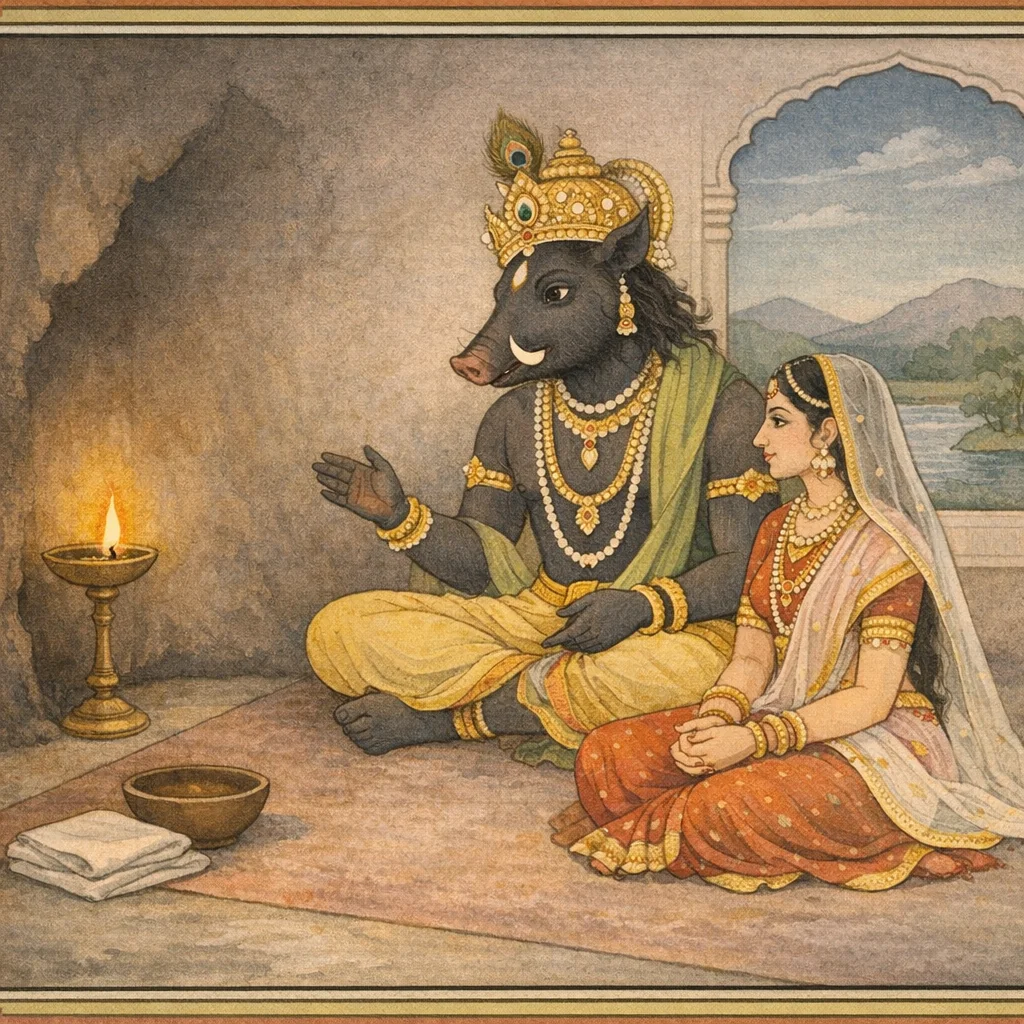
Varāha instructs Pṛthivī on a sequence of social and ritual transgressions and their prāyaścitta (expiations), presenting ethical discipline as a means to lessen karmic burden and steady human conduct upon Earth. He first warns against approaching Varāha’s rites while wearing red cloth (raktavastra), associating it with rajas, and prescribes graded fasts: single-meal, air-only, and water-only. He then addresses touch (saṃsparśa) in darkness without a lamp and without śāstric guidance, describing a “fall” into impaired births and prescribing a corrective vow of eye-covering, regulated diet, and observance on a specified dvādaśī. Further sections treat offences involving black cloth (kṛṣṇavastra), performing rites in unwashed garments, giving dog-tainted leftovers, eating Varāha’s flesh, and consuming jālapāda; each is paired with illustrative rebirth sequences and detailed dietary-vow expiations, culminating in reintegration as a disciplined bhāgavata practitioner.
Primary Speakers
Key Concepts
Shlokas in Adhyaya 135
Verse 1
अथ जालपादभक्षणापराधप्रायश्चित्तम् ॥ श्रीवराह उवाच ॥ रक्तवस्त्रेण संयुक्तो यो हि मामुपसर्पति ॥ तस्यापि शृणु सुश्रोणि कर्म संसारमोक्षणम् ॥
Now, the expiation (prāyaścitta) for the offense connected with consuming ‘jālapāda’. Śrī Varāha said: “Whoever approaches me while clothed in a red garment—listen, O fair-hipped one—even for him I shall describe the rite that frees from worldly bondage.”
Verse 2
रजस्वलासु नारीषु रजो यत्तत्प्रवर्तते ॥ तेनासौ रजसा पुष्टो कर्मदोषेण जानतः ॥
Among menstruating women, the menstrual flow (rajas) that occurs—by that rajas he becomes affected, through the fault of an act, knowingly.
Verse 3
वर्षाणि दश पञ्चैव वसते तत्र निश्चितात् ॥ रजो भूत्वा महाभागे रक्तवस्त्रपरायणः ॥
For fifteen years, indeed, he dwells there; becoming, as it were, ‘rajas’, O noble one—devoted to wearing red garments.
Verse 4
प्रायश्चित्तं प्रवक्ष्यामि तस्य कायविशोधनम् ॥ येन शुध्यन्ति ते भूमे पुरुषाः शास्त्रनिश्चिताः ॥
I shall explain his expiation—the purification of the body—by which, O Earth, those persons are purified, as determined by the authoritative treatises.
Verse 5
एकाहारं ततः कृत्वा दिनानि दश सप्त च ॥ वायुभक्षस्त्रीण्यहानि दिनमेकं जलाशनः ॥
Then, observing a single meal (per day) for seventeen days; for three days living on air (i.e., fasting), and for one day subsisting on water.
Verse 6
एवं स मुच्यते भूमे मम विप्रियकारकः ॥ प्रायश्चित्तं ततः कृत्वा ममासौ रोचते सह ॥
Thus, O Earth, he who acted displeasingly toward me is released. Having then performed the expiation, he becomes acceptable to me again.
Verse 7
एतत्ते कथितं भूमे रक्तवस्त्रविभूषिते ॥ प्रायश्चित्तं महाभागे सर्वसंसारमोक्षणम् ॥
This has been told to you, O Earth adorned with red garments: the expiation, O noble one, which brings release from the entirety of worldly bondage.
Verse 8
यस्तु मामन्धकारेषु विना दीपेन सुन्दरि ॥ स्पृशते च विना शास्त्रं त्वरमाणो विमोहितः ॥
But, O fair one, whoever touches me in darkness without a lamp, and—confused and hasty—does so without recourse to the śāstra,
Verse 9
पतनाṃ तस्य वक्ष्यामि शृणुष्व त्वं वसुन्धरे ॥ तेन क्लेशं समासाद्य क्लिश्यते च नराधमः ॥
I shall describe his downfall; listen, O Vasundharā. Through that act he incurs affliction, and the base man suffers.
Verse 10
अनन्यमानसो भूत्वा भूमे ह्येतत्प्रसाधयेत् ॥ प्रायश्चित्तं प्रवक्ष्यामि अन्धकारे तु यः पुरा ॥
Having become single-minded, O Earth, one should duly accomplish this. I shall state the expiation for the one who formerly (committed it) in darkness—
Verse 11
संस्पृशेत्सोऽपि धर्मात्मा येन लोकं मम व्रजेत् ॥ अक्ष्णोराच्छादनं कृत्वा दिनानि दश पञ्च च ॥
Even a righteous person should perform that act of touching in such a way that he may attain my world; having covered the eyes for ten days and five more (i.e., fifteen days),
Verse 12
एकाहारं ततः कृत्वा दिनविंशं समाहितः ॥ यस्य कस्यापि मासस्य एकामेव च द्वादशीम् ॥
Then, observing a single daily meal, composed in mind, for twenty days; and (choosing) one Dvādaśī day in any month—
Verse 13
एकाहारस्ततो भूत्वा निषीदेत्च जलाशनः ॥ ततो यवान्नं भुञ्जीत गोमूत्रेण तु पाचितम् ॥
Then, keeping the discipline of a single meal, one should sit, taking only water; thereafter one should eat barley-food, cooked with cow’s urine.
Verse 14
प्रायश्चित्तेन चैतेन मुच्यते पातकात्ततः ॥ यः पुनः कृष्णवस्त्रेण मम कर्मपरायणः ॥
By this very expiation he is then released from the sin. But whoever, again, devoted to my rites, does so wearing a black garment—
Verse 15
देवि कर्माणि कुर्वीत तस्य वै पातनं शृणु ॥ घुणो वै पञ्चवर्षाणि लाजवास्तुसमाश्रयः ॥
O Goddess, if one performs rites in that improper manner, listen to his downfall: he becomes a ghuṇa, a wood-worm, for five years, dwelling amid husks and chaff as his abode.
Verse 16
पञ्च वर्षाणि नकुलो दश वर्षाणि कच्छपः ॥ एवं भ्रमति संसारे मम कर्मपरायणः ॥
For five years he becomes a mongoose, for ten years a tortoise; thus he wanders in saṁsāra, though devoted to my rites.
Verse 17
पारावतेषु जायेत नव वर्षाणि पञ्च च ॥ जातो ममापराधेन स्थितः पारावतो भुवि ॥
He is born among pigeons for nine years and five more (i.e., fourteen years). Born through an offense against me, he remains on earth as a pigeon.
Verse 18
मम तिष्ठति पार्श्वेषु यत्रैवाहं प्रतिष्ठितः ॥ प्रायश्चित्तं प्रवक्ष्यामि तस्य संसारमोक्षणे
Wherever I Myself am established, he remains at My side. I shall teach the prāyaścitta, the expiation, that brings about his release from saṃsāra.
Verse 19
त्रीणि पिण्डांस्त्रिरात्रं तु एवं मुच्येत किल्बिषात् ॥ य एतेन विधानेन देवि कर्माणि कारयेत्
By offering three piṇḍas and observing a three-night rite, one is thus released from wrongdoing (kilbiṣa)—whoever, O Devī, has the rites performed according to this procedure.
Verse 20
शुचिर्भागवतो भूत्वा मम मार्गानुसारतः ॥ न स गच्छति संसारं मम लोकं स गच्छति
Having become pure and devoted (bhāgavata), in accordance with My path, he does not go to saṃsāra; he goes to My world.
Verse 21
वाससा चाप्यधौतेन यो मे कर्माणि कारयेत् ॥ शुचिर्भागवतो भूत्वा मम मार्गानुसारकः
Whoever has My rites performed while wearing unwashed clothing—yet the intended standard is that one should be pure, devoted (bhāgavata), and a follower of My path.
Verse 22
तस्य दोषं प्रवक्ष्यामि अपराधं वसुन्धरे ॥ पतन्ति येन संसारं वाससोच्छिष्टकारिणः
I shall explain that fault—indeed, the offense, O Vasundharā—by which those who act with garment-impurity (vāsas-ucchiṣṭa) fall into saṃsāra.
Verse 23
देवि भूत्वा गजो मत्तस्तिष्ठत्येकं नरो भुवि ॥ उष्ट्रश्चैकं भवेञ्जन्म जन्म चैकं वृकस्तथा
O Devi, having become a rutting elephant, a man remains upon the earth for one birth. For one birth he becomes a camel, and for one birth likewise a wolf.
Verse 24
गोमायुरेकं जन्मापि जन्म चैकं हयस्तथा ॥ सारङ्गस्त्वेकजन्मा वै मृगो भवति वै ततः
For one birth he is a jackal, and for one birth likewise a horse. Then indeed, for a single birth he becomes a sāraṅga (antelope/deer); thereafter he becomes a deer.
Verse 25
सप्तजन्मान्तरं पश्चात्ततो भवति मानुषः ॥ मद्भक्तश्च गुणज्ञश्च मम कर्मपरायणः
After seven intervening births, then he becomes human. He is my devotee, discerning of qualities, and devoted to my prescribed rites.
Verse 26
दक्षो निरपराधश्च अहङ्कारविवर्जितः ॥ धरण्युवाच ॥ श्रुतमेतन्मया देव यत्त्वया समुदाहृतम्
He is capable, free from offense, and devoid of egoism. Dharaṇī said: “O Deva, I have heard this which has been declared by you.”
Verse 27
संसारं वाससोच्छिष्टा येन गच्छन्ति मानुषाः ॥ प्रायश्चित्तं च मे ब्रूहि सर्वकर्मसुखावहम्
Concerning the saṃsāra into which humans go because of garment-impurity (vāsas-ucchiṣṭa), tell me also the expiation (prāyaścitta) that brings well-being in relation to all rites and acts.
Verse 28
प्रायश्चित्तं प्रवक्ष्यामि मम कर्मपरायणः ॥ यावकेन त्रीण्यहानि पिण्याकेन दिनत्रयम् ॥
I shall declare the expiatory observance for one devoted to my prescribed conduct: for three days one should subsist on yāvaka-gruel, and for three days on piṇyāka (oil-cake).
Verse 29
पर्णभक्षस्त्रीण्यहानि पयोभक्षो दिनत्रयम् ॥ पायसेन त्रिरात्रं तु वायुभक्षो दिनत्रयम् ॥
For three days one should subsist on leaves; for three days on milk; then for three nights on pāyasa (rice cooked in milk); and for three days one should subsist on air, that is, fast.
Verse 30
एवं कृत्वा महाभागे वाससोच्छिष्टकारिणः ॥ अपराधं न विन्देरन्संसारं न प्रयान्ति च ॥
Having done thus, O fortunate one, those who have committed the fault concerning garments made impure by remnants incur no further offense, and they do not proceed into saṁsāra, the cycle of wandering rebirth.
Verse 31
श्वानोच्छिष्टं तु यो दद्यान्मम कर्मपरायणः ॥ पापं तस्य प्रवक्ष्यामि संसारे च महद्भयम् ॥
But whoever gives to others what has been left or defiled by a dog—though professing devotion to my prescribed conduct—I shall declare his wrongdoing and the great fear that follows in saṁsāra.
Verse 32
श्वानो वै सप्त जन्मानि गोमायुः सप्त वै तथा ॥ उलूकः सप्तवर्षाणि पश्चाज्जायेत मानुषः ॥
Indeed, (such a one) becomes a dog for seven births, likewise a gomāyu (jackal) for seven births; then an owl for seven years; afterward one is born as a human.
Verse 33
विशुद्धात्मा श्रुतिज्ञश्च मद्भक्तश्चैव जायते ॥ गृहे भागवतोत्कृष्टे अपराधविवर्जितः ॥
Then he is born with a purified self, versed in sacred learning, and devoted to Me; in an excellent household of the Bhāgavatas, free from offense.
Verse 34
शृणु तत्त्वेन वसुधे प्रायश्चित्तं महौजसम् ॥ तरन्ति मानुषा येन त्यक्त्वा संसारसागरम् ॥
Hear truly, O Vasudhā, the expiation of great power—by which human beings cross over, having left behind the ocean of saṁsāra.
Verse 35
मूलभक्षो दिनत्रय्यां फलाहारो दिनत्रयम् ॥ शाकभक्षो दिनत्रय्यां पयोभक्षो दिनत्रयम् ॥
For three days one should subsist on roots; for three days on fruits; for three days on vegetables and greens; and for three days on milk.
Verse 36
दध्याहारो दिनत्रय्यां पायसेन दिनत्रयम् ॥ वाय्वाहारो दिनत्रय्यां स्नानं कृत्वा दृढव्रतः ॥
For three days one should take curd as food; for three days, pāyasa; for three days, ‘air as food’ (fasting). Having bathed, one should keep the vow firmly.
Verse 37
भुक्त्वा वराहमांसं तु यश्च मामिह सर्पति ॥ पातनं तस्य वक्ष्यामि यथा भवति सुन्दरी ॥
But whoever, having eaten the flesh of a boar, approaches Me here, I shall explain his downfall—how it comes to be, O fair one.
Verse 38
वराहो दश वर्षाणि कृत्वानुचरते वने ॥ व्याधो भूत्वा महाभागे समाः पञ्च च सप्त च ॥
Having lived as a boar for ten years, he then roams in the forest; and, O fortunate one, becoming a hunter, he remains so for five years and also for seven.
Verse 39
ततश्च मूषको भूत्वा वर्षाणि च चतुर्दश ॥ ऊनविंशतिवर्षाणि यातुधानश्च जायते ॥
Then, becoming a mouse, he lives for fourteen years; and for nineteen years he is born as a yātudhāna, a harmful demonic being.
Verse 40
सल्लकी चाष्टवर्षाणि जायते भवने बहु ॥ व्याघ्रस्त्रिंशच्च वर्षाणि जायते पिशिताशनः ॥
He is born as sallakī for eight years, in a house with many (occupants or possessions); and as a tiger, a flesh-eater, he is born for thirty years.
Verse 41
एवं संसारितां गत्वा वराहामिषभक्षकः ॥ जायते विपुले सिद्धे कुले भागवते तथा ॥
Thus, having passed through repeated transmigration as one who eats the flesh of boars, he is then born in a distinguished and accomplished family—likewise, in a devoted (bhāgavata) lineage.
Verse 42
हृषीकेशवचः श्रुत्वा सर्वं सम्पूर्णलक्षणम् ॥ शिरसा चाञ्जलिं कृत्वा वाक्यं चेदमुवाच ह ॥
Having heard the words of Hṛṣīkeśa in full, complete in all their marks, he bowed his head, joined his palms, and spoke these words.
Verse 43
एतन मे परमं गुह्यं तव भक्तसुखावहम् ॥ वराहमांसभक्तस्तु येन मुच्येत किल्बिषात् ॥
This is for me a supreme secret, bringing welfare to your devotees: by what means may one who consumes boar-meat be freed from fault (kilbiṣa)?
Verse 44
तरन्ति मानुषा येन तिर्यक्संसारसागरात् ॥ गोमयेन दिनं पञ्च कणाहारेण सप्त वै ॥
By what means do people cross beyond the ocean of transmigration into animal states?—(Let him subsist) on cow-dung for five days, and on a diet of grains (kaṇa) for seven days, indeed.
Verse 45
पानीयं तु ततो भुक्ता तिष्ठेत्सप्तदिनं ततः ॥ अक्षारलवणं सप्त सक्तुभिश्च तथा त्रयः ॥
Then, having taken only water, he should remain so for seven days thereafter; (then) for seven (days) without alkaline and salty (foods); and likewise for three (days) with saktu (parched flour).
Verse 46
क्षान्तं दान्तं तथा कृत्वा अहङ्कारविवर्जितः ॥ दिनान्येकोनपञ्चाशच्चरेत्कृतविनिश्चयः ॥
Having made himself patient and self-controlled, free from egoism, he should practice (this discipline) for forty-nine days, firm in resolve.
Verse 47
विमुक्तः सर्वपापेभ्यः ससंज्ञो विगतज्वरः ॥ कृत्वा मम च कर्माणि मम लोकं स गच्छति ॥
Freed from all faults, fully conscious and without fever, and having performed acts enjoined as mine, he goes to my world.
Verse 48
जालपादं भक्षयित्वा यस्तु मामुपसर्पति ॥ जालपादस्ततो भूत्वा वर्षाणि दश पञ्च च ॥
Whoever, having eaten a jālapāda, thereafter approaches me—becoming a jālapāda as a consequence—remains so for ten and five years, that is, fifteen years.
Verse 49
कुम्भीरो दश वर्षाणि पञ्च वर्षाणि सूकरः ॥ तावद्भ्रमति संसारे मम चैवापराधतः ॥
For ten years he becomes a kumbhīra, and for five years a boar; for that span he wanders in saṃsāra—indeed, due to an offense against me.
Verse 50
कृत्वा तु दुष्करं कर्म जायते विपुले कुले ॥ शुद्धो भागवतश्रेष्ठो ह्यपराधविवर्जितः ॥
But after performing a difficult act of rectification, he is born in a distinguished family—purified, an excellent bhāgavata devotee, and indeed free from offense.
Verse 51
सर्वकर्माण्यतिक्रम्य मम लोकं स गच्छति ॥ प्रायश्चित्तं प्रवक्ष्यामि जालपादस्य भक्षणे ॥
Having transcended all binding actions, he goes to my realm. I shall now teach the prāyaścitta, the expiation, for the eating of a jālapāda.
Verse 52
तरन्ति मनुजा येन घोरसंसारसागरात् ॥ यावकान्नं दिनत्र्यां वायुभक्षो दिनत्रयम् ॥
By this discipline people cross the dreadful ocean of saṃsāra: for three days let there be yāvaka-food, and for three days subsisting on air—that is, fasting.
Verse 53
फलभक्षो दिनत्र्यां तिलभक्षो दिनत्रयम् ॥ अक्षारलवणान्नाशी पुनस्तत्र दिनत्रयम् ॥
For three days let him subsist on fruits; for three days on sesame; then again for three days, on food without alkali and without salt.
Verse 54
दशपञ्च दिनान्येवं प्रायश्चित्तं समाचरेत् ॥ जालपादापराधस्य एवं कुर्वीत शोधनम्॥ विनीतात्मा शुचिर्भूत्वा य इच्छेत्सुशुभां गतिम् ॥
Thus, for fifteen days one should duly undertake the expiation (prāyaścitta). In this manner purification is to be performed for the offense involving a jālapāda. With a disciplined mind, having become pure, this is for one who seeks an auspicious course and destiny.
Verse 55
अन्धो भूत्वा महाभागे एकं जन्म तमोमयः ॥ सर्वाशी सर्वभक्षश्च मानवः सोऽभिजायते ॥
O fortunate lady, having become blind, for one lifetime he abides in a condition bound to darkness; he is born as a human who eats indiscriminately—an eater of all kinds of food.
Verse 56
येनासौ लभते सिद्धिं कृष्णवस्त्रापराधतः ॥ सप्ताहं यावकं भुक्त्वा त्रिरात्रं सक्तुपिण्डिकाम् ॥
By this he attains successful purification from the offense concerning the kṛṣṇa-vastra (black garment): having eaten yāvaka for a week, and for three nights taking a ball of saktu (parched flour).
Verse 57
किल्बिषाद्येन मुच्यन्ते तव कर्मपरायणाः ॥ श्रीवराह उवाच ॥ शृणु तत्त्वेन मे देवि कथ्यमानं मयाऽनघे ॥
“By what practice are those devoted to action—those belonging to you—released from sin and the like?” Śrī Varāha said: “Listen, O goddess, in truth, to what is being explained by me, O sinless one.”
Verse 58
एवं दिनान्येकविंशत्कृत्वा वै शुभलक्षणम् ॥ अपराधं न विन्देत मम लोकं स गच्छति
Thus, having observed the auspicious regimen for twenty-one days, one incurs no offence; such a person goes to my world.
Verse 59
तिलभक्षो दिनान्सप्त पाषाणस्य च भक्षकः ॥ पयो भुक्त्वा दिनं सप्त कारयेद्बुद्धिमान्मनः
For seven days one should subsist on sesame; and, as an austere substitute-food, partake of ‘stone-like’ fare; then, taking only milk for seven days, the wise should steady and discipline the mind.
Frequently Asked Questions
The text frames ethical self-restraint (śauca, controlled diet, and rule-governed action) as a corrective technology for social harm: transgressions in ritual approach, impurity, and careless conduct are said to destabilize one’s karmic trajectory, while prāyaścitta restores disciplined participation in communal and terrestrial order (with Pṛthivī as the dialogic witness).
A specific lunar marker appears: observance on a dvādaśī (12th lunar day), described as choosing a dvādaśī within any month (yasya kasyāpi māsasya ekāmeva ca dvādaśīm). Most other prescriptions are counted by day-units (e.g., 3, 7, 15, 20, 21 days; saptāha; trirātra) rather than seasons.
Although the instructions are ritual-ethical, the dialogue’s framing with Pṛthivī positions human discipline as a component of terrestrial stability: purity rules, restraint, and regulated consumption function as norms that reduce harmful excess and disorder on Earth, presenting an early model of “ecology through conduct” rather than a geography-based environmental program.
No royal dynasties, named sages, or administrative lineages are referenced. The only explicit figures are Varāha (as instructor) and Pṛthivī (as questioner), with social categories implied through terms like bhāgavata and generic rebirth exempla (animals and humans) used for moral illustration.