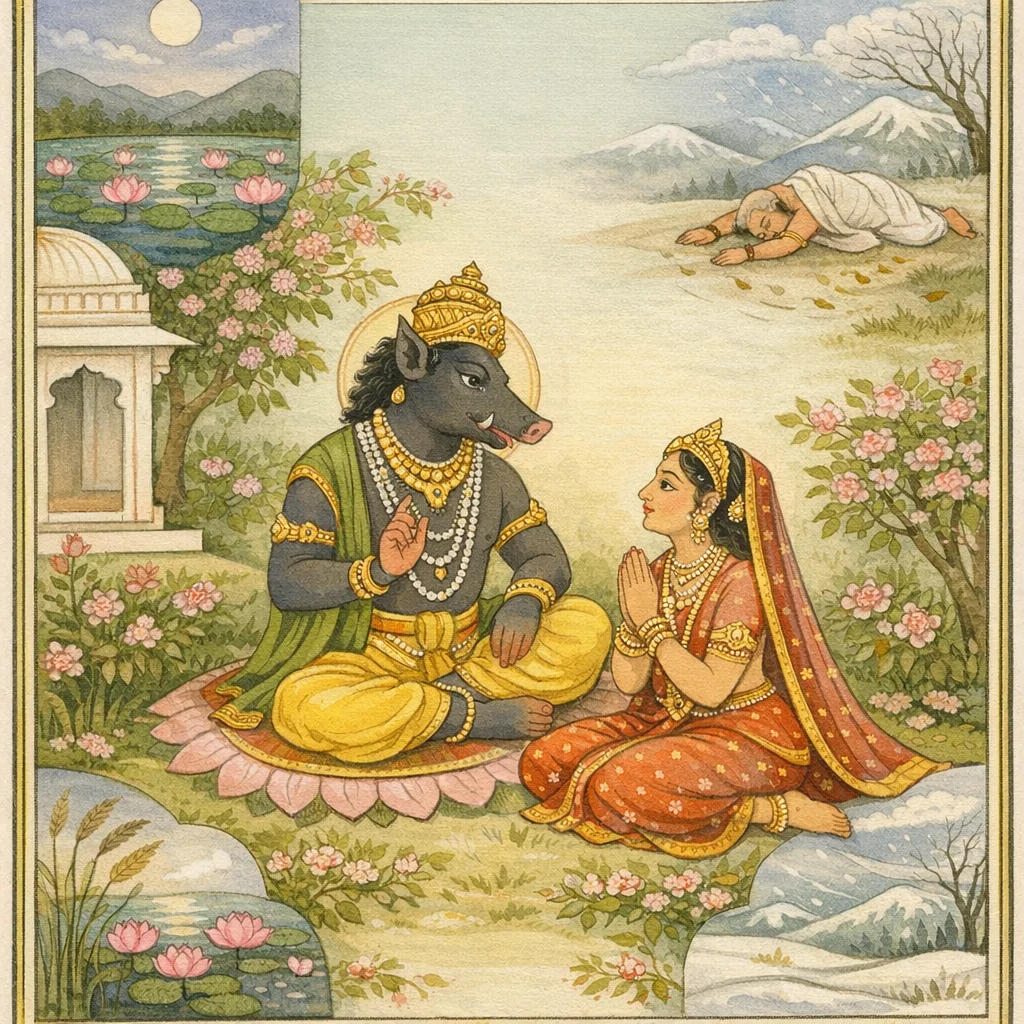
Adhyaya 123: The Greatness of Fragrant Flowers and Leaves: Prabodhinī (Awakening) Observances and Seasonal Rites
Sumanogandhādi-māhātmya (Prabodhinī-śārada-śaiśira-karmāṇi)
Ritual-Manual (Vrata and Seasonal Devotional Practice) with Eco-Ethical Emphasis
After hearing of Kokā’s merit, Pṛthivī marvels that even an animal birth can reach the supreme goal and asks Varāha for the dharma by which humans perceive and please Mādhava. Varāha teaches a “secret” liberative discipline (saṃsāra-mokṣaṇa) arranged by seasons and calendrical observances: an autumnal (śārada) rite on the auspicious Dvādaśī of the month of Kaumuda, featuring a long prabodhinī-mantra, and declaring that steady devotion yields enduring merit. He then sets forth a winter (śaiśira) practice with blossoming plants, prostration, and a brief mantra seeking rescue through the harsh season of saṃsāra. The dialogue further details offerings of fragrant leaves (gandha-patra) and flowers in Mārgaśīrṣa and Vaiśākha, explains why Dvādaśī is praised as especially efficacious, and frames Pṛthivī’s well-being as upheld by disciplined, season-attuned worship and plant-based offerings.
Primary Speakers
Key Concepts
Shlokas in Adhyaya 123
Verse 1
अथ सुमनोगन्धादिमाहात्म्यम्॥ सूत उवाच॥ श्रुत्वा तु कोकामाहात्म्यं पृथिवी धर्मसंहितम्॥ विस्मयं परमं याता श्रुत्वा धर्मं महौजसम्॥
Now (begins) the account of the greatness of Sumanogandhā and related matters. Sūta said: Having heard the greatness of Kokā—an account bound up with dharma—Pṛthivī was filled with the highest wonder, having heard that dharma of great potency.
Verse 2
धरण्युवाच॥ अहो प्रभावः कोकाया माहात्म्यं क्रोडरूपिणः॥ तिर्यग्योनिगतो वापि प्राप्तो यत्परमां गतिम्॥
Dharaṇī said: “Ah, what power! Such is the greatness of Kokā, and of the Lord who bears the form of a boar. For even one who has entered an animal womb may, through it, attain the highest state.”
Verse 3
तव देव प्रसादेन किञ्चिदिच्छामि वेदितुम्॥ यन्मया पूर्वपृष्टोऽसि केन धर्मेण मानवाः॥
By your grace, O God, I wish to know something further: when I previously questioned you, by what dharma do human beings attain their aim?
Verse 4
तपसा कर्मणा वापि पश्यन्ति त्वां हि माधव॥ प्रसादसुमुखो भूत्वा निखिलं वक्तुमर्हसि॥
Through ascetic discipline (tapas) or through action, they indeed behold you, O Mādhava; becoming gracious in countenance, you should speak the whole teaching.
Verse 5
एवं पृष्टस्तदा देव्याः माधव्याः स तु माधवः॥ प्रहस्य पुनरेवेदं वक्तुं समुपचक्रमे॥
Thus questioned then by the goddess Mādhavī, Mādhava, smiling, began once more to speak this teaching.
Verse 6
श्रीवराह उवाच॥ एवमेतन्महाभागे यथा त्वं भीरु भाषसे॥ कथयिष्यामि ते धर्मं गुह्यं संसारमोक्षणम्॥
Śrī Varāha said: “So it is, O greatly fortunate one, as you timidly speak. I shall tell you a dharma—secret in its depth—that brings release from saṃsāra.”
Verse 7
गते मेघागमे काले प्रसन्नशरदाशये॥ अम्बरे विमले जाते विमले शशिमण्डले॥
When the season of rain-clouds had passed and the autumn days were serene, when the sky became spotless and the orb of the moon was bright and pure—
Verse 8
नातिशीतं न चात्युष्णे काले हंसविराविणि॥ कुमुदोत्पलकह्लारपद्मसौरभनिर्भरे॥
In a time neither very cold nor excessively hot, resonant with the calls of geese, and filled with the fragrance of kumuda, utpala, kahlāra, and lotus blossoms—
Verse 9
कुमुदस्य च मासस्य भवेद्या द्वादशी शुभा॥ तस्यां मामर्चयेद्यस्तु तत्प्रभावं शृणुष्व मे॥
And when the auspicious twelfth lunar day (Dvādaśī) of the month of Kumuda arrives—whoever worships me on that day, listen from me to its power and effect.
Verse 10
कृत्वा ममैव कार्याणि द्वादश्यां तत्र माधवि॥ ममैवाराधनार्थाय इमं मन्त्रमुदीरयेत्॥
Having performed the acts prescribed for Me on Dvādaśī (the twelfth lunar day), O Mādhavī, one should recite this mantra for the purpose of My worship.
Verse 11
मन्त्रः— ब्रह्मणा च रुद्रेण यः स्तूयमानो भवानृषिवन्दितो वन्दनीयश्च प्राप्ता द्वादशीयं ते प्रबुध्यस्व जागृष्व मेघा गताः पूर्णश्चन्द्रः शारदानि पुष्पाणि लोकनाथ तुभ्यमहं ददानीति धर्महेतोस्तव प्रीतये प्रबुद्धं जाग्रतं लोकनाथ त्वां भजमाना यज्ञेन यजन्ते सत्रेण सत्रिणो वेदैः पठन्ति भगवन्तः शुद्धाः प्रबुद्धा जाग्रतो लोकनाथ।
Mantra: “You who are praised by Brahmā and Rudra, revered by the ṛṣis and worthy of reverence—your Dvādaśī has arrived; awaken, arise. The clouds have departed; the moon is full; the autumn flowers are here. O Lord of the world, I offer these to You. For the sake of dharma and for Your satisfaction—awakened and arisen, O Lord of the world—those who worship You worship through yajña; the performers of sattra rites through their sessions; the pure recite the Vedas. Awakened and arisen, O Lord of the world.”
Verse 12
एवं कर्माणि कुर्वन्ति द्वादश्यां वै यशस्विनि॥ मम भक्ताः व्रतं श्रेष्ठं ते यान्ति परमां गतिम्॥
Thus, O illustrious one, My devotees perform these acts on Dvādaśī; observing this excellent vow, they attain the highest state.
Verse 13
एवं वै शारदं कर्म निखिलं कथितं मया॥ देवि संसारमोक्षार्थं मम भक्तसुखावहम्॥
Thus, O Goddess, I have described the entire autumnal rite—aimed at liberation from saṃsāra and conducive to the well-being of My devotees.
Verse 14
इति प्रबोधिनी कर्म॥ अन्यच्च ते प्रवक्ष्यामि शैशिरं कर्म शोभनम्॥ यानि कर्माणि कुर्वन्ति पुंसो यान्ति परां गतिम्॥
Thus concludes the Prabodhinī rite. Further, I shall explain to you the auspicious winter-season rite—those acts by which people attain the highest state.
Verse 15
शीतवाताभिसन्तप्ता मम भक्त्या व्यवस्थिताः॥ अनन्यमनसो भूत्वा योगाय कृतनिश्चयाः॥
Afflicted by cold winds, yet established in devotion to Me, becoming single-minded, they form a firm resolve for yogic discipline.
Verse 16
शिशिरे यानि कर्माणि पुष्पिताश्च वनस्पतिः॥ तैरेव चार्चनं कृत्वा जानुभ्यां पतितः क्षितौ॥
In winter, performing those rites—and using the flowering plants—one should worship accordingly, falling to the ground upon one’s knees in reverent prostration.
Verse 17
कराभ्यामञ्जलिं कृत्वा इमं मन्त्र मुदीरयेत्॥
Forming the añjali gesture with both hands, one should recite this mantra.
Verse 18
मन्त्रः— शिशिरो भवान् धातरिमं लोकनाथ हिमं दुस्तरं दुष्प्रवेशं कालं संसारान्मां तारयेमं धर्ता त्रिलोकनाथ।
Mantra: “You are the winter-season itself, O Sustainer; O Lord of the world—through this icy, hard-to-cross, hard-to-enter time, ferry me across saṃsāra, O Supporter, O Lord of the three worlds.”
Verse 19
अन्यच्च ते प्रवक्ष्यामि तच्छृणुष्व वसुन्धरे॥ मासं मार्गशिरं चैव वैशाखं च मम प्रियम्॥
Further, I shall tell you—listen, O Vasundharā—about the month Mārgaśīrṣa, and also Vaiśākha, which is dear to Me.
Verse 20
अहं तत्र प्रवक्ष्यामि पुष्पादीनां च यत्फलम् ॥ नववर्षसहस्राणि नववर्षशतानि च
There I shall explain the fruit (phala) of offerings such as flowers and the like; by that merit one abides for nine thousand years, and for nine hundred years as well.
Verse 21
तिष्ठते विष्णुलोकेऽस्मिन् यो ददाति स्म निश्चलम् ॥ एकैकं गन्धपत्रं च दानमेतन्महत्फलम्
In this Viṣṇu-world, one who gives with unwavering resolve remains there. Even a single fragrant leaf—this gift is said to yield a great fruit.
Verse 22
मतिमान्धृतिमान्भूत्वा गन्धपुष्पाणि दापयेत् ॥ पुनरन्यत्प्रवक्ष्यामि गन्धपत्रस्य यत्फलम्
Becoming discerning and steadfast, one should cause fragrant flowers to be given. Again, I shall state another matter: the specific fruit of offering a fragrant leaf.
Verse 23
द्वादश्यां चैव यो दद्यात्त्रीन्मासांश्च समाहितः ॥ कौमुदस्य तु मासस्य मार्गशीर्षस्य वै तथा
And whoever, being composed and attentive, would give on the Dvādaśī (twelfth lunar day) for three months—namely in the month called Kaumuda, and likewise in Mārgaśīrṣa—
Verse 24
वैशाखस्य तु मासस्य वनमालां सुपुष्पिताम् ॥ एकचित्तं समाधाय गन्धपुष्पाणि यो न्यसेत्
And in the month of Vaiśākha, (offering) a forest-garland rich with blossoms—whoever, having fixed the mind on a single focus, would place fragrant flowers—
Verse 25
वर्षाणि द्वादशैवेह तेन पूजा कृता भवेत् ॥ शालपुष्पेण मिश्रेण कौमुद्यां गन्धकेन च
For twelve years here, worship is held to have been performed by him. In Kaumudī, with a mixture including śāla-flowers, and also with fragrance—
Verse 26
मासि मार्गशिरे भद्रे दद्यादुत्पलमिश्रितम् ॥ एवं महत्फलं भद्रे गन्धपत्रस्य च स्मृतम्
In the month of Mārgaśīrṣa, O auspicious one, one should offer a gift mixed with utpala (lotus). Thus, O auspicious one, the great fruit of the fragrant leaf is remembered in tradition.
Verse 27
श्रुत्वेति वचनं तस्य प्रश्रयेण तु माधवि ॥ प्रहस्य प्रणयाद्वाक्यमित्युवाच वसुन्धरा
Having heard his words, O Mādhavī, with deference, Vasundharā smiled and spoke an affectionate statement.
Verse 28
द्वादशीं चापि देवेश प्रशंससि सदा मम ॥ इति पृष्टस्तदा देव्याः धरिण्या स तु माधवः
“You too always praise the Dvādaśī to me, O Lord of the gods.” Thus questioned then by the goddess Dharaṇī, Mādhava was addressed.
Verse 29
प्रहस्य तामुवाचेदं वचनं धर्मसंश्रितम् ॥ शृणु तत्त्वेन मे देवि येनेमौ मम च प्रियौ
Smiling, he spoke to her these words grounded in dharma: “Listen truly, O goddess, by which these two are dear to me as well.”
Verse 30
तिथीनां द्वादशी चापि सर्वयज्ञफलाधिका ॥ त्वया द्विजसहस्रेभ्यो यत्फलं प्राप्नुयान्नरः
Among the lunar days (tithis), Dvādaśī is said to surpass the fruit of all sacrifices; by honoring you, a person gains the same merit as would be obtained by giving gifts to thousands of Brahmin priests.
Verse 31
तदेकं संप्रदायैव द्वादश्यामभिविन्दति ॥ कौमुद्यां च प्रबुद्धोऽस्मि वैशाख्यां च समुद्घृतः
By offering that single gift, one indeed attains its reward on Dvādaśī. “In Kārtika (Kaumudī) I am awakened, and in Vaiśākha I am raised up again,” so it is declared.
Verse 32
महानाधिहरॊ योगस्तेनैतत्प्रभवो धरे ॥ अतः कौमुदिकायां तु वैशाख्यां यतमानसः
This observance is a yoga that removes great afflictions; from it arises this benefit, O Earth. Therefore, in Kaumudī (Kārtika) and in Vaiśākha, one should practice with a concentrated mind.
Verse 33
गन्धपत्रं करे गृहीय इमं मन्त्र मुदीरयेत् ॥ मन्त्रः — भगवन्नाज्ञापय इमं बहुतरं नित्यं वैशाखं चैव कार्तिकम्
Taking a fragrant leaf in the hand, one should recite this mantra: “O Bhagavān, command and accept this abundant observance—the perpetual Vaiśākha and also Kārtika.”
Verse 34
गृहीाण गन्धपत्राणि धर्ममेव प्रवर्धय ॥ नमो नारायणेत्युक्त्वा गन्धपत्रं प्रदापयेत्
“Accept these fragrant leaves; truly increase dharma.” Having said, “Namo Nārāyaṇa,” one should present the fragrant leaf.
Verse 35
पुष्पाणां च प्रवक्ष्यामि यो गुणो यच्च वै फलम् ॥ दत्त्वा वै गन्धपत्राणि पुष्पहस्तः शुचिर्नरः ॥ ॐ नमो वासुदेवायेत्युक्त्वा मन्त्र मुदीरयेत्
I shall explain the nature of flowers and the result they bestow. Having offered fragrant leaves, a purified person, holding flowers in hand, should utter the mantra, “Oṃ, homage to Vāsudeva,” and then recite what follows.
Verse 36
मन्त्रः — भगवन्नाज्ञापय सुमनांसीमानि अर्चयितुं मां सुमनसङ्कुरु गृहीष्व सुमनस्कं देव सुगन्धेन ते नमः
Mantra: “O Blessed Lord, command and permit me to worship with these flowers; make my mind well-disposed. Accept this offering with a joyful heart, O Deva; homage to you with fragrance.”
Verse 37
दिव्यं वर्षसहस्रं वै मम लोकेषु तिष्ठति ॥ एकैकस्य तु पुष्पस्य पुण्यमेतन्महाफलम्
The offerer dwells in my worlds for a divine thousand years; and for each single flower, this merit yields a great reward.
Verse 38
सुमनो गन्धसम्भूतं यत्त्वया पूर्वपृच्छितम्
As for that ‘sumanas’—the flower born of fragrance—which you asked about earlier, I now address it.
Verse 39
यावल्लोकाश्च धार्यन्ते तावत्कालं वसुन्धरे ॥ मद्भक्तो जायते धन्यो नान्यभक्तः कदाचन
So long as the worlds are sustained, for that very span of time, O Earth: one devoted to me is born fortunate; one without such devotion is never so.
Verse 40
यस्त्वथैतेन मन्त्रेण शिशिरे कर्म कारयेत् ॥ स गच्छेत्परमां सिद्धिं मम भक्त्या व्यवस्थितः ॥
Whoever, by this mantra, has the rite performed in the winter season—steadfastly established in devotion to me—attains the highest accomplishment (siddhi).
Verse 41
प्रभो द्वादश मासाश्च षष्ट्युत्तरशतत्रयम् ॥ तत्र द्वावेव किं मह्यं भगवन् किं प्रशंससि ॥
O Lord, there are twelve months and also three hundred and sixty days. Among these, which two in particular are for my benefit? O Bhagavān, which do you commend?
Verse 42
प्राप्नोति ददमानस्तु मम कर्मपरायणः ॥ न जन्ममरणं चैव न ग्लानिं न च वै क्षुधाम् ॥
But one who gives (in accordance with the rite), devoted to performing my prescribed acts, attains the fruit: no birth and death, no exhaustion, and indeed no hunger.
Frequently Asked Questions
The chapter frames liberation-oriented conduct (saṃsāra-mokṣaṇa) through disciplined, calendrically timed devotion: Varāha teaches that sustained bhakti expressed via Dvādaśī observance, mantra-recitation, and regulated offerings yields enduring merit and a ‘supreme’ post-mortem trajectory. The internal logic emphasizes intentionality (ekacitta, samāhita), bodily humility (prostration), and season-attuned restraint as the ethical core.
Key markers include Dvādaśī tithi (explicitly praised as preeminent), the month Kaumuda with śārada conditions (clear sky, full moon imagery), and additional months Mārgaśīrṣa and Vaiśākha (also Kārttika is referenced in a mantra-context). The text also distinguishes śārada (autumn) and śaiśira (winter) as separate ritual-ethical regimes.
Through Pṛthivī as interlocutor and the repeated use of seasonal ecology (flowers, fragrant leaves, winter hardship), the chapter models a terrestrial ethic in which humans align practice with natural cycles and employ renewable vegetal materials (puṣpa, gandha-patra) rather than extractive or violent offerings. The narrative positions Earth’s order—months, seasons, blooms—as the pedagogical framework for disciplined conduct.
No royal dynasties or administrative lineages are named in the provided passage. Cultural-religious figures invoked within mantras include Brahmā and Rudra as paradigmatic praisers, and epithets of Viṣṇu/Varāha (e.g., Nārāyaṇa, Vāsudeva, Lokanātha), functioning as theological identifiers rather than historical personages.