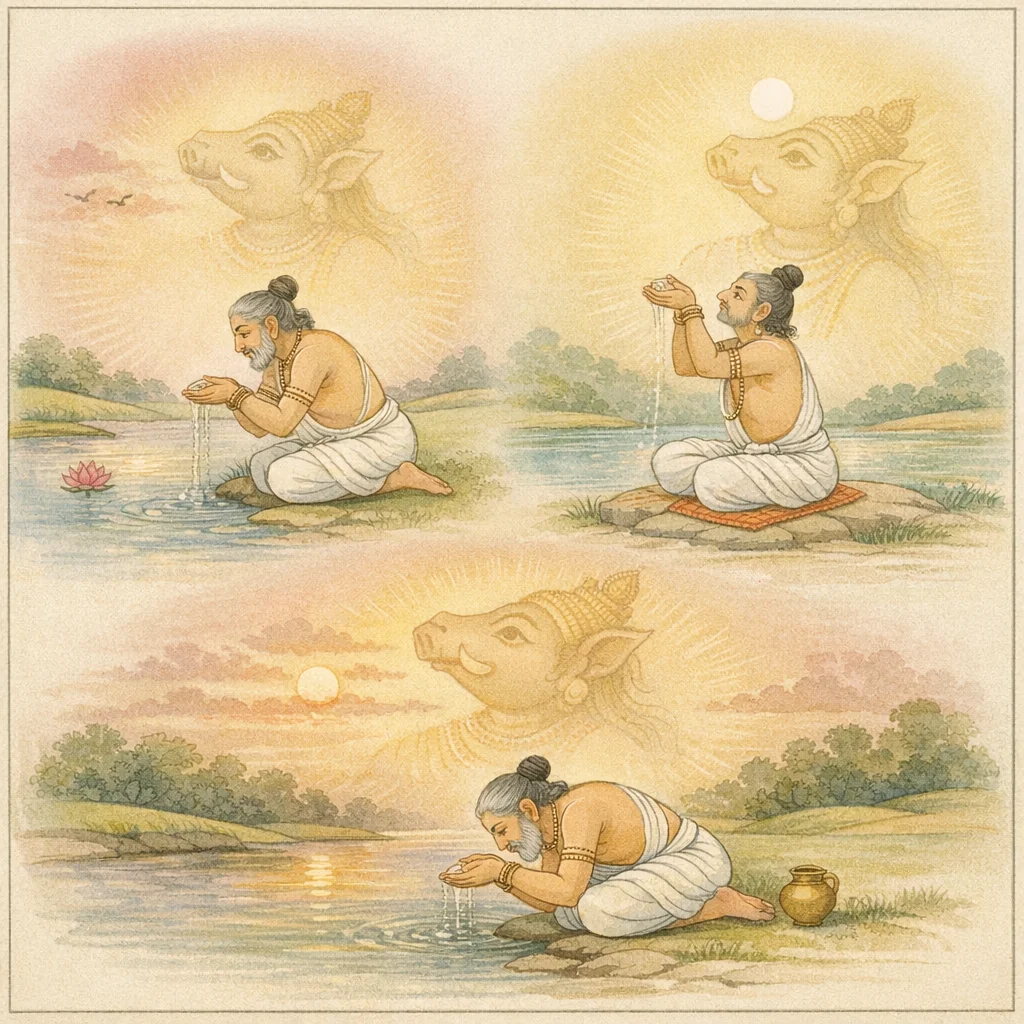
Adhyaya 120: Procedure for the Three Daily Twilight Mantra-Observance
Trisandhyā-mantra-upasthāna-vidhiḥ
Ritual-Manual (Sandhyā, Mantra, Devotional Discipline)
In dialogue, Varāha instructs Pṛthivī (Dharā/Devī) in a “supremely secret” teaching meant to help one cross saṃsāra. The chapter prescribes a disciplined devotional regimen: after proper bathing, the self-controlled, devoted practitioner approaches worship with reverence. Varāha declares himself all-pervading in every direction—above, below, and all around—thus grounding directional rites. He then teaches the trisandhyā (three-twilight) observance: the worshipper faces different directions, offers water in joined palms (jalāñjali), and recites praise-mantras to Nārāyaṇa/Puruṣottama as ancient, limitless, and liberating. The text stresses secrecy and transmission only to initiated, steadfast students, and promises moral and existential uplift through consistent practice.
Primary Speakers
Key Concepts
Shlokas in Adhyaya 120
Verse 1
अथ त्रिसन्ध्यामन्त्रोपस्थानम् ॥ श्रीवराह उवाच ॥ शृणुष्व परमं गुह्यं पूर्वं पृष्टं त्वया धरे ॥ देवि सर्वं प्रवक्ष्यामि संसारतरणं महत्
Now, the rite of attending upon (reciting) the mantra for the three daily junctures. Śrī Varāha said: Listen, O Dharā—this supreme secret, previously asked by you. O Goddess, I shall explain everything: the great means of crossing beyond saṃsāra.
Verse 2
स्नानं कृत्वा यथान्यायं मम कर्मपरायणाः ॥ उपसर्पन्ति ये भक्त्या कदान्नाशा जितेन्द्रियाः
Having bathed according to proper rule, those devoted to my rites approach (me) with devotion—eating simple fare and with their senses restrained.
Verse 3
यश्चैवमुच्यते भद्रे मम रूपं सनातनम् ॥ अहमेव वरारोहे सर्वभूतसनातनम्
And what is thus spoken of, O auspicious one, is my eternal form. I alone, O fair-hipped one, am the eternal principle abiding in all beings.
Verse 4
अधश्चोर्ध्वं च तिर्यक् च अहमेव व्यवस्थितः ॥ दिशां च विदिशां चैव उपर्युपरि भामिनि
Below, above, and across, I alone am established; in the directions and intermediate directions as well—everywhere, again and again, O radiant one.
Verse 5
सर्वथा वन्दनीयास्ते मम भक्तेन सर्वदा ॥ क्रियासमूह युक्तेन यदीच्छेत्परमां गतिम्
In every way they are to be revered always by my devotee—by one engaged in the full set of prescribed observances—if one desires the highest destination.
Verse 6
अन्यच्च ते प्रवक्ष्यामि गुह्यं लोके महद्यशः ॥ यथा वै वन्दनीयास्ते मम मार्गानुसारिणः
And I shall tell you something else—secret, yet of great renown in the world—namely, how those who follow my path are to be revered.
Verse 7
कृत्वापि परमं कर्म बुद्धिमादाय तद्विधाम् ॥ ततः पूर्वमुखो भूत्वा पुनर्गृह्य जलाञ्जलिम्
Even after performing the principal rite, having adopted the appropriate intention and understanding, then—facing east—one should again take a handful of water as an offering.
Verse 8
ॐ नमो नारायणेत्युक्त्वा इमं मन्त्रमुदीरयेत्
Having said, “Oṃ, homage to Nārāyaṇa,” one should then recite this mantra.
Verse 9
यजामहे धर्मपरायणोद्भवं नारायणं सर्वलोकप्रधानम् ॥ ईशानमाद्यं पुरुषं पुराणं संसारमोक्षाय कृपाकरं तम्
We worship Nārāyaṇa, arisen from devotion to dharma, the foremost lord of all worlds—the sovereign, the primordial Person, the Ancient one—him who is compassionate, for liberation from saṃsāra.
Verse 10
मन्त्राः ऊचुः ॥ यथा तु देवः प्रथमादिकर्ता पुराणकल्पश्च यथा विभूतिः ॥ तथा स्थितं चादिमनन्तरूपममोघसङ्कल्पमनन्तमीḍe ॥
The mantras said: “As the Lord is the first, the primordial Creator, so too are the ancient tradition (purāṇa) and the cosmic cycle (kalpa), and so too is His sovereign power (vibhūti). Thus established, I praise the beginningless One of endless forms, whose resolve is unfailing—the Infinite.”
Verse 11
ततस्तेनैव कालेन पुनर्गृह्य जलाञ्जलिम् ॥ तेनैव चास्य योगेन भूत्वा चैवोत्तरामुखः ॥ नमो नारायणेत्युक्त्वा इमं मन्त्र मुदीरयेत् ॥
Then, at that same time, taking again water in the joined palms, and by that same yogic discipline, turning to face north, having said “Homage to Nārāyaṇa,” one should recite this mantra.
Verse 12
यजामहे दिव्यं परं पुराणमनादिमध्यान्तमनन्तरूपम् ॥ भवोद्भवं विश्वकरं प्रशान्तं संसारमोक्षावहमद्वितीयम् ॥ १३॥ ततस्तेनैव कालेन भूत्वा वै दक्षिणामुखः ॥ नमः पुरुषोत्तमायेत्युक्त्वा इमं मन्त्र मुदीरयेत् ॥
“We worship the divine, the supreme, the primeval—without beginning, middle, or end; of endless forms; the source of becoming, the maker of the universe, tranquil, the bringer of liberation from saṃsāra, non-dual.” Then, at that same time, turning to face south, having said “Homage to Puruṣottama,” one should recite this mantra.
Verse 13
यजामहे यज्ञमहो रूपं तु सत्यं ऋतं च कालादिमरूपमाद्यम् ॥ अनन्यरूपं च महानुभावं संसारमाक्षोय कृतावतारम् ॥
We worship the sacrifice—marvelous in form—indeed truth and cosmic order (ṛta), the primordial form beyond time and the beginning; of unmatched form, of great majesty, who has undertaken a descent (avatāra) for the sake of the world’s course (saṃsāra).
Verse 14
काष्ठकृत्यस्ततो भूत्वा कृत्वा चेन्द्रियनिग्रहम् ॥ अच्युते तु मनः कृत्वा इमं मन्त्र मुदाहरेत् ॥
Then, becoming steady like a piece of wood, having restrained the senses, and fixing the mind upon Acyuta, one should utter this mantra.
Verse 15
यजामहे सोमपं भवन्तं ते सोमार्कनेत्रं शतपत्रनेत्रम् ॥ जगत्प्रधानं ननु लोकनाथं मृत्युत्रिसंसारविमोक्षणं च ॥
We worship you, O Soma-drinker; you whose eyes are the Moon and the Sun, whose vision is like a hundred-petaled lotus—the foundation of the world, truly the Lord of the realms, and the one who releases from death and the onward course of saṃsāra.
Verse 16
त्रिषु सन्ध्यास्वनेनैव विधिना कुर्यान्मम च कर्म तत् ॥ बुद्ध्या युक्त्या च मत्या च यदीच्छेत्परमां गतिम् ॥
At the three daily sandhyās, one should perform this practice of mine by this very method—using intellect, discernment, and intention—if one seeks the highest attainment.
Verse 17
गुह्यानां परमं गुह्यं योगानां परमो निधिः ॥ सांख्यानां परमं सांख्यं कर्मणां कर्म चोत्तमम् ॥
This is the most secret among secrets; the supreme treasure among yogas; the highest Sāṃkhya among Sāṃkhyas; and, among actions, the most excellent action.
Verse 18
एतन्मरणकालेऽपि गुह्यं विष्णुप्रभाषितम् ॥ बुद्ध्या धारयितव्यं न विस्मर्तव्यं कदाचन ॥
Even at the time of death, this secret teaching—spoken by Viṣṇu—should be held in the intellect and should never be forgotten.
Verse 19
य एतत्पठते नित्यं कल्पोच्छ्रायी दृढव्रतः ॥ ममापि हृदये नित्यं स तिष्ठति न संशयः ॥
Whoever recites this daily—steadfast in vow, elevated through the aeon—abides continually even in my own heart; of this there is no doubt.
Verse 20
य एतेन विधानॆन त्रिसन्ध्यं कर्म कारयेत् ॥ तिर्यग्योनिविनिर्मुक्तो मम लोकं स गच्छति ॥
One who, according to this prescribed विधि, performs the rite at the three sandhyā junctions (morning, noon, and evening) is freed from birth among non-human wombs and attains my realm.
Verse 21
ततः पश्चान्मुखो भूत्वा पुनर्गृह्य जलाञ्जलिम् ॥ द्वादशाक्षरमुच्चार्य इमं मन्त्रमुदीरयेत् ॥
Then, turning to face west, and again taking a handful of water in the joined palms, having uttered the twelve-syllabled formula, one should recite this mantra.
Verse 22
एतन्न दद्यान्मूर्खाय पिशुनाय शठाय च ॥ दीक्षितायैव दातव्यं सुशिष्याय दृढाय च ॥
This should not be given to an ignorant person, nor to a malicious informer, nor to a deceitful one; it is to be given only to one who is initiated (dīkṣita) and to a good disciple who is steadfast.
Frequently Asked Questions
The text frames disciplined daily practice—purification (snāna), self-restraint (jitendriya), and reverent mantra-recitation—as a method for saṃsāra-taraṇa (crossing cyclic existence). Philosophically, it emphasizes a pervading divine presence across all directions and states that consistent, properly performed trisandhyā observance supports moral steadiness and liberation-oriented life.
No tithi, nakṣatra, month, or seasonal markers are specified. The timing is structured by the three daily sandhyās (twilight junctions), implying routine observance at the standard dawn, midday junction, and dusk periods rather than a calendrical festival schedule.
While it does not present explicit ecological prescriptions, the Varāha–Pṛthivī dialogic frame and the emphasis on purification, restraint, and orderly daily rites can be read as an ethic of terrestrial stability: regulated human conduct is portrayed as harmonizing the practitioner with the world’s directional/cosmological order, indirectly supporting the maintenance of balance associated with Pṛthivī.
No royal dynasties, sages’ lineages, or administrative figures are named. The chapter’s references are primarily theological and liturgical, centered on Nārāyaṇa/Puruṣottama and on the qualified teacher-to-disciple transmission (dīkṣita, suśiṣya) of secret ritual knowledge.